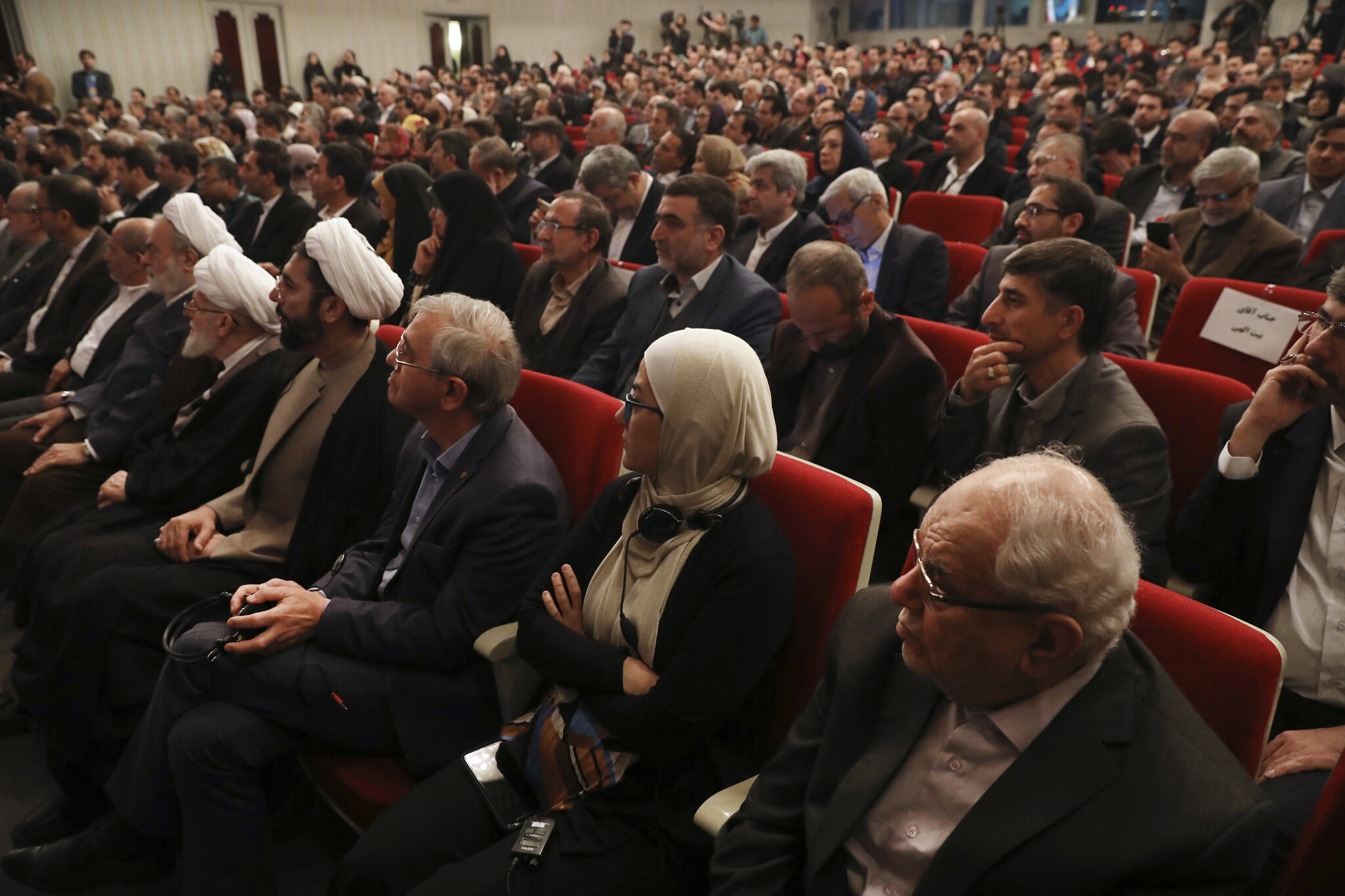
Participants listen to a speaker during the Mustafa scientific award ceremony in Tehran, Iran, November 11, 2019. (AP Photo/Vahid Salemi)
TEHRAN, Iran — Iran on Monday awarded a top prize in the study of science and technology to two US-educated scientists.
Vice President Sourena Sattari granted the Mustafa award to five scientists — three Iranians and two Turks — during a ceremony.
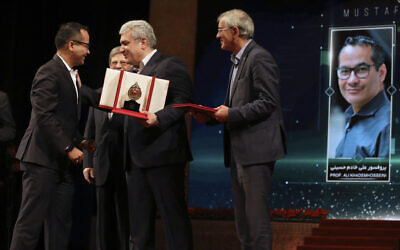
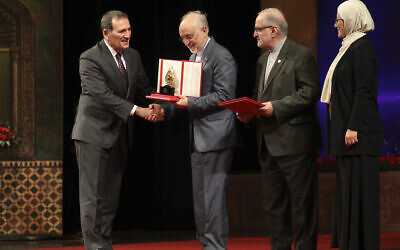
Among the recipients was UCLA professor Ali Khademhosseini, for his work on the application of nanostructures in the treatment of disease. Umran Inan, a Turkish professor of electrical engineering at Stanford University, also received the prize.
Upon granting the awards, Sattari stressed that Iran’s achievements came from investing in its young people and not only from its oil revenue.
UCLA professor Ali Khademhosseini, left, is granted the Mustafa scientific prize by Vice President Sourena Sattari, center left, at a ceremony in Tehran, Iran, November 11, 2019. (AP Photo/Vahid Salemi)
It was the third award ceremony for the biennial prize since 2015. Iran launched the prize as part of its goal to become a regional scientific powerhouse.
Get The Times of Israel's Daily Editionby email and never miss our top stories
This year’s prize comes against the backdrop of US sanctions on Tehran and Iran’s unraveling nuclear deal with world powers.
UCLA’s Khademhosseini told AP he hopes the sanctions will be removed to pave the ground for scientific cooperation.
“Clearly sanctions made things more difficult,” said Khademhossenin. “That’s something that hopefully over time we can overcome.”
Advertisement
Umran Inan, a Turkish professor of electrical engineering at Stanford University, left, is granted the Mustafa scientific prize by Vice President and head of the Atomic Energy Organization of Iran, Ali Akbar Salehi, center, during a ceremony in Tehran, Iran, November 11, 2019. (AP Photo/Vahid Salemi)
The science and technology $500,000 prize is awarded to Muslim researchers and scientists, regardless of whether they live in Muslim-majority nations or elsewhere, as well as non-Muslim scientists in Muslim countries.
In 2017, the Turkish-French national, Sami Erol Gelenbe, and Iran’s Mohammad Amin Shokrollahi, were honored for their achievements in systems assessment in model-making and computer coding.
Iran first handed out the prize in 2015 to a Taiwanese-Singaporean nanotechnology researcher Jackie Y. Ying and Jordanian-American chemistry professor Omar Yaghi.
Help us report truthfully on social media
As a multimedia journalist, my job is to take the quality, fact-based journalism produced by The Times of Israel newsroom and make it accessible across every platform — from Instagram posts to podcasts to short-form videos.
This is how many, especially young people, consume news these days. But misinformation is rampant on social media. Our team at ToI produces accurate, responsible short-form reporting on Israel and the Jewish world.
If you believe in the importance of factual social media journalism, please consider joining our reader support group, The Times of Israel Community. Your financial support is essential to sustain responsible multimedia reporting.
We’re really pleased that you’ve read X Times of Israel articles in the past month.
That’s why we started the Times of Israel - to provide discerning readers like you with must-read coverage of Israel and the Jewish world.
So now we have a request. Unlike other news outlets, we haven’t put up a paywall. But as the journalism we do is costly, we invite readers for whom The Times of Israel has become important to help support our work by joining The Times of Israel Community.
For as little as $6 a month you can help support our quality journalism while enjoying The Times of Israel AD-FREE, as well as accessing exclusive content available only to Times of Israel Community members.
Thank you, David Horovitz, Founding Editor of The Times of Israel


 Add ToI as a Preferred Source on Google