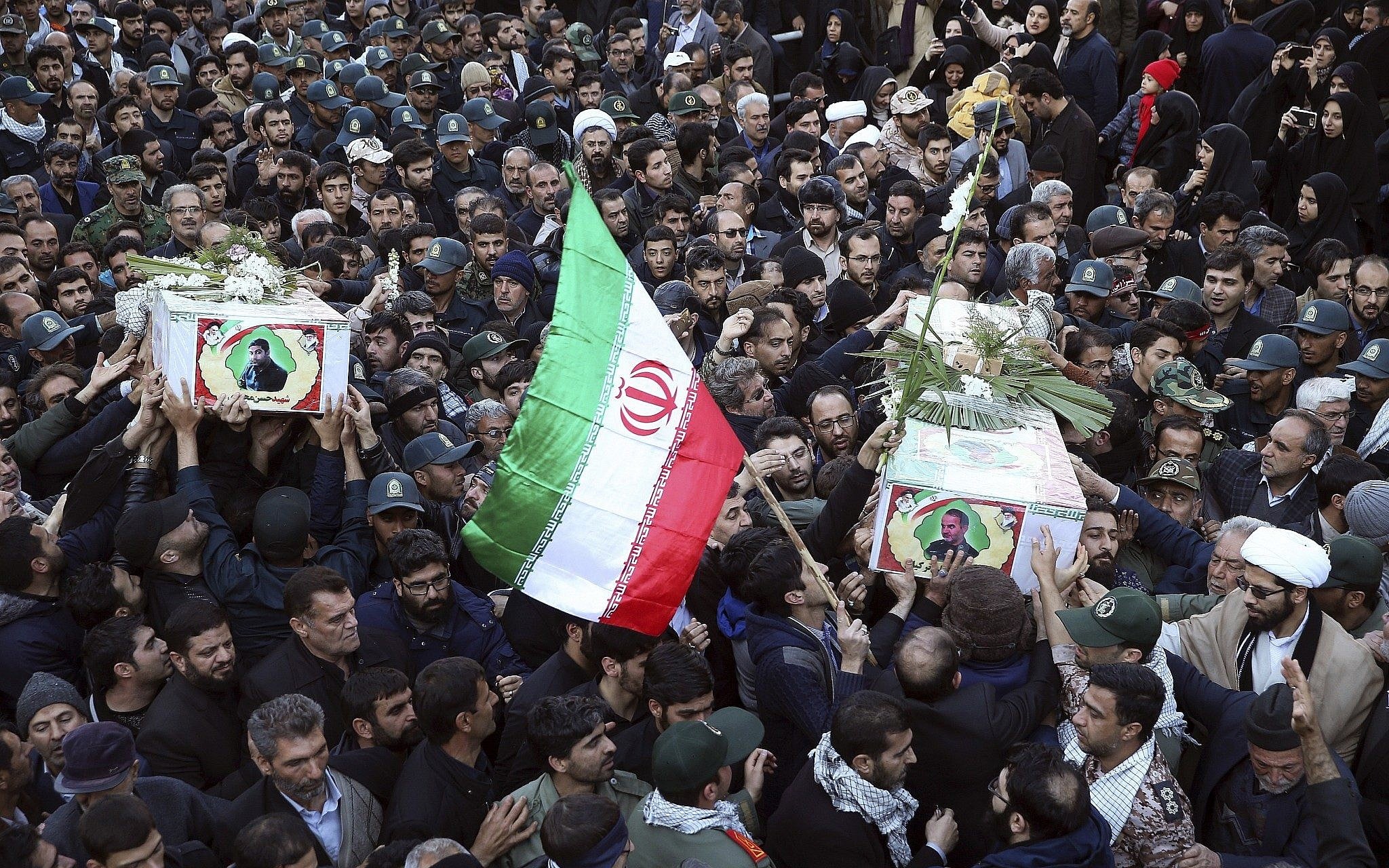
Mourners carry a flag-draped casket during a mass funeral in Isfahan, Iran, February 16, 2019, for 27 people killed in a suicide car bombing that targeted members of Iran's powerful Revolutionary Guard. (AP /Ebrahim Noroozi)
TEHRAN, Iran — Iran’s President Hassan Rouhani has demanded Pakistan act “decisively against anti-Iranian terrorists” in a phone call with the country’s premier, Tehran said, a month after a bloody attack on security forces.
Iran says a Pakistani suicide bomber was behind the February 13 attack that killed 27 Revolutionary Guards in its volatile southeastern province of Sistan-Baluchistan.
A Sunni jihadist group, Jaish al-Adl (Army of Justice), which Tehran says operates mostly out of bases in neighboring Pakistan, claimed responsibility for the blast.
Iran has accused Pakistan’s army and intelligence agency of sheltering the jihadists and summoned the country’s ambassador in the wake of the attack.
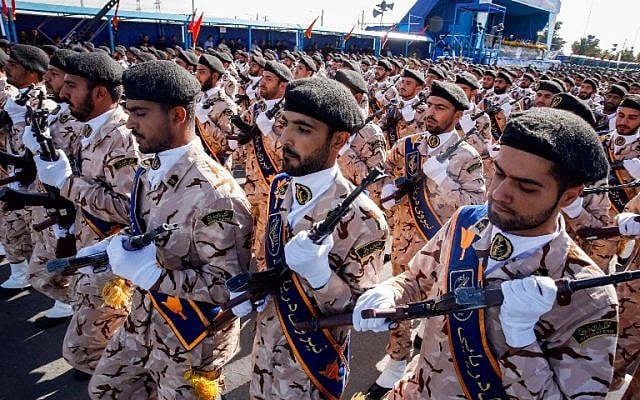
Members of Iran’s Revolutionary Guard Corps (IRGC) march during the annual military parade marking the anniversary of the outbreak of the devastating 1980-1988 war with Saddam Hussein’s Iraq, in the capital Tehran on September 22, 2018. (AFP/STR)
In the phone conversation Saturday evening with Pakistani Prime Minister Imran Khan, Rouhani called to maintain good ties and pointed the finger of blame at Tehran’s traditional regional and international foes.
Get The Times of Israel's Daily Editionby email and never miss our top stories
“We shouldn’t allow decades of friendship and brotherhood between the two countries be affected by terrorist groupuscules that we both know from where they are being armed and financed,” Rouhani said, according to a government statement.
The Iranian president was alluding to the United States and Israel, as well as Saudi Arabia and the United Arab Emirates, which it accuses of aiding jihadist groups responsible for attacks from Pakistani soil.
February’s bombing was the latest of numerous attacks on Iran’s security forces and officials in Sistan-Baluchistan, where the minority Sunni Baluchis accuse the authorities of discrimination.
Advertisement
Help us report truthfully on social media
As a multimedia journalist, my job is to take the quality, fact-based journalism produced by The Times of Israel newsroom and make it accessible across every platform — from Instagram posts to podcasts to short-form videos.
This is how many, especially young people, consume news these days. But misinformation is rampant on social media. Our team at ToI produces accurate, responsible short-form reporting on Israel and the Jewish world.
If you believe in the importance of factual social media journalism, please consider joining our reader support group, The Times of Israel Community. Your financial support is essential to sustain responsible multimedia reporting.
We’re really pleased that you’ve read X Times of Israel articles in the past month.
That’s why we started the Times of Israel - to provide discerning readers like you with must-read coverage of Israel and the Jewish world.
So now we have a request. Unlike other news outlets, we haven’t put up a paywall. But as the journalism we do is costly, we invite readers for whom The Times of Israel has become important to help support our work by joining The Times of Israel Community.
For as little as $6 a month you can help support our quality journalism while enjoying The Times of Israel AD-FREE, as well as accessing exclusive content available only to Times of Israel Community members.
Thank you, David Horovitz, Founding Editor of The Times of Israel


 Add ToI as a Preferred Source on Google