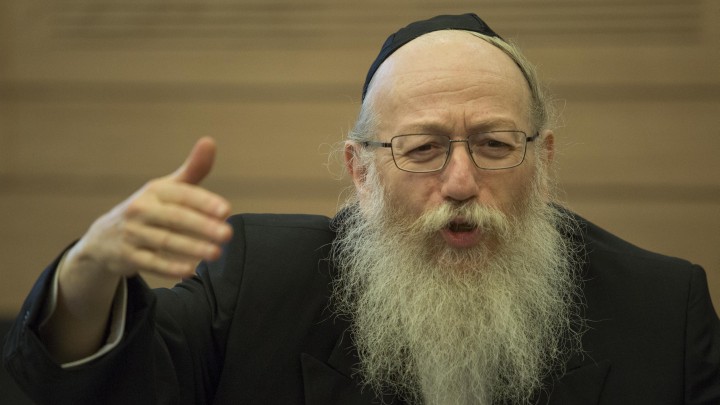
File: Health Minister Yaakov Litzman. (Noam Revkin Fenton/Flash90)
Israel could be just six months away from allowing general practitioners to prescribe cannabis, Health Minister Yaakov Litzman said Wednesday.
Litzman is leading a reform of the Health Ministry’s medical cannabis policy that seeks to devolve the authority to prescribe the drug from the ministry’s centralized medical cannabis unit to the nation’s 23,000 doctors, a move that would dramatically ease access to the drug.
“If the reform, which is expected to go into effect within a few weeks, moves ahead without problems, I’ll allow practicing doctors to give cannabis prescriptions to their patients in keeping with Health Ministry regulations,” Litzman, of the United Torah Judaism party, told a joint session of the Knesset Health Committee and the Knesset Committee on Controlled Substances Wednesday morning.
“Patients should be able to receive the cannabis in a dignified way, without waiting or having to run around” because of Health Ministry bureaucracy, the minister added.
A worker tends to cannabis plants at the Tikun Olam cannabis growing facility near Safed (photo credit: Abir Sultan/Flash 90)
Litzman rejected the notion that the move would turn cannabis into a recreational drug in Israel, and insisted the ministry would not allow the export of Israeli-grown cannabis to other countries. It would also put an end to the distribution of cannabis by the growers, he vowed.
Get The Times of Israel's Daily Editionby email and never miss our top stories
“I want to emphasize that we will implement strict oversight on this issue, and we will make sure that only those who need cannabis will get access to it,” he told lawmakers.
Litzman noted the high rates of cannabis use in Israel, with some 23,000 known consumers of medical cannabis, suggesting the reform might rein in that use.
Advertisement
We can't do this work alone.
The war with Iran has been draining for all of us in Israel. But when I heard about a high casualty incident – ballistic missile impacts in Arad and Dimona that left nearly 200 people wounded – I drank a cup of coffee, packed a bag, and headed south.
There, I spoke with Shilgit, the head of an after-school program for underprivileged youth. Standing outside her destroyed center, Shilgit said it was a miracle that no children were hurt and spoke about the community coming together in the hours since.
As a Times of Israel reporter, I’m committed to telling stories of resilience like Shilgit’s. But my colleagues and I can't do this alone. If you value work like this,please consider joining our reader support group, The Times of Israel Community. Your financial support is essential to keep real human reporting like this going.
We’re really pleased that you’ve read X Times of Israel articles in the past month.
That’s why we started the Times of Israel - to provide discerning readers like you with must-read coverage of Israel and the Jewish world.
So now we have a request. Unlike other news outlets, we haven’t put up a paywall. But as the journalism we do is costly, we invite readers for whom The Times of Israel has become important to help support our work by joining The Times of Israel Community.
For as little as $6 a month you can help support our quality journalism while enjoying The Times of Israel AD-FREE, as well as accessing exclusive content available only to Times of Israel Community members.
Thank you, David Horovitz, Founding Editor of The Times of Israel