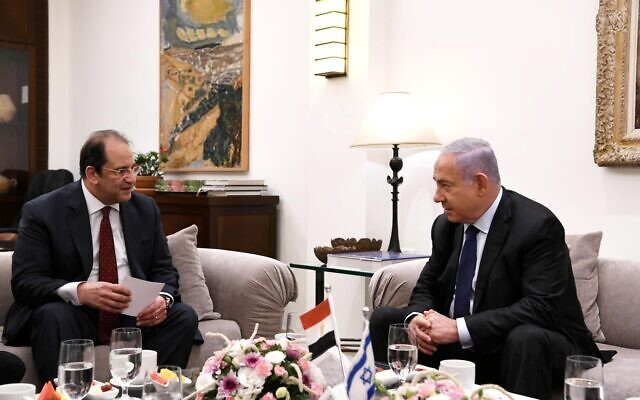
Prime Minister Netanyahu hosts an Egyptian delegation led by Egypt’s intelligence chief Abbas Kemal, who is in the country for talks on the ceasefire that ended fighting between Israel and the Hamas terror group that rules Gaza earlier this month.
A statement from Netanyahu’s office says the two discussed strengthening bilateral cooperation and “the regional issues,” and that they hailed “the joint effort between the countries on various security and diplomatic matters.”
Netanyahu reiterated Israel’s demand for the return of two citizens and the bodies of two soldiers killed in the 2014 Gaza war believed held by Hamas, according to the Prime Minister’s Office, which says they also discussed “the mechanisms and processes for preventing the strengthening of Hamas and preventing it from being aided by resources that will be allocated in the future for the civilian population.”
The statement doesn’t use the word ceasefire or make any explicit mention of the agreement Egypt helped broker to end the 11 days of hostilities that erupted on May 10, after Hamas fired rockets toward Jerusalem amid escalating Israeli-Palestinian tensions over the city.
Prime Minister Minister Benjamin Netanyahu hosts Egyptian intelligence chief Abbas Kamel at his official residence in Jerusalem, May 30, 2021. (Amos Ben-Gershom/GPO)
Also taking part in the sit-down was National Security Adviser Meir Ben-Shabbat, who met with Kemal earlier for what the PMO says was a “lengthy discussion on these matters.”
The meetings come as Foreign Minister Gabi Ashkenazi is being hosted by his Egyptian counterpart Samey Shoukry for talks on the Gaza ceasefire.
Help us report truthfully on social media
As a multimedia journalist, my job is to take the quality, fact-based journalism produced by The Times of Israel newsroom and make it accessible across every platform — from Instagram posts to podcasts to short-form videos.
This is how many, especially young people, consume news these days. But misinformation is rampant on social media. Our team at ToI produces accurate, responsible short-form reporting on Israel and the Jewish world.
If you believe in the importance of factual social media journalism, please consider joining our reader support group, The Times of Israel Community. Your financial support is essential to sustain responsible multimedia reporting.
We’re really pleased that you’ve read X Times of Israel articles in the past month.
That’s why we started the Times of Israel - to provide discerning readers like you with must-read coverage of Israel and the Jewish world.
So now we have a request. Unlike other news outlets, we haven’t put up a paywall. But as the journalism we do is costly, we invite readers for whom The Times of Israel has become important to help support our work by joining The Times of Israel Community.
For as little as $6 a month you can help support our quality journalism while enjoying The Times of Israel AD-FREE, as well as accessing exclusive content available only to Times of Israel Community members.
Thank you, David Horovitz, Founding Editor of The Times of Israel


 From the Liveblog of
Sunday, May 30, 2021
From the Liveblog of
Sunday, May 30, 2021
 Add ToI as a Preferred Source on Google