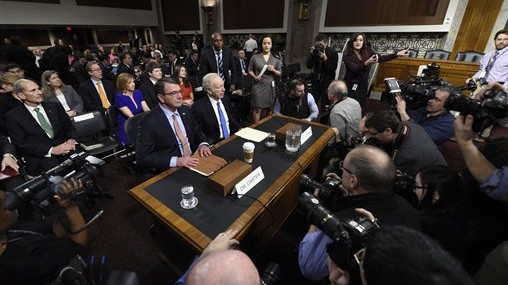
Speaking to members of the Senate Armed Services Committee at his confirmation hearing, President Barack Obama’s pick to run the Pentagon, Ashton Carter, says he’s inclined to back increased US assistance to Ukraine, including lethal arms, to fight anti-government rebels backed by neighboring Russia.
The White House is reconsidering its opposition to giving Ukraine defensive weapons and other lethal aid to help its struggling military repel the insurgents backed by Moscow. That would be a possible escalation that has been strongly supported by many members of Obama’s national security team, but it also would risk turning Ukraine into a proxy war with Russia.
Ashton Carter, left, President Barack Obama’s choice to head the Defense Department, left, and former Connecticut Sen. Joe Lieberman, sit on Capitol Hill in Washington, Wednesday, Feb. 4, 2015, prior to Carter testifying before the Senate Armed Services Committee hearing on his nomination to replace Chuck Hagel. (photo credit: AP Photo/Susan Walsh)
Carter also says that Russia’s military moves in Ukraine are “a clear violation” of a 1994 commitment that Russia made to respect the sovereignty of the newly independent Ukraine as part of Ukraine’s agreement to give up the nuclear weapons it inherited from the former Soviet Union.
Nominated to be the fourth Pentagon chief of an Obama administration now in its 7th year, Carter faced questions about Iraq, Afghanistan, the Islamic State, the Guantanamo Bay military prison, Russia and other hot spots during his Senate appearance. His confirmation is widely expected, yet members of the committee used the heavily attended hearing to challenge and criticize Obama’s foreign policy decisions.
— AP
Help us report truthfully on social media
As a multimedia journalist, my job is to take the quality, fact-based journalism produced by The Times of Israel newsroom and make it accessible across every platform — from Instagram posts to podcasts to short-form videos.
This is how many, especially young people, consume news these days. But misinformation is rampant on social media. Our team at ToI produces accurate, responsible short-form reporting on Israel and the Jewish world.
If you believe in the importance of factual social media journalism, please consider joining our reader support group, The Times of Israel Community. Your financial support is essential to sustain responsible multimedia reporting.
We’re really pleased that you’ve read X Times of Israel articles in the past month.
That’s why we started the Times of Israel - to provide discerning readers like you with must-read coverage of Israel and the Jewish world.
So now we have a request. Unlike other news outlets, we haven’t put up a paywall. But as the journalism we do is costly, we invite readers for whom The Times of Israel has become important to help support our work by joining The Times of Israel Community.
For as little as $6 a month you can help support our quality journalism while enjoying The Times of Israel AD-FREE, as well as accessing exclusive content available only to Times of Israel Community members.
Thank you, David Horovitz, Founding Editor of The Times of Israel


 From the Liveblog of
Wednesday, February 4, 2015
From the Liveblog of
Wednesday, February 4, 2015
 Add ToI as a Preferred Source on Google