

New brush sweeps clean: Jerusalem mayor prioritizes municipal makeover
Moshe Lion, in capital’s top job since December 2018, has pushed forward with cleaning the city and erasing its reputation for dirt; the pandemic hasn’t changed that
 Add ToI as a Preferred Source on Google
Sue Surkes is The Times of Israel's environment reporter
If the old adage is true that what residents most expect from their local councils is that they mend broken sidewalks and pick up dog poop, then Jerusalem Mayor Moshe Lion could be track to becoming a local hero.
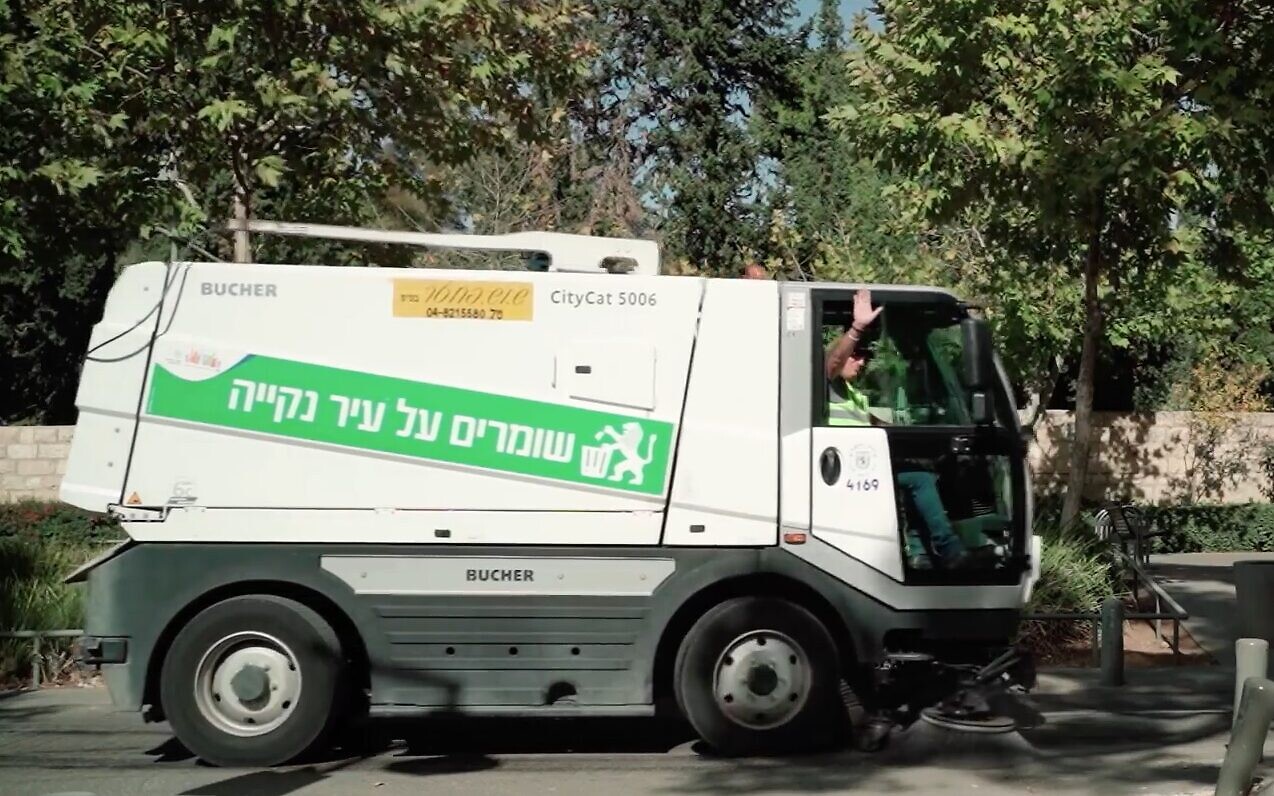
The slogan “Keeping Jerusalem Clean” has been appearing over the past year on everything from municipal vehicles to billboards, buses and bus stops.
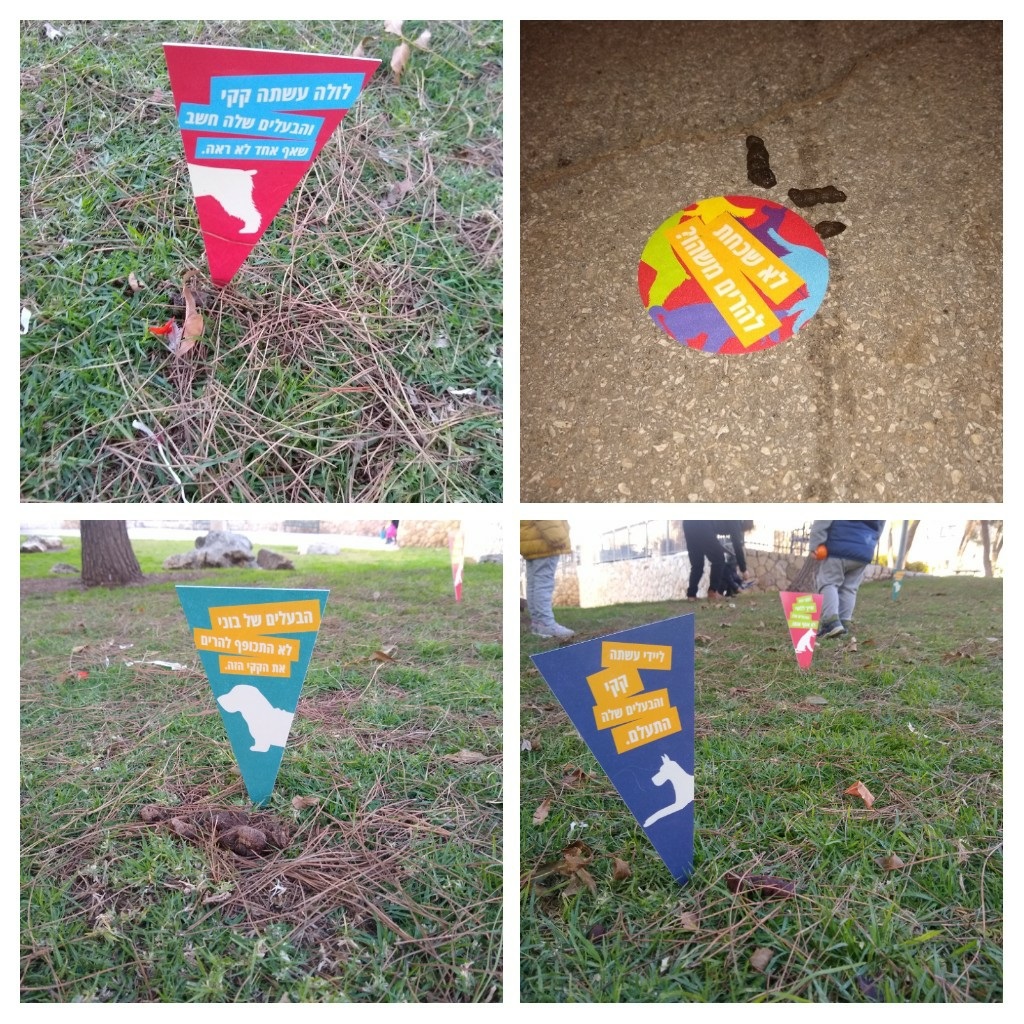
Fines for the owners of feculent canines shot up from 22 in 2018 to 569 last year — Lion’s first year in office. And projects to replace asphalt sidewalks with more elegant ones laid with Jerusalem stone or concrete flagstones seemed to be popping up everywhere until the coronavirus lockdown.
Since winning the local elections on his second attempt, in October 2018, and entering office two months later, Lion has prioritized cleaning up the city and consigning its filthy reputation to the proverbial dustbin of history, with all city offices expected to rise to the challenge. And the coronavirus pandemic is not expected to undermine its progress.
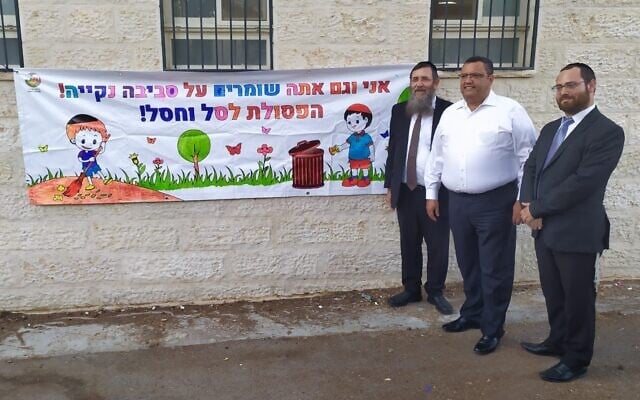
Says Lion, “I believe a clean and well-kept city will attract strong residents, successful businesses and development projects, thereby leading to economic development and increased employment.”
Itzik Nidam, head of the council’s Operations Department, which includes trash collection, reels off a string of impressive figures to illustrate that progress is being made.
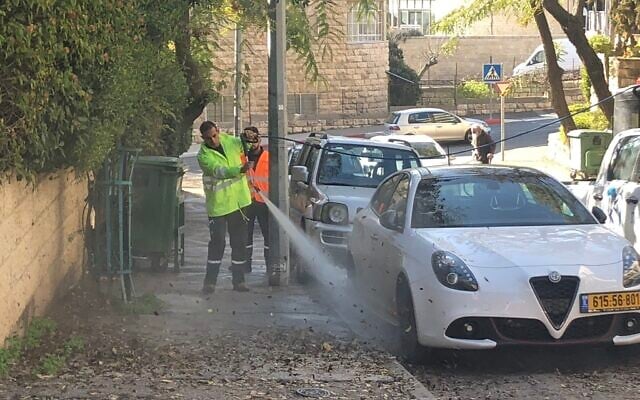
This year, there are 500 street cleaners, up from 180 a year ago, and the aim is to reach 600. Thirty street-cleaning vehicles have been added to the fleet, as well as 13 large trucks with cranes for picking up big pieces of junk, such as old refrigerators and yard waste. These latter vehicles are used on specific days in each neighborhood, according to a schedule on the municipality’s website (in Hebrew).
Prior to now, it was the regular garbage collectors who had to throw plant waste into the general collection trucks, often reporting the hapless gardeners who in many cases are subsequently fined. (Incidentally, according to Nidam, gardeners who wish to save water can order wood chip to mulch their planting beds by dialing the city hotline, 106. The city will deliver it for free).
Last year, the municipality started to empty general trash containers on Saturday nights, after the Sabbath. This has proven to keep the capital cleaner throughout the week, Nidam says.
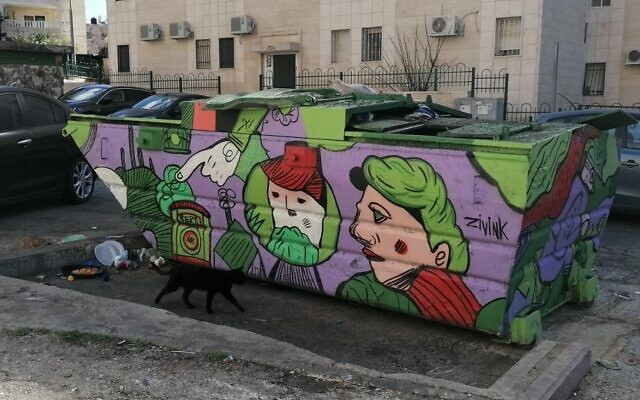
It is also phasing out the large trash collection containers, known colloquially as “frogs,” which, in the meantime,are being tarted up by professional artists. These are set to be replaced with more aesthetic containers that are partly buried underground. Some 1,700 of the latter have already been installed in the newer, peripheral, neighborhoods, such as Armon Hanatziv, Gilo, Har Homa and Givat Masuah. With a target of 3,000, the council will soon be introducing these large dustbins further into town.
Recycling: The capital operates a combined system
Israel has a source-separated recycling system, which means that the public is responsible for separating trash into the correct, color-coded bins. Source-recycled items, as opposed to those that are thrown into the general trash and sorted later, are usually of higher quality because the chances of cross contamination, for example from food waste, oil, or grease, are lower.
Jerusalem is unusual in that it operates a combined system in which residents separate some of their trash and dump the rest into the green bins for general trash, which is sorted at the Greenet facility in the north of the city.
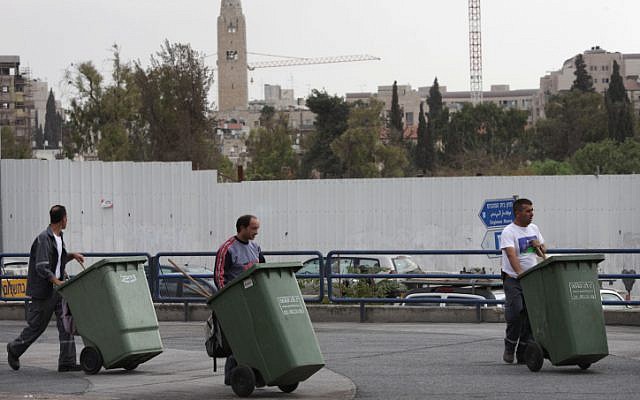
This dual approach is probably a good thing given the amount of confusion among residents.
A cursory look into a general-waste green bin will reveal that residents have been too lazy, ignorant or confused to put bottles, paper and other items that should have been separated at source into the correct color-coded receptacles.
Similarly, eager recyclers, who want to be sure that they recycle as much as possible, tend to stuff cages solely intended for plastic bottles with all manner of other plastic waste, including plastic bags.
A spokesperson for the ELA company, which recycles plastic bottles, claimed that items other than bottles in these cages were separated and sent onward for recycling.
But Nidam recommends: If in doubt, throw it into the green bins — it will be separated at Greenet further down the line.
Disappearing recycling containers and parrot cages
Recent months, prior to the coronavirus, saw a flurry of rumors about recycling containers disappearing from Jerusalem streets.
Itzik Nidam confirms that some 300 were removed — with no plans to take any more — in cases where they had been broken or vandalized, had blocked narrow sidewalks, or had bothered residents who had asked that they be taken away.
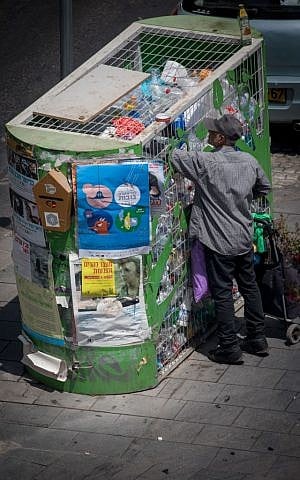
“They can be a real nuisance,” he said. “There are around 5,000 recycling containers throughout the city, of which 3,000 are just for paper and bottles. A lot of them are burned, vandalized or overturned. People put stuff next to them, not in them. We even found one bottle recycling container that had been taken and turned into a parrot cage.
“That’s why we need to put the containers where the conditions are suitable. Where they don’t obstruct pedestrians, and where residents are likely to separate their trash for recycling and not just leave it anywhere.” He adds that another 100 “recycling centers” — neighborhood sites where containers for the recycling of various items are concentrated in one place — are being planned for the capital.
‘Not true’ that contents of recycling bins end up in landfill
Another pervasive rumor is that trash put into recycling containers ends up in general landfill anyway, the final station for around 80% of the country’s waste overall. Not so, says Nidam.
Plastic bottles — both those smaller than 1.5 liters, which are returned to supermarkets for deposit reclaim, and bigger bottles that are dumped in bottle recycling cages — are recycled by the ELA company and the raw materials are sent to Turkey, he explains.
Glass deposited into purple containers (and glass beverage bottles smaller than 1.5 liters, which qualify for deposit returns) are taken for recycling by the not-for-profit Tamir Corporation. The glass is shredded to be melted and made into new glass products, or absorbed into asphalt for roads, building blocks and more.
Paper and cardboard are sent to the Amnir company in Rishon Lezion for recycling. (At present, the market for cardboard is drying up and prices have plummeted; China no longer wants it, although Turkey will take some, so continue to put into dedicated containers to keep it clean).
Container and packaging, e-waste containers are ‘on the way’
Two types of recycling where the capital has fallen behind are now being dealt with, Nidam says reassuringly.
The city is negotiating a contract for the recycling of electrical and electronic waste with M.A.I – The Israel Electronics Recycling Corporation, one of two companies authorized by the government to treat such waste.
It is also in talks (and has been for quite some time) with Tamir, the only legally recognized entity for dealing with packaging waste.
Last year, the Environmental Protection Ministry threatened the city with a NIS 528,000 ($150,000) fine for breaking a law passed in 2011 that obliges all local authorities to distribute recycling bins for containers and packaging.
The city had been dragging its feet, because its contract with Greennet allows the latter to sell the packaging as part of its business model. Canceling this would mean paying Greenet compensation.
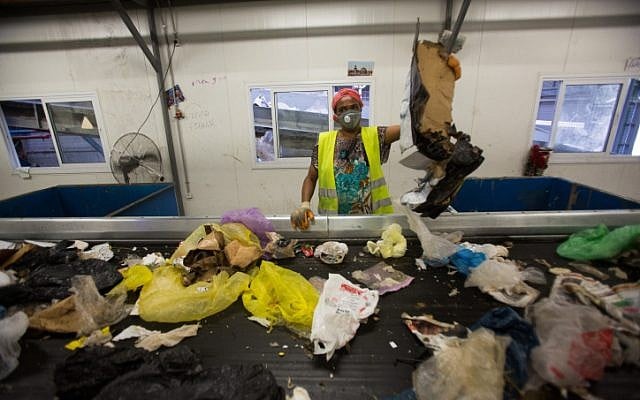
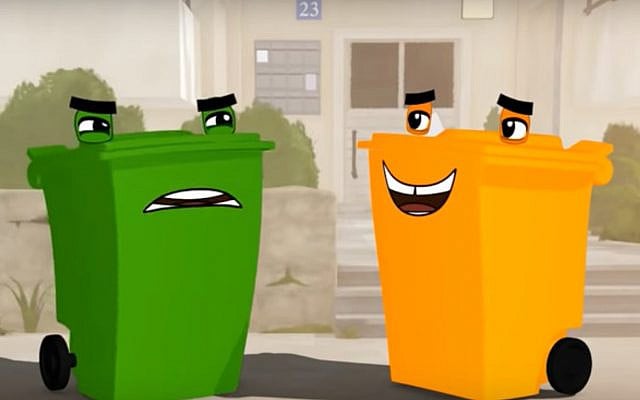
Nidam says the ministry’s threat was never acted upon, that the municipality and the ministry are in constant dialogue over the issue, and that the city will soon be proposing a joint project with Tamir. Watch out for the distinct orange container recycling bins already distributed around 93 local authorities and serving some 4.5 million Israelis.
There is still a long way to go. There is, for example, no service for residents (although there is one for restaurants) to recycle cooking oil, which can be turned into biofuel. If you do deep fry, never throw the used oil down the sink or the drains — put it into a container and deposit it in the general trash. The same goes for highly toxic liquids such as acetone and paint thinner (similar to one another), which are harmful to flora and fauna if they enter the water system. Tiny amounts can be absorbed by kitchen paper and put into the bin. Larger amounts of acetone can be put into a metal bowl and left to evaporate in the open air, far from humans or animals. Paint thinner can be strained and reused.
Education, education
In addition to upgrading the physical infrastructure for a cleaner Jerusalem, the city says it is strengthening educational and community programming on keeping the city squeaky clean.
To this end, the Operations Department has employed Shai Moshe as its “urban cleanliness coordinator.” His job is to work with other municipal departments to attack the problem and to raise public awareness through whatever means possible.
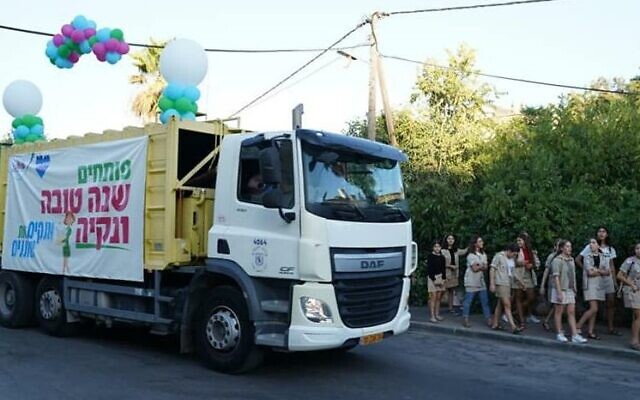
“Before the coronavirus lockdown, we were working with youth groups who handed out fridge magnets, I’ve been working with Osnat Bavli [responsible at the municipality for education for sustainability and recycling] to have garbage collectors go into schools, and we’ve piloted a cleanliness awareness program in ultra-Orthodox girls’ schools, which has reached 14,000 pupils.” Schoolgirls in the Haredi neighborhood of Ramat Polin, for example, came up with the name “Ramat Po Clean,” a play on words that means “Here in Ramat, it’s clean.”
The model is based on successful national campaigns promoting traffic safety and against the picking of wildflowers, says Moshe. In these, children were exposed to two kinds of formal activities, and two kinds of informal ones. “If it’s constant and consistent, the message gets through,” he says.
“It’s a process that will take a few years, but programs have started, and they’re working. We haven’t reached all of the residents yet, but that is our aim.”
As populations grow, in Israel and the world, garbage is only increasing.
It is worth remembering that not all items can be recycled, that seepage from landfill helps to poison groundwater, and that recycling items can use as much polluting energy as initially producing them.
So, if you want to help the environment, acquire less, reuse and repair first.







The Times of Israel Community.