

No room at the Golan inn: 6 things to know for July 1
Israelis are happy to help displaced Syrians, but are staunchly opposed to taking them in despite the humanitarian catastrophe unfolding across the frontier
 Add ToI as a Preferred Source on Google
Joshua Davidovich is The Times of Israel's Deputy Editor
1. A humanitarian crisis is continuing to unfold in southern Syria, with regime forces backed by Russian airstrikes steamrolling into towns and seemingly forcing them to cry “uncle.”
- Amid the onslaught, Syrians are “streaming” toward the Golan Heights, in Haaretz’s telling.
- It’s not clear how many displaced persons are heading for the Israeli border for protection, but with the UN estimating 160,000 forced from their homes and reports of some 60,000 on the Jordan border — well, you can do the math.
- Israel Hayom reports that the army is giving the Syrians some 300 tents, 13 tons of food, 15 tons of baby food, three pallets of medical supplies and medicine and 30 tons of clothes and shoes. The tabloid also plays up the medical aid Israel is giving wounded Syrians, as it has for several years.
- The paper’s main headline, though, “Aid yes, Absorption no,” makes clear Israel’s continued staunch opposition to taking in any refugees.
- Pretty much the same headline appears in Yedioth Ahronoth, and the paper’s online edition has a very unscientific internet poll which shows overwhelming support for Israel refusing to let in refugees, with 83% saying they want the refugees to stay out and only 17% being for letting them on, out of 217 respondents.
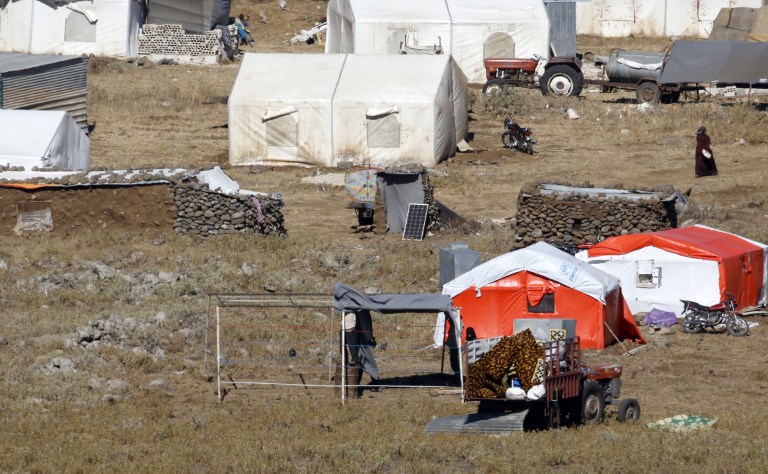
2. The AFP news agency has pictures of refugees setting up tents near the Israeli border, and in Haaretz Elizabeth Tsurkov, one of the most dogged and well informed researchers into Israel involvement in the Syrian civil war on the Golan, puts a face to some of those setting up camp.
- Tsurkov quotes one man who fled there saying many heading there believe they will be protected by the 1974 agreement setting up the border area as a demilitarized zone.
- “Civilians are asking Israel to protect them, or to annex the area remaining [under rebel control] to Israel,” she quotes the head of a humanitarian organization saying.
- Tsurkov brings other anecdotal evidence of the crush of people on the border area, like Israel’s phone network, used by Syrians near the border for years, being overloaded, and the border town of Rafid, long a refuge to losse fleeing, filling up.
- “The residents opened their homes to the refugees. The houses are completely full. There are at least five families in every home. The refugees are along the border fence with the Golan. No humanitarian organization can cope with the families here. The numbers are enormous. The situation is terrible. This is Judgment Day,” a resident says.
3. If one were looking for a symbol of Israel’s seeming lack of caring for the refugees, they would need look no further than the front page of Yedioth, which almost totally ignores the crisis just steps away from Israel’s border in favor of the news that Lionel Messi and Cristiano Ronaldo crashed out of the World Cup.
- “There was a dramatic silence, with no massive celebrations. It seemed like everyone was trying to absorb just having witnessed one of the greatest shows of soccer in history,” the paper’s correspondent writes from Kazan, where France beat Argentina 4-3, as if it were the scene of some great World War II battle.
- Other Israeli journalists, who had apparently forgotten that Argentina really had no business even making it this far, are also awestruck by the news, or perhaps dumbstruck is the better word. Israeli news site Walla writes that “Argentines woke to a dark day Sunday,” even though it’s still the middle of the night there.
4. Prince William, meanwhile, seems to have been thunderstruck by his visit to the region, if the British Daily Mirror tabloid can be believed.
- The paper reports that the prince has decided to devote his life to finding Middle East peace after his visit here.
- “A highly-placed Palace source told the Sunday Mirror that the Duke is determined to solve the region’s long-simmering mutual hostility – a problem which has stumped a series of world leaders,” the paper reports.
- “This is the start of something new. I will forever honor my commitments to the people I have met,” he’s quoting telling aides at the end of the trip.
- “William is a young, intelligent man who is very in tune with the politics of the world,” the palace source is quoted saying. “No one will forget when he told the Palestinian people they have ‘not been forgotten.’”
- Needless to say, Israelis are skeptical:
https://twitter.com/EylonALevy/status/1013279979101151232
5. Israel Hayom reports that Israelis fear pro-Palestinian actors in Europe are working to get Israel booted from FP9, an innovation program meant to succeed Horizon 2020.
- The paper reports that a petition was recently circulated signed by 154 groups and unions from 16 countries calling for “for any Israeli defense or security companies to be immediately removed from EU plans.”
- With a budget of some 100 billion euros, (the paper misreports $100 billion, but who’s counting?) Israeli companies can lose out on billions of shekels if removed from the innovation scheme, Israel Hayom notes.
6. In the US, journalists are coming together in the wake of the deadly shooting at the Annapolis Capital Gazette.
https://twitter.com/swischnowski/status/1013233306148786176
- In Israel, though, the small cadre of local English-language journalists are bickering publicly after the Jerusalem Post reported that US officials are annoyed by what they see as a decision by Haaretz’s English edition to change the headline of an op-ed from Trump negotiator Jason Greenblatt to be more confrontational toward Palestinian counterpart Saeb Erekat.
- In response, Haaretz publisher Amos Schocken publicly accuses the JPost of seeking to put Haaretz in a negative light (and a correspondent for Haaretz calls a JPost reporter a “pipsqueak” for daring to challenge his boss.)
Say it differently Lahav. Whenever you think you identified something you can cause people to despise Haaretz as “anti Israel” you do not miss the opportunity. This time you just got carried away with stupidity. It’s a wonder. Why are you so interested in us?
— Amos Schocken???????? (@AmosSchocken1) July 1, 2018
- While Haaretz editors (full disclosure: I worked on the Haaretz English edition several years ago) may have changed Greenblatt’s headline to read “Trump Mideast Envoy: The Palestinians Deserve So Much More Than Saeb Erekat,”piquing Erekat, and US officials may indeed be peeved, their accusation that the paper distorted Greenblatt’s words seems somewhat disingenuous.
- Greenblatt himself wrote “Dr. Erekat – we have heard your voice for decades and it has not achieved anything close to Palestinian aspirations or anything close to a comprehensive peace agreement. Other Palestinian perspectives might help us finally achieve a comprehensive peace agreement where Palestinian and Israeli lives can be better,” which is pretty faithfully distilled into the headline.
- Unless you are Thomas Friedman, anyone who submits any article for publication does so with the expectation that editors may change the headline or make other edits, so it’s unclear why Greenblatt thought he would be treated any differently.








The Times of Israel Community.