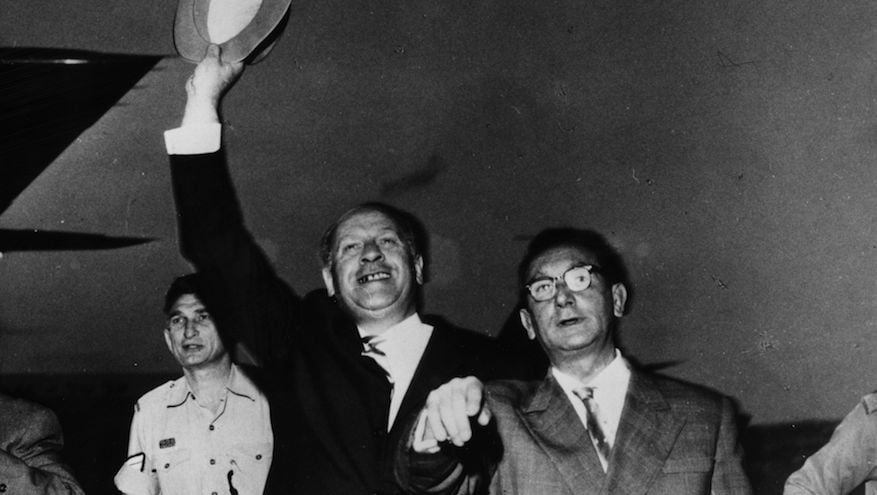
German industrialist Oskar Schindler waves after his arrival in Israel in 1962, to be honored for saving the lives of over 1,000 Jews during World War II. (Keystone/Getty Images via JTA)
PRAGUE, Czech Republic — A disused factory in the Czech Republic where German industrialist Oskar Schindler employed more than a thousand Jews to save them from the gas chambers is to host a Holocaust memorial, officials said Tuesday.
Parts of the complex in Brnenec (Bruennlitz in German), close to Schindler’s birthplace in Svitavy (Zwittau), were given the status of cultural monument earlier this month, according to the Czech culture ministry.
Built in the 19th century, the laboratory, mill, chemical depot, front door and a square used for roll call “have close historical links… to the Gross-Rosen concentration camp in Brnenec,” the ministry’s spokeswoman, Simona Cigankova, told AFP.
During World War II, Schindler (1908-1974), saved the lives of 1,200 Jews by employing them in his enamelware and munitions factories in Nazi-occupied Poland and Czechoslovakia.
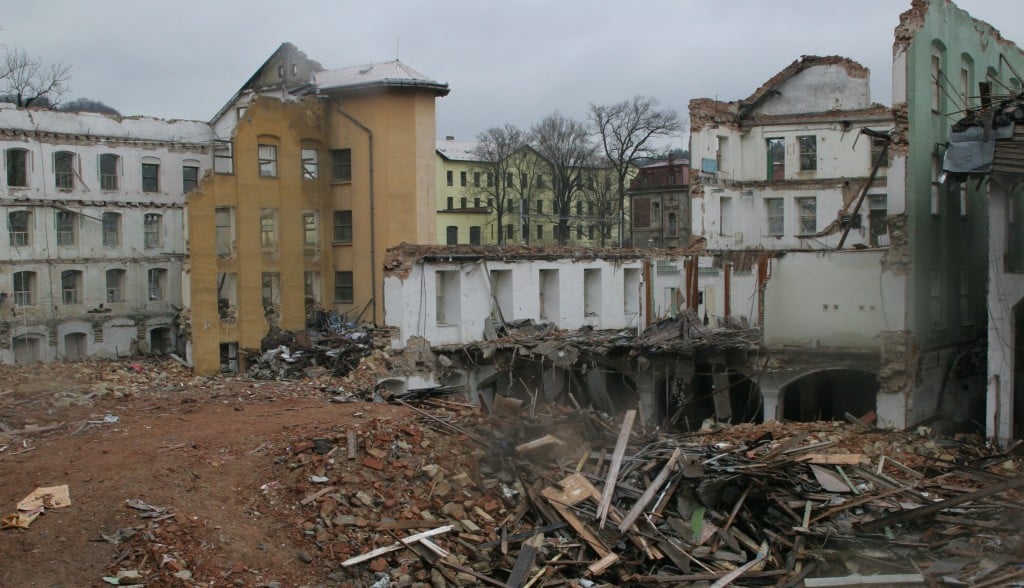
The lower part of the Schindler factory next to a demolished 19th-century building. (Eva Munk/JTA)
His tale was enshrined in the bestselling 1982 novel “Schindler’s Ark” and its 1993 Steven Spielberg film adaptation, “Schindler’s List.”
Get The Times of Israel's Daily Editionby email and never miss our top stories
A Czech foundation plans to restore the dilapidated factory in Brnenec and create a Holocaust memorial and an exhibition depicting Schindler’s life there, with an opening scheduled for 2019.
“Our aim is to restore the building to its original condition, including the watchtower,” Jaroslav Novak, head of the Shoah and Oskar Schindler Foundation told journalists recently.
Advertisement
Help us report truthfully on social media
As a multimedia journalist, my job is to take the quality, fact-based journalism produced by The Times of Israel newsroom and make it accessible across every platform — from Instagram posts to podcasts to short-form videos.
This is how many, especially young people, consume news these days. But misinformation is rampant on social media. Our team at ToI produces accurate, responsible short-form reporting on Israel and the Jewish world.
If you believe in the importance of factual social media journalism, please consider joining our reader support group, The Times of Israel Community. Your financial support is essential to sustain responsible multimedia reporting.
We’re really pleased that you’ve read X Times of Israel articles in the past month.
That’s why we started the Times of Israel - to provide discerning readers like you with must-read coverage of Israel and the Jewish world.
So now we have a request. Unlike other news outlets, we haven’t put up a paywall. But as the journalism we do is costly, we invite readers for whom The Times of Israel has become important to help support our work by joining The Times of Israel Community.
For as little as $6 a month you can help support our quality journalism while enjoying The Times of Israel AD-FREE, as well as accessing exclusive content available only to Times of Israel Community members.
Thank you, David Horovitz, Founding Editor of The Times of Israel


 Add ToI as a Preferred Source on Google