

Train service returns after 3 months despite mounting coronavirus cases
With each trip limited to half capacity, passengers must reserve their place in advance; Israel Railways says overcrowding will cause progress to be reversed
 Add ToI as a Preferred Source on Google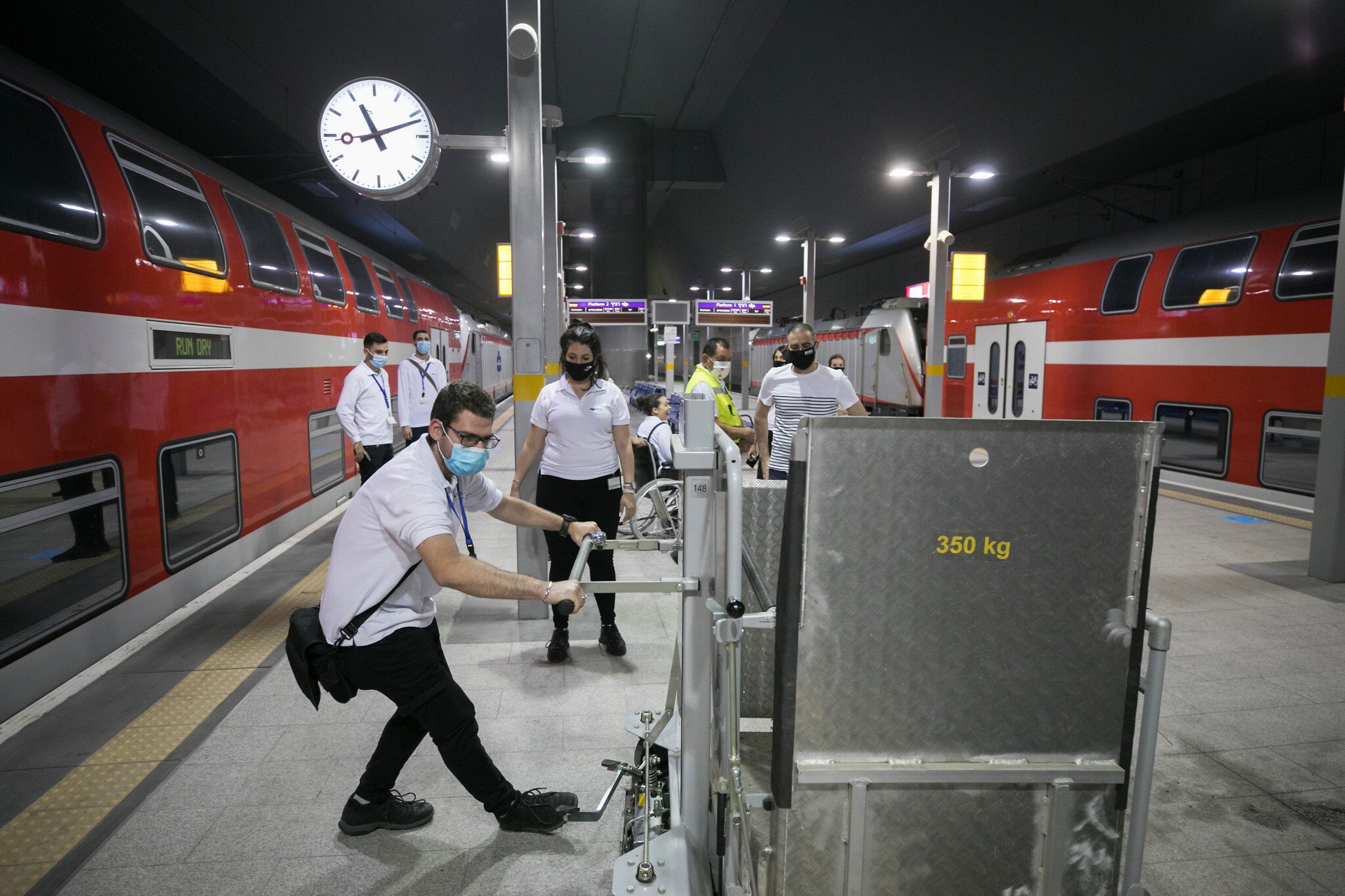
Intercity train service resumed across Israel Monday morning after three months of closure, as the country sought to continue on its path toward reopening despite mounting coronavirus infection rates.
Trains were shut down on March 25 along with the rest of public transportation as the country swiftly locked down during the initial wave of the virus. While buses began running with part, then full, service months ago, trains were kept shut, leading to anger and frustration among commuters who rely on the service.
Under social distancing guidelines, passenger trains are being limited to a maximum of 500 riders each — half of the normal capacity — in order to prevent crowding. Travelers must book their places in advance by ordering new mandatory ride vouchers on the Israel Railways website.
The vouchers are not a replacement for tickets and travelers must still buy a stub or swipe their Rav Kav cards at the turnstiles. Passengers must also carry a valid ID that matches the one appearing on the voucher.
A detailed explanation on the new voucher system is available in English here. Vouchers will be available online starting 48 hours before the planned trip, and will also be available at train station kiosks in cases where seats remain.
But Israel Railways CEO Michael Maixner cautioned that if trains are more crowded than allowed, “we will have to reverse.”
“We prepared quickly, in accordance with the new plan approved by the coronavirus cabinet,” Maixner said, referring to a ministerial committee managing COVID-19 policy.
“I estimate that problems and malfunctions are possible in the first few days,” Maixner said. “We will do everything to improve whatever needs improvement.”
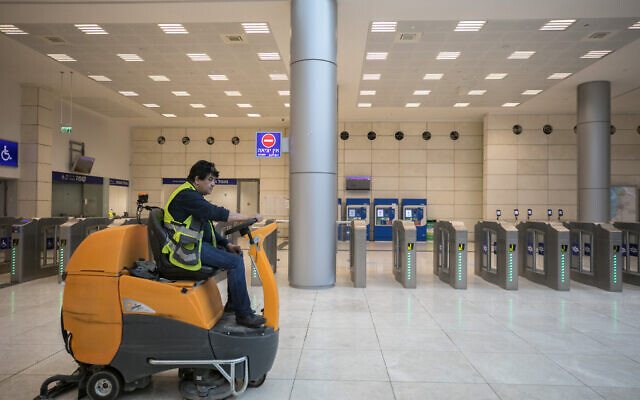
(Olivier Fitoussi/Flash90)
Face masks must be worn at all times on the train and in the stations, and eating and drinking is forbidden during rides.
Passengers whose body temperature is over 38 degrees Celsius will not be allowed into the stations, and workers will enforce social distancing in the waiting lines.
Maixner said that if the reopening goes according to the plan, trains could be filled in the future with 75% of the regular number of passengers.
One of the passengers Monday was Transportation Minister Miri Regev, who boarded a train in Tel Aviv on her way to a coronavirus cabinet meeting in Jerusalem.

“We have no intention to open just to [re]close,” Regev said, while warning that closing was an option if the public doesn’t adhere to the rules.
As many people stayed away from the stations Monday, Regev added: “The travelers will come back in the end because there is no other way. They have no cars. These are students, families, elderly, who want to eventually go back to using the train.”
The date for resuming train service was postponed several times over the last month, as infection numbers began to rise again following a brief hiatus.
Rail has been one of the last major services to remain shut as the country increasingly opened up over recent weeks. But the issue has come under increasing criticism, with the lack of trains causing more crowding on buses, leading some to question whether the limitations were defeating their purpose.
Israel has seen the number of new COVID-19 cases continue to climb by nearly 300 a day, leading the Health Ministry on Sunday to instruct hospitals around the country to prepare to reopen their coronavirus wards.
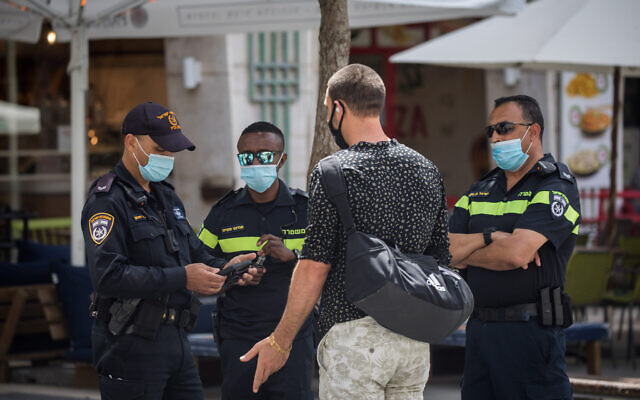
Diagnoses have risen steadily over recent weeks after being brought down to some 20 cases a day in May following two months of strict restrictions that shuttered business and schools and kept many from being able to travel more than a few hundred feet from home.
The Health Ministry recorded some 145 new cases between Saturday night and Sunday night, bringing the number of active cases to 4,743. The lower daily tally may have been due to a smaller number of tests over the weekend than on weekdays, with the rate of positive results out of all tests remaining at around 2%.
The ministry said there were 40 people in serious condition, 28 of them on ventilators. Another 53 people were in moderate condition and the rest were displaying mild symptoms. The death toll since the start of the pandemic is 306.
Government officials have warned new limitations could be imposed if numbers continue to rise, although ministers decided to restart rail services regardless.
New Health Ministry Director-General Chezy Levy on Sunday sounded the alarm on rising coronavirus infection rates in 50 towns and cities around the country, while indicating the government was not seeking to reimpose lockdown measures to curb the spread.
“Just during the past week, over 1,700 new cases were discovered, and 30-40 serious cases. There is no doubt there is a change in the infection rate. It worries us,” Levy told reporters.
Levy, who took up the post last week, said younger people make up a higher percentage of the sick, relative to the period between March and May. New infections have been detected in over 50 communities, which he said indicates “broad community spread.” With some 15,000 daily tests, the number of those coming back positive has climbed from 1.3 percent to over 2%, he said.
Even as he warned of the spiraling rates of infection, Levy said he opposed renewing lockdown measures and said the government was not currently in favor of the step.
“I don’t think we need to head toward a lockdown. The government, too, is not talking about a lockdown,” said Levy, urging citizens to keep social distancing and wearing masks. He also acknowledged “public fatigue from the difficult lockdown,” but stressed that all must remain vigilant and even those displaying mild symptoms should go get tested.
“I don’t think we’ve lost control. We are aware of the situation,” he said.










The Times of Israel Community.