Turkey to start Mediterranean gas exploration ‘as soon as possible’
After signing controversial deal with Libya, Erdogan says it’s ‘no longer legally possible’ to have search and drilling activities or a pipeline without countries’ okay
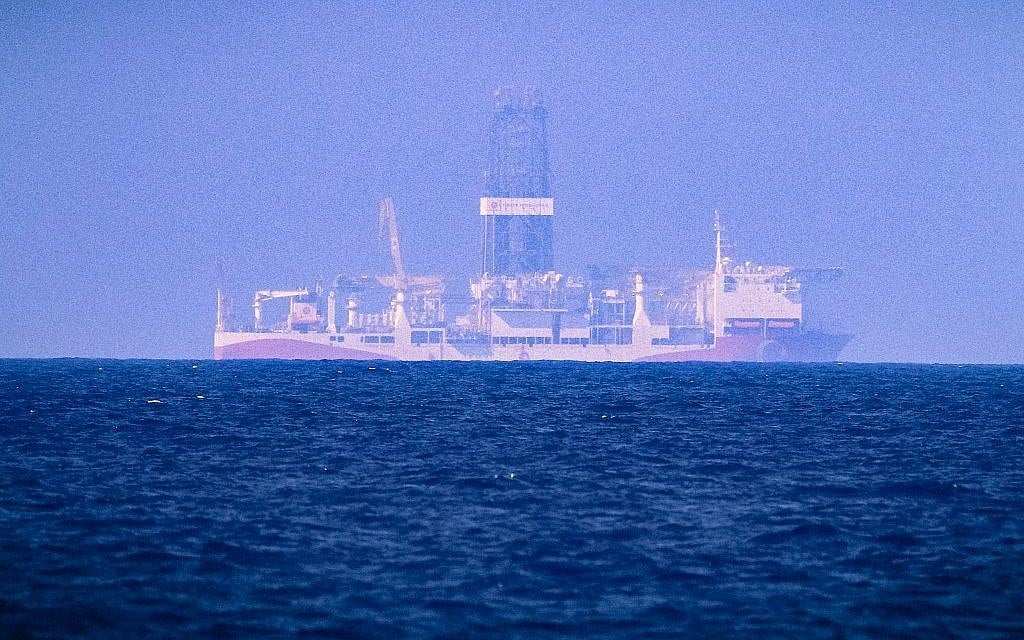
The drilling vessel Fatih deployed by Turkey to search for gas and oil in waters considered part of the EU state's exclusive economic zone on June 24, 2019 (AFP)
ANKARA, Turkey — Turkey will start exploring for gas in the eastern Mediterranean this year, President Recep Tayyip Erdogan vowed Thursday, after signing a maritime deal with Libya.
“We will start search and drilling activities as soon as possible in 2020 after issuing licenses for the areas,” Erdogan said during a two-hour speech in the capital.
He added that Turkey’s seismic exploration vessel Oruc Reis would soon be deployed.
Ankara angered neighboring countries in the Mediterranean with an agreement signed with the Tripoli government in November, which claimed extensive areas of the sea for Turkey.
Greece says the deal fails to take into account the island of Crete, while Turkey has already upset Cyprus by sending ships to search for oil and gas off the divided island.
Get The Times of Israel's Daily Editionby email and never miss our top stories
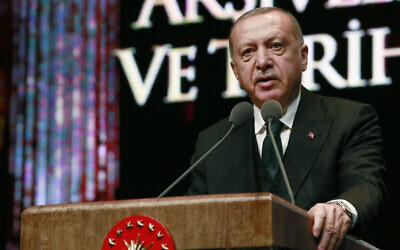
Turkey’s President Recep Tayyip Erdogan speaks during a meeting on Turkish archives, in Ankara, Turkey, April 24, 2019. (Presidential Press Service via AP, Pool)
Erdogan said it was “no longer legally possible” for any search and drilling activities or a pipeline without Libya or Turkey’s approval.
Earlier this month, Greece, Cyprus and Israel signed a deal to construct an EastMed pipeline to ship gas to Europe, despite Turkey’s vehement opposition.
Turkey and Libya also signed a security deal in November which was followed by the deployment of Turkish forces in the north African country.
Advertisement
While Turkey supports the UN-recognized government of Premier Fayez al-Sarraj, countries like Egypt and the United Arab Emirates back Libyan strongman Khalifa Haftar in his assault against Tripoli.
Help us report truthfully on social media
As a multimedia journalist, my job is to take the quality, fact-based journalism produced by The Times of Israel newsroom and make it accessible across every platform — from Instagram posts to podcasts to short-form videos.
This is how many, especially young people, consume news these days. But misinformation is rampant on social media. Our team at ToI produces accurate, responsible short-form reporting on Israel and the Jewish world.
If you believe in the importance of factual social media journalism, please consider joining our reader support group, The Times of Israel Community. Your financial support is essential to sustain responsible multimedia reporting.
We’re really pleased that you’ve read X Times of Israel articles in the past month.
That’s why we started the Times of Israel - to provide discerning readers like you with must-read coverage of Israel and the Jewish world.
So now we have a request. Unlike other news outlets, we haven’t put up a paywall. But as the journalism we do is costly, we invite readers for whom The Times of Israel has become important to help support our work by joining The Times of Israel Community.
For as little as $6 a month you can help support our quality journalism while enjoying The Times of Israel AD-FREE, as well as accessing exclusive content available only to Times of Israel Community members.
Thank you, David Horovitz, Founding Editor of The Times of Israel


 Add ToI as a Preferred Source on Google