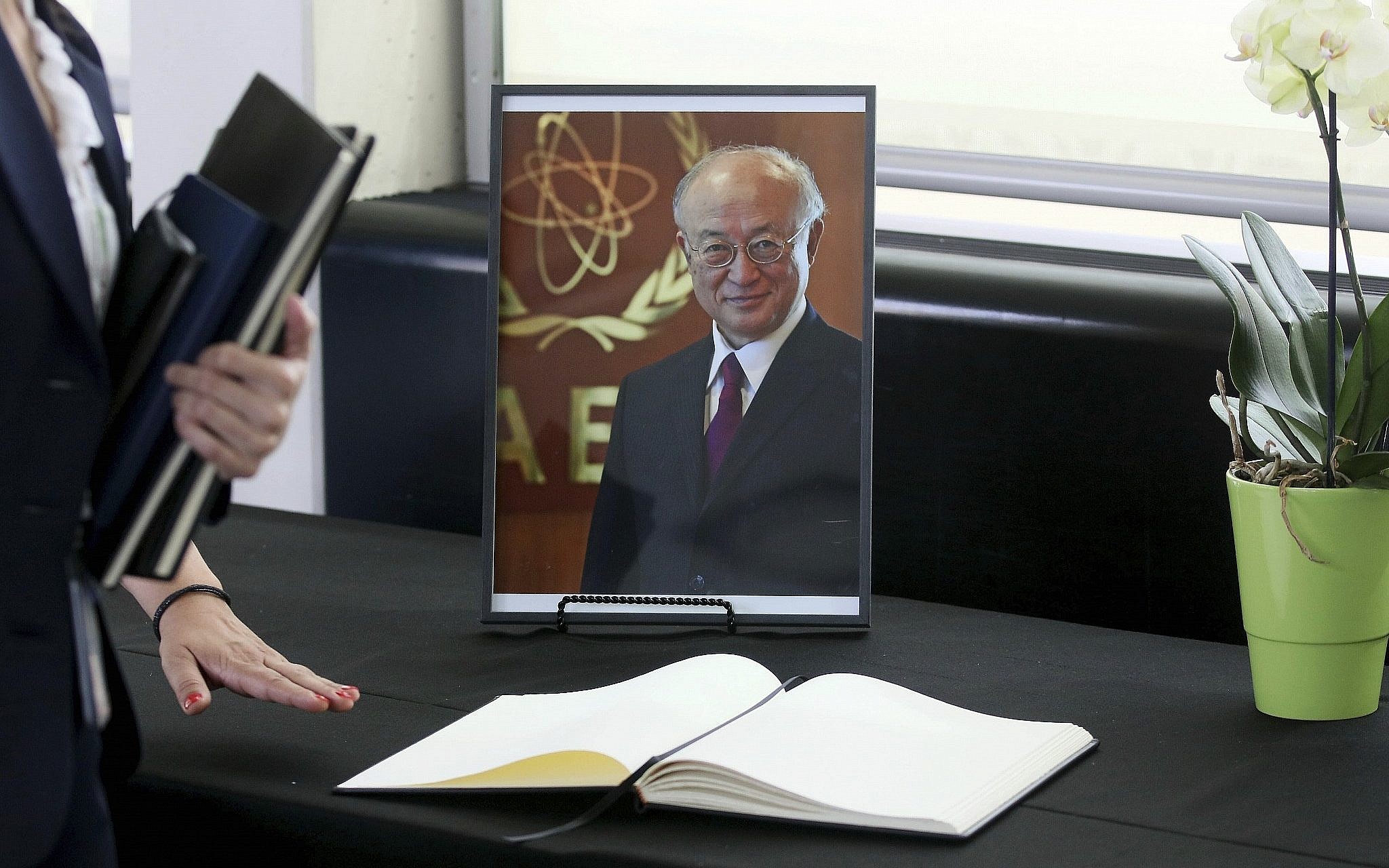
A book of condolence in front of a portrait of the late director general of the IAEA, Yukiya Amano, in Vienna, Austria, July 22, 2019. (AP Photo/Ronald Zak)
The United Nations’ nuclear watchdog aims to name a new leader in October following the death last month of Yukiya Amano, its director general for the past decade.
The International Atomic Energy Agency said as its board of governors met in Vienna Thursday that nominations for the job should be submitted by September 5 and the new director general is expected to be appointed in October. The new leader should take office by January 1.
Cornel Feruta, a Romanian diplomat and the IAEA’s chief coordinator, is serving as the acting director general pending the naming of a permanent successor to Amano.
The Japanese diplomat, who died at age 72, was extensively involved in negotiations over Iran’s nuclear program and the cleanup of the 2011 Fukushima nuclear disaster in Japan.
A technician at the Uranium Conversion Facility just outside the city of Isfahan, Iran, 255 miles (410 kilometers) south of the capital Tehran, February 3, 2007. (AP/Vahid Salemi/File)
Amano’s death came at a time of increasing concerns and escalating tensions over Iran’s nuclear program, after US President Donald Trump left a 2015 deal with world powers last year. Iran recently breached the cap of enriched uranium set out in the agreement and European nations were working frantically to salvage the accord.
Get The Times of Israel's Daily Editionby email and never miss our top stories
Iran’s semi-official Tasnim news agency claimed last week that Israel was responsible for the death of the UN nuclear watchdog chief. The International Atomic Energy Agency dismissed the Tasnin report. It told The Times of Israel: “[We] categorically deny these false reports. Director General Yukiya Amano passed away on 18 July as a result of his illness.”
Help us report truthfully on social media
As a multimedia journalist, my job is to take the quality, fact-based journalism produced by The Times of Israel newsroom and make it accessible across every platform — from Instagram posts to podcasts to short-form videos.
This is how many, especially young people, consume news these days. But misinformation is rampant on social media. Our team at ToI produces accurate, responsible short-form reporting on Israel and the Jewish world.
If you believe in the importance of factual social media journalism, please consider joining our reader support group, The Times of Israel Community. Your financial support is essential to sustain responsible multimedia reporting.
We’re really pleased that you’ve read X Times of Israel articles in the past month.
That’s why we started the Times of Israel - to provide discerning readers like you with must-read coverage of Israel and the Jewish world.
So now we have a request. Unlike other news outlets, we haven’t put up a paywall. But as the journalism we do is costly, we invite readers for whom The Times of Israel has become important to help support our work by joining The Times of Israel Community.
For as little as $6 a month you can help support our quality journalism while enjoying The Times of Israel AD-FREE, as well as accessing exclusive content available only to Times of Israel Community members.
Thank you, David Horovitz, Founding Editor of The Times of Israel


 Add ToI as a Preferred Source on Google