

US, Iranian envoys share rare private exchange after heated UN meeting
US ambassador to UN seen speaking to Iranian counterpart following Security Council gathering on nuclear deal where US warned against ‘malign Iranian behavior’
 Add ToI as a Preferred Source on Google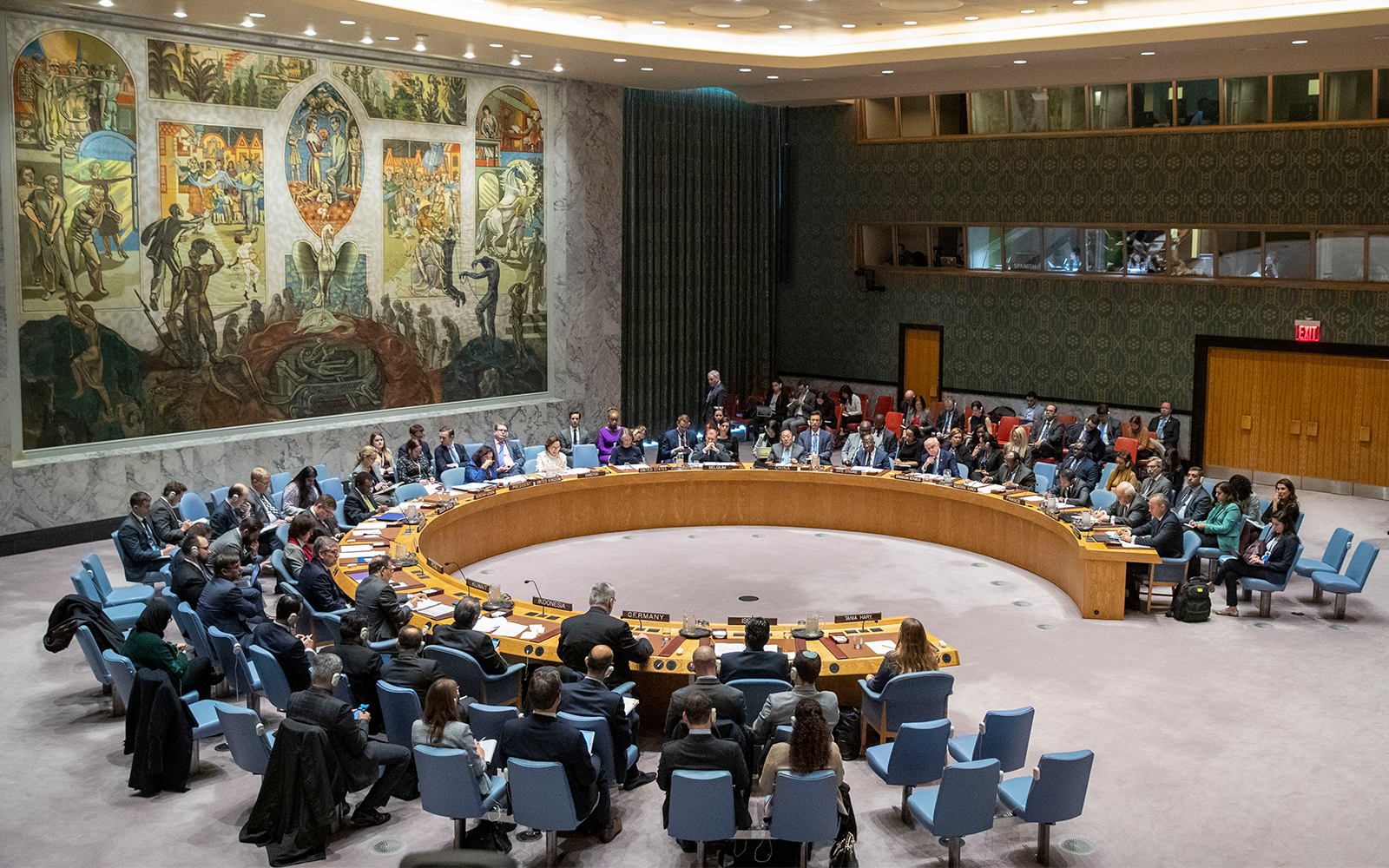
UNITED NATIONS — The US and Iranian envoys to the United Nations shared a rare, brief private exchange on the sidelines of a Security Council meeting on Thursday where the US vowed to do everything in its power “to curb malign Iranian behavior” if Tehran continues to destabilize the Middle East.
Both spoke at the meeting on the implementation of a resolution endorsing the 2015 nuclear deal between Iran and key world powers, meant to curb Tehran’s atomic program in exchange for the lifting of punishing sanctions. The US pulled out of the agreement last year and re-imposed sanctions on Iran, which has led to heightened tensions.
In her speech, US ambassador to the UN Kelly Craft said the US was “willing to engage in dialogue with Iran to negotiate a deal that will better serve international peace and security. But we will not sit idly by while Iran continues to destabilize the region.” She said the Trump administration also “rejects Iran’s use of nuclear brinkmanship to normalize its destabilizing behavior.”
Iranian Ambassador Majid Takht Ravanchi called the US offer of unconditional talks “disingenuous.” The US wants to enter dialogue from a position of strength from maintaining sanctions and maximum pressure, “and not based on equal footing,” he said.
“Iran does not negotiate under the threat of a sword,” Ravanchi said.
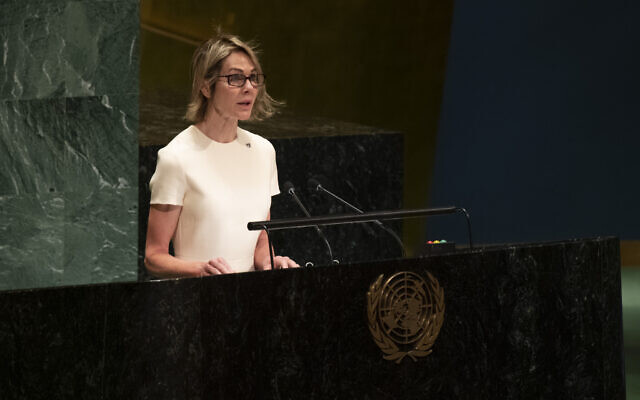
During his speech before the 15-member council, Ravanchi mentioned a two-year-old toddler named Ava who had died in June from a rare disease known as EB and blamed US sanctions.
“It is a shame that the US bullying has resulted in discontinuation of export of certain medicines to Iran, causing nightmare for some patients,” Ravanchi said in his remarks.
“For instance, a European company, under the pressure of US sanctions, has stopped exporting special bandages for patients suffering from EB, a rare genetic condition resulting in easy blistering of the skin,” he said.
After the meeting, a live camera at the United Nations filmed Craft come up to Ravanchi, a rare, direct diplomatic interaction between the two countries. Craft tried to shake hands with Ravanchi and his colleague, though both men bowed and folded their hands as if in a prayer to acknowledge her and avoid shaking her hand.
According to a Reuters report, Craft approached Ravanchi to express her condolences over the death of the child.
Alireza Miryousefi, a spokesman at Iran’s UN mission, described the interaction as “merely” a short conversation about young children affected by EB (epidermolysis bullosa), a genetic skin disorder.
“It is not out of the ordinary for UN diplomats accredited to the UN to run into each other, or to have brief encounters, at HQ,” Miryousefi wrote on Twitter.
However, in past years, Iranian officials have tried to avoid direct interactions with their US counterparts.
Path forward
Ravanchi said in his speech that US implementation of the council’s 2015 resolution endorsing the international Iran nuclear deal “will pave the way for a genuine dialogue to start.”
Ravanchi said that in negotiations on the nuclear deal, Iran rejected attempts to include its legitimate defense capabilities and its role in the region.
Tensions have been incredibly high between the nations since President Donald Trump unilaterally withdrew from Tehran’s nuclear deal in May 2018. For the administration of Iranian President Hassan Rouhani, the withdrawal and reimposed sanctions have been devastating for the country’s long-ailing economy. Rouhani also faces ever-increasing criticism from hard-liners and any interaction with the US could further fuel that.
At the meeting, US diplomat Rosemary DiCarlo told the Security Council that tensions in the region “have worryingly escalated” during 2019.
“We witnessed attacks against oil tankers, strikes against a civilian airport, and a highly sophisticated and synchronized attack against oil facilities in Saudi Arabia,” she said. “Combined with acrimonious rhetoric, these developments have dangerously brought the region closer to a serious confrontation.”
DiCarlo warned that “such an eventuality would be devastating and must be prevented at all costs.”
The meeting followed UN Secretary-General Antonio Guterres’ recent report saying the United Nations has not been able to independently corroborate that cruise missiles and drones used in attacks earlier this year on an airport and oil facilities in Saudi Arabia “are of Iranian origin” — or were transferred from Iran “in a manner inconsistent” with the 2015 UN resolution.
DiCarlo reiterated that finding, saying the UN is still collecting and analyzing additional information on the drones and cruise missiles.
For example, she said, “we have recently received confirmation that some of the cruise missile components were, in fact, not made by the identified manufacturers but could have been copies.” The United States, Britain, France Germany and Israel have blamed Iran for the attacks, but Iran and Russia insist Tehran was not responsible.
Craft, the US ambassador, told the council that “there is simply no other plausible explanation.”
She said only Iran could have carried out complex attacks like the ones on Saudi Aramco oil facilities in Abqaiq and Khurais on Sept. 14, which Yemen’s Houthi Shiite rebels claimed responsibility for.
The weapons used didn’t have the range to come from Houthi territory and the drones had “numerous characteristics in common with Iranian designs,” Craft said.
She said the damage at the oil facilities “shows that the attack came from the north, not from the south, as you would expect if the Houthis were responsible.”
What this means, Kraft said, is that Iran “attacked a sovereign nation from its territory” which should be condemned by all nations.
British Ambassador Karen Pierce stressed the importance for the Europeans of preserving the 2015 nuclear deal with Iran, which she called “fundamental to regional and international peace and security.” She added that it is essential diplomatic efforts continue.
Pierce expressed regret at Iran’s recent steps reducing its nuclear commitments and worry at indications that Tehran is illegally transferring conventional arms, missiles and missile technology in the region.
“We call on Iran to cease such activities, which only deepen mistrust and increase regional tensions,” she said.
But Russia’s ambassador, Vassily Nebenzia, told the council the “so-called evidence provided about culpability of Iran is not persuasive and it is not corroborated in the secretary-general’s report.”
He added that the report “is plagued by a chronic lack of evidence.”
Nebenzia called the 2015 agreement between Iran and the US, Russia, China, Britain, France and Germany “the crowning achievement of multilateralism.”
“We cannot allow political pressure, economic asphyxiation and military blackmail to prevail,” he said. “The end goal needs to be the establishment of a genuinely inclusive security architecture which reflects the legitimate concerns of all countries in the region.”







The Times of Israel Community.