

When Moses almost parted the Red Sea on the Great Seal of the United States
New book contends Hebrew prophets influenced the Puritans who established America — and the patriots who led it to independence
 Add ToI as a Preferred Source on Google
Reporter at The Times of Israel
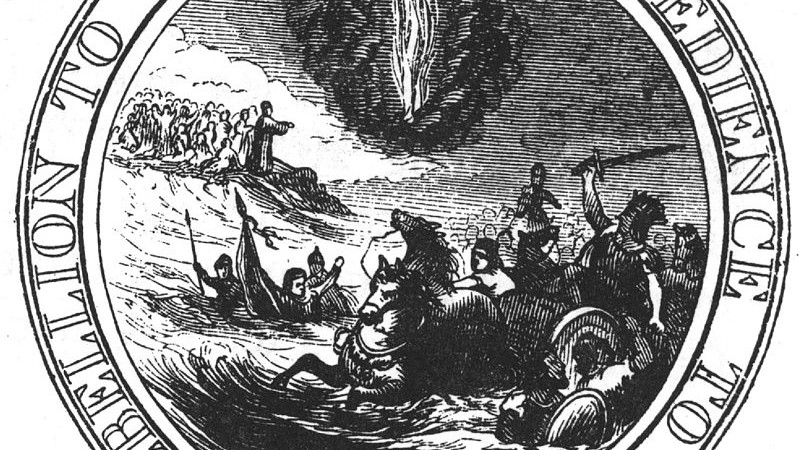
If Ben Franklin had his way, the Great Seal of the United States might have featured Moses instead of a bald eagle.
Moses was one of several Hebrew prophets admired by the Puritans who created the early American colonies, and the revolutionaries who led those colonies to independence. This reverence is part of a provocative new book by Yale professor Philip Gorski.
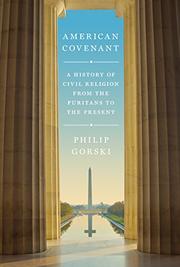
In “American Covenant: A History of Civil Religion from the Puritans to the Present,” Gorski contends that the US was founded as a prophetic republic.
“There’s a little more emphasis on an active citizenry, civic virtue, individual rights with civic duties,” Gorski told The Times of Israel. “An active citizenry is the only way to uphold free institutions. Not just laws and rights but civic action, civic duty. That’s what it aspires to be.”
This stemmed from prophetic religion, which “does not imagine that it can foresee the future, the end times,” Gorski said, “but rather, with Amos, Isaiah and Jeremiah, it calls people back to core values.”
We ignore this call at our peril, said Gorski, who comes from “a very long line of Lutheran pastors” and “was raised in the ensconced liberal Protestant tradition.”

“Prophetic republicanism has always had a darker twin,” he said — “some kind of religious nationalism, usually some kind of Christian nationalism. It’s different in a sense in that it does think it embodies a post-national apocalyptic showdown between good and evil that places the US squarely on the side of good, always on the side of good. It always goes easily into racial nationalism. It’s what we’re seeing today.”
The book comes out just in time for Patriots Day, the April 19 anniversary of the battles of Lexington and Concord that started the American Revolution.
The 17th-century Puritans who founded the early American colonies respected the Hebrew scriptures, Gorski said.
“It was a period where Christian clergy in Europe became much more educated, especially Protestant clergy,” said Gorski. “Some certainly did know Hebrew… In a lot of images from the period, you often see Hebrew lettering, Hebrew scriptures. For some, the most learned, they begin to engage with rabbinic scholars of various kinds.”
Parting the Atlantic
Puritans made their own exodus across the Atlantic, from England to North America.
“They saw their own state as very much in the mirror of the Exodus narrative,” Gorski said. “They were also very self-conscious about establishing covenants. They’d open a church, it was a covenant. They founded a town, it was a covenant. There were separate covenants for politics and religion.”
“Prophets call people back to the terms of the covenant,” he said. “This figures into the Protestant religious tradition: the figure, the genre of the jeremiad, a fiery sermon denouncing the sins of the people calling them to live up to the covenant.”
Amos, Isaiah and the aptly named Jeremiah “were not just three people as we now know from prophetic scriptures,” Gorski said. “They were by far the most important in their rhetoric, the way they talk. It caught the attention [of Puritans] in their scriptural allusions and the reforms they would make.”
The Puritan cry for reform became the patriot call for revolution. On July 4, 1776, the US declared its independence, and the Continental Congress named Franklin and future presidents John Adams and Thomas Jefferson to form a committee to design a Great Seal.
Franklin’s design, described in a handwritten note, “alluded to ‘Moses standing on the shore, and extending his hand over the sea, thereby causing the same to overwhelm Pharaoh who is sitting in an open chariot, a crown on his head and a sword in his hand,’” said University of Pittsburgh professor Lester Olson, author of “Emblems of American Community in the Revolutionary Era.”
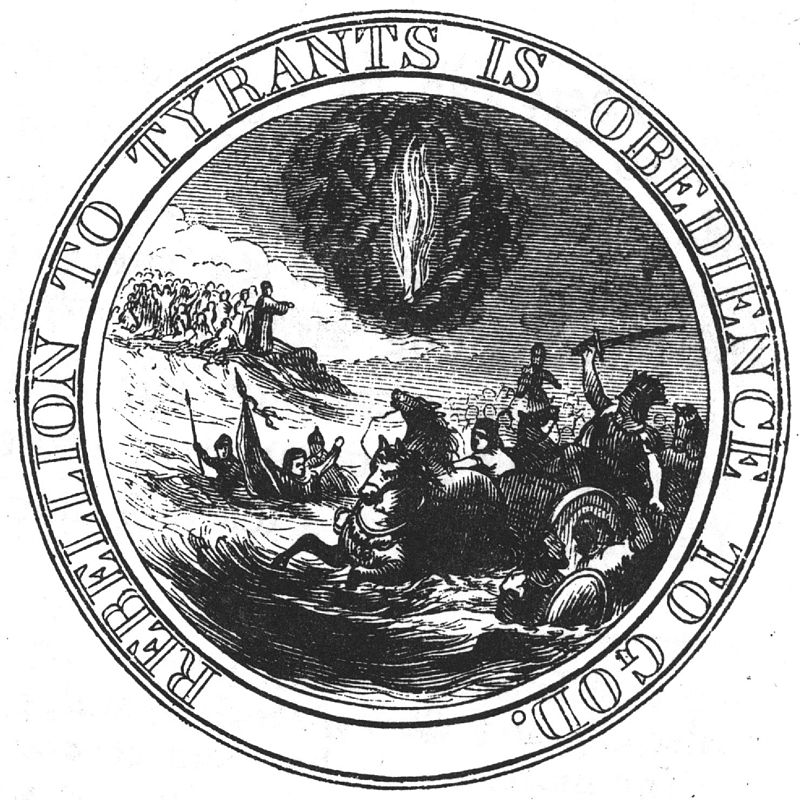
“[Franklin] added ‘Rays from a pillar of fire in the clouds reaching to Moses, to express that he acts by command of the Diety,’” Olson said.
Gorski esplained that the image of Moses leading the Israelites over the Red Sea “shows how powerful, how influential the Exodus narrative was, and remained, during the revolutionary era.”
He contended that the idea of a representative government — the American republic — has its roots in the Hebrew republic. “It was a very widespread, common argument,” said Gorski.
The colonies won independence in 1783; the year before, after three separate committees, Congress accepted the Great Seal in its final version — with an eagle instead of Moses.
“Franklin’s proposal for a design was not put forward by the [first] committee, though they did recommend his motto, ‘Rebellion to Tyrants is Obedience to God,’” Olson said. “Instead, the committee put forward a design suggested by [artist] Pierre Du Simitiere. But that committee’s report was tabled, an action that essentially killed it.”
The design that won out is “the other side of America. Power and greatness, the capacity embodied in the eagle,” he said.
“In a way, it’s too bad,” said Gorski. “I would have preferred it [the Moses seal] to the eagle. It’s something more worth remembering, aspiring to.”







The Times of Israel Community.