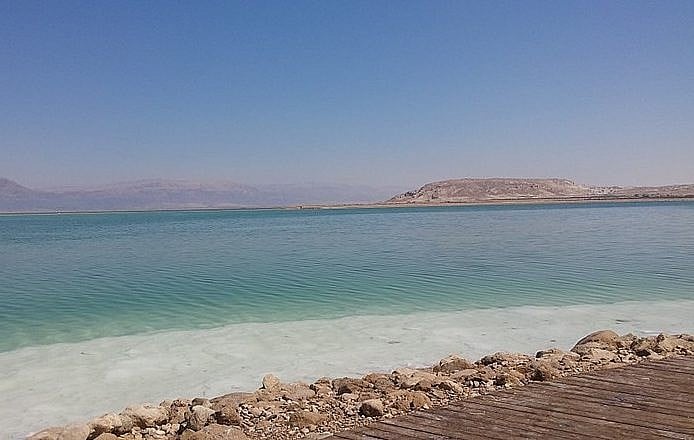
Neve Zohar beach on the Dead Sea, where an 88-year-old woman drowned on May 27, 2018. (Maya Harran: CC-BY-SA-4.0, Wikimedia Commons)
An 88-year-old woman was declared dead on Sunday after drowning in the Dead Sea.
The woman, who was not immediately named, drowned off the Neve Zohar beach south of the Ein Bokek resort.
Paramedics administered first aid and tried to resuscitate her, without success.
Common wisdom says that it is impossible to drown in the Dead Sea because of its high salt content, which, famously, stops swimmers from sinking and enables them to float on its surface, raft-like. But the very buoyancy that attracts visitors from all over the world can turn deadly if one flips over onto one’s stomach. This is because it is difficult to get one’s head out of the water by forcing the feet down to turn back over.
Drinking the saltwater can harm the heart and kidneys.
Get The Times of Israel's Daily Editionby email and never miss our top stories
People float on the water in the Dead Sea, Israel, on May 27, 2017. (Yonatan Sindel/Flash90)
In any event, experts recommend not spending more than 20 minutes in the sea for any one dip to avoid dehydration and electrolyte imbalance.
The waters of the lowest place on earth saw the drownings last year of a 68-year-old Russian millionaire lawmaker, Vasily Tarasyuk, and a 68-year-old Argentinian tourist. In 2016, an 83-year-old man drowned there.
Several years ago, Yaniv Almog of the Soroka Medical Center in Beersheba told the Haaretz newspaper, “It is impossible to sink in the Dead Sea and drown in the ordinary way. Most people don’t drown in it; they trip, fall and swallow the water.”
Advertisement
Help us report truthfully on social media
As a multimedia journalist, my job is to take the quality, fact-based journalism produced by The Times of Israel newsroom and make it accessible across every platform — from Instagram posts to podcasts to short-form videos.
This is how many, especially young people, consume news these days. But misinformation is rampant on social media. Our team at ToI produces accurate, responsible short-form reporting on Israel and the Jewish world.
If you believe in the importance of factual social media journalism, please consider joining our reader support group, The Times of Israel Community. Your financial support is essential to sustain responsible multimedia reporting.
We’re really pleased that you’ve read X Times of Israel articles in the past month.
That’s why we started the Times of Israel - to provide discerning readers like you with must-read coverage of Israel and the Jewish world.
So now we have a request. Unlike other news outlets, we haven’t put up a paywall. But as the journalism we do is costly, we invite readers for whom The Times of Israel has become important to help support our work by joining The Times of Israel Community.
For as little as $6 a month you can help support our quality journalism while enjoying The Times of Israel AD-FREE, as well as accessing exclusive content available only to Times of Israel Community members.
Thank you, David Horovitz, Founding Editor of The Times of Israel


 Add ToI as a Preferred Source on Google