

A riddle wrapped in a mystery inside a strike on Hezbollah
The little we know about Sunday’s attack just leaves more gaping unknowns, like whether Israel considered how the group would be forced to respond after the death of a top commander

 Add ToI as a Preferred Source on Google
Avi Issacharoff, The Times of Israel's Middle East analyst, fills the same role for Walla, the leading portal in Israel. He is also a guest commentator on many different radio shows and current affairs programs on television. Until 2012, he was a reporter and commentator on Arab affairs for the Haaretz newspaper. He also lectures on modern Palestinian history at Tel Aviv University, and is currently writing a script for an action-drama series for the Israeli satellite Television "YES." Born in Jerusalem, he graduated cum laude from Ben Gurion University with a B.A. in Middle Eastern studies and then earned his M.A. from Tel Aviv University on the same subject, also cum laude. A fluent Arabic speaker, Avi was the Middle East Affairs correspondent for Israeli Public Radio covering the Israeli-Palestinian conflict, the war in Iraq and the Arab countries between the years 2003-2006. Avi directed and edited short documentary films on Israeli television programs dealing with the Middle East. In 2002 he won the "best reporter" award for the "Israel Radio” for his coverage of the second intifada. In 2004, together with Amos Harel, he wrote "The Seventh War - How we won and why we lost the war with the Palestinians." A year later the book won an award from the Institute for Strategic Studies for containing the best research on security affairs in Israel. In 2008, Issacharoff and Harel published their second book, entitled "34 Days - The Story of the Second Lebanon War," which won the same prize.
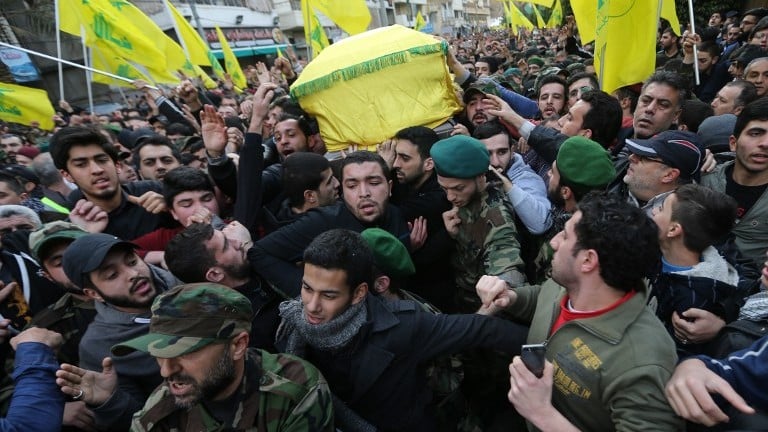
The more details that emerge after the alleged Israeli strike Sunday afternoon in the Syrian Golan Heights town of Quneitra, the more questions and quandaries arise.
Iran announced Monday that among those killed in the attack was Mohammad Ali Allahdadi, a general in its Revolutionary Guard.
Allahdadi was known to be one of powerful al-Quds Force commander Qasem Soleimani’s closest confidantes. According to reports circulating in Arab and international media, Allahdadi was not the only Iranian casualty.
AFP reported on Monday that a total of six Iranians were killed in the airstrike, aside from the additional six members of Lebanese terror group Hezbollah.
Jihad Mughniyeh — the son of Imad Mughniyeh, a top Hezbollah operative assassinated in 2008 — was killed in the Sunday attack, and so was Mohammed Issa, the commander of Hezbollah forces in Iraq and Syria. Another of those killed was Abbas Hijazi, whose father Kamal was one of Hezbollah’s founders.
Most probably, Col. Ali Tabatabai, who Channel 10 called the head of the group’s offensive operations, was killed in the attack as well, though his name was later omitted from reports in Lebanese media.
Israel has so far offered no official response to the attack, neither confirming nor denying taking part in its implementation, and all information related to what Jihad Mughniyeh was doing there was attributed to “Western intelligence sources.”
The “sources” were quoted extensively in Israeli news reports, explaining that Mughniyeh had played a role in several attacks against Israeli targets. But the lack of an official response creates uncertainty as to the necessity of what Hezbollah described to be a helicopter and drone strike in broad daylight.
Did the attack aim to thwart an immediate terrorist threat, as was hinted by various media reports? Was this threat so imminent that it warranted risking a major eruption of violence against Israel? Were the officials who authorized the strike aware that Iranian Revolutionary Guard generals were also in the targeted vehicles? Did IDF Chief of Staff Benny Gantz support the action? Did all other Israeli intelligence agencies?
These questions can not yet be properly addressed, mostly due to the silence of Israel’s security establishment. It is doubtful any Israeli leader had been attempting to make political gains by pulling off such a complicated military mission.
It’s clear that the killing of Mughniyeh, the son of such an organization symbol, and a senior Iranian general, will not be taken lightly by Hezbollah, which will feel obligated to respond, perhaps severely.
Less clear is whether the Israeli officials apparently behind the attack took all of this into account when pushing Hezbollah head Hassan Nasrallah into a corner.
Was the threat posed by the Shiite group so significant? Had Hezbollah acquired unconventional or previously unknown weapons, the risks of which to Israel outweigh those that may come in a retaliatory attack? At the moment there is no answer.
Hezbollah will try to respond, but how is still unknown. They may try to limit their actions, so as not to drag the region into a full-out war.
However, even a limited response may ignite a large fire across the Middle East. As the cliche goes, “You may know how it begins but you never know how its going to end.”
Hezbollah has a plethora of military capabilities and ways to respond to the attack. During an interview with Al-Jazeera, a group spokesman vowed Monday that retaliation will feel “like an earthquake.” The organization possess a large arsenal of rockets, unmanned aerial vehicles, and specialized units, known as the Radawan Force, trained specifically to carry out raids deep inside Israel.
During this summer’s war with Gazan fighters, Israel learned that even Hamas had a force trained for attacks inside Israel. It can be assumed that if Hamas has this ability, Hezbollah forces will as well, and they will most probably be better equipped.
Not to mention the possibility of Hezbollah sleeper cells operating abroad, in the West Bank, in Israel itself, and much more.
And the question rises again, could it be that the decision makers who confirmed the attack, did not take into account the possibility of a broad retaliation?
One can only hope that this time we do not reach a situation in which a commission is appointed to examine the results of a future war.





The Times of Israel Community.