

Egypt: Pope versus president
Lebanon’s top Christian cleric supports dialogue with Assad, ‘who is no worse than his opponents’
 Add ToI as a Preferred Source on Google
Elhanan Miller is the former Arab affairs reporter for The Times of Israel
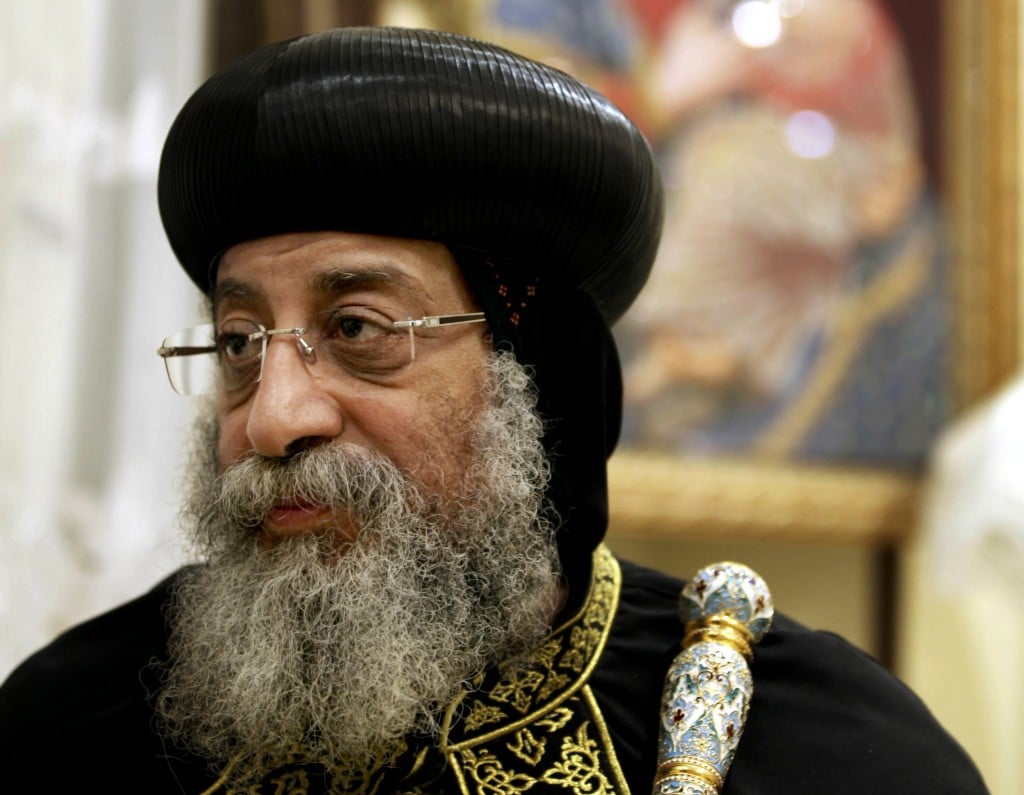
A rare public attack by Egypt’s Coptic Pope Tawadros II upon President Mohammed Morsi following sectarian clashes in Cairo features high on Arab news Wednesday.
“Pope Tawadros levels harsh criticism against President Morsi: He failed to protect the Coptic church from an unprecedented attack,” reads the headline of London-based daily Al-Quds Al-Arabi, which calls the pope’s statements “a historic first, unknown to the relations between church and state in Egypt.”
Commenting on clashes between Copts and Muslims across from the St. Marks Church in Cairo earlier this week, Tawadros told On TV channel on Tuesday that “[Morsi’s] neglect and incompetence in dealing with the crisis are very clear.” He added that expressing dismay with the events is not enough, and decisive action must be taken by the state.
“The Coptic pope: Egypt’s image is on the ground,” reads the headline in Saudi-owned daily A-Sharq Al-Awsat, quoting a portion of the telephone conversation between Tawadros and Morsi on Sunday. Morsi sent a delegation of three officials to St. Mark’s Cathedral in Cairo on Tuesday to discuss the violence with church officials.
But London-based daily Al-Hayat claims on Wednesday that the presidential effort at rapprochement with the church was unsuccessful, particularly following statements by Morsi’s public relations assistant, Issam Haddad, who blamed the Copts for the violence.
Al-Hayat columnist Abdullah Iskandar writes in an op-ed Wednesday that the Muslim Brotherhood is continuing in the tradition of the Mubarak regime of fanning the flames of sectarian strife, albeit in a different manner.
“The Brotherhood, along with leaders of the Islamic parties, has waged an unprecedented campaign of incitement against anyone who criticizes its position on the constitution, claiming it is the only protector of sharia. By doing so, they are establishing a great social schism through targeting the judicial and media establishments and social strata such as liberals and Copts,” writes Iskandar.
“In other words, the Brotherhood has switched its way of dealing with the elements of sectarian strife from the security realm — through which the previous regime acted — to the social realm … after having grounded the discrimination in the constitution.”
Amr Shobaki, in independent Egyptian daily Al-Masry Al-Youm, writes that the common denominator of sectarianism in the Mubarak and Morsi eras is discrimination against the Coptic minority.
“It is true that there are also extremist reactions on the Christian side, expressing a rhetoric of hate toward the Muslim partners in the state. However, the responsibility of the majority remains much greater, because they are the ones who claimed ‘Islam is the solution’ and promised reform, which time has proven was a big lie,” writes Shobaki in an op-ed titled “Sectarianism in the time of the Brotherhood.”
“Surely, there is a state of sectarian tension between Muslims and Christians and not fabricated anarchy as some Brotherhood leaders claimed, using the same language of the previous regime when it spoke of external conspiracies to justify its inability to address the sectarian crises as a result of its failed policies,” writes Shobaki.
‘Assad is no worse than his opposition’
As Lebanon’s new prime minister, Tammam Salam, meets with parliamentary groups in an attempt to construct a new government, Al-Hayat reports on a visit by Lebanon’s top Christian Maronite cleric to Paris, where he met with President Francois Hollande and Foreign Minister Laurent Fabius.
Cardinal Bechara Al-Ra’i told the French officials he was concerned about the mass migration of Orthodox Christians from Syria, indicating that the Islamist rebels were more to blame for their departure than Assad.
“President Assad is no worse than those fighting [him] in Syria,” Al-Ra’i reportedly told his hosts, calling for a “political solution” to the crisis, and adding that Assad is “ready for dialogue.”




The Times of Israel Community.