

Let my asylum seekers go
After the High Court overturns a law allowing illegal migrants to be jailed, some crow victory while others eat crow
 Add ToI as a Preferred Source on Google
Joshua Davidovich is The Times of Israel's Deputy Editor
Between a mass shooting in Washington, a mother killing her kids, the striking down of a law that put asylum-seekers in jail, and Iran saying it might agree to shut down a nuclear site, Israeli papers Tuesday are a mix of the horrible and the hope-inspiring.
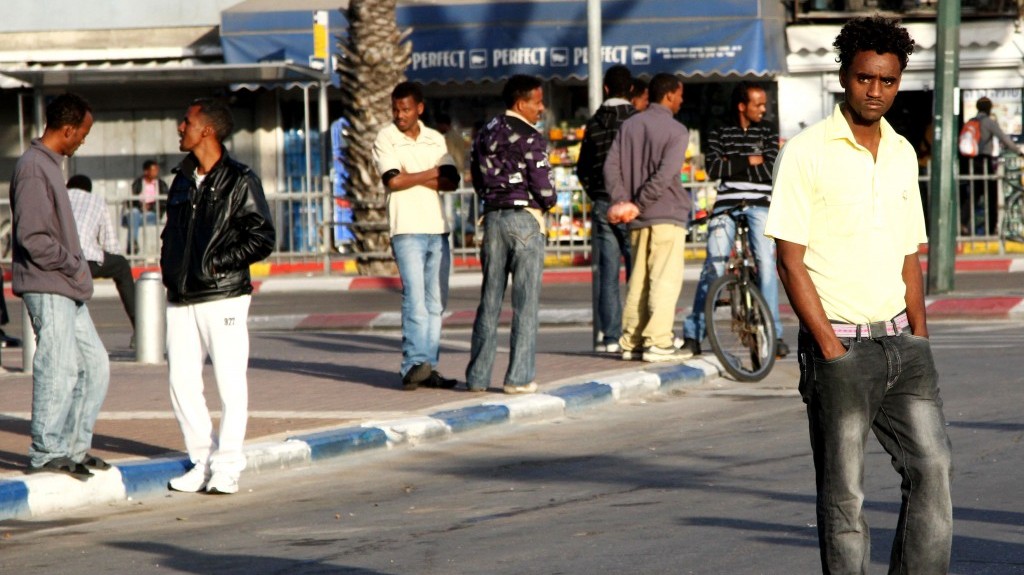
Haaretz goes for ugliest front page of the day, using as its lead “picture” a massive block quote about the unanimous High Court ruling that strikes down a law that saw the African asylum-seekers jailed upon entering Israel as unconstitutional. The paper devotes a large chunk of its inside real estate as well to the ruling, including an exploration of where lawmakers can go from here. The paper writes that the ruling cannot be appealed and “if the government wants to continue to avoid giving unauthorized migrants legal standing, it will need to come up with creative solutions. For now the main option seems to be new, less extreme legislation.”
The paper, which has long been opposed to the law, hails the ruling as a victory, with Aeyal Gross writing that the High Court has provided a dose of humanity to an oft-vilified population. “It must be hoped that the cabinet and the Knesset will seize this opportunity to develop a policy that takes Israel’s obligations toward asylum seekers seriously and upholds both their rights and the rights of residents of south Tel Aviv, rather than pitting these two disadvantaged populations against each other.”
Israel Hayom also leads off with the same story but takes the other side of the debate, running a quote from a resident of south Tel Aviv on its front page: “Our lives have turned to hell.”
Shlomo Maslawi, a resident of said neighborhood, writes a fiery commentary piece in the paper asking why the court didn’t care about the freedom and human rights of him and his neighbors. “In the last few years we’ve managed to come to a solution that will bring a bit of succor to the residents. Not out of hate, but just because of the fact that our lives have become worthless. We have no security, no quality of life, and it seems like nobody cares.”
Maariv leads off with the Der Spiegel report that Iranian President Hasan Rouhani would agree to give up the Fordo nuclear site in exchange for an easing of sanctions. The paper notes that US Senator Lindsey Graham is also looking to pass a measure that would give Obama permission to use force against Iran should diplomatic efforts in fact fail. “It’s too early to estimate what the chances a measure like this has of passing the Senate,” the paper notes. “And certainly not the House of Representatives, but Graham is considered one of the more influential lawmakers in Washington. If his measure gets off the ground, he will free Obama from the limiting precedent that he set in when he announced he would go to Congress for permission to strike Syria.”
Yedioth Ahronoth’s front page is all doom and gloom, with a dozen dead in Washington, DC, and two children killed in Jerusalem with their mother, who also tried to off herself, as the prime suspect. “I wasn’t able to save the kid,” the paper writes in massive blood red letters that don’t sensationalize the story at all, quoting the children’s aunt, who was in the house at the time. The paper pulls off snippets of the mother’s life off the Internet, calling it “Net testimony,” with the unspoken claim that they offer a window into her mind. “Her Facebook page has almost no photos of people. It’s filled with pictures of the walls of Jerusalem, zoo animals, landscapes and just two pictures of her kids. Aside from her sister and a Belgian friend, almost nobody comments on it.”
Prof. Zvi Melshni, a mental health expert, writes in a commentary that it may have been very hard to prevent the tragedy. “It’s not always possible to prevent a tragedy of this kind, when the signs of crisis are only seen after the fact. Killing your kids is an extraordinary kind of attack. But when it happens, it’s possible to find many cases where the responsible parent suffered from depression … We are speaking of parents who see their children as extensions of themselves, and if they don’t want to live, also the kids don’t want to go on living. When mothers kill their children, it usually stems from a hardship or lack of desire to care for the kids.”
In homage to the 20-year anniversary of the Oslo signings, Maariv puts together a package of opinions of four main players, Yossi Beilin, Ron Pundak, Ron Cohen and Yossi Sarid, whose views are more winding than the patchwork of West Bank zones they created. Beilin, for one, thinks the agreement is still bearing fruit, but not in a good way.
“Oslo is held by the right as an agreement that allows them to continue building settlements. The enemies of Oslo are those who support it the most today, and I say more than anything we need to stop with Oslo,” he says.
In Haaretz, Yehuda Ben Meir writes that despite promises from the Americans to the contrary, the Syrian turn toward diplomacy is applicable to Iran as it shows US-Russian efforts can work to avert conflict.
“The agreement between the United States and Russia … is likely – if it is actually implemented – to constitute a very important development, a genuine turning point in global politics,” he writes. “This is an achievement for both America and Russia, and indirectly for Israel as well. The significance of the last few days, as our prime minister noted, is that creative diplomacy, backed by a threat of military action, can accomplish great things.”








The Times of Israel Community.