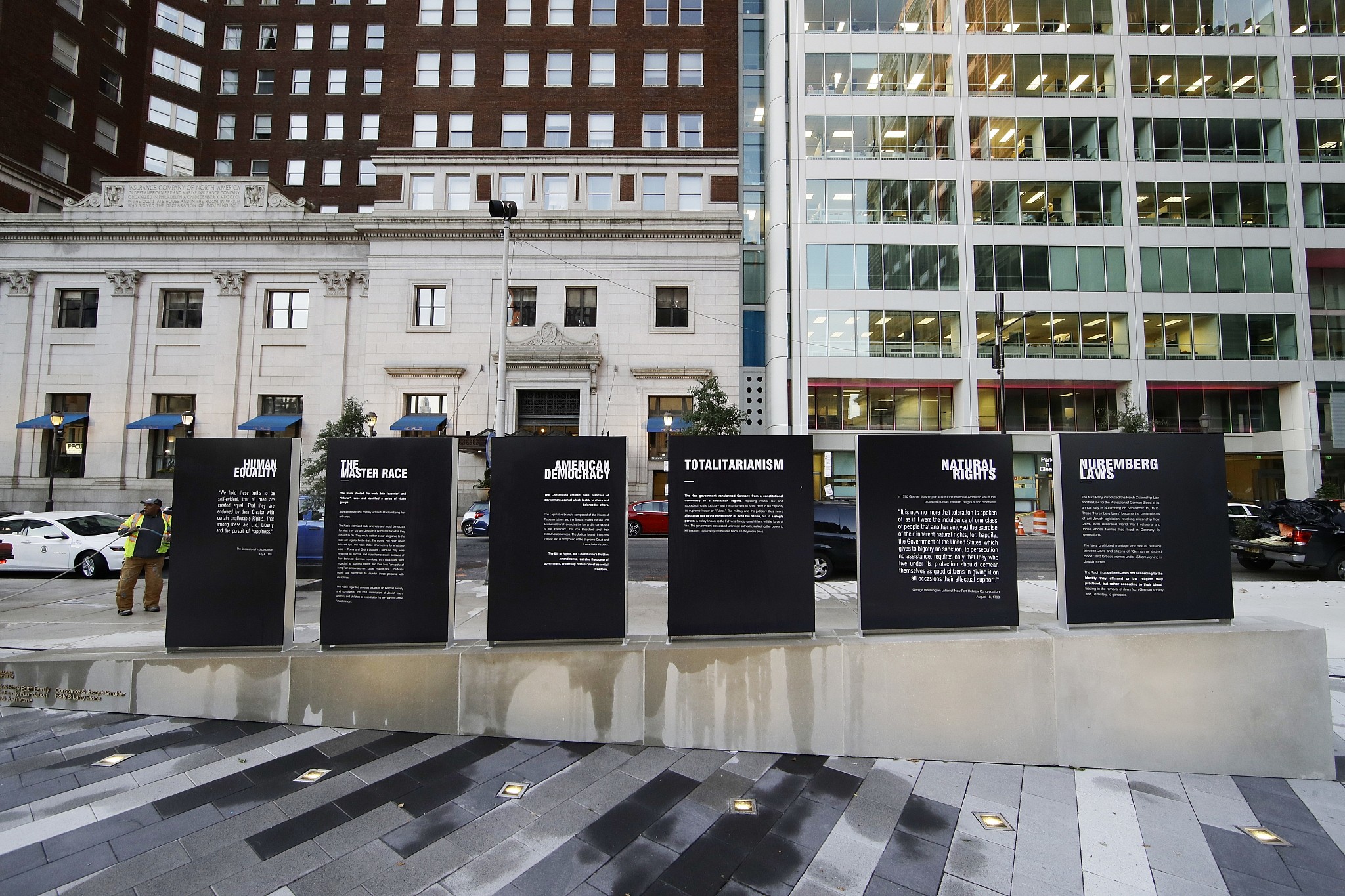
This photo shows the redesigned Holocaust Memorial Plaza in Philadelphia, Monday, Oct. 22, 2018. The memorial that originally opened in 1964 has been expanded and enhanced to focus on both remembrance and education. (AP Photo/Matt Rourke)
An expansion of Philadelphia’s Holocaust Memorial Plaza, the first public memorial to the genocide in the United States, was dedicated.
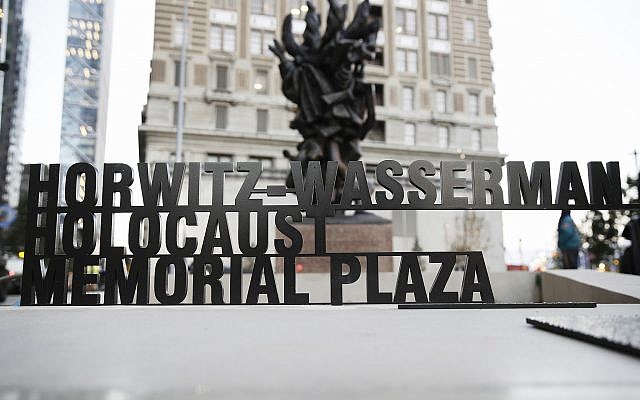
The Horwitz-Wasserman Holocaust Memorial Plaza adds to the public plaza surrounding the Monument to Six Million Jewish Martyrs dedicated in 1964.
The plaza features six pillars erected in memory of the 6 million Jewish victims of the Holocaust, with each pillar chronicling a Holocaust atrocity and contrasting it with American constitutional protections and values.
Original train tracks from the railroad adjacent to the Treblinka death camp are embedded in the pavement near the “Theresienstadt tree,” a sapling of the tree nurtured by children in the Czech camp though they knew they would not live long enough to see it grow and mature.
A sign is displayed at the redesigned Holocaust Memorial Plaza in Philadelphia, Monday, Oct. 22, 2018. The memorial that originally opened in 1964 has been expanded and enhanced to focus on both remembrance and education. (AP Photo/Matt Rourke)
At the far western portion of the plaza, a tree grove represents the woodlands that sheltered members of the resistance movement.
Get The Times of Israel's Daily Editionby email and never miss our top stories
In partnership with the University of Southern California Shoah Foundation, the plaza features educational, multimedia content via IWalk, a USC Shoah Foundation-developed mobile app that connects specific locations at the plaza with personal testimonials of Holocaust survivors and other witnesses. The app also includes access to eyewitness accounts of the Holocaust from more than 50,000 survivors. It is available in English and Spanish, and provides users with an age-appropriate, customized experience.
“This unique memorial in Philadelphia is a stark reminder to never forget,” Pennsylvania Attorney General Josh Shapiro said Monday at the dedication ceremony. “It will serve as an important place of remembrance and reflection.”
Advertisement
Help us report truthfully on social media
As a multimedia journalist, my job is to take the quality, fact-based journalism produced by The Times of Israel newsroom and make it accessible across every platform — from Instagram posts to podcasts to short-form videos.
This is how many, especially young people, consume news these days. But misinformation is rampant on social media. Our team at ToI produces accurate, responsible short-form reporting on Israel and the Jewish world.
If you believe in the importance of factual social media journalism, please consider joining our reader support group, The Times of Israel Community. Your financial support is essential to sustain responsible multimedia reporting.
We’re really pleased that you’ve read X Times of Israel articles in the past month.
That’s why we started the Times of Israel - to provide discerning readers like you with must-read coverage of Israel and the Jewish world.
So now we have a request. Unlike other news outlets, we haven’t put up a paywall. But as the journalism we do is costly, we invite readers for whom The Times of Israel has become important to help support our work by joining The Times of Israel Community.
For as little as $6 a month you can help support our quality journalism while enjoying The Times of Israel AD-FREE, as well as accessing exclusive content available only to Times of Israel Community members.
Thank you, David Horovitz, Founding Editor of The Times of Israel


 Add ToI as a Preferred Source on Google