

High Court convenes to hear petitions demanding Oct. 7 state inquiry, without audience
Bereaved families clash outside court; session broadcast live but public not allowed to attend, to avoid disruptions
 Add ToI as a Preferred Source on Google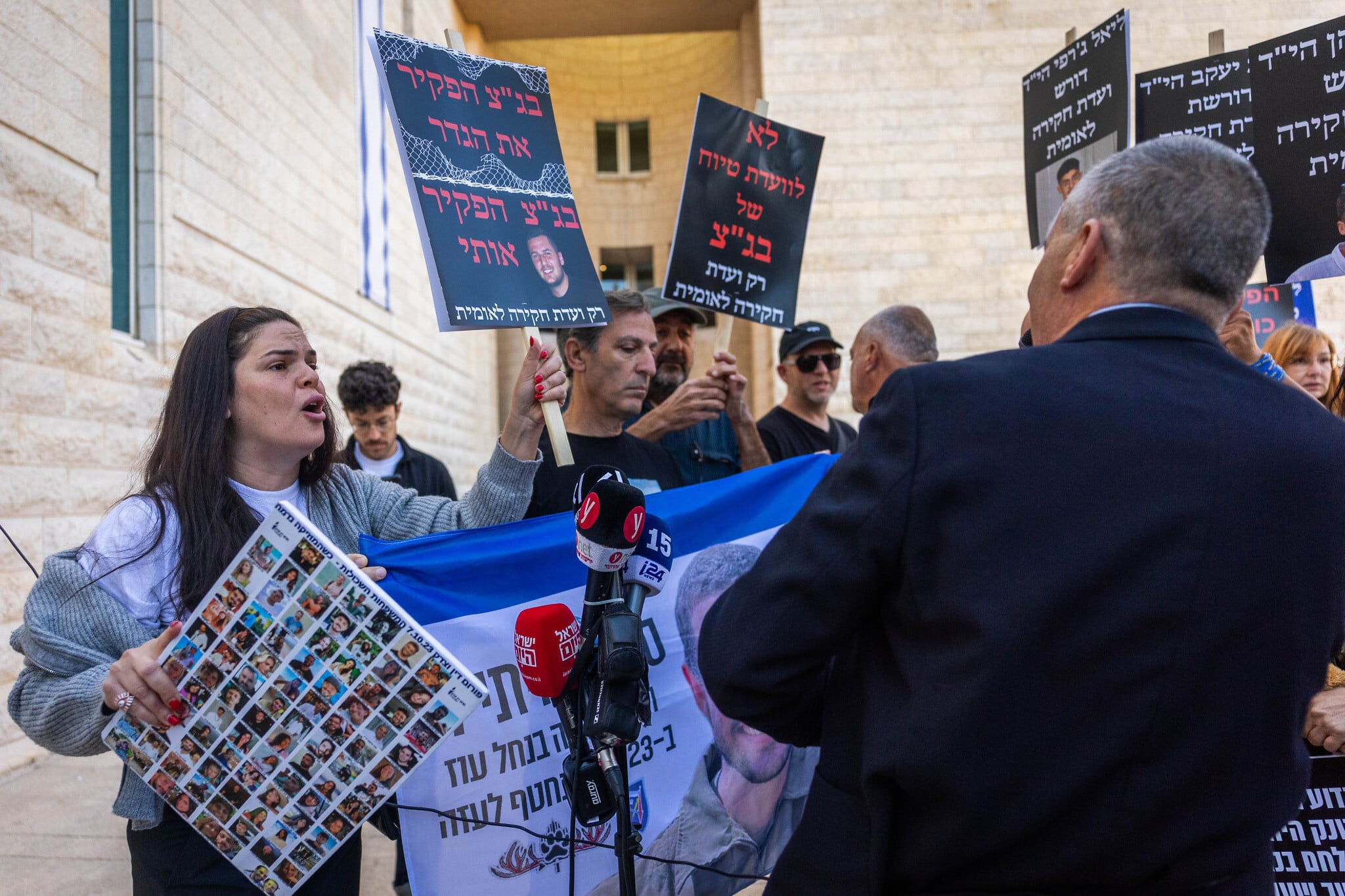
The High Court of Justice convened in Jerusalem on Thursday to discuss petitions demanding the establishment of a state commission of inquiry into the failures surrounding the October 7, 2023, Hamas-led attack on Israel.
Bereaved families engaged in mutual recriminations outside the court shortly before the hearing began, with some demanding a probe they say is the only way to honor their loved ones and thoroughly investigate the disaster, and others claiming a state commission would be inherently biased and arguing the court had no jurisdiction to order one.
To avoid disruptions during deliberations on the explosive issue, the court did not allow public attendance at the hearing. In a statement issued Wednesday, the court said the hearing “could be met with disruptions, riots or interruptions at a level that is expected to make proper administration substantively more difficult.”
The proceedings were instead broadcast live.
Similarly high-profile cases in recent years have been disrupted by hecklers, including lawmakers, forcing pauses in the proceedings and prompting condemnations from the bench. The case in question, in which various organizations and watchdog groups are accusing the government of shirking its duty, would be among the most sensitive.
Prime Minister Benjamin Netanyahu and his government have resisted pressure to establish a state commission of inquiry for more than two years since the Hamas onslaught, in which some 1,200 people were killed and 251 taken hostage, triggering the war in Gaza and other fronts. It was the deadliest terror attack in Israel’s history, and is widely seen as the worst disaster the Jewish state has suffered since its establishment.
The petitioners have said that a state commission is the only tool available to investigate the catastrophe in a politically independent and comprehensive manner. Opponents of the government point out that a state commission is the only completely independent form of inquiry that has true investigative powers and is not connected to the political leadership, and reject the government’s efforts to establish an inquiry whose members are appointed by politicians.
Netanyahu has argued that because a state commission is appointed by the judiciary — whose powers his coalition has sought to curb — the probe would be biased against the government. However, the government did not make this argument in its formal response to the petitions submitted to the court.
Instead of forming a state commission, the government late last year backed a bill that would create what it called a “national-state commission of inquiry,” whose members the coalition and opposition would handpick.
The opposition has boycotted the committee process for that legislation, and has vowed to boycott any process for creating such an inquiry should that bill pass. As of Thursday, the bill remained in committee.
In November, the High Court issued a conditional order requiring the government to justify why it is not establishing a state commission of inquiry.
In its response, the government – which is being represented privately by the lawyer Michael Rabello – argued that the authority to establish a state commission resides with the government alone, and pointed to previous High Court decisions which ruled in accordance with that opinion.
The government is being privately represented because Attorney General Gali Baharav-Miara, who would ordinarily argue on its behalf, has herself taken the position that the government must establish a state commission into the events of October 7.
Outside the court, families supportive of the government shouted at those demanding a state commission, claiming they were trying to “whitewash” the October 7 attack, and accusing them of “having opened the gates to the massacre,” Channel 12 reported.
“You are the ones who tied the hands of our soldiers and freed the hands of the enemy,” one of the pro-government protesters said, reflecting right-wing claims that the courts had in the past restrained the IDF, which they allege enabled the Hamas invasion.
תיעוד: עימות בין מפגינים, בהם הורים שכולים, מחוץ לביהמ"ש העליון – לקראת הדיון בבג"ץ בעתירות הדורשות הקמת ועדת חקירה@almog_tamar pic.twitter.com/M6NDpaD1CL
— כאן חדשות (@kann_news) April 23, 2026
Eyal Eshel, the father Roni Eshel, a surveillance soldier who was killed on October 7 on the Nahal Oz base, said he “came to support the justices of the Supreme Court.”
“This is your job, this is why you are sitting here in Jerusalem. After long months, there is no more room for tears, no more room for cover-ups. The time has come for a historic verdict. The prime minister has chosen again and again the path of division, the prime minister has chosen internal war, and that’s what it looks like here this morning.”






The Times of Israel Community.