

Virus czar may mull High Holiday restrictions, wants high schoolers to stay home
Ronni Gamzu says he may look to prevent family gatherings, though too early to tell; claims he is losing sleep over possible ramifications of return to school
 Add ToI as a Preferred Source on Google
Nathan Jeffay is The Times of Israel's health and science correspondent
Israel’s coronavirus czar said Tuesday he may recommend that the government adopt tighter restrictions over the High Holidays, while also urging high schools to restrict attendance to once a week, if at all, saying that he is losing sleep over the possibility of a spike in cases after studies restart.
Ronni Gamzu, the government’s coronavirus point-man, said the upcoming Jewish holiday season, which begins with Rosh Hashanah in exactly one month, may come with measures aimed at preventing traditional family gatherings that could worsen the spread of the disease.
“We all thoroughly understand the difficulty associated with going out, movement and family meals,” Gamzu said during a press briefing. “At the moment it’s too early to talk about the specifics of the restrictions, but I may recommend more significant restrictions on gathering and movement.”
But, he said, “this has really not been decided yet and it depends what happens until then,” adding that it was premature to decide on any moves and that he is fighting to prevent another lockdown.
The comments marked a shift for Gamzu, who has opposed restrictive measures and moved to roll back measures that cause economic harm while seeking other methods to deal with the coronavirus, despite Israel’s morbidity rate refusing to budge from around 1,800 infections a day.
Gamzu said that he is still attempting to fight another lockdown, but that the move is not off the table.
“I’m pushing myself and pushing the entire system to combat coronavirus without lockdown. I’m not sure I’ll succeed,” he said.
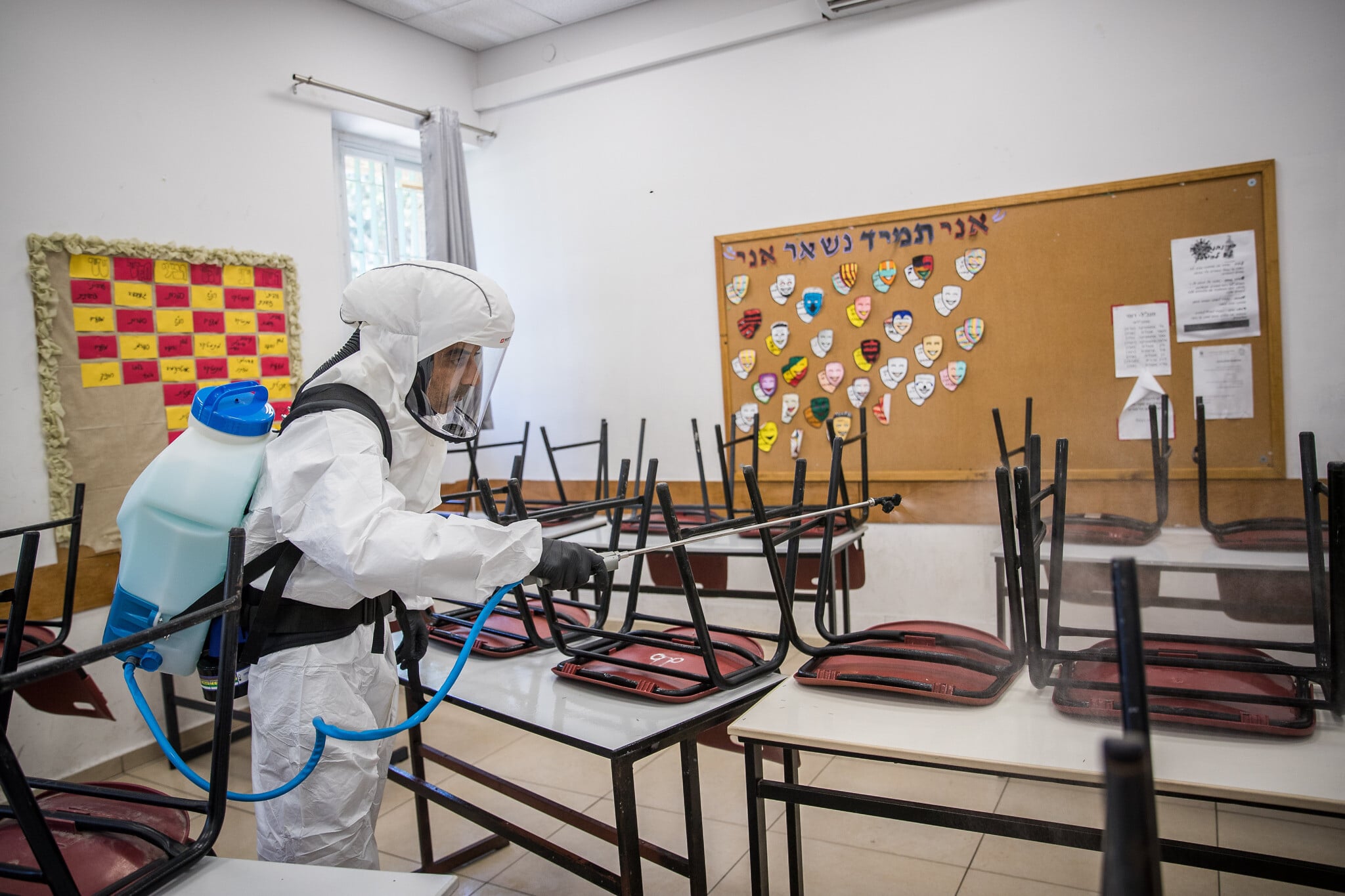
Gamzu noted that the planned opening of schools on September 1 marked a major challenge, and said he would be raising his concerns about the start of the school year with the coronavirus cabinet on Thursday.
“There is a risk here and I’m trying to bring it up with the government, and I know they will weigh the risk and the benefits,” he told journalists.
The intensity of Israel’s second wave has widely been blamed on the rapid return of students to school after lockdown. Gamzu said that with a return to studies now looming just as Israel is reining in the second wave, the country is in a “very delicate situation,” and the question of potential consequences “takes hours of my sleep.”
Israel currently has 23,399 active cases of the coronavirus, down from more than 36,000 in late July. There are now 827 people in hospitals, 410 of them in serious condition and 113 ventilated. The death count stands at 698.

Gamzu said that children over the age of 12 are proving as susceptible to coronavirus as adults. “It’s a real challenge,” he said, referring to the return to school, which is scheduled for September 1.
“I believe we should separate the lower and the higher classes. The higher classes, over around 12 [years old], have the same infection rate as the grown ups, so we have to look differently at these two layers,” he said.
“The first layer can come to schools in capsules, or in a way that allows the maximum number per class,” Gamzu said. “The other layer should be looked at in a different way, ranging between staying at home entirely and doing remote studies, and coming [to school] around one day a week in order to have a framework.”
Striking an optimistic note, Gamzu said that Israel’s low death rate in relation to the total number of cases is impressive, and suggested that it is the lowest in the world.
“People were talking about the magical way Germany treated its patients; Israel is doing better,” he said.
Calculations by John Hopkins University indicate that Israel is faring well in terms of case fatality, with just 0.7% of people diagnosed so far dying, but found that it ranks number 17 internationally, not number 1. Germany’s rate is 4.1%.
Israel is slowly moving to restart flights, and Gamzu said he wants to see coronavirus testing at Ben-Gurion International Airport within a month.
“I will assist [airport authorities] in any possible way because I believe this is the way to go for incoming and outgoing [travel],” Gamzu commented.
Approaching a month as coronavirus czar, Gamzu, a former Health Ministry chief who is CEO of Tel Aviv’s Sourasky Medical Center, said that he is working hard to develop the infrastructure for improved tracing to establish who infected people have been in contact with. “To build the infrastructure will take me another three weeks,” he said.
He stated that alongside boosting contact tracing capabilities, his main priorities include improving the public’s trust in the government’s fight against the pandemic and empowering local authorities to play a bigger part in combating the virus.









The Times of Israel Community.