

Live updates (closed)
 Add ToI as a Preferred Source on Google


The Times of Israel liveblogged Friday’s events as they happened.
Sa’ar to meet Rubio next week on first trip to DC as foreign minister — official

US Secretary of State Marco Rubio meets Foreign Minister Gideon Sa'ar in Jerusalem on February 16, 2025 (Rafi Ben Hakun/GPO)
Gideon Sa’ar will make his first trip to Washington next week since being appointed foreign minister in November of last year, an Israeli official confirms to The Times of Israel.
Sa’ar will meet with US Secretary of State Marco Rubio on Wednesday, the official says.
PM’s office says Israel will dispatch negotiating team when location for talks is set

Israelis hold a protest march in Tel Aviv calling for an end to the war in Gaza and a safe return of the Israeli hostages held by Hamas, on August 21, 2025. (Avshalom Sassoni/Flash90)
Prime Minister Benjamin Netanyahu’s office issues a statement attributed to a senior Israeli official who says that once a location for negotiations is determined, the premier will order the dispatch of an Israeli delegation to hold talks aimed at securing the release of all remaining hostages and at ending the war on Israel’s terms.
It’s not clear whether Netanyahu’s statement was coordinated with any of the Arab mediators who are currently waiting for Israel to respond to their phased hostage release proposal that Hamas accepted on Monday.
The mediators are hoping that Israel will accept the proposal to allow for the immediate commencement of negotiations in either Doha or Cairo in order to finalize the terms, such as the identities of the Palestinian security prisoners who will be released.
Netanyahu appears to instead be talking about a deal that will see the release of all 50 remaining hostages at once.
This is something that Hamas has long offered in exchange for an end to the war and an Israeli withdrawal from Gaza.
But Netanyahu has argued that this exchange would leave Hamas in power with the ability to revive itself.
Instead, the cabinet approved earlier this month a series of terms for ending the war that effectively amount to Hamas’s complete surrender.
The conditions are the release of all remaining hostages at once, the disarmament of Hamas, the demilitarization of the Gaza Strip, overall Israeli security control of the Gaza Strip and the transfer of governance to a body that is not Hamas or the Palestinian Authority.
Hamas has already rejected calls to give up its weapons, and the IDF has estimated that the full dismantlement of Hamas’s terror infrastructure in Gaza will take years to complete, leading critics to accuse Netanyahu of seeking to prolong the war to stay in power.
US legislative committee says it’s investigating antisemitism in leading teacher union
The US House Committee on Education and the Workforce is investigating antisemitism in the National Education Association, a leading teacher union, representing more than three million public school educators and administrators.
The committee has put heavy pressure on universities for alleged antisemitism since the start of the war in Gaza.
In a letter to the president of the union, US Rep. Tim Walberg, a Michigan Republican, cites the union’s vote to ban materials by the Anti-Defamation League and alleged antisemitism in the union’s 2025 handbook.
In one example, the union’s handbook says the group will mark International Holocaust Remembrance Day by “recognizing more than 12 million victims of the Holocaust,” without mentioning Jews.
The handbook also says the union plans to educate members about the Nakba, without providing context about the creation of the State of Israel, the letter says.
The committee demands that the union provide all documents and communications from its leadership relating to antisemitism, Israel, and the Palestinians since the start of the Gaza war; meeting minutes that refer to the conflict; documents related to the ADL vote; and other materials related to the conflict and antisemitism.
The committee gives the union a deadline of September 4 to respond.
Israeli envoy to UK hits back at criticism of new settlement plans: ‘Wouldn’t tell the British where to build in London’

Israeli Ambassador to the UK Tzipi Hotovely arrives to attend a Service of Thanksgiving at Westminster Abbey on V-E Day in London, May 8, 2025. (AP/Kirsty Wigglesworth)
Israel’s envoy to the United Kingdom hits back at British Foreign Secretary David Lammy over his criticism of a controversial new Israeli settlement plans.
“I wouldn’t tell the British where to build in London,” Ambassador Tzipi Hotovely tells the Daily Mail.
“We see E1 as part of greater Jerusalem,” she adds, referring to the construction project.
Oscar-winning Spanish actor assails Israeli ‘NAZIS’ over years-old video of cheering IDF snipers
Renowned Spanish actor Javier Bardem accuses the Israeli military of being “Nazis” in a post on social media, accompanied by a years-old video of an IDF sharpshooter shooting a Palestinian on the Gaza border as his fellow soldiers cheer.
The video drew international attention and outrage when it first circulated in 2018.
Bardem, in his post, does not acknowledge that the footage is at least seven years old, and it is unclear if he is aware of that.
“The IDF are NAZIS,” he writes on Instagram in both English and Spanish. “Do you remember Amon Göth in Schindler’s List? A sadistic SS officer who shot prisoners from his balcony purely for entertainment. He embodied the banality of evil and the impunity of cruelty within an oppressive military apparatus.”
“Today, that same logic of terror and dehumanization is what the IDF applies against the Palestinian people,” the Oscar-winning actor writes.
In the footage — apparently filmed through a scope or binoculars — soldiers can be heard discussing the shot, as the sniper trains his rifle on the suspect, who was several meters from the Gaza border security fence.
The suspect does not appear to be armed.
As the sharpshooter fires, one of the onlooking soldiers erupts into cheers.
“Whoa! What a video! YES! Son of a bitch. What a video! Look they’re running to evacuate him,” the photographer enthuses.
As a group of Palestinians can be seen carrying the injured man away, the photographer adds, “What a legendary video.”
Judah Ari Gross contributed to this report.
Resort manager arrested in southern France on charges of religious discrimination after denying entry to Israeli youth
The manager of a leisure resort in the south of France has been arrested after refusing to allow entry to a group of Israeli youth due to his “personal beliefs,” French media reports.
French newspaper Ouest-France reports that the tour group of some 150 Israeli youth, ages 8 to 16, had made a reservation at the leisure resort well in advance, without incident.
But when they arrived at the center, located in Porté-Puymorens, in the southern Pyrénées-Orientales region, the 52-year-old manager turned them away, citing his “personal beliefs” as his reason for doing so.
The incident was reported to the police, who, according to the prosecutor’s office, detained him on suspicion of “discrimination on the basis of religion in the context of the offer or provision of goods or services.”
According to Ouest-France, the maximum sentence for this charge, if found guilty, is three years’ imprisonment.
Report: US trying to arrange meeting between Israeli, Syrian leaders during UN General Assembly next month
Report: The United States is working to arrange a meeting between the Syrian leader and Netanyahu next month.
The United States is working to organize a meeting between Syrian leader Ahmed al-Sharaa and Prime Minister Benjamin Netanyahu, and with the participation of US President Donald Trump, during the UN General Assembly in New York next month, Sky News Arabia reports.
The report adds that Syria’s recent appointment of a new representative to the United Nations may indicate that the meeting will take place on the sidelines of the General Assembly.
Iranian FM to discuss nuclear talks, sanctions with European counterparts later today
Iran’s Foreign Minister Abbas Araqchi will have a joint phone call with French, British and German counterparts later today to discuss nuclear talks and sanctions, state news agency IRNA reports.
The three European powers have threatened to activate United Nations sanctions on Iran under a “snapback” mechanism if Iran does not return to the negotiation table.
‘The gates of hell will soon open’: Katz says government approved IDF plans for Gaza City takeover

Defense Minister Israel Katz visits an IDF post in the Gaza Strip buffer zone, August 5, 2025. (Ariel Hermoni/Defense Ministry)
Defense Minister Israel Katz says the government has approved the IDF’s plans to “defeat Hamas in Gaza,” as the military prepares to push into Gaza City in a new offensive.
“The gates of hell will soon open over Hamas murderers and rapists in Gaza — until they agree to Israel’s conditions for ending the war, primarily the release of all hostages and their disarmament.”
He says that if Hamas doesn’t capitulate, Gaza City “will become Rafah and Beit Hanoun” — two cities that have been largely turned to rubble by Israeli bombardment.
Israel says 220 trucks of aid entered Gaza yesterday, another 370 collected by UN for delivery
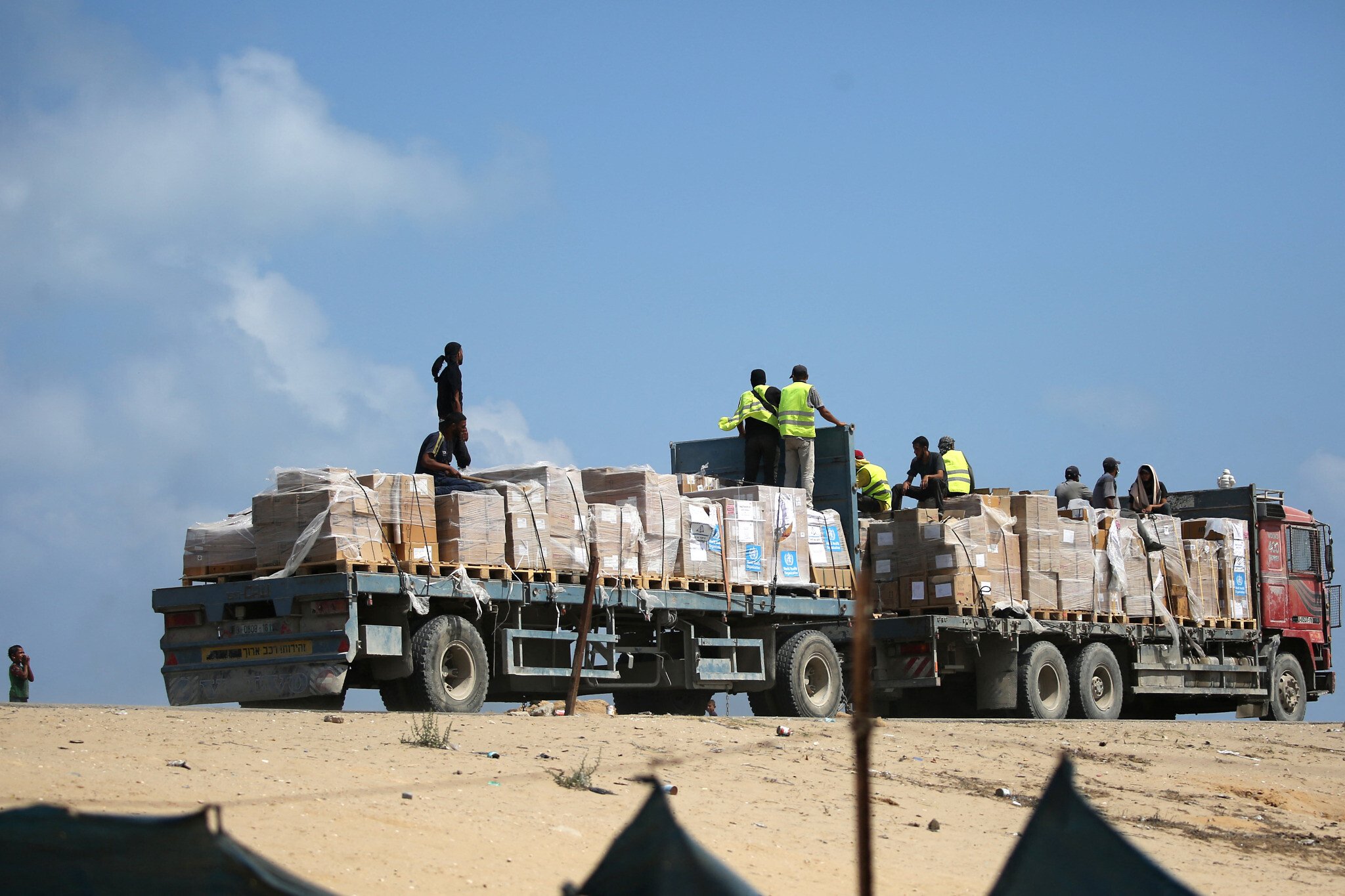
A truck transporting humanitarian aid drives down a road in Deir al-Balah in the central Gaza Strip on August 21, 2025. (Eyad Baba/AFP)
Over 220 trucks carrying humanitarian aid entered the Gaza Strip yesterday through the Kerem Shalom and Zikim crossings, Israel’s Coordinator of Government Activities (COGAT) says.
According to COGAT, over 370 trucks carrying aid were also collected by the United Nations and other international organizations from the Gaza side of the crossings yesterday to be distributed.
“The contents of hundreds of trucks are still awaiting collection on the Gazan side of the crossings,” COGAT says.
Another 155 pallets of aid — about four trucks’ worth — were airdropped by Jordan, the United Arab Emirates, Germany, the Netherlands, France, Singapore, and Indonesia in Gaza yesterday, according to the IDF. Each pallet has several hundred kilograms of food.
Similar amounts of aid deliveries have been reported daily for approximately the past few weeks.
The UN has said 600 trucks of aid need to be distributed each day in order to properly feed the Strip’s roughly two million people amid the war.
COGAT also says that “tankers of UN fuel entered for the operation of essential humanitarian systems” yesterday, and that it coordinated the entry and exit of humanitarian aid workers rotating in and out of Gaza.
Mayor of Barcelona barred from entering Israel, hours ahead of planned visit

Now-mayor of Barcelona, Jaume Collboni speaks at the headquarters of the Socialist Party of Catalonia (PSC) in Barcelona on May 28, 2023 after the local and regional elections held in Spain. (Lluis Gene/AFP)
The mayor of Barcelona, Jaume Collboni, has been denied entry into Israel over anti-Israel comments he has made in the past, according to Hebrew media reports.
Collboni had been scheduled to arrive in Israel tonight, Ynet reports, but was informed at the last minute that the Population and Immigration Authority had decided to bar him from entering.
Collboni’s visit to the country, had it not been canceled, would have included a stop at Yad Vashem and meetings with the Palestinian Authority, Channel 12 says.
The decision to bar his entry comes some three months after Barcelona’s city council voted to cut institutional ties with the Israeli government and suspend its friendship agreement with Tel Aviv over the war in Gaza.
Jerusalem man indicted after asking rabbi for permission to kill the attorney general
Police prosecutors filed charges this morning against a man accused of making threats against the life of Attorney General Gali Baharav-Miara, law enforcement announces.
The defendant, a 36-year-old resident of Jerusalem, was arrested on Wednesday evening after he allegedly sent a letter to the former Chief Rabbi Yitzhak Yosef seeking his permission to kill the attorney general.
He is indicted on the charge of making threats against the legal official, law enforcement officials announce.
The defendant was formerly scheduled to go free this morning on a judge’s order, after police in court struggled to refute arguments made by the suspect’s lawyer. But police say they brought him again to court after “sufficient evidence was gathered against him” and managed to extend his detention another two days.
The defendant is set to remain in police custody until Sunday, August 24.
He is suspected of asking Yosef to issue a ‘din rodef’ against Baharav-Miara — a religious decree applied to grave offenders thought to be an imminent and lethal danger to others. In Jewish law, one is permitted to stop a rodef by any means, even if this requires killing them. The term has no standing in Israeli law.
Global hunger monitor declares famine in Gaza for first time; Israel dismisses ‘biased’ report
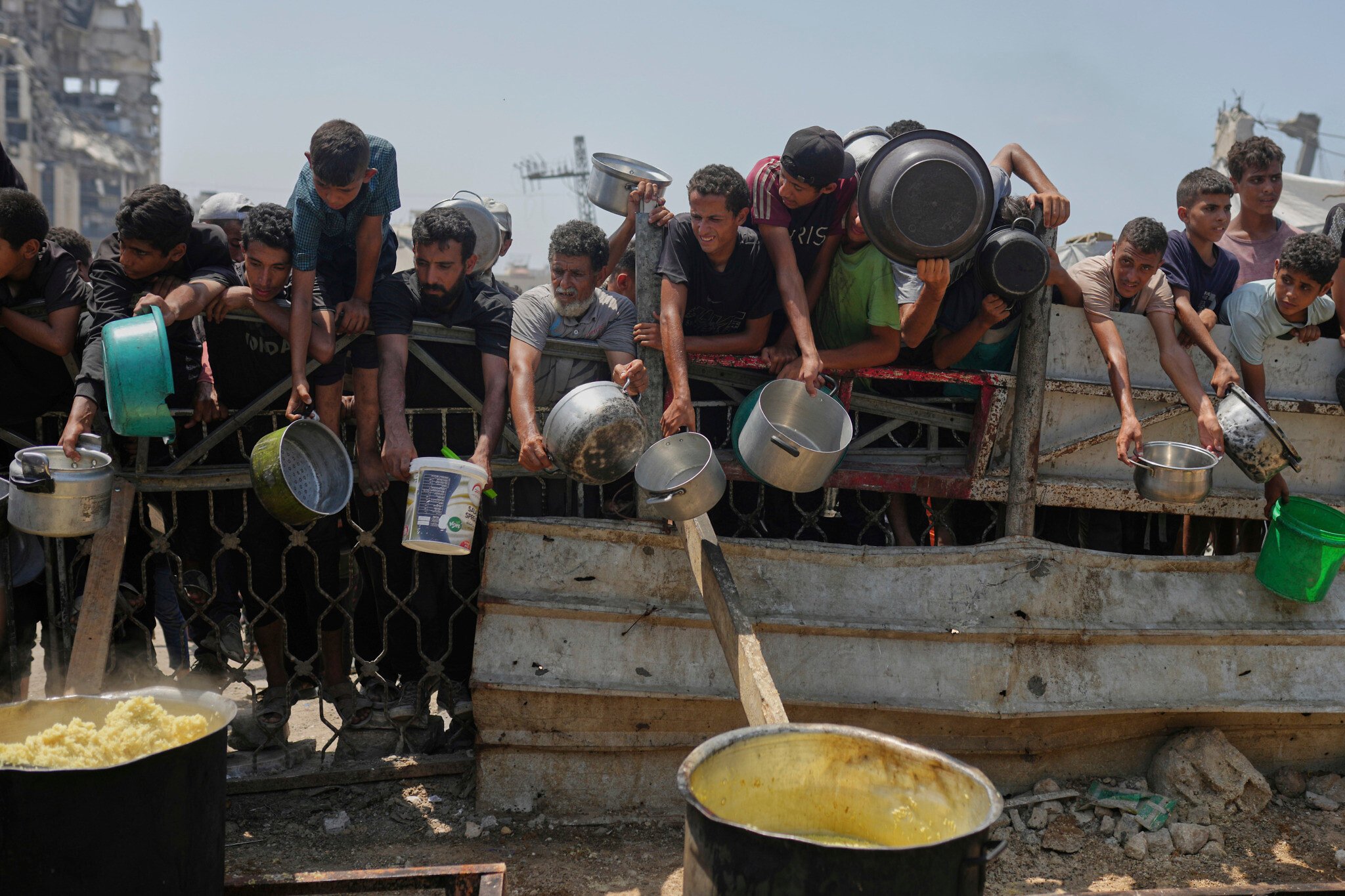
Palestinians struggle to get donated food at a community kitchen in Gaza City, northern Gaza Strip, August 16, 2025. (AP Photo/Jehad Alshrafi)
A global hunger monitor declares for the first time that famine has struck the densely populated northern Gaza Strip, some 22 months after the outbreak of war in the enclave following the deadly Hamas invasion of Israel on October 7, 2023.
The charge is swiftly denied by Israel, with the Coordinator for Government Activities in the Territories accusing the Integrated Food Security Phase Classification system (IPC) of basing its report on “biased and self-interested sources originating from Hamas.”
According to the IPC report, an estimated 514,000 — or nearly a quarter of Gaza’s population — are experiencing famine, and that number is expected to rise to 641,000 by the end of September.
Some 280,000 of those people are in a northern region covering Gaza City — known as Gaza governorate — which the IPC says is in famine, its first such determination in the enclave. The rest are in Deir al-Balah and Khan Younis, central and southern areas that the IPC projects will be in famine by the end of next month.
The IPC says hunger has been driven by fighting and the blockade of aid, and magnified by widespread displacement and the collapse of food production in Gaza, pushing hunger to life-threatening levels across the entire territory after 22 months of war.
More than half a million people in Gaza, about a quarter of the population, face catastrophic levels of hunger, and many are at risk of dying from malnutrition-related causes, the IPC report says.
Last month, the IPC said the “worst-case scenario of famine” was unfolding in Gaza, but stopped short of an official determination.
For a region to be classified as in a famine, at least 20 percent of people must be suffering extreme food shortages, with one in three children acutely malnourished and two people out of every 10,000 dying daily from starvation or malnutrition and disease.
Even if a region has not yet been classified as in famine because those thresholds have not been met, the IPC can determine that households there are suffering famine conditions, which it describes as starvation, destitution and death.
COGAT, which coordinates humanitarian affairs in the Gaza Strip, issues a simultaneous counter-report refuting the contents of the IPC report.
“Instead of providing a professional, neutral, and responsible assessment, the report adopts a biased approach riddled with severe methodological flaws, thereby undermining its credibility and the trust the international community can place in it,” fumes COGAT chief Maj. Gen. Ghassan Alian.

“We expect the international community to act responsibly and not be swept away by false narratives and unfounded propaganda, but rather to examine the complete data and the facts on the ground.”
The defense ministry body charges that IPC’s data-collection methods are unreliable and partially based on assessments made by UNRWA workers in the Gaza Strip — “some of whose employees are Hamas operatives.”
The COGAT report focuses primarily on aid that has entered the Gaza Strip since May 2025, and mentions only in passing the “temporary closure” of crossings in March 2025 that led to the complete cessation of aid deliveries for 11 weeks.
It says that since May, “over 10,000 trucks of aid have entered the Gaza Strip,” while the US- and Israel-backed Gaza Humanitarian Foundation has “distributed more than 2.2 million relief packages to civilians in need.”
It blames the UN and other aid organizations for failing to deliver aid across the Strip in a timely manner.
The COGAT report points to recent steps that Israel has taken to ease restrictions on delivering aid following widespread international pressure last month, including the daily “humanitarian pauses” to allow aid to be delivered, and allowing countries to airdrop supplies into the Strip.
While aid groups say that these steps have improved the situation somewhat, it is not enough to make up for the lost weeks when the border crossings were closed.
For the past few weeks, between 200-300 trucks of aid have entered the Gaza Strip daily, but the amount is far short of the 600 trucks of aid that the UN has said must be distributed each day in order to properly feed the enclave’s population.
Foreign Ministry accuses IPC of basing ‘despicable’ Gaza famine assessment on ‘Hamas lies’
Israel’s Foreign Ministry accuses the IPC of releasing a “fabricated report to fit Hamas’s fake campaign,” after global hunger monitor declared famine in large parts of the Gaza Strip.
The Foreign Ministry claims that the monitor “twisted its own rules and ignored its own criteria just to produce false accusations against Israel: the IPC changed its own global standard, cutting the 30% threshold to 15% for this report only, and totally ignoring its second criterion of death rate.”
The IPC report states that data analyzed between July 1 and Aug. 15 showed clear evidence that thresholds for starvation and acute malnutrition have been reached. Gathering data for mortality has been harder, the monitor acknowledged, but said it was reasonable to conclude from the evidence that the necessary threshold has likely been reached.
The foreign ministry asserts that the IPC report in its entirety “is based on Hamas lies laundered through organizations with vested interests.”
The report “will be thrown into the despicable trash bin of political documents,” it finishes.
The IPC has just published a “tailor-made” fabricated report to fit Hamas’s fake campaign.
Unbelievably, the IPC twisted its own rules and ignored its own criteria just to produce false accusations against Israel: the IPC changed its own global standard, cutting the 30% threshold…— Israel Foreign Ministry (@IsraelMFA) August 22, 2025
Starving Gaza ‘is a war crime,’ says UN rights chief
UN rights chief Volker Turk says “it is a war crime to use starvation as a method of warfare,” minutes after famine was declared in the Gaza Strip by an international hunger monitor.
Turk says the resulting deaths “may also amount to the war crime of willful killing,” while UN Secretary-General Antonio Guterres said “we cannot allow this situation to continue with impunity.”
Guterres also calls for “an immediate ceasefire, the immediate release of all hostages, and full, unfettered humanitarian access.”
Israel rejects the accusations of having created a famine in the Gaza Strip.
Times of Israel staff contributed to this report.
Germany says recognition of Palestinian state ‘counterproductive’ at this stage
A German government spokesman says that Berlin has no current plans to recognize a Palestinian state because that would undermine any efforts to reach a negotiated two-state solution with Israel.
“A negotiated two-state solution remains our goal, even if it seems a long way off today. … The recognition of Palestine is more likely to come at the end of such a process and such decisions would now be rather counterproductive,” the spokesperson says during a press conference.
Countries including Australia, United Kingdom, France and Canada have recently said they will recognize a Palestinian state under varying conditions.
IDF says troops hit primed rocket launcher in central Gaza amid operations across the Strip

IDF troops operate in the Gaza Strip, in images published on August 22, 2025. (Israel Defense Forces)
The Israeli Air Force hit a primed Hamas rocket launcher in central Gaza’s Deir al-Balah yesterday, the military says.
Additionally, the military says an IAF drone hit a mortar-launching site used by Hamas in Wednesday’s assault on an army encampment in Khan Younis.
The strikes come as ground operations continue across Gaza.
On the outskirts of Gaza City, the military says the 99th and 162nd divisions eliminated terror operatives and destroyed sites used by terror groups, including a weapons depot in the Zeitoun neighborhood.
In southern Gaza’s Khan Younis, the IDF says the 36th Division struck buildings where Hamas operatives were gathered.
הושמדו משגרי רקטות מוכנים לשיגור, מחסני אמצעי לחימה וחוסלו מחבלים: כוחות צה”ל ממשיכים להעמיק את הפגיעה ביכולות הצבאיות של ארגוני הטרור ברצועת עזה
כוחות צה”ל בפיקוד הדרום, בהכוונת אמ”ן ושב”כ, ממשיכים לפעול נגד ארגוני הטרור ברחבי רצועת עזה.
אתמול, כלי טיס של חיל האוויר, בהכוונת… pic.twitter.com/FGDH8fPBmo
— צבא ההגנה לישראל (@idfonline) August 22, 2025
FBI searching home of former Trump adviser John Bolton amid national security probe
The FBI is searching the Maryland home of former Trump administration national security adviser John Bolton as part of an investigation into the handling of classified documents, a person familiar with the matter says.
The person is not authorized to discuss the investigation by name and so speaks on condition of anonymity to The Associated Press.
IDF investigating after soldier filmed throwing stones at parked car in Palestinian village
The IDF says it is investigating after an Israeli soldier was filmed throwing a stone at a parked car in the West Bank Palestinian village of al-Mughayyir.
The incident apparently took place yesterday during scans by the army in the village for a Palestinian gunman who opened fire on Israeli settlers nearby this week.
The military says it does not yet know the soldier’s identity and is continuing to investigate the matter.
חיילים זורקים אבנים ושוברים שמשות של מכוניות בכפר אלמוע׳ייר ליד רמאללה. כמובן שמדובר ״בזכות הגנה עצמית של מדינת ישראל מול המכונית הפלסטינית״. pic.twitter.com/GPnXO3sXv4
— Ahmad Tibi (@Ahmad_tibi) August 21, 2025
During visit to Tulkarem, IDF chief says military ‘expanding activity in Gaza’

IDF Chief of Staff Lt. Gen. Eyal Zamir speaks to officers in the West Bank city of Tulkarem, August 22, 2025. (Israel Defense Forces)
IDF Chief of Staff Lt. Gen. Eyal Zamir visited the West Bank city of Tulkarem this morning alongside other senior officers.
Zamir says there is nowhere in the West Bank that the military cannot reach to “prevent attacks and to continue enabling operational freedom of action,” according to remarks provided by the IDF.
“As in all sectors, we do not wait; we thwart threats before they grow,” he says, adding that “the campaign is ongoing; we are expanding activity in Gaza.”
The military says Zamir was joined by Central Command chief Maj. Gen. Avi Bluth, Operations Directorate chief Maj. Gen. Itzik Cohen, and West Bank division commander Brig. Gen. Yaki Dolf.
Hamas demands opening of Gaza border crossings for aid after UN famine declaration

People walk past trucks loaded with aid for Gaza waiting on the Egyptian side of the Strip's Rafah crossing on August 18, 2025. (Khaled DESOUKI / AFP)
Hamas calls for an immediate end to the war in Gaza and lifting of Israeli-imposed restrictions on the flow of aid into the Strip after the United Nations Integrated Food Security Phase Classification (IPC) system officially declared a famine in parts of the territory.
In a statement published online, the terror group calls for “immediate action by the UN and the Security Council to stop the war and lift the siege” and demands that border crossings into Gaza be opened “without restrictions to allow the urgent and continuous entry of food, medicine, water and fuel.”
Israel denies creating a famine in Gaza, and says the IPC report relies on Hamas sources and accuses the system of having “twisted its own rules” in declaring a famine.
IDF working to down drone from Yemen that set off sirens near borders with Egypt and Gaza
The IDF says it is working to shoot down a drone launched at Israel from Yemen, as sirens continue to sound in the communities of Bnei Netzarim and Naveh near the borders with the Gaza Strip and Egypt.
Several interception attempts were made, and the Israeli Air Force is still tracking the target, the IDF says.
Houthi drone shot down over southern Israel, IDF says
A drone launched at Israel by the Houthis in Yemen was intercepted over southern Israel a short while ago, the IDF says.
The drone set off sirens in several communities near the borders with the Gaza Strip and Egypt. The military says it made several attempts to shoot it down before successfully intercepting it.
There are no reports of damage or injuries in the incident.
Hostage families plan day of nationwide protests for Tuesday, accuse PM of ‘torpedoing’ deal
The Hostages and Missing Families Forum announces plans for a “day of mass public identification” with the captives on Tuesday.
Protests will take place across the country, with a central rally set to take place at Hostages Square at 8 p.m. following a march from the nearby Savidor train station, the Forum says.
The announcement comes a day after Prime Minister Benjamin Netanyahu vowed to take over Gaza City and said he would hold talks on a deal to release all the hostages, prompting criticism from some hostage families for his failure to address a partial ceasefire-hostage deal that Hamas said it had accepted.
“We are in the midst of another premeditated torpedoing [of a deal] by Prime Minister Benjamin Netanyahu,” the Forum says in a press release on its new protest plans. “The government is disconnected from the nation and is sacrificing its citizens.”
The announcement comes after the Forum earlier this week deferred a day of nationwide protests planned for this coming Sunday, to follow the mass demonstrations that took place this past Sunday.
The Forum says this past Sunday’s protests were “just the beginning.”
“This coming Tuesday, Israel will rally to the side of the hostages, to the side of the soldiers exhausted by the burden, to the side of tens of thousands of evacuees waiting to return to their homes in safety,” after being displaced by the Hamas onslaught of October 7, 2023, the Forum says.
European powers say Iran nuclear talks to take place next week, warn time running out on ‘snapback’ sanctions

Britain's Foreign Secretary David Lammy (R) and Germany's Foreign Minister Johann Wadephul (2nd R) greet Iran's Foreign Minister Abbas Araghchi (L) prior to a meeting on Tehran's nuclear program, at the Intercontinental Hotel in Geneva, Switzerland, June 20, 2025. (Handout / German Federal Foreign Office / AFP)
France and Germany confirm that European powers will hold nuclear talks with Iran next week following a telephone conversation today between Iranian Foreign Minister Abbas Araghchi and his British, German and French and European Union counterparts.
In a statement on X following the phone call, French Foreign Minister Jean-Noel Barrot says “time is running out” for the talks, as an October deadline looms for the European powers to impose “snapback” sanctions on Iran under a moribund 2015 nuclear deal.
“We have just made an important call to our Iranian counterpart regarding the nuclear program and the sanctions against Iran that we are preparing to reimpose,” says Barrot. “Time is running out. A new meeting will take place next week on this issue.”
German Foreign Minister Johann Wadephul writes on X that Europe remains committed to diplomacy, but “time is very short and Iran needs to engage substantively to avoid the activation of snapback.”
‘We have been clear that we will not let the snapback of sanctions expire unless there is a verifiable and durable deal,” Johann Wadephul says, adding that the Europeans have instructed their political directors to meet with Iranian counterparts next week.
Pro-hostage deal protesters block Ayalon Highway
Protesters for a hostage deal block traffic in both directions on the Ayalon highway, near Tel Aviv’s Hashalom interchange.
Footage on social media shows the demonstrators unfurling banners reading “Stop until they’re all back” and setting up a table for a Shabbat meal.
Hebrew media quote the protesters as saying that while Prime Minister Benjamin Netanyahu “sits at the Shabbat table, hostage families are forced to spend Friday in fear for the fate of their loved ones.”
They say “there is a deal on the table” and demand Netanyahu accept it.
פעילים למען החטופים חוסמים את נתיבי איילון במחלף השלום | @lee_ayash pic.twitter.com/pbsVtxngXB
— i24NEWS (@i24NEWS_HE) August 22, 2025
Pro-hostage deal protesters block Route 6 as families rally outside PM’s residence
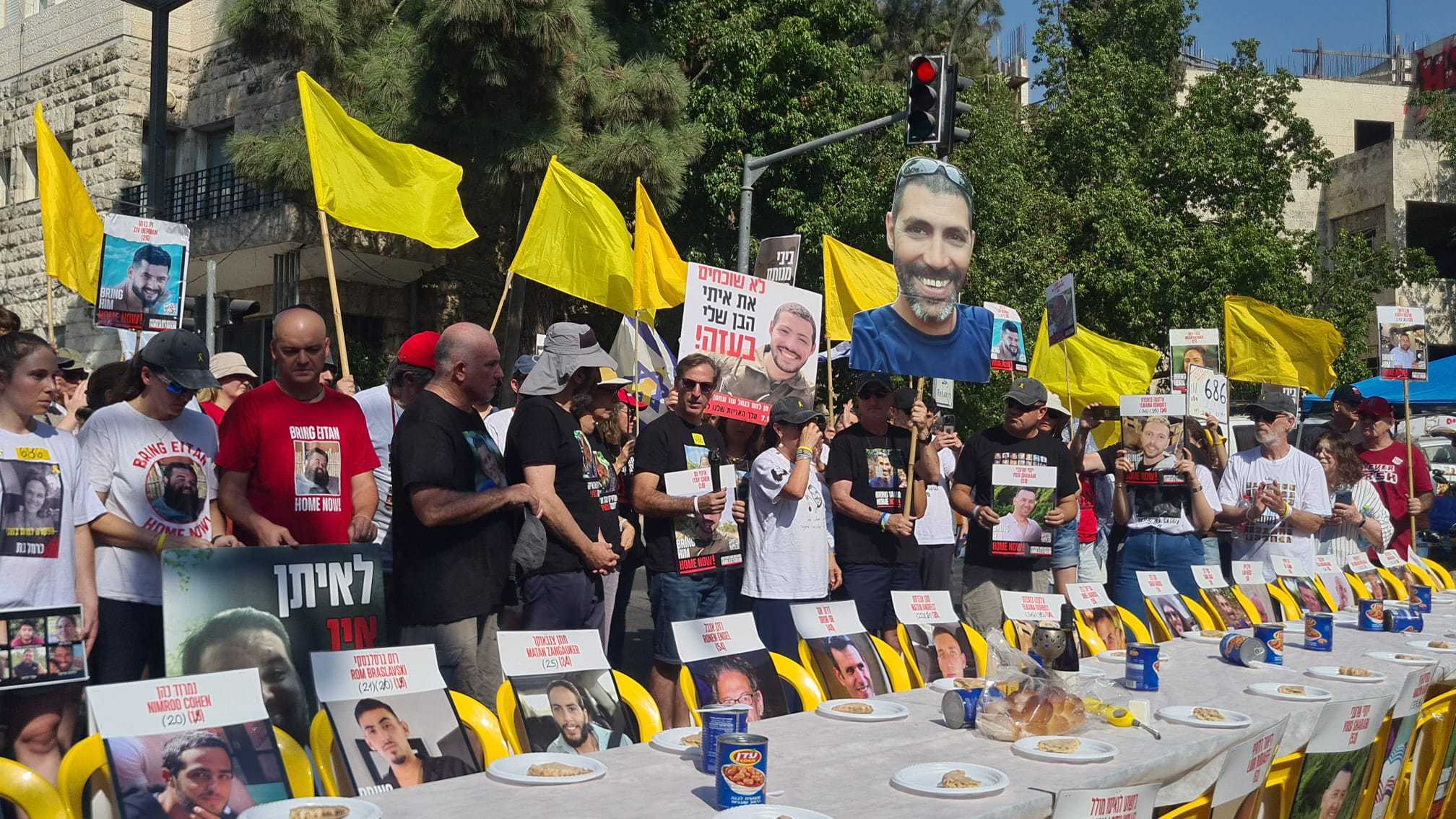
Hostage families rally next to a shabbat table set up outside the Jerusalem residence of Prime Minister Benjamin Netanyahu, August 22, 2025. (Pro-Democracy Movement)
Pro-hostage deal protesters set up a mock Shabbat table and block traffic on Route 6, near the Elyakin Interchange in the north, as families of captives hold Sabbath services and rally outside Prime Minister Benjamin Netanyahu’s Jerusalem residence.
Ynet quotes the protesters on Route 6 as saying: “There will be no Shabbat meal anywhere in the country until everyone’s back and the war ends.”
שלושים איש החליטו עכשיו לחסום את כביש שש באזור מחלף אליקים, "למען החטופים". שוב נהגים אקראיים סופגים בריונות לא לגיטימית. אסור למשטרת ישראל לאפשר את זה pic.twitter.com/2npzksxiXP
— Akiva Novick (@akivanovick) August 22, 2025
In a statement, the Hostages and Missing Families Forum cites the hostage families outside the Prime Minister’s Residence as saying: “Netanyahu — leave the Shabbat table and move to the negotiating table.”
Photos from the Forum of a Shabbat table set up outside Netanyahu’s residence shows pictures of remaining hostages placed on seats around a table set for a meal of pita slices and canned beans — the food given the captives in Gaza.
Yael Adar, mother of slain captive Tamir Adar, assails Netanyahu in a speech outside the premier’s residence for approving the new Gaza City offensive rather than moving forward on a ceasefire-hostage deal.
“Instead of heading south for meetings on conquering Gaza, you should go up to Jerusalem to convene the cabinet, and say one thing — ‘I’m sending a negotiating team, and [they’re] not coming home until there is a deal to bring back all the hostages,” she says.

PMO says UN Gaza famine declaration a ‘modern blood libel,’ touts Israeli humanitarian efforts
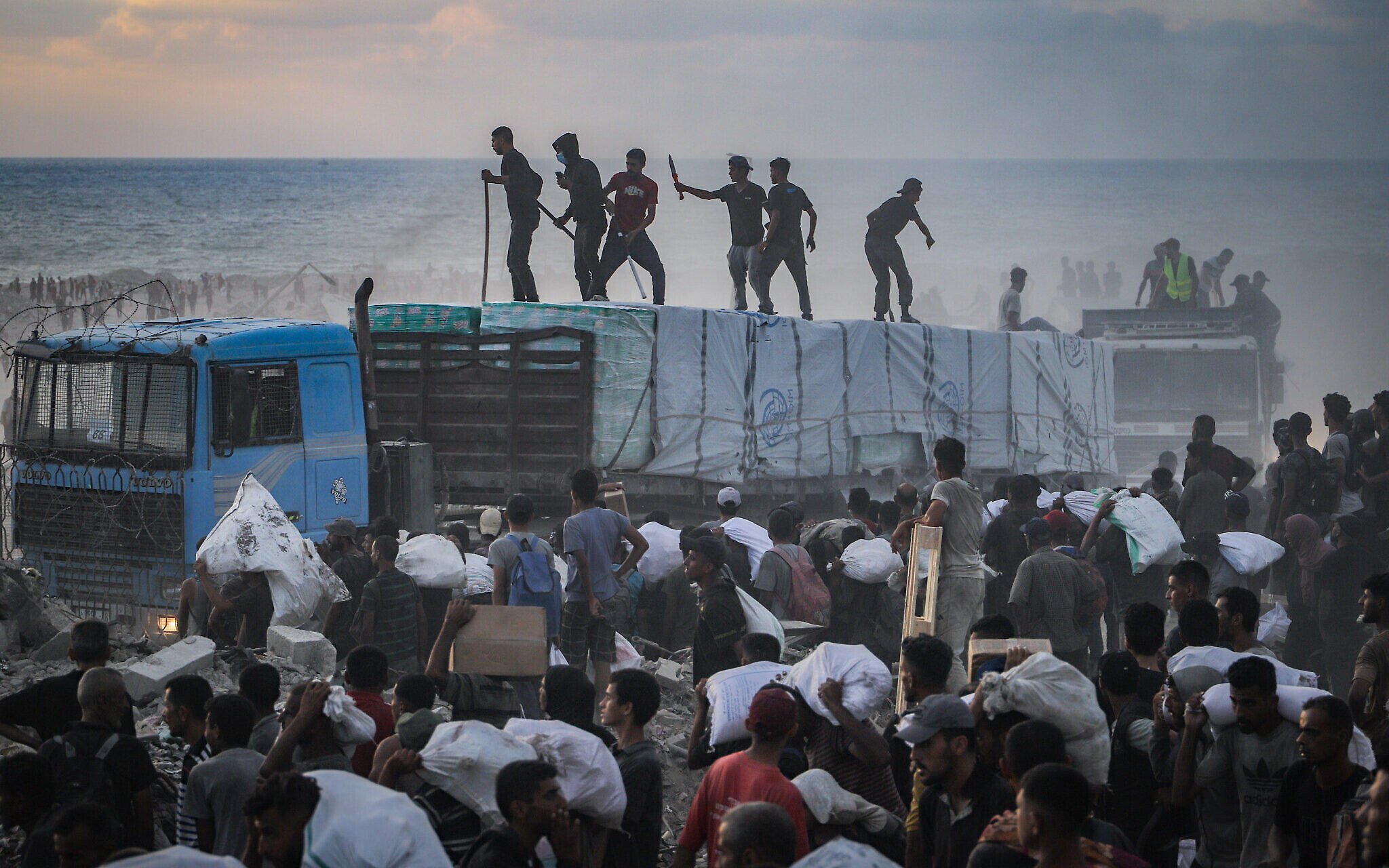
Armed Palestinians sit on trucks carrying humanitarian aid near the Zikim border crossing between Israel and Beit Lahia in the northern Gaza Strip, August 18, 2025. (Khalil Kahlout/ Flash90)
Prime Minister Benjamin Netanyahu’s office says the United Nations declaration of famine in parts of the Gaza Strip is an “outright lie” and “modern blood libel.”
“Israel does not have a policy of starvation. Israel has a policy of preventing starvation,” the Prime Minister’s Office says in a statement on X. “The only ones being intentionally starved in Gaza are the Israeli hostages.”
The statement says the report by the UN’s Integrated Food Security Phase Classification (IPC) system ignores Israel’s humanitarian efforts and fails to mention a drop in the prices of oil, sugar, salt, flour, yeast and chickpeas in Gaza that the PMO attributes to the entry of humanitarian supplies into the Strip. The source of the information on the prices is unclear.
Citing data from the Defense Ministry’s Coordinator of Government Activities in the Territories, the PMO says Israel has facilitated the entry of millions of tons of aid into Gaza since war there was triggered by the Hamas onslaught of October 7, 2023.
The statement also says the controversial US- and Israeli-backed Gaza Humanitarian Foundation, as well as NGOs facilitated by Israel, have served millions of warm meals to Gazans.
On the other hand, the PMO cites UN data as saying that in July, “of 1,012 aid trucks collected, only 10 reached warehouses; the rest were looted before distribution.” The PMO also accuses the UN of having refused to deliver “hundreds of pallets of food” from the Kerem Shalom Crossing.
The PMO concedes there had been “temporary shortages” of aid in Gaza “which Israel overcame with airdrops, maritime deliveries, safe transport routes and GHF distribution points manned by American companies.”
According to the PMO, the shortages were caused by “Hamas’s systematic theft.”
The statement does not mention the 11-week aid blockade Israel imposed on the Strip following the collapse of the last ceasefire-hostage deal on March 2.
Barcelona mayor calls Israeli decision to bar his entry a ‘hostile act’ meant to isolate Palestinians

Then-mayoral candidate Jaume Collboni speaks at the Socialist Party of Catalonia's headquarters in Barcelona on May 28, 2023, after the local and regional elections in Spain. (Lluis Gene/AFP)
After he was denied entry to Israel, Barcelona Mayor Jaume Collboni accuses the government of seeking to “isolate the Palestinian people and hide from the world the constant violations of human rights they endure.”
Collboni, whose city has cut off ties with Israel, says in a Catalan-language Instagram post that he was invited by his Palestinian counterparts in Ramallah and Bethlehem “to learn firsthand about the realities of Palestinian cities.”
He says the trip was set to include a meeting in Jerusalem with left-wing Israeli groups B’Tselem and Peace Now; a laying of wreaths at the graves of the late Israeli prime minister Yitzhak Rabin and Palestinian Authority president Yasser Arafat; and a visit to a new camp in Amman run by UNRWA, the UN agency for Palestinian refugees that Israel has accused of cooperating with terror groups.
Collboni makes no mention of a planned visit to Yad Vashem, the Holocaust memorial in Jerusalem, where Hebrew media said he was set to go.
He calls the decision to deny entry to his delegation a “hostile act” and says it “only strengthens our resolve… for peace, justice and the recognition of the Palestinian people’s rights. Their voice is also ours.”
Palestinian detained for allegedly firing at Israeli civilians in West Bank yesterday, security forces say
Israeli soldiers and police officers detained a Palestinian suspected of opening fire on a group of Israeli civilians near the West Bank settlement of Adei Ad yesterday, the Shin Bet, IDF and Israel Police say.
The 30-year-old Palestinian, a resident of the nearby village of al-Mughayyir, had allegedly fired at the Israelis — without hitting any — before engaging in a physical confrontation, during which one Israeli man was lightly hurt.
He was nabbed yesterday, several hours after the shooting, according to a military official.
During an initial interrogation by the Shin Bet, the suspect provided “findings that tied him to the attack,” the joint Shin Bet, IDF and police statement says.
The Israeli forces found a handgun suspected to have been used in the attack, the statement adds.
Israeli family attacked at Dutch holiday park after local group urges action against tourists from Israel
A family of Israeli tourists was attacked at a holiday park in the Netherlands Thursday evening, days after local anti-Israel groups posted videos online of Israeli tourists at another park and “called for action against them,” Israel’s embassy in The Hague says, though local police reportedly says the victims’ nationality was not the cause for the attack.
Two victims of the attack at Center Parcs De Kempervennen, near Eindhoven, required hospitalization, and one suspect was detained, the embassy says in a Dutch-language statement, adding that “it is assumed that multiple suspects were involved.”
The embassy, whose building was defaced last week, adds that this is the latest in a series of attacks on Israelis visiting the Netherlands.
“We expect the Dutch authorities to take all necessary measures to protect Israelis and Jews in the Netherlands. Intimidation and violence against individuals because of their background is unacceptable,” the embassy says.
Dutch media identifies the hospitalized Israelis as a 37- and 41-year-old, one of whom suffered a head wound, and the detained suspect as a 15-year-old boy.
According to local newspaper Eindhovens Dagblad, the violence took place amid a paintball game between the Israeli tourists and another group, and police say the Israelis’ nationality was not the reason for the attack.
However, the outlet says “discriminatory and threatening slogans were shouted during the altercation,” and quotes a Dutch Jewish community group that was in contact with the victims as saying they were deliberately attacked because they were Israeli.
In recent weeks, Israeli tourists have experienced several high-profile anti-Israel incidents, including attacks and protests, amid the war in Gaza sparked by the Hamas onslaught of October 7, 2023. A poll published earlier this month found a majority of Israelis fear they won’t be able to travel abroad due to mounting global criticism of the Jewish state.
IDF says it killed Hezbollah operative in drone strike on southern Lebanon
A Hezbollah operative was killed in an Israeli drone strike in southern Lebanon’s Ayta ash-Shab earlier today, the IDF says.
According to the military, the operative was involved in efforts to restore Hezbollah infrastructure in the area.
Since a November 2024 ceasefire, the IDF says it has killed over 230 Hezbollah operatives in strikes in Lebanon, accusing the operatives of having violated the terms of the truce.
Member of Syrian armed forces said killed in Islamic State suicide attack
A member of Syria’s internal security forces was killed in a suicide attack by Islamic State at a checkpoint in the city of Mayadin in the Deir Ezzor area, which borders Iraq, Syrian state media reports.
According to SANA, the attack was carried out by at least two assailants, one of whom detonated himself while the other was killed by troops.
The attack comes two days after a US-led coalition captured a senior Islamic State commander in northwest Syria, near the Turkish border, according to state media and a war monitor.
Gaza City offensive to commence in mid-September, hostage-ceasefire talks to resume next week — report
Israel is expected to launch its new offensive on Gaza City in mid-September, some two weeks after newly called-up reservists are set to report for duty on September 2, Channel 12 reports.
Some one million Palestinians currently in Gaza City will be called upon to evacuate as soon as Sunday, the network says.
According to the report, Prime Minister Benjamin Netanyahu and the political echelon are pushing to speed up the launch of the operation, while the military wants to first take steps to safeguard the hostages and the troops, and also evacuate the Palestinians from Gaza City and ensure there is international legitimacy for the operation.
The network cites Israeli officials as saying it is urgent to get out the hostages as soon as possible due to their dire condition. Sources cited by the outlet say that there are currently no substantive disagreements between Israel and Hamas on a ceasefire-hostage deal, but “it all depends on Netanyahu.”
“There are no magic solutions,” the sources were quoted as saying. “If [we] want to bring back the hostages [we] can do that now.”
The terror group recently said it accepted a partial hostage deal that Israel had agreed to in the past, while Netanyahu has vowed to push on in Gaza City and to negotiate only for a deal that would release all the hostages. A source cited by Channel 12 says a partial deal was never on the table, and that Israel has only sought a comprehensive deal in two phases.
Despite the apparent impasse in the ceasefire talks, Israel is expected to send negotiators to renewed ceasefire-hostage talks in the coming days, Channel 12 reports, adding that talks have already begun on setting the time and place for the negotiations, which have stalled since Israel and the US recalled their negotiators from Doha last month.
The network says it is unclear where the renewed talks will take place, and that they will commence in a location other than Doha or Cairo, where they have taken place until now.
Israel reportedly assesses that the impending operation in Gaza City is placing great pressure on Hamas, possibly leading to greater flexibility in the talks.
According to the network, Netanyahu seeks to drive that point home by renaming the operation “Iron Fist,” rather than the name “Gideon’s Chariots 2” that has been used until now, following the original Operation Gideon’s Chariots that was launched in May.
Sources present in Netanyahu’s consultations say he has been using the name Operation Iron Fist over the past couple of days, Channel 12 says.
IDF: Ballistic missile launched from Yemen, sirens expected within minutes
A ballistic missile has been launched from Yemen at Israel, the military says.
Sirens are expected to sound in central Israel in the coming minutes.
Sirens sound in central Israel after missile launch from Yemen, IDF working to down projectile
Sirens sound in central Israel following the launch of a ballistic missile from Yemen. The IDF says it is working to shoot down the projectile.
Houthi missile apparently broke up mid-air during descent; no immediate reports of impacts or injuries
A ballistic missile launched by the Houthis in Yemen at Israel a short while ago apparently broke up in the air during its descent, according to initial IDF assessments.
The Israeli Air Force launched interceptor missiles to shoot down the falling fragments.
The IDF says the results of the interception attempts are under investigation.
There are no immediate reports of impacts or injuries. Sirens had sounded in central Israel.
Since March 18, when the IDF resumed its offensive against Hamas in the Gaza Strip, the Houthis in Yemen have launched 71 ballistic missiles and at least 23 drones at Israel. Several of the missiles have fallen short.
Dutch FM says resigning after Netherlands cabinet failed to agree on sanctions against Israel

Dutch Foreign Minister Caspar Veldkamp arrives for the EU-Southern Neighborhood Ministerial Meeting in Brussels, Belgium, on July 14, 2025. (NICOLAS TUCAT / AFP)
Dutch Foreign Minister Caspar Veldkamp resigns after a cabinet meeting failed to agree on sanctions against Israel.
“I see that I am insufficiently able to take meaningful additional measures to increase pressure on Israel,” Veldkamp tells Dutch news agency ANP after a cabinet debate on possible sanctions against Israel was deadlocked.
Last month, Veldkamp declared Israel’s National Security Minister Itamar Ben Gvir and Finance Minister Bezalel Smotrich unwelcome in the Netherlands, accusing them of inciting settler violence in the West Bank and ethnic cleansing in the Gaza Strip.
On Thursday, Veldkamp said he wanted to take further steps against Israel, but later acknowledged he lacked confidence he could act effectively in the coming weeks or months.
The minister says the steps he had proposed were “seriously discussed” but encountered resistance in successive cabinet meetings.
“I feel constrained in setting the course I consider necessary as foreign minister,” he says.
The Netherlands was among 21 countries that signed a joint declaration on Thursday condemning Israel’s approval of a major West Bank settlement project as “unacceptable and contrary to international law.”
Times of Israel staff contributed to this report.
IDF confirms Houthi missile likely fell apart mid-air, says it’s investigating reported fragment impacts
The IDF confirms that the Houthi missile launched from Yemen at Israel tonight likely broke up in the air during its descent.
The Israeli Air Force launched several interceptor missiles to shoot down the fragments, the military says.
There are reports of several locations in central Israel where fragments landed. The IDF says it is investigating.
There are no reports of injuries.
White House appears to dismiss UN declaration of famine in Gaza
The White House appears to dismiss the findings of a UN-backed global hunger monitor after the latter issued a report concluding that famine had struck Gaza for the first time.
“We are looking into credible reports that the IPC recently changed its definition for what constitutes a famine,” reads a statement from a US State Department spokesperson.
The statement appears to be referring to the Integrated Food Security Phase Classification’s (IPC) decision to utilize a different system to measure malnutrition in Gaza than it has used in other conflict zones.
To track hunger in Gaza, IPC used the Mid-Upper Arm Circumference (MUAC) measurement, as opposed to the weight-for-height Z-score (WHZ).
Under MUAC, 15% of people measured need to be identified as acutely malnourished in order for a famine to be declared, whereas the threshold for WHZ is 30%. Israel has accused IPC of lowering its own criteria in order to conclude that there is famine in Gaza. In its report, the UN agency explained that it used the MUAC measurement instead of WHZ because the former is easier and cheaper to track amid the challenging wartime conditions.
The US appears to reject the approach and the conclusions reached in the report, with the State Department spokesperson saying that addressing the “challenging issues of getting aid to Gazans means honestly addressing problems for the sake of Gazans, who deserve better, not engaging in semantics.”
The spokesperson clarifies that the US still thinks the humanitarian situation in Gaza is a “serious concern” and that Washington is working to find ways to deliver aid to Gazan civilians in an active war zone where the Hamas terror group is trying to remain in power.
“Hamas is systematically promoting a false narrative of deliberate mass starvation to put political pressure on Israel,” the spokesperson asserts.
The US statement points out UN figures that show the vast majority of its trucks coming into Gaza over the past two months have been looted, arguing that food is going into the Strip but is not reaching those who need it most. Notably, the figures cited are from May 19, when Israel lifted its aid blockade over Gaza after 78 days.
Aid organizations say that the blockade helped spur the current hunger crisis and that the 22 months of war have led to a collapse of the humanitarian response in Gaza that was necessary to ensure that food continued reaching vulnerable populations at earlier stages of the war.
The State Department spokesperson says the US is focused on “getting aid to the people in need while implementing safeguards to prevent Hamas from stealing and looting the assistance.”
Trump suggests fewer than 20 hostages still alive in Gaza, bucking official Israeli tally
US President Donald Trump tells reporters in the Oval Office that fewer than 20 hostages held by terror groups in Gaza are still alive, bucking Israel’s official tally and sparking despair from the families of the captives.
“So now they have 20,” he says, “but the 20 is actually probably not 20 because a couple of them are not around any longer.”
In his comments, Trump decries Hamas’s “extortion.” He also takes credit for the release of “hundreds” of hostages, though fewer than 150 captives remained in Gaza when he took office on January 20, and terror groups in the Strip continue to hold 50 captives, 28 of whom have been confirmed dead by the IDF.
There are also grave concerns for the well-being of two captives, Israeli officials have said.
Trump is also asked why the US appears to be backing the Israeli decision to take over Gaza City when the hostage families are opposed.
“Not all of them,” Trump replies. “And you have to understand, I’m the one who got all of the hostages out.”
“We’re doing everything we can to get the hostages out,” he says, adding that “it’s not easy.”
'I'm the one who got all the hostages out, if it wasn't for me, they wouldn't be out'
Speaking in the Oval Office, Donald Trump talks to the media about the remaining hostages in Gaza, saying 'the situation has to end'https://t.co/JomsP48R8k pic.twitter.com/HMltLaBnJQ
— Sky News (@SkyNews) August 22, 2025


read more: