

Live updates (closed)
 Add ToI as a Preferred Source on Google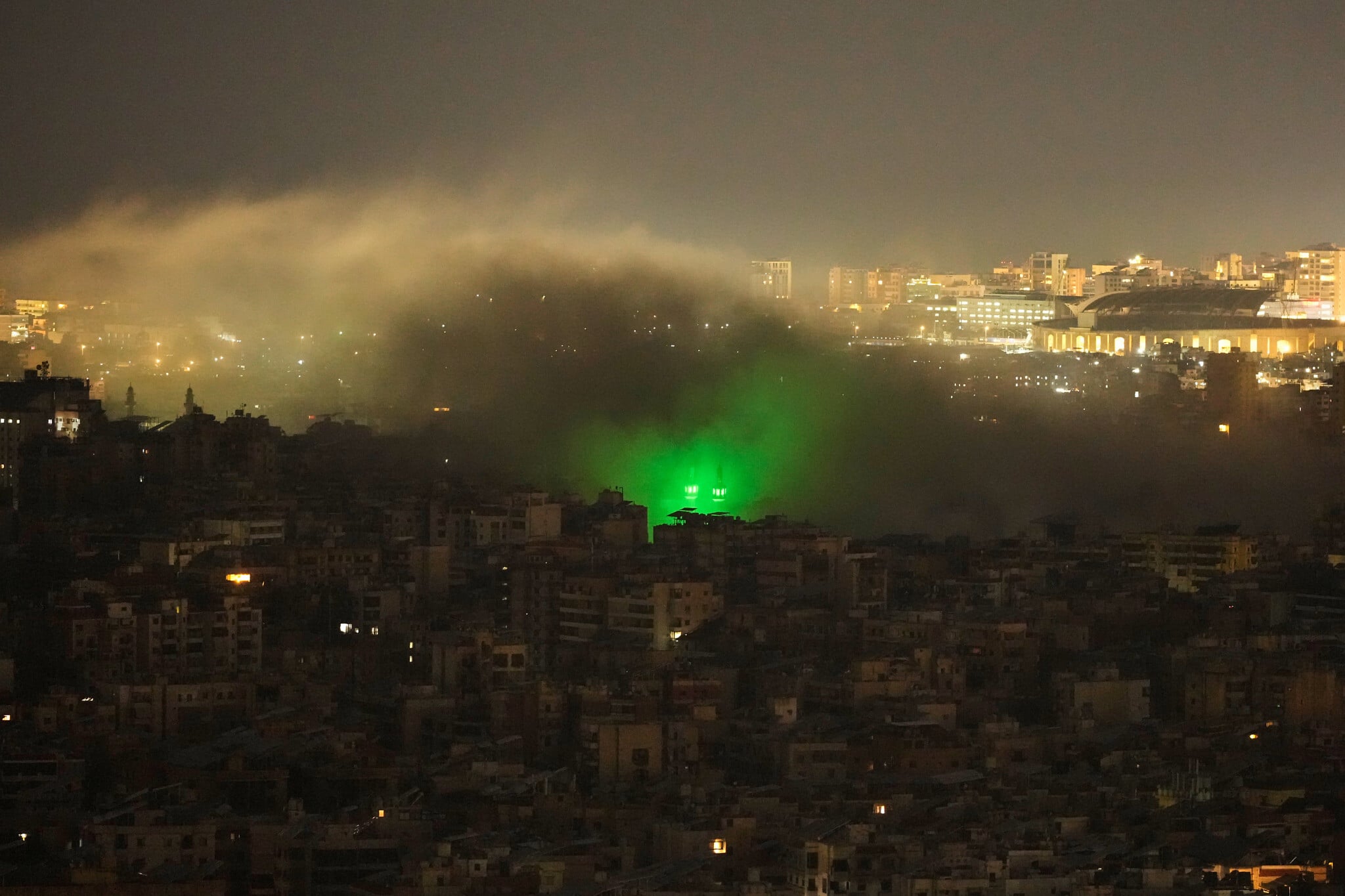
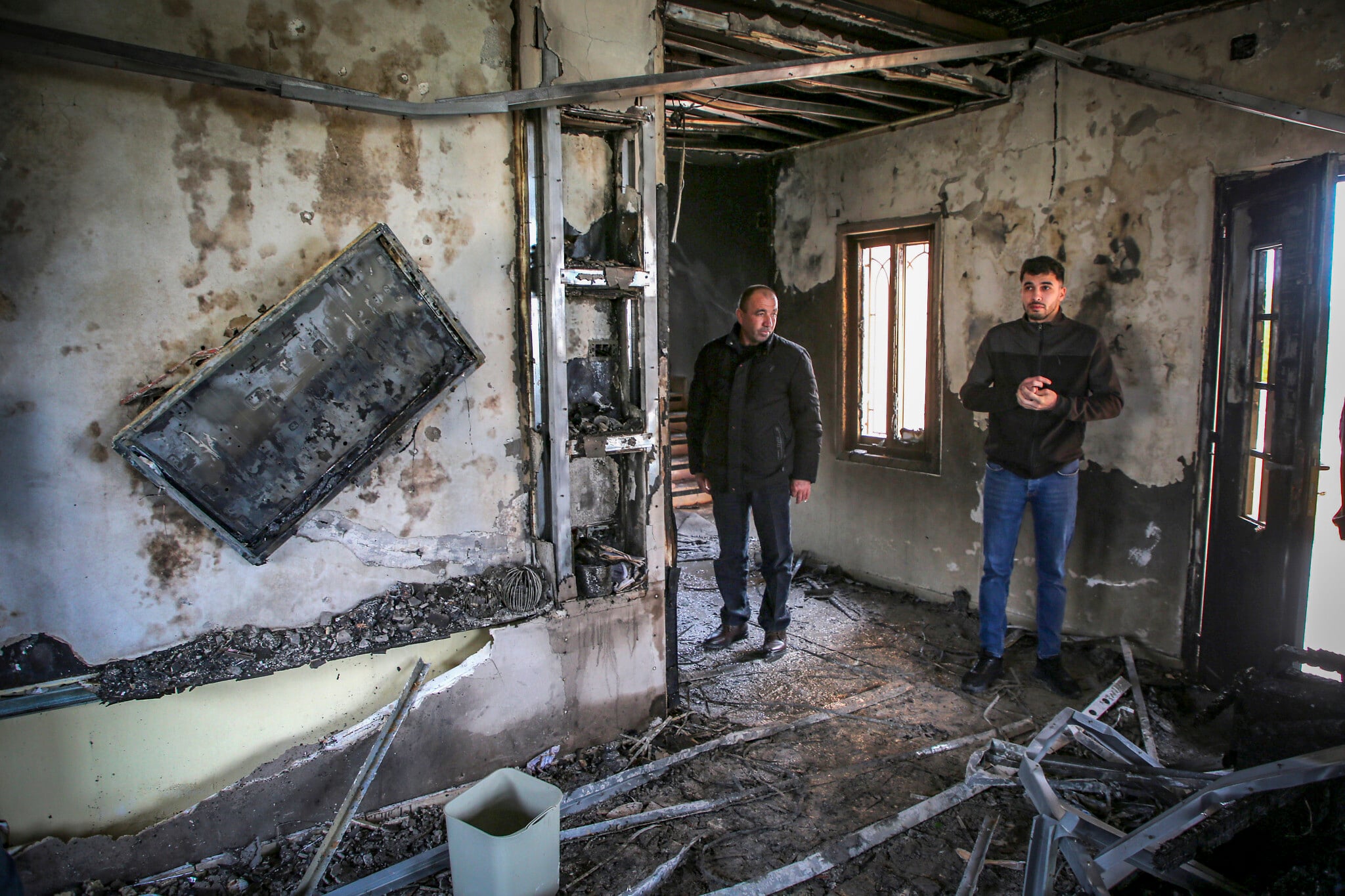
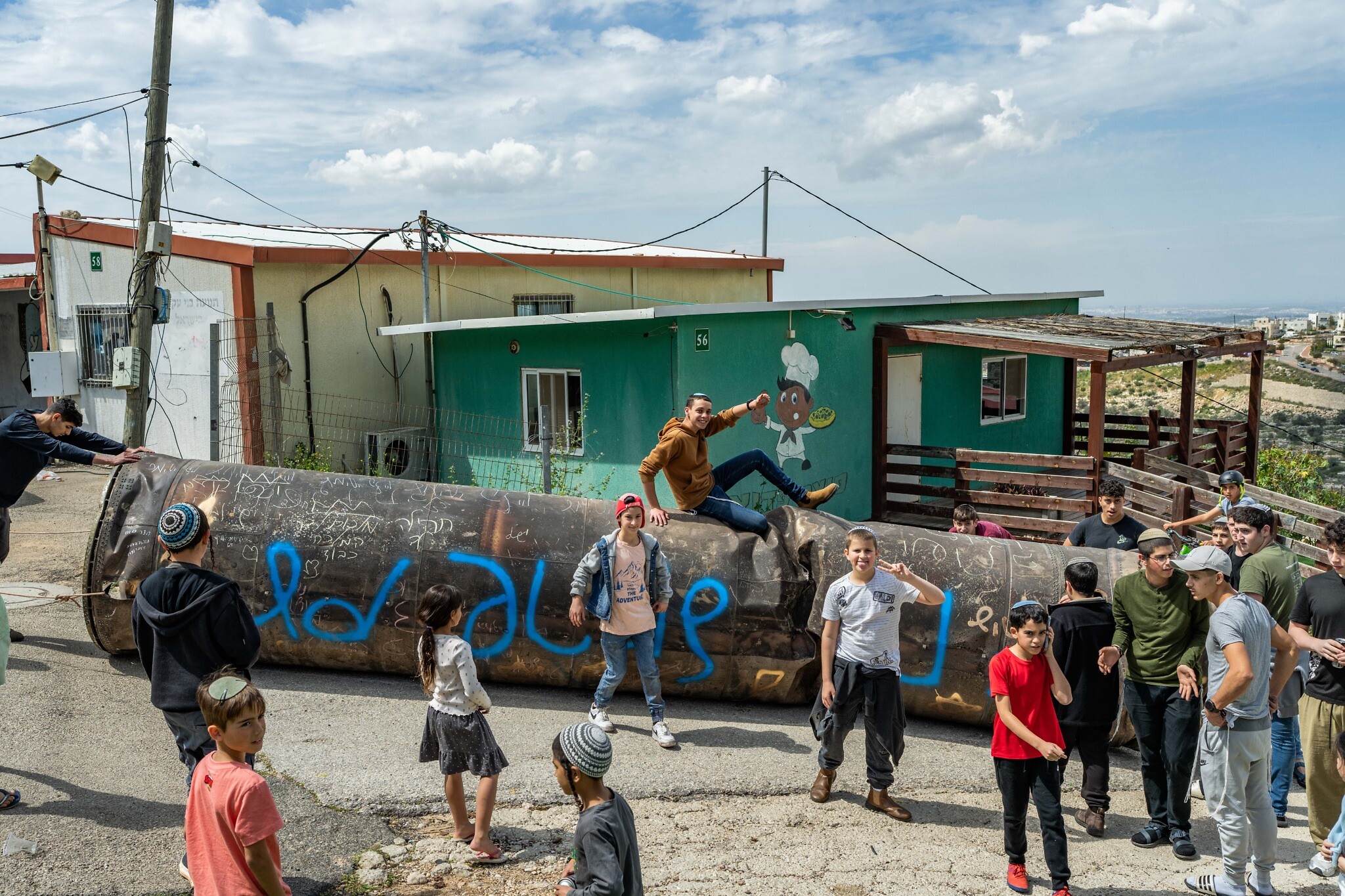
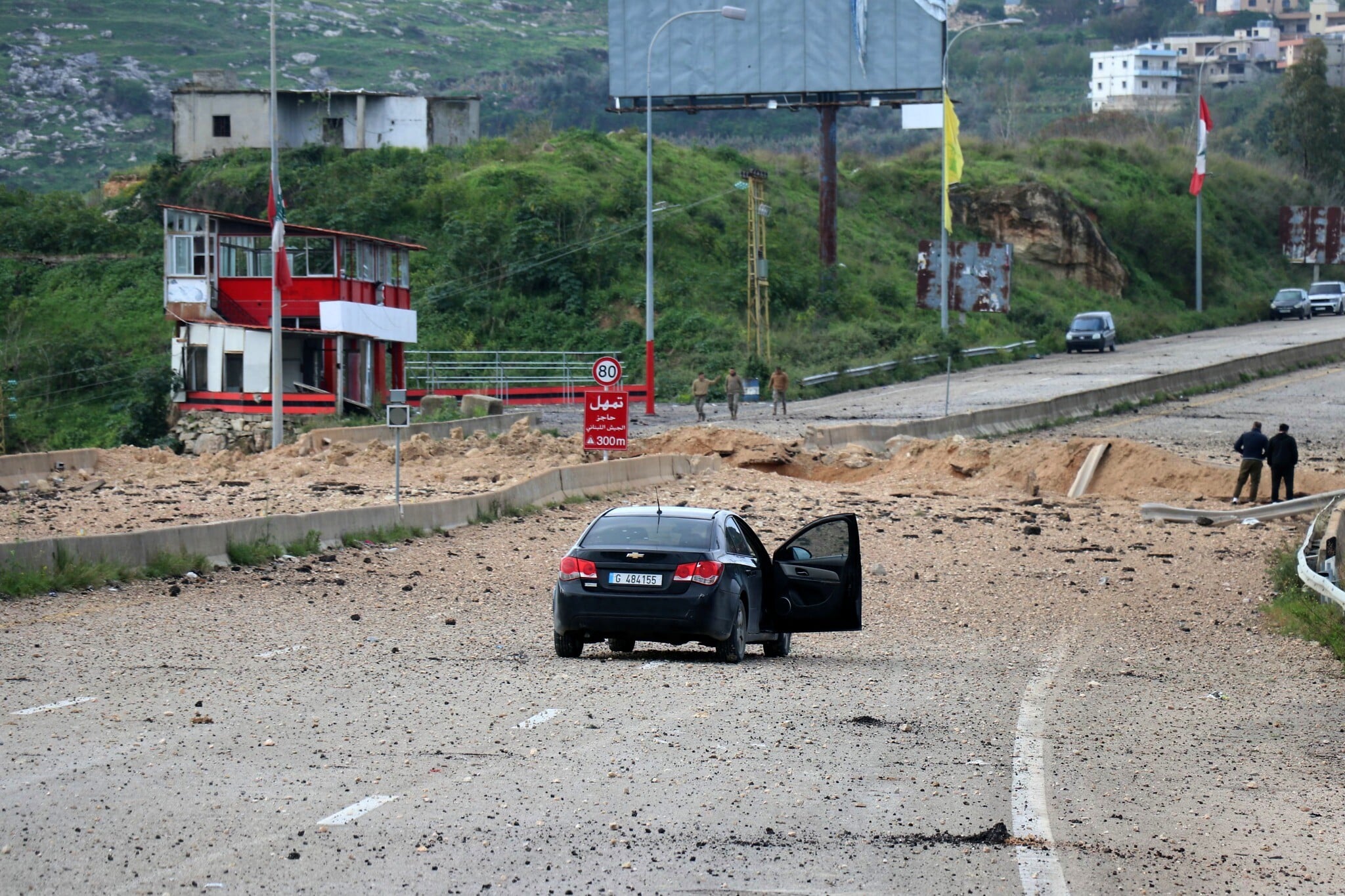
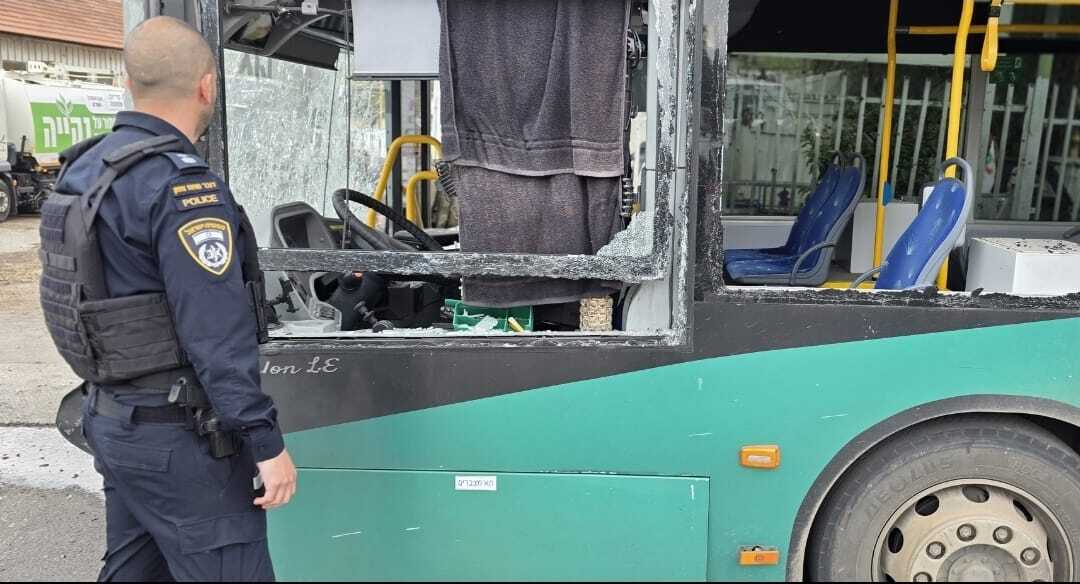
The Times of Israel liveblogged Monday’s events as they unfolded.
9 days on, authorities yet to probe officers in deadly shooting of Palestinian family
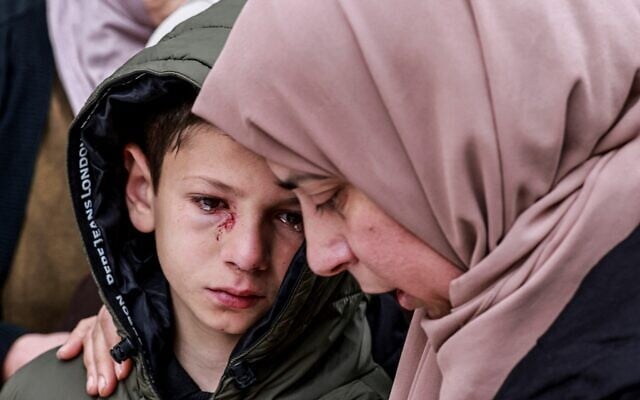
One of the surviving children, Mustafa, injured when Israeli soldiers fired on the vehicle carrying his parents and two siblings, is comforted during their funeral in the West Bank's northern town of Tammun on March 15, 2026. (Jaafar ASHTIYEH / AFP)
Nine days have passed since Israeli security forces shot dead a Palestinian couple and their two young children in the West Bank village of Tammun, but none of the Border Police officers involved has been summoned for questioning, Haaretz reports.
Border Police have claimed that officers believed the car carrying the family sped toward them, though an investigation has been launched into the incident.
One of the surviving children, 11-year-old Khaled Bani Awda, told Palestinian media after the incident that the gunfire had been directed straight at the car.
“The army arrived. They pulled me out of the car. There were people sitting on my chest. They told me: ‘Tell us everything that happened to you or we will kill you.’ I told them we had been shopping in Nablus and then returned home, and that in the car were my father, my mother, and my three brothers. [The officer] called me a liar and then hit me in the face,” he said.
Direct talks between US and Iran could be held in Islamabad as soon as this week — sources
A Pakistani official and a second source tell Reuters that direct talks on ending the war could be held in Islamabad as soon as this week.
Egypt, Pakistan and Gulf states have been relaying messages between Iran and the US, a European official tells Reuters.
Iranian media reports that President Masoud Pezeshkian and Pakistani Prime Minister Shehbaz Sharif discussed the impact of the war on regional and global security in a phone call earlier today.
Pezeshkian is quoted as having said that Iran is committed “to preserving stability and security and countering foreign interference in regional affairs” and wants to strengthen cooperation with the countries of the region.
Pro-Iranian group in Iraq fires rockets into northeastern Syria
A pro-Iranian Iraqi armed group launched a rocket attack on Monday against a base in northeastern Syria that was recently vacated by US-led anti-jihadist coalition forces, an Iraqi security official and a Syrian monitor say.
“An Iraqi faction fired seven Arash-4 rockets, an improved version of the Grad rocket, towards a base in the Hassakeh region” in northeastern Syria, the Iraqi official says to AFP. He adds that a rocket launcher platform had been found abandoned in the northern Rabia area, near the Syrian border.
The Syrian Observatory for Human Rights war monitor confirms an evening attack against the base but does not comment on any potential damage. It adds in a brief statement that US forces had recently withdrawn from there.
Syria’s army took control of the base after the US-led coalition withdrew in mid-March.
Iraq has been unwillingly drawn into the conflict, which started on February 28 when the US and Israel launched a massive wave of strikes on Iran.
Pro-Tehran armed groups have claimed responsibility for near-daily attacks on US interests in Iraq and across the region, while strikes have also targeted these groups.
No injuries reported after day’s fifth Iran missile attack
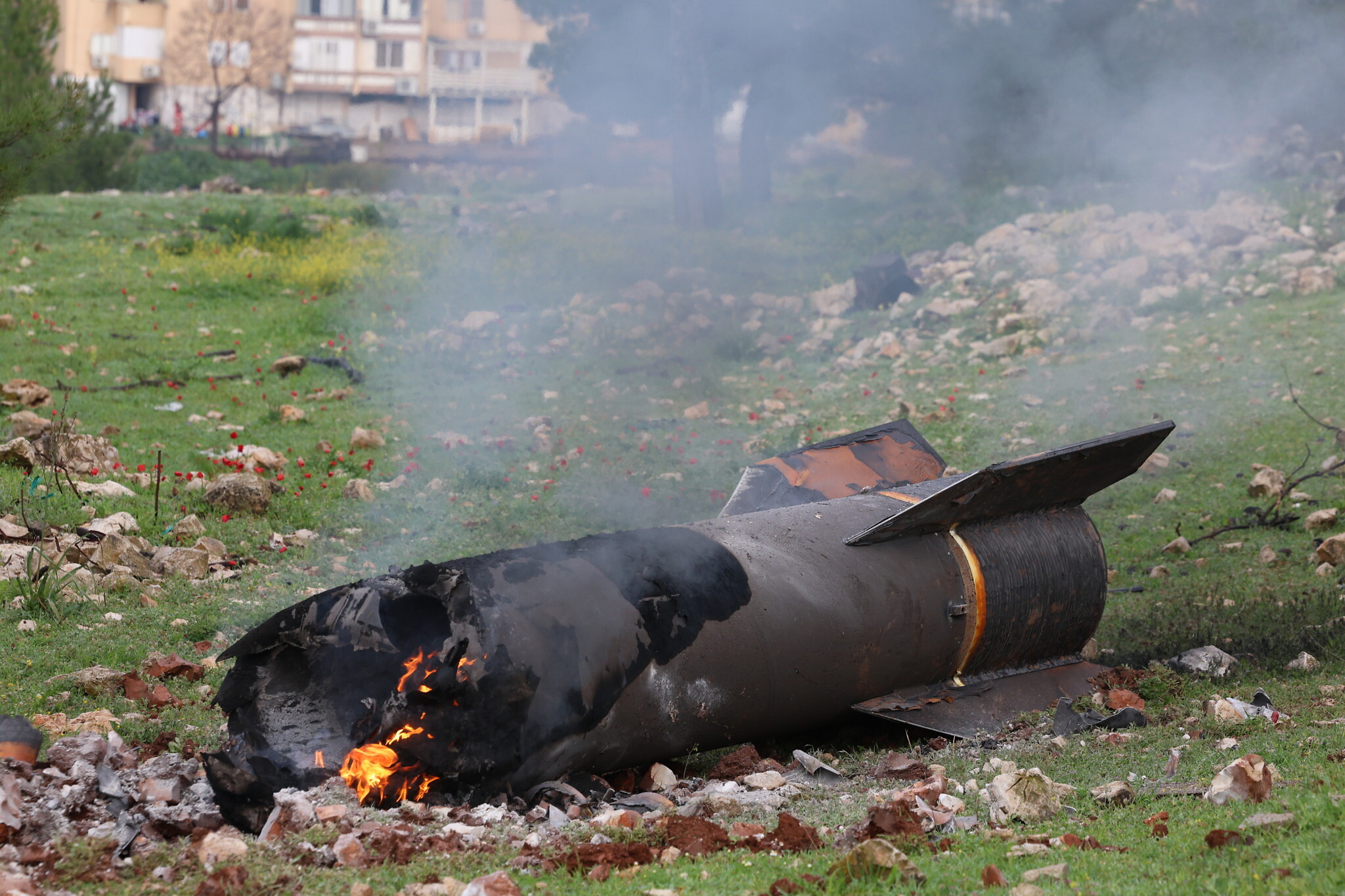
No injuries are reported following Iran’s latest ballistic missile attack, the fifth today.
The missile, which triggered sirens in the southernmost city of Eilat, was likely intercepted according to preliminary military assessments.
IDF detects day’s fifth Iran missile attack heading toward Eilat
The IDF has detected a new Iranian ballistic missile attack targeting the Eilat area in southern Israel.
Sirens are expected to sound in the coming minutes.
Man convicted of hate crime for attacking Israeli in New York after Oct. 7
Yehia Amin, accused of attacking an Israeli tourist in Manhattan 2023, is convicted of a hate crime in a New York City court.
On October 18, 2023, shortly after the Hamas invasion of Israel, Amin stalked and punched a 23-year-old Jewish Israeli near Times Square, the Manhattan District Attorney’s Office said in an indictment after the incident.
Amin is convicted of assault as a hate crime in the third degree in the New York State Supreme Criminal Court. He is expected to be sentenced to 90 days in prison, followed by five years of probation, at the end of May.
The attack was part of a surge in antisemitic incidents after the Hamas attack on Israel.
The indictment said the victim was walking with four friends who were all wearing kippahs when they passed by Amin, who recognized them as Jewish and began to pursue them.
Amin taunted the group, telling them, “Hamas should kill more of you,” “May Allah kill all the Jews,” and “All Jews should die.”
Amin ran up behind the victim and punched him in the back of the head, then fled the scene.
The Israelis followed him, along with a police officer, who arrested him.
While under arrest, Amin continued to shout antisemitic statements, including, “God kill all the Jewish people,” the District Attorney’s Office said.
The conviction is one of a series of hate crimes and Israel-related cases from 2023 and 2024 that are being resolved in New York City courts.
Hate crime convictions are rare in the city because prosecutors must prove the offender was motivated by bias against the victim, a high legal bar.
No injuries reported after day’s fourth Iran missile attack
No injuries are reported following Iran’s latest ballistic missile attack, the first in 11 hours and the fourth today.
The missile, which triggered sirens in the southern cities of Dimona and Yeruham, was intercepted according to preliminary military assessments.
A large explosion was heard over the Jerusalem area amid the interception attempts.
IDF confirms Beirut strikes, saying its targeting Hezbollah sites
The IDF confirms striking in Beirut a short while ago, saying it has launched a wave of airstrikes against Hezbollah targets.
Earlier, the IDF reiterated an evacuation warning for Beirut’s southern suburbs, a Hezbollah stronghold, ahead of strikes on the terror group’s sites.
Report: Iran outlines formal, obdurate demands for a deal; offers possible concessions behind the scenes
Iran has laid out a set of formal, obdurate demands for ending the war, in the context of the Trump-announced indirect talks, Channel 12 reports.
According to the report, Iranian officials are seeking firm guarantees that fighting will not resume, alongside a new arrangement for the Strait of Hormuz that would effectively place it under Iranian control.
Channel 12 says Iran is also demanding the closure of US military bases across the region and financial compensation for damages sustained during the war.
However, a separate Channel 12 report suggests Tehran may also be privately signaling some limited flexibility in the talks, and sets out what it says are Iran’s opening negotiating positions, as understood by the United States, without citing sources.
According to this report, Iran may be willing to halt its ballistic missile program for five years, “reduce” its uranium enrichment, and enter discussions over its stockpile of 60 percent enriched uranium.
Channel 12 adds that Iran could also agree to allow International Atomic Energy Agency inspections of remaining centrifuges and to stop funding regional proxy groups, including Hezbollah, Hamas, and Iraqi militias.
Belgium deploys soldiers to reinforce security at Jewish sites
Soldiers have been deployed on the streets of leading Belgian cities to bolster security for the Jewish community, after what officials say were antisemitic attacks in Belgium and the Netherlands.
The move follows an explosion this month at a synagogue in Liege that authorities called an antisemitic act.
“From today, we’re putting soldiers back on the streets in Brussels and Antwerp because safety is a basic right,” Belgian Defence Minister Theo Francken says in a post on X.
The deployment, in collaboration with federal police, will provide security at Jewish sites including synagogues and schools, Belgian authorities said in a press release last week.
Antwerp “is again a little safer…. the Jewish community too. We say NO to antisemitism!” Francken says.
The upgrade in security also follows an arson attack on a synagogue in Rotterdam and an explosion at a Jewish school in Amsterdam in the neighboring Netherlands.
Dutch police have arrested five suspects, aged 17 to 19, over the synagogue attack in Rotterdam.
A Belgian defense ministry spokesperson says that soldiers would be deployed in three different phases: first in Brussels and Antwerp, later in Liege.
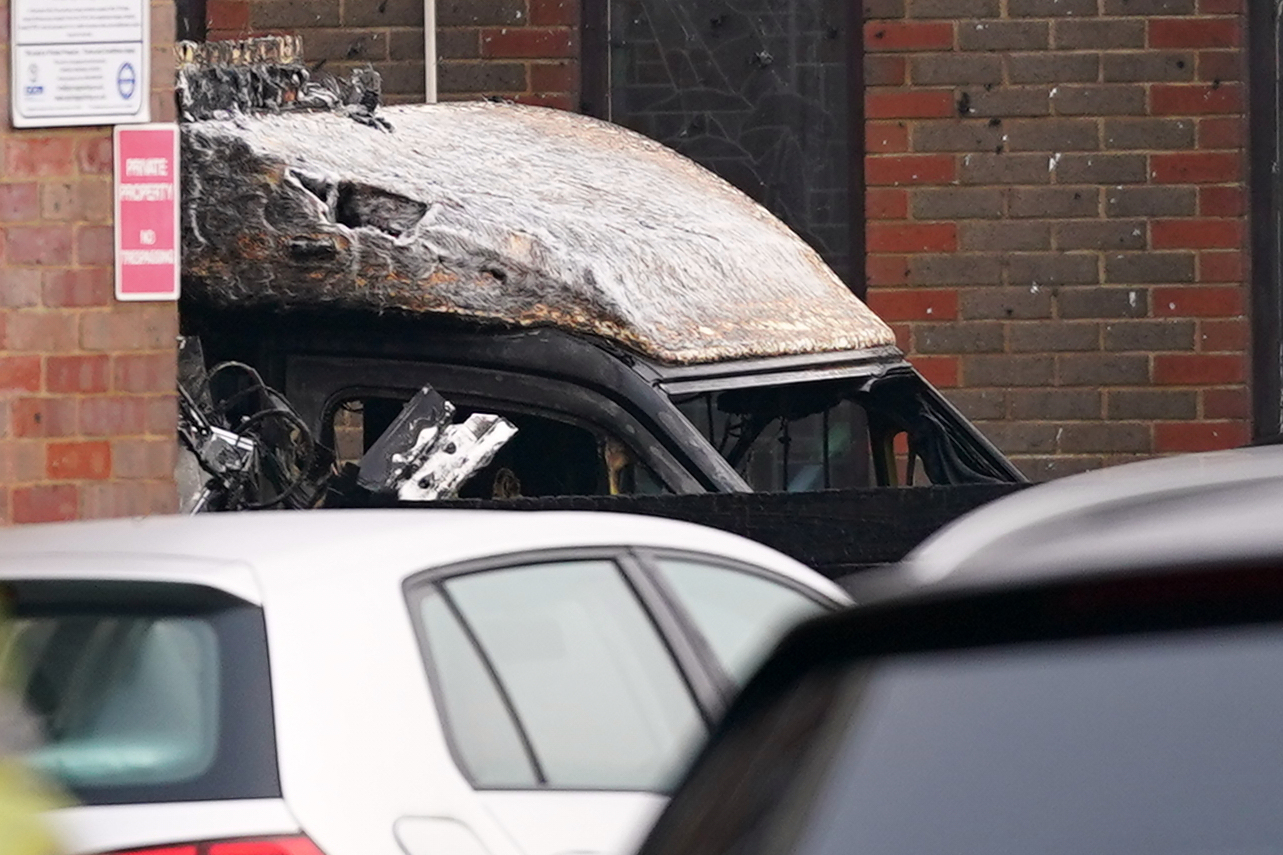
Rights advocates have raised concerns about possible attacks against Jewish communities around the world following the launch of the US and Israeli war with Iran. Four ambulances belonging to a Jewish community organization in north London were set ablaze on Monday.
After 11 hour lull, IDF detects Iran missile en route to southern Israel
After a lull of 11 hours, the IDF has detected a new Iranian ballistic missile attack.
Sirens are expected to sound in southern Israel in the coming minutes.
Bahrain proposes UN Security Council approve use of force to protect Hormuz shipping
Bahrain has put forward a draft of a United Nations Security Council resolution that would authorize countries to use “all necessary means” — diplomatic language for force — to protect commercial shipping in and around the Strait of Hormuz, according to a text seen by Reuters.
Diplomats say the draft text is backed by other Gulf Arab states and the United States, although they say it is unlikely to succeed.
The move underscores mounting concern in the region that Iran could continue to threaten the Strait of Hormuz, a strategic chokepoint that carries about a fifth of global oil supplies and underpins Gulf economies.
Closing the Strait has been one of Iran’s main objectives. Shipping through the waterway has ground to a near-halt after Iran hit vessels in its conflict with the US and Israel.
The draft resolution calls Iran’s actions a threat to international peace and security.
The text would authorize countries, acting alone or through voluntary multinational naval coalitions, to use “all necessary means” in and around the Strait of Hormuz – including in the territorial waters of littoral states – to ensure passage and to prevent moves that block or interfere with international navigation.
The resolution also expresses the readiness to impose measures, including targeted sanctions.
The draft text “demands that the Islamic Republic of Iran immediately cease all attacks against merchant and commercial vessels and any attempt to impede lawful transit passage or freedom of navigation in and around the Strait of Hormuz.”
Two European and one Western diplomat say there is little prospect of such a resolution being adopted by the Security Council, as Iran’s allies Russia and China are likely to veto the text if needed.
A resolution needs at least nine votes in favor and no vetoes by Russia, China, the US, Britain, or France to be adopted by the 15-member body.
However, the diplomats say France is also working on an alternative draft resolution that would seek a UN mandate once the situation has calmed.
Trump approved Iran operation after Netanyahu argued for joint killing of Khamenei, sources say
Less than 48 hours before the US-Israeli strike on Iran began, Prime Minister Benjamin Netanyahu spoke by phone to President Donald Trump about the reasons for launching the kind of complex, far-off war the American leader once had campaigned against.
Both Trump and Netanyahu knew from intelligence briefings earlier in the week that Iranian Supreme Leader Ayatollah Ali Khamenei and his key lieutenants would soon meet at his compound in Tehran, making them vulnerable to a “decapitation strike” – an attack against a country’s top leader often used by Israelis, but traditionally less so by the United States.
But new intelligence suggested that the meeting was moved forward to Saturday morning from Saturday night, according to three people briefed on the call.
The call has not been previously reported.
Netanyahu, determined to move forward with an operation he had urged for decades, argued that there might never be a better chance to kill Khamenei and to avenge previous Iranian efforts to assassinate Trump, these people said. Those included a murder-for-hire plot allegedly orchestrated by Iran in 2024, when Trump was a candidate.
By the time the call took place, Trump had already approved the idea of the United States carrying out a military operation against Iran, but had not yet decided when or under what circumstances the United States would get involved, say the sources, who spoke on condition of anonymity to discuss sensitive internal deliberations.
The US military had spent weeks building up a presence in the region, prompting many within the administration to conclude it was just a matter of when the president would decide to move forward. One possible date, just a few days earlier, had been scuttled because of bad weather.
Reuters was unable to determine how Netanyahu’s argument affected Trump as he contemplated issuing orders to strike, but the call amounted to the Israeli leader’s closing argument to his US counterpart. The three sources briefed on the call say they believed it — along with the intelligence showing a closing window to kill Iran’s leader — was a catalyst for Trump’s final decision to order the military to move ahead with Operation Epic Fury on February 27.
Trump could make history by helping eliminate an Iranian leadership long reviled by the West and by many Iranians, Netanyahu argued. Iranians might even take to the streets, he said, overthrowing a theocratic system that had governed the country since 1979 and been a leading source of global terrorism and instability ever since.
The first bombs struck on Saturday morning, February 28. Trump announced that evening that Khamenei was dead.
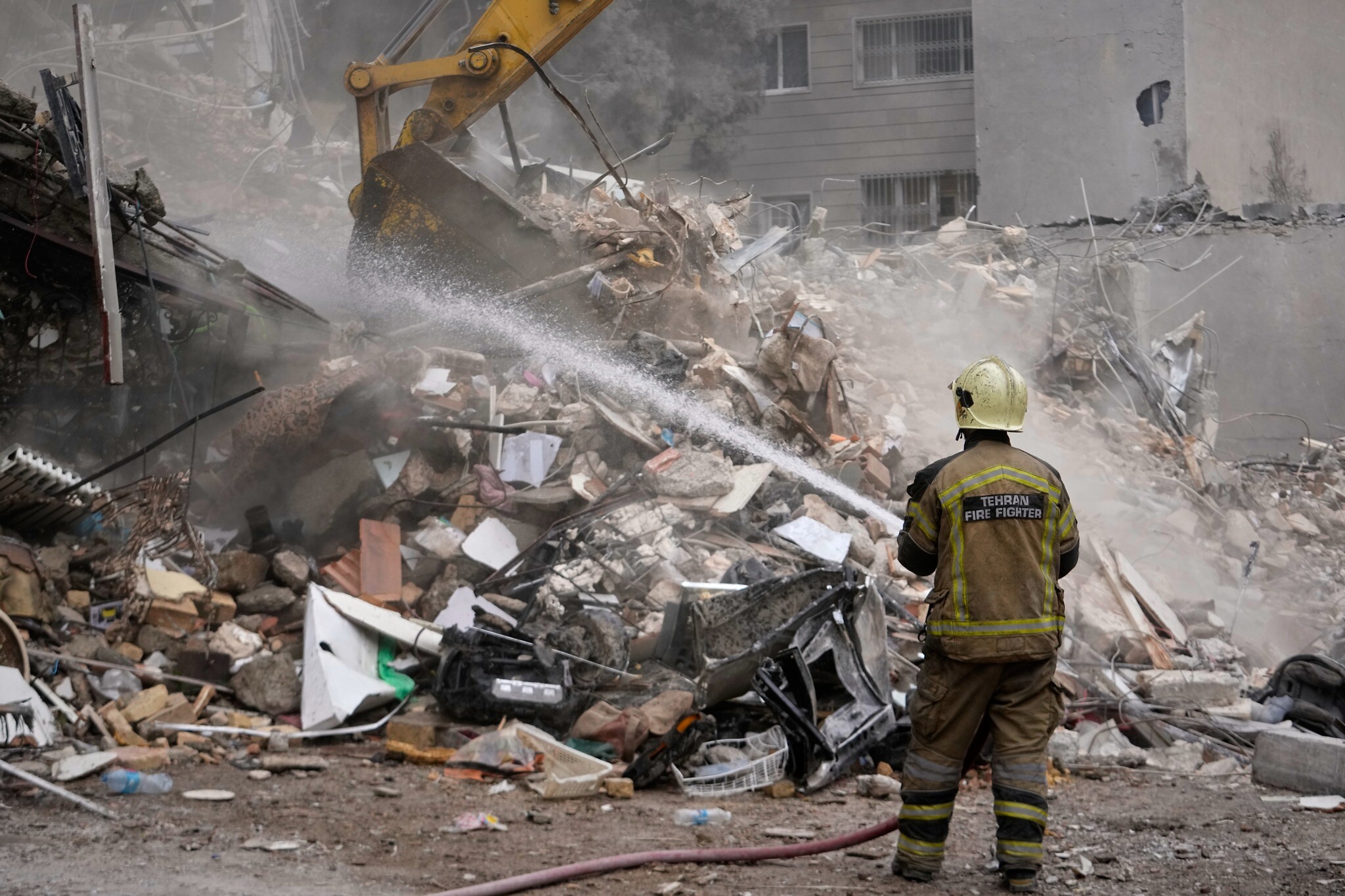
Lebanese media reports new IDF strikes in Beirut’s south suburbs
Lebanese media reports new Israeli airstrikes in Beirut’s southern suburbs.
Earlier, the IDF reiterated an evacuation warning for the area, a Hezbollah stronghold, ahead of strikes on the terror group’s sites.
غارة تستهدف الضاحية الجنوبية لبيروت #ملحق pic.twitter.com/UtDMBpcWeI
— Mulhak – ملحق (@Mulhak) March 23, 2026
Israeli-founded companies in California earn an annual $4 billion, employ 14,000 — report
Israeli-founded companies employ 14,452 people in California, generating $4 billion in earnings, according to a report by the United States-Israel Business Alliance, a group that works to foster business ties between the two countries.
The report by the United States-Israel Business Alliance is based on 2024 data, the most recent year for which the figures are available.
The report tallies 367 companies in California with at least one Israeli founder. Thirty-two of those companies are unicorns, or private firms valued at more than $1 billion.
The average salary at the companies is $175,093, roughly double the average in the state. The firms add $6.5 billion in total value to the state’s economy, generate $8.9 billion in gross economic output, or sales, and account for 22,650 jobs overall, when also counting positions created indirectly, such as in warehouses.
The companies account for .16% of California’s gross domestic product. California has the largest economy of any US state; if the state was a country, it would be one of the top five national economies worldwide.
The California report is the group’s fourth to examine Israelis’ economic impact in US states. Previous reports tallied their economic impact in Florida, New York, and Virginia.
In total, there are 1,563 Israeli-founded companies in the four states, creating 114,152 total jobs and $38 billion in economic output.
Israel said to fear deal might not address highly-enriched uranium stockpile; Netanyahu reaches out Dermer
Israel is reportedly concerned that a “bad deal” with Iran could take shape that does not address Iran’s stockpile of over 400 kilograms of 60 percent enriched uranium, enough for 11 nuclear bombs, Channel 12 reports.
It says Prime Minister Benjamin Netanyahu reached out to his most trusted aide, Ron Dermer, to work on Israel’s behalf with the US on the deal. It says Netanyahu first got word of potential negotiations on Thursday and reached out to Dermer then.
The report quotes security sources expressing concern about the fate of the 60% enriched uranium:
“We do not know if there will be a deal in the near future or if this is a characteristic ‘Trump maneuver,'” it quotes a security source saying.
“But if there is a deal, and it does not involve the removal from Iran of its enriched uranium, any big words about ‘devastation’ and ‘degraded capability’ will not be true. The truth will be that it is an epic failure.”
Israeli official said to believe Netanyahu will help shape deal with Iran
Prime Minister Benjamin Netanyahu has been updated over the past 24 hours on ongoing contacts between the United States and Iran, Channel 12 reports, as Israeli officials assess that Tehran’s political leadership may be open to a deal.
According to the news outlet, Israel believes US President Donald Trump is seeking to avoid a broader energy war, but officials in Jerusalem do not expect to be blindsided by any agreement. Israeli officials assess that, if a deal is reached, it would presumably align with Israel’s core war objectives, with one source saying that Trump “remembers who was with him in battle.”
Channel 12 reports that Israel is now working to ensure that the terms of a potential agreement will meet its demands, prioritizing an end to Iran’s nuclear program and strict limits on uranium enrichment. Regime change, the outlet says, is viewed as a less central goal, though Israel will likely claim to have created the necessary conditions for one.
Another source adds that, as in the previous ceasefire deal with Iran, which ended the 12-day war in June 2025, Netanyahu is expected to be involved in shaping any final agreement to end this round of fighting.
At the same time, Israeli sources caution that a successful deal from Jerusalem’s perspective would effectively require Iranian surrender, while one security source expresses skepticism that any agreement is currently within reach – and doubt that Iran would honor it even if achieved.
Channel 12 further notes that any potential deal could also have implications for the northern front, in light of the ongoing fighting with Hezbollah in Lebanon.
Sara Netanyahu lands in US ahead of summit hosted by Melania Trump
Sara Netanyahu, wife of Prime Minister Benjamin Netanyahu, is seen disembarking from an El Al flight in New York ahead of a White House event hosted by US First Lady Melania Trump.
Melania Trump is hosting the two-day Fostering the Future Together Global Coalition Summit, which will include representatives from 45 countries and 28 leading technology companies.
The summit starts at the US State Department on March 24 and ends the next day at the White House.
Netanyahu is seen with Consul-General in New York Ofir Akunis and top aide to the premier, Topaz Luk.
אורי משגב
תיעוד ראשון מהחזית בניו יורק.
שרה נתניהו יורדת מהביזנס של אל-על, מלווה בידי השאוויש אופיר אקוניס, טופז לוק ומאבטחיה הצמודים.
מלחמה שלמה היא לא הראתה את הפרצוף שלה מחוץ לבונקר. כלום. לא מילאה אף חובה ציבורית. אבל כשהגיעה הזמנה ממלאניה טראמפ לכנס הזוי של "נשים… pic.twitter.com/0KKJOI1oRf
— the little prince (@thelitt80824365) March 23, 2026
Lufthansa reportedly extends some Middle East flight cuts into October
Lufthansa is extending its suspension of flights to Iran and parts of the Middle East for several more months as regional tensions rise, Bloomberg News reports.
Lufthansa flights to Dubai and Tel Aviv will remain on hold until May 31, while services to other cities, including Abu Dhabi, Beirut and Tehran, are suspended until October 24, the report says, citing the company.
Netanyahu says Trump updated him on new opportunity for Iran deal that ‘protects our interests’
In his first remarks since US President Donald Trump announced he was holding talks with Iran about ending the war, Prime Minister Benjamin Netanyahu says that Israel “will protect our vital interests in every situation.”
In an upbeat video statement, issued some seven hours after Trump’s announcement, Netanyahu says he spoke with “our friend” Trump in a phone call today.
Earlier today I spoke with our friend President Trump.
President Trump believes there is an opportunity to leverage the tremendous achievements we have reached alongside the US military to realize the goals of the war through an agreement that will safeguard our vital interests. pic.twitter.com/15Z7fRvvQX
— Prime Minister of Israel (@IsraeliPM) March 23, 2026
Trump, he says, “believes that there is a chance to leverage the massive achievements of the IDF and the US military in order to achieve the goals of the war through an agreement — an agreement that protects our vital interests.”
At the same time, Netanyahu stresses, Israel “is continuing to strike, in Iran and in Lebanon.”
“We are crushing the missile program and the nuclear program, and continuing to strike Hezbollah hard,” he says. “Only days ago, we eliminated two more nuclear scientists, and our arm is still outstretched.”
Rockets launched from Iraq’s Mosul towards US base in northeastern Syria, say sources
At least seven rockets were launched from the Iraqi town of Rabi’a towards a US military base in northeastern Syria, two Iraqi security sources say.
No further details were provided for the incident.
A rocket launch platform was found in the Rabi’a district, west of Mosul, and a burnt vehicle used to fire seven rockets towards the Syrian side was seized, two security sources say.
US advises its citizens in Oman to shelter in place
The United States has advised its citizens in Oman to shelter in place “due to ongoing activity,” according to a security alert from the US embassy in Muscat.
IDF says troops capture two operatives from elite Hezbollah unit in southern Lebanon over the weekend

Members of Hezbollah's elite Radwan Force who were captured by the military in southern Lebanon, in a handout photo issued on March 23, 2026. (Israel Defense Forces)
IDF troops captured two armed Hezbollah operatives, members of the terror group’s elite Radwan Force, during operations in southern Lebanon over the weekend, the military says.
According to the IDF, troops of the Givati Brigade spotted the Radwan operatives while they were planning to launch anti-tank missiles at the forces, as well as at Israel.
A short while later, the pair surrendered to the troops, the military says, adding that the forces located weapons and other military equipment alongside the operatives.
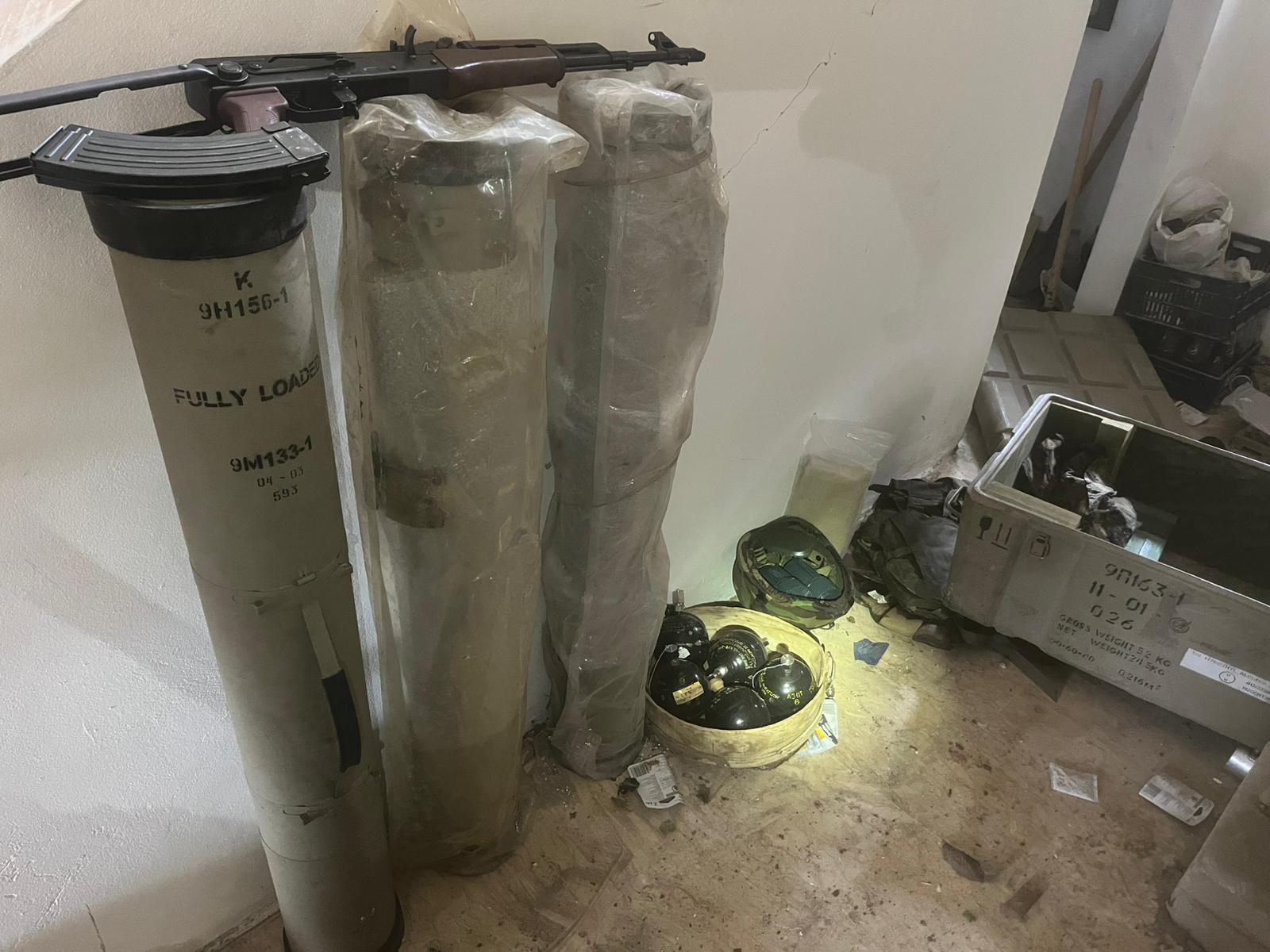
Overnight, the IDF says it destroyed the building from which the Radwan fighters had been operating.
The two operatives were taken to Israel and questioned by the Military Intelligence Directorate’s Unit 504, which specializes in human intelligence.
The IDF says that their interrogation revealed that the two Radwan operatives arrived in southern Lebanon from the Beqaa Valley area at the start of the war with Iran.
“This case once again proves that the Lebanese army failed and did not prevent the movement of terrorists and weapons south of the Litani [River],” the military says.
Report: US dismisses Iran FM as ‘fax machine,’ seeks direct talks with decision-maker Qalibaf
The United States is pushing to move beyond indirect contact with Iran and open a direct line to a senior decision-maker in Tehran, Channel 12 reports, citing sources involved in the ongoing mediation effort.
According to the sources, Washington has made clear that it does not want to negotiate through Foreign Minister Abbas Araghchi, who is viewed as lacking real authority – with one source describing him as “a fax machine who only passes messages” – and instead aims to engage Iran’s parliament speaker Mohammad Baqer Qalibaf, who is closely aligned with newly appointed Supreme Leader Mojtaba Khamenei and considered one of the most influential figures in Iran following the assassination of Ali Larijani.
A source involved in the talks says mediators – Egypt, Turkey and Pakistan – identified “greater willingness” on both the Iranian and American sides to move forward.
“The Iranians were open to it, and the Americans also wanted to advance because of the markets and oil prices,” the source says, referring to Iran effectively having closed the Strait of Hormuz, a critical oil shipping route.
US continues striking Iran after Trump reveals existence of talks to end war
The American military says it continues carrying out strikes in Iran, after US President Donald Trump announced earlier that his administration has been engaged in productive talks with Iran regarding a “complete and total resolution” of hostilities.
“US forces continue to aggressively strike Iranian military targets with precision munitions,” the US Central Command says on X, attaching footage of recent strikes.
U.S. forces continue to aggressively strike Iranian military targets with precision munitions. pic.twitter.com/DnPJFgEueZ
— U.S. Central Command (@CENTCOM) March 23, 2026
Knesset committee to vote on advancing death penalty bill to final two readings next week
The Knesset National Security Committee will hold a final vote tomorrow on advancing the coalition’s controversial death penalty for terrorists bill to the final two readings needed for it to pass into law, National Security Minister Itamar Ben Gvir’s Otzma Yehudit party announces.
Ben Gvir will attend the committee vote on the legislation, which would mandate the death penalty for terror convicts and is sponsored by Otzma Yehudit MK Limor Son Har-Melech.
Haaretz reported on Sunday that the committee is hoping to send the bill to the plenum as early as next week.
The bill has been subjected to numerous objections and proposed amendments from opposition lawmakers and the committee’s legal adviser, who have argued that the bill is unconstitutional and discriminatory.
Significant changes were made last week to “soften” the bill, following pressure from Prime Minister Benjamin Netanyahu’s office, which argued that the draft was harsher than US capital punishment standards and could expose Israel to diplomatic and legal scrutiny abroad.
Those revisions removed a clause mandating the death penalty without judicial discretion, allowing judges the option to choose between capital punishment and life imprisonment. Another change removed the requirement for trials to take place in military courts, permitting trials in civilian courts. And a third dropped language defining terror victims as “Israeli citizens,” a clause that would have excluded Palestinian victims, in a bid to avoid accusations of discrimination.
David’s Sling system failed to down Iranian ballistic missiles that struck southern towns — IDF
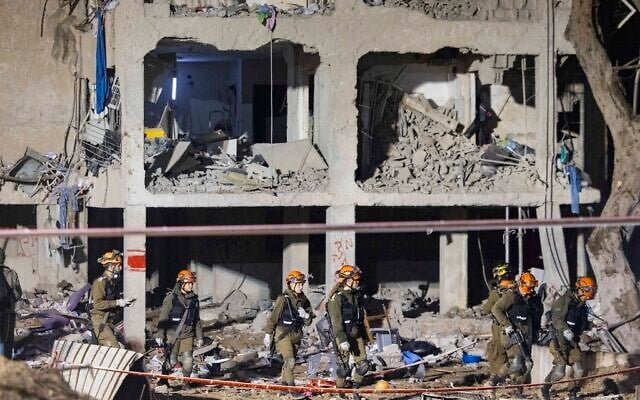
Security and rescue forces at the scene where a missile fired from Iran at Israel caused damage to residential buildings and injured civilians in the southern Israel city of Arad, March 22, 2026. (Chaim Goldberg/Flash90)
The Israeli air defense system that failed to shoot down two Iranian ballistic missiles that struck the southern cities of Dimona and Arad on Saturday night was the medium-range David’s Sling, the military confirms.
According to the Israeli Air Force’s probes of the incidents, there was no connection between the errors that led to the missile impacts, which injured nearly 200 people and caused extensive damage. The fact that the incidents occurred in the same area within two hours was entirely coincidental, the IAF said.
The missiles that hit Dimona and Arad carried conventional warheads — not cluster warheads — with hundreds of kilograms of explosives. The military said the Iranian missiles were likely from the Ghadr family of projectiles and are a known threat.
The David Sling system had engaged both projectiles, but its interceptors failed to knock them down, the military said.
Two earlier missile attacks on the same area in southern Israel were successfully intercepted using the same air defense system, according to the IAF.
More than 400 ballistic missiles have been launched from Iran at Israel since the start of the war, with the military reporting an interception rate of 92 percent of attacks heading for populated areas and key infrastructure.
While not initially designed to intercept long-range ballistic missiles, David’s Sling was first used against Iranian ballistic missiles during the June 2025 war, successfully shooting down several projectiles launched from 1,500 kilometers (932 miles) away.
David’s Sling has been used in the current war as well, downing numerous Iranian missiles. This comes after the Defense Ministry said in early February that it had completed a series of “complex” tests with the David’s Sling aimed at “upgrading readiness for future threats.”
Israel operates a multi-tiered missile defense array, with the Arrow 3 currently the country’s most advanced long-range missile defense system, meant to intercept ballistic missiles — like the kind fired from Iran — while they are still outside of Earth’s atmosphere.
The use of the medium-range system instead of the Arrow 3 to shoot down Iranian ballistic missiles is believed to be part of the military’s efforts to conserve Israel’s stockpile of expensive long-range interceptors.
While each David’s Sling missile costs roughly $1 million to use, the Arrow 3 system can cost Israel over $2.5 million per use.
Iranian man released after alleged attempt to enter UK submarine base
An Iranian man who was arrested last week for allegedly attempting to enter Britain’s nuclear submarine base in Scotland has been released, pending further inquiries, Scottish prosecutors say.
The 34-year-old man was arrested on Thursday alongside a 31-year-old Romanian woman, after what Police Scotland described as two people attempting to enter HM Naval Base Clyde, which is located on the west coast of Scotland.
Police Scotland on Saturday said that the pair were due to appear at Dumbarton Sheriff Court on Monday.
Scotland’s public prosecution service says in a statement, however, that it has decided “there should be no proceedings” against the 31-year-old woman, and that it reserves the right to proceed if further evidence becomes available.
The statement adds that the 34-year-old man had been “liberated from custody pending further inquiries and did not appear in court,” with the case against him remaining live.
Their arrest came three weeks into the US-Israeli war on Iran. While Britain has not taken part in the attacks on Iran, the country’s forces have downed Iranian missiles and drones in the Gulf region.
HM Naval Base Clyde is key to Britain’s security, hosting the country’s nuclear-armed submarine fleet as well as its attack submarines.
Netanyahu and Vance said to discuss potential deal with Iran in phone call
Prime Minister Benjamin Netanyahu and US Vice President JD Vance held a phone call earlier today to discuss efforts to renew talks between the US and Iran, Channel 12 reports, citing an unnamed source familiar with the matter.
The pair discussed the components of a possible deal between the US and Iran, the source says.
London summons Iran envoy over ‘reckless’ actions in UK, overseas
Britain’s foreign ministry has summoned Iran’s ambassador to London, Seyed Ali Mousavi, criticizing what it called Tehran’s “reckless and destabilizing actions” in the UK and overseas.
“The summons follows the recent charging of two individuals, one Iranian national and one British-Iranian dual national, under the National Security Act, on suspicion of providing assistance to a foreign intelligence service,” a Foreign Office spokesperson says.
“This government will take all measures necessary to protect the British people, including exposing Iran’s reckless and destabilizing actions at home and abroad,” the spokesperson adds.
Two Iranians appeared in court in London on Thursday accused of spying on the Jewish community in London on behalf of Tehran, including by allegedly carrying out reconnaissance of potential targets such as a synagogue.
Reports: Settlers spray graffiti at school near Nablus; teenager assaulted in nearby village
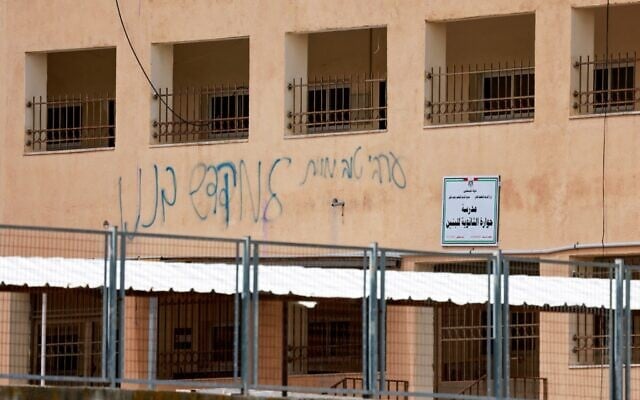
Graffiti daubed by Jewish settlers that reads, "A good Arab is a dead Arab" stains the walls of the Palestinian Huwara Secondary School, where an Israeli flag reportedly placed on the school's roof by Israeli settlers was removed and the Palestinian flag restored by the school in Huwara, south of the city of Nablus in the West Bank on March 23, 2026.(Jaafar ASHTIYEH / AFP)
Palestinian media outlets report that settlers entered a school earlier today in the northern West Bank village of Huwara and sprayed graffiti on the walls.
Among the Hebrew slogans written there were “Revenge” and “A good Arab is a dead Arab.”
Footage from the incident appears to show two individuals entering the school, hanging an Israeli flag at the entrance, spraying graffiti, and then leaving the scene. The school later removed the flag and restored a Palestinian one
Palestinian media also reports that a 16-year-old boy from the village of Deir al-Hatab was assaulted by settlers and treated by the Red Crescent.
Israeli settlers stormed the town of Huwara in Nablus in the West Bank today, raised an Israeli flag and drew a Star of David on the town’s elementary school.
If a Palestinian tried to do this to an Israeli school, he would be shot on the spot before even reaching the door. pic.twitter.com/IQDTIzyhzE
— Ihab Hassan (@IhabHassane) March 23, 2026
Trump: There’s a very good chance for a deal with Iran
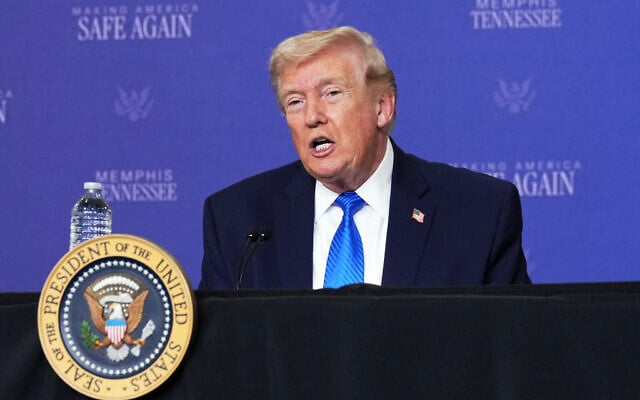
US President Donald Trump participates in a roundtable discussion on public safety at a Tennessee Air National Guard Base, March 23, 2026, in Memphis, Tennessee. (AP Photo/ Mark Schiefelbein)
US President Donald Trump says, “We’ve been negotiating [with Iran] for a long time, and this time, they mean business.”
“It’s only because of the great job that our military did,” Trump says in remarks during an event in Tennessee.
“Hopefully a deal is possible, but no matter what, we’ll ensure that Iran never obtains a nuclear weapon,” Trump says.
“Now, Iran has one more opportunity to end its threats to America and our allies, and we hope they take it. Either way, America and the entire world will soon be much safer and there will be a much more secure planet,” he adds.
He reiterates that purported talks with Iran are going very well. “They want peace. They agree [that] They will not have a nuclear weapon, etc., etc., but we’ll see.”
“I would say there’s a very good chance” for a deal,” Trump says.
He insists that the deal being discussed with Iran will be beneficial to US allies in the Middle East, including Israel, which “has been a great partner in this fight.”
“We’re giving it five days, and then we’re going to see where that takes us… I think it could very well end up being a very good deal for everybody — as good as if we went all the way and just literally annihilated the place,” Trump says.
IDF says it struck IRGC’s main security HQ
The Israeli Air Force struck the “main security headquarters” of Iran’s Islamic Revolutionary Guard Corps during a wave of strikes in Tehran a short while ago, the military says.
The IDF says the headquarters was embedded within “civilian infrastructure,” and was used by the IRGC to “synchronize regional units responsible for enforcing regime order and internal security,” including the Basij paramilitary force.
Steps were taken to mitigate civilian harm in the strike, the military adds.
Mediators seeking US-Iran summit in Islamabad in coming days — report
Channel 12 cites an unnamed Israeli official who said that mediating countries are trying to convene a meeting in Islamabad, Pakistan between the US and Iran — possibly as soon as later this week.
The US would be represented by Jared Kushner and Steve Witkoff as well as Vice President JD Vance, while Iran’s delegation would be headed by parliament speaker Mohammad Bagher Qalibaf, the Israeli official says.
Explosions, sirens ring out in Bahrain
Several strong explosions and air alert sirens ring out in Bahrain, according to an AFP journalist, the first to be heard in the Gulf since US President Donald Trump said talks to end the war with Iran were underway.
“Citizens and residents are urged to remain calm and head to the nearest safe place,” Bahrain’s interior ministry says on social media.
4 wounded by Hezbollah rocket fire on Kiryat Shmona arrive at Safed, Haifa hospitals
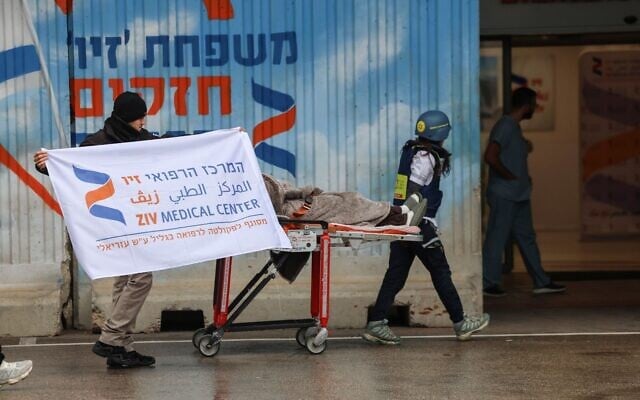
An injured person arrives at Ziv Medical Center in Safed following a Hezbollah rocket attack on Kiryat Shmona on March 23, 2026. (Courtesy/Ziv Medical Center) (edited)
Three injured people have arrived at the Ziv Medical Center in Safed following a Hezbollah rocket attack on the northern border city of Kiryat Shmona, the hospital says.
All the injured are conscious, and their condition is described as stable.
Two of the injured have shrapnel injuries to the face and limbs.
A man in his 30s who was also injured in the strike was taken by helicopter to the Rambam Health Care Campus in Haifa. His condition is not yet known.
Ukraine has ‘irrefutable’ evidence of Russia providing intelligence to Iran, Zelensky says
Ukraine’s military intelligence has “irrefutable” evidence that Russia continues to provide intelligence to Iran, Ukrainian President Volodymyr Zelensky says after meeting the head of military intelligence.
“Russia is using its own signals intelligence and electronic intelligence capabilities, as well as part of the data obtained through cooperation with partners in the Middle East,” he says on X.
Kremlin last week dismissed a Wall Street Journal report that Russia was sharing satellite imagery and improved drone technology with Iran as “fake news”.
US asked for meeting with Iran’s parliament speaker Qalibaf, Iranian official says
The United States on Saturday requested a meeting with Iran’s parliament speaker Mohammad Baqer Qalibaf, a senior Iranian official told Reuters, without mentioning any proposed venue.
The official, who asked not to be identified due to the sensitivity of the matter, says the Supreme National Security Council has yet to decide on any proposed talks and Iran had yet to respond.
Israir says it will limit flights to 5 destinations due to wartime restrictions
Israeli carrier Israir says it will have to limit its flight operations to five destinations only as severe restrictions at Tel Aviv’s Ben Gurion Airport come into effect due to increasing Iranian ballistic missile attacks.
From 5 p.m. today, Israir will operate a reduced flight schedule to nearby Athens in Greece, and Larnaca in Cyprus, alongside Rome in Italy, Tbilisi in Georgia, and Addis Ababa in Ethiopia.
“The new framework severely limits our ability to operate flights on a regular and cost-effective basis,” says Israir. “As part of the outline, we were allowed to operate only about 50% of the number of flights that were recently operated, and each flight is capped at up to 50 passengers from Israel.”
“The destinations will serve as hubs for continuing flights to various destinations,” the airline adds.
Passengers who have already purchased tickets to Athens, Larnaca, Rome, Tbilisi and Addis Ababa will be reassigned to flights in accordance with the new schedule. Once the reassignment process is completed, flights will be open for sale on Arkia’s website and through travel agents.
Mayors of southern Lebanon villages says Israel urged them to push displaced out
Mayors of several towns in southern Lebanon say the Israeli military has ordered them to force out the displaced who had escaped their Shia-majority towns, considered Hezbollah strongholds, during the group’s war with Israel.
Since Lebanon was pulled into the Middle East war following Iran-backed Hezbollah’s March 2 rocket fire on Israel, more than a million people have been displaced by Israeli strikes.
Most of the displaced have fled southern and eastern Lebanon and Beirut’s southern suburbs, all areas where Hezbollah is dominant.
“I received a phone call on Sunday from the Israeli army demanding that my town be ‘cleaned up within 24 hours,'” Elie Abu Nakoul, mayor of Kawkaba in the Hasbaya district, tells AFP.
“I have 21 displaced families and 200 local families, so who will I protect?” he said, adding that he had “no other option but to protect the displaced families from any Israeli targeting and to protect the people of my town from danger.”
The displaced families are due to leave Kawkaba later today.
Over the past week, Abu Nakoul says he has received repeated calls from the Israeli army demanding that he provide the names of displaced people sheltering in his village.
“I refused to provide the names, as this would violate Lebanese law, and I emphasised that the displaced families are innocent civilians, in an attempt to keep them here,” he says.
In nearby Abu Qamha, town notable Michel Abu Rashed received a similar call from Israel, but he also refused to provide names of the displaced.
Lebanon is home to an array of religious communities, and the Hasbaya district includes several Druze, Christian and Sunni Muslim towns.
It borders the Marjayoun district, which has seen Israeli army incursions and clashes with Hezbollah fighters in several areas.
The municipality of Al-Mari in Hasbaya announces in a statement its “commitment to these forced directives,” expressing that it regrets forcing displaced people to leave as it was “imposed” on it.
Egypt frees blogger after more than six years in jail
Egyptian blogger Mohamed Ibrahim Radwan, better known by the moniker Mohamed Oxygen, has been freed after spending more than six years in prison for spreading fake news, according to the press freedom NGO Reporters Without Borders (RSF).
“RSF, which awarded Mohamed Oxygen the RSF Courage Prize in 2023, is delighted by his release” on March 20, the NGO says.
Founder of the blog “Oxygen Egypt,” Radwan was arrested in 2019 after publishing videos on social media about protests against President Abdel Fattah al-Sisi, who has sought to muzzle dissent since coming to power after ousting his predecessor in 2013.
The Egyptian Initiative for Personal Rights says Radwan was sentenced to four years in prison in 2021, and should have been released sooner.
His conviction was “preceded by several years of pre-trial detention that were not deducted from his sentence, in violation of the law,” the group says.
RSF’s 2025 World Press Freedom Index ranks Egypt near the bottom, at 170th out of 180.
According to human rights groups, the country holds tens of thousands of political prisoners, activists, journalists and opponents in its jails, a claim Cairo denies.
Iran parliament speaker: Trump’s ‘fake news’ about talks designed to manipulate markets
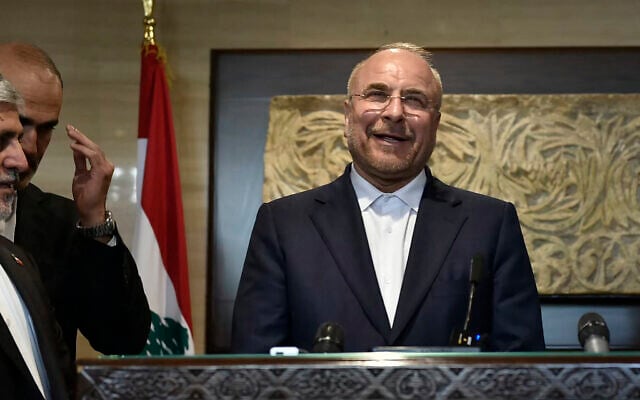
Iran's Parliament Speaker Mohammad Bagher Ghalibaf gives a press conference following a meeting with his Lebanese counterpart in Beirut on October 12, 2024. (AFP)
Iran Parliament Speaker Mohammad Bagher Ghalibaf denies that any negotiations have taken place with the US after Israeli media claimed that he was the official that US President Donald Trump’s envoys have been talking to in recent days.
“Our people demand the complete and humiliating punishment of the aggressors,” Ghalibaf says.
“All officials stand firmly behind their leader and people until this goal is achieved,” he adds, ostensibly referring to Iran’s new supreme leader Mojtaba Khamenei.
“No negotiations with America have taken place. Fake news is intended to manipulate financial and oil markets and to escape the quagmire in which America and Israel are trapped,” he says.
Trump told reporters earlier that the US was negotiating with “the man who I believe is the most respected and the leader.”
Pakistan reportedly acting as main go-between in Trump’s Iran crisis
Pakistan is positioning itself as the lead mediator trying to broker an end to the US’s and Israel’s war against Iran, the Financial Times reports.
Pakistani army chief Asim Munir spoke with US President Donald Trump on Sunday, the newspaper reports, citing two people briefed on the call.
Sirens triggered in Western Galilee amid suspected Hezbollah drone attack
Fresh sirens sound in the Western Galilee, warning of a suspected drone attack from Lebanon.
Hezbollah has carried out several rocket and drone attacks on northern Israel today.
Lebanon says one killed near Beirut, as Israel says it struck IRGC member
An Israeli strike on Hazmieh east of Beirut killed at least one person, Lebanon’s health ministry says, the second strike on the residential Christian area in the ongoing Israel-Hezbollah war.
The Israeli military says around the same time that it had “struck an IRGC Quds Force terrorist in Beirut,” referring to the foreign operations arm of Iran’s Revolutionary Guards.
Hazmieh, which is near Lebanon’s presidential palace, hosts several foreign embassies.
Iran’s foreign ministry denies talks with US
Iran’s foreign ministry spokesperson denies holding any talks with the US during the past 24 days, shortly after President Donald Trump said the two sides had found “major points of agreement” in the past few days.
“Over the past few days, messages were received through some friendly countries indicating a US request for negotiations aimed at ending the war,” says foreign ministry spokesman Esmaeil Baqaei, according to the official IRNA news agency.
However, he “denied any negotiations or talks with the United States during the past 24 days of the imposed war.”
Pope Leo says aerial military strikes should be banned
Pope Leo sharply criticizes aerial bombardments, saying they are indiscriminate and should be banned, in his latest anti-war comments as the US-Israeli war on Iran enters its fourth week.
Leo, the first US pope, does not specifically mention the expanding conflict in a meeting with executives and staff from Italy’s ITA Airways, but he strongly decries the use of airpower in warfare.
“No one should have to fear that threats of death and destruction might come from the sky,” says the pope.
“After the tragic experiences of the 20th century, aerial bombings should have been banned forever,” he says. “Yet they still exist … this is not progress; it is regression!”
The pope has called repeatedly for a ceasefire in the Iran war. On Sunday, he called the conflict a “scandal to the whole human family.”
ITA Airways, controlled by Germany’s Lufthansa and the successor to bankrupt national flag carrier Alitalia, is the airline that usually flies the pope out of Rome when he makes overseas trips.
Germany’s Merz says he shared concerns over Iranian power plant attacks with Trump
German Chancellor Friedrich Merz says that he had spoken to US President Donald Trump on Sunday and expressed his concerns about threatened attacks on Iran’s power plants.
“I am grateful that he said today that he is postponing them for another five days and is now also opening the possibility for immediate and direct contact with the Iranian leadership,” says Merz at a press conference in Berlin.
El Al says it will only fly to 7 destinations in Europe and US amid war-time restrictions
Israel’s flag carrier El Al says flights out of Tel Aviv’s Ben Gurion Airport will be limited to seven destinations across major cities in Europe and the US, following the newly imposed war-related restrictions on the country’s airspace.
“We emphasize that the strict limitations on operations at Ben-Gurion Airport mean that we have transitioned to essential flight activity only, in order to maintain Israel’s air bridge to and from the world,” says El Al.
The Transportation Ministry’s decision announced late on Sunday to slash air traffic at Ben Gurion Airport to one flight per hour, effective from 5 p.m. today, has led to a “dramatic reduction in aviation activity – limiting our outbound flights to 15 per day and capping each departure flight at 50 passengers,” says El Al.
El Al announces that it will operate a small number of flights to the following destinations: New York, Los Angeles, Miami, London, Paris, Rome, and Athens. Flights arriving from these destinations will operate with no passenger limitations.
“Given the limited number of seats, passenger allocation will be carried out according to flight assignment prioritization based on the original flight date, with priority given to exceptional humanitarian and medical cases,” El Al says.
Kremlin says it is monitoring what it calls ‘conflicting signals’ on Iran situation
The Kremlin said on Monday that it was monitoring what it described as contradictory statements regarding the situation in Iran, but hoped the conflict would be resolved quickly, the state TASS news agency reports.
“There have been many different statements today, including some contradictory ones. We continue to monitor the situation closely and hope that it will soon return to a peaceful course,” TASS cites Kremlin spokesman Dmitry Peskov as saying.
US President Donald Trump said on Monday that there had been talks between the United States and Iran over the past day and that the two sides had “major points of agreement,” saying that a deal could be done soon to end the conflict.
Smotrich calls for annexation of southern Lebanon
Israel should extend its border with Lebanon up to the Litani River deep inside the country’s south, Finance Minister Bezalel Smotrich says, as Israeli troops bombed bridges and destroyed homes in the area in an escalating military assault against Hezbollah.
The comments by Smotrich are the most explicit yet by a senior Israeli official on seizing Lebanese territory in a fight Israel says targets Iran-backed Hezbollah militants.
Smotrich tells an Israeli radio program that the military campaign in Lebanon “needs to end with a different reality entirely, both with the Hezbollah decision but also with the change of Israel’s borders.”
“I say here definitively…in every room and in every discussion, too: the new Israeli border must be the Litani,” Smotrich says.
Smotrich, leader of a small far-right party in Prime Minister Benjamin Netanyahu’s cabinet, often makes comments that go beyond official Israeli policy.
Netanyahu’s office does not immediately respond to a request for comment on the remarks. Defense Minister Israel Katz hinted earlier this month at plans to capture land, saying Lebanon could face “loss of territory” if it did not disarm Hezbollah.
Smotrich’s remarks are deeply resonant in Lebanon, which is trying to emerge from a decades-old cycle of invasions and occupations by its neighbor. Israeli forces have launched repeated assaults on Lebanon since 1978 and occupied the south from 1982 to 2000.
A Lebanese official tells Reuters that Beirut is still counting on foreign powers to put enough pressure on Israel to put an end to the war, through an offer from President Joseph Aoun to hold direct talks.
Smotrich also calls for Israel to annex territory it now controls in the Gaza Strip, up to an armistice line with Hamas. A ceasefire signed in October left Israel in control of 53% of Gaza, where it has ordered residents out and bulldozed buildings.
Bank of Israel chief says gov’t will have to raise taxes to finance rising defense needs
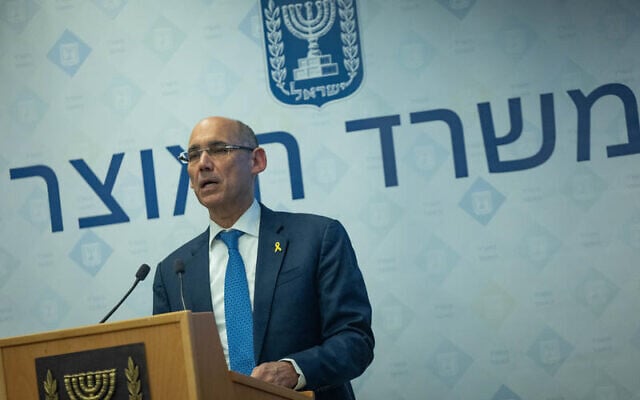
Governor of the Bank of Israel Amir Yaron speaks during a press conference at the Finance Ministry in Jerusalem on August 6, 2025. (Yonatan Sindel/Flash90)
Bank of Israel Governor Amir Yaron cautions that the government will need to raise taxes to finance the country’s rising defense needs, and return to a downward trajectory of debt payments amid an ongoing war with Iran.
“Nobody likes to pay taxes,” says Yaron at a press conference in Jerusalem. “But looking ahead, we need to ask ourselves how we manage, on the one hand, a budget that finances security needs and on the other hand directs budgets for expenditure that support the engines of future economic growth.”
“The need to reduce the debt-to-GDP ratio, maintain it at a prudent level over time, and create fiscal space to respond to future shocks—alongside relatively low civilian spending — underscores the difficulty of securing funding sources for these expenditures and the potential need to increase government revenues to achieve these objectives,” Yaron adds.
Yaron reiterates that the government needs to cut expenses that do not support growth while increasing state revenues.
The governor’s recommendations come as the government faces criticism over its wartime decision to significantly boost the allocation of funds to coalition priorities while simultaneously slashing the budgets of all ministries, which will harm public health, education, and other public services.
“Lowering the debt-to-GDP ratio alongside high defense spending, investing in growth engines, will require budgetary adjustments that also include cuts in spending that don’t support growth, and therefore the government needs to increase the revenue side,” says Yaron.
Speaking at a presentation of the central bank’s 2025 annual report, Yaron notes that civilian public spending in Israel is already low by international comparison.
“If we want to increase productivity, which is low and public services, it will be necessary to increase investment in growth-supporting items such as infrastructure and education,” says Yaron.
Two Iran missiles landed in Lebanon last night — IDF
Two ballistic missiles launched from Iran at Israel last night struck Lebanese territory, the Israeli military says.
It apparently marked the first time that Iranian ballistic missiles hit Lebanon during the current war.
“Hezbollah, which calls itself the ‘defender of Lebanon,’ is in fact a defender of the Iranian terror regime,” says Lt. Col. Ella Waweya, the IDF’s Arabic-language spokeswoman.
She says, “Hezbollah sacrificed the residents of Lebanon by entering the war due to Iranian interests.”
“And now, it has already led to direct harm by the Iranian regime to the residents of Lebanon,” Waweya adds.
#خاص وخطير🔸 جيش الدفاع يكشف: اثنان من الصواريخ التي أطلقها النظام الإرهابي الإيراني أمس إلى دولة إسرائيل يسقطان في الأراضي اللبنانية
🔸حزب الله الذي يطلق على نفسه "حامي لبنان" ما هو إلا حامي النظام الإرهابي الإيراني.
🔸إن الواقع واضح: ضحى حزب الله بالمواطنين اللبنانيين عندما… pic.twitter.com/NSL3CX9q3v
— Lieutenant Colonel Ella Waweya | إيلا واوية (@CaptainElla1) March 23, 2026
2 Gas tankers sail through Hormuz to India, but most ships still stuck
Two tankers bound for India sailed through the Strait of Hormuz on Monday carrying liquefied petroleum gas (LPG) loaded in the United Arab Emirates and Kuwait, although overall traffic through the critical waterway remained blocked.
Hundreds of vessels and some 20,000 seafarers have remained stranded inside the Gulf since Tehran threatened to attack ships attempting to leave via the Strait of Hormuz, through which about 20% of global oil and liquefied natural gas normally flow.
The Pine Gas tanker sailed through the Strait with the Jag Vasant following close by, ship tracking data on the MarineTraffic platform shows.
The Pine Gas broadcast a message identifying itself as “India ship and crew,” according to separate LSEG ship tracking data.
India’s Ministry of Ports, Shipping and Waterways confirms that the two Indian-flagged tankers, carrying more than 92,000 tonnes of LPG, had sailed through Hormuz with their Indian crews on board.
The vessels were expected to reach ports in India between March 26 and 28, the ministry says.
IDF says it destroyed or disabled around 330 of Iran’s 470 missile launchers
The IDF says it has destroyed or disabled around 330 of Iran’s estimated 470 ballistic missile launchers.
More than half of the launchers were destroyed in strikes, while the others are considered to be inoperational after the Israeli Air Force struck entrances to subterranean facilities where they are stored, according to the military.
The military says the IAF continues to hunt down the remaining roughly 150 launchers to reduce the missile fire on Israel, which has slowed to around 10 missiles a day in recent days, down from around 90 on the first day of the war.
The Israeli military cannot comment on US President Donald Trump’s announcement of negotiations with Iran, saying it is a “political echelon matter.”
The IDF says it is operating in accordance with the directives of Israel’s political leadership and will continue to strike in Iran according to its plans until instructed otherwise.
IDF diverts battalion from Lebanon to West Bank amid uncurbed settler attacks
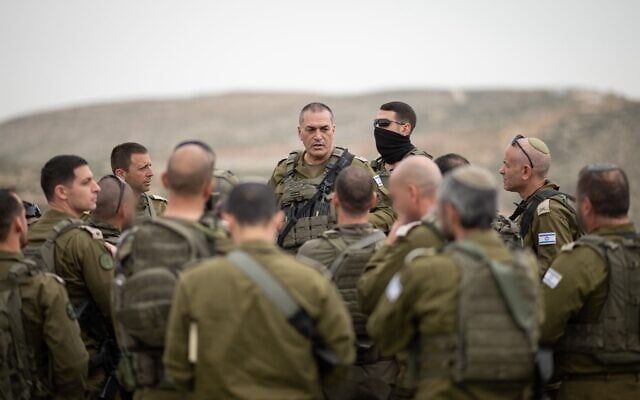
IDF Chief of Staff Lt. Gen. Eyal Zamir meets with officers in the West Bank, March 18, 2026. (Israel Defense Forces)
The IDF has diverted an infantry battalion that was intended to be deployed to Lebanon to the West Bank amid a spate of attacks by settlers against Palestinians, the army says.
The battalion from the School for Infantry Corps Professions and Squad Commanders was sent to the West Bank yesterday, and the military says it may send more troops due to the uptick in violence by Israelis against Palestinians.
The move comes amid mounting international criticism of Israel’s failure to crack down on attacks by settler extremists, which have been taking place on a near-daily basis. Critics note that Israel’s security forces can be part of the problem, sometimes either taking part in the attacks or standing by without interfering as they unfold.
IDF says it struck several Iranian military bases and weapon production sites
The IDF says it struck several Iranian military bases and weapons production sites during a wave of airstrikes in Tehran overnight
Dozens of Air Force fighter jets dropped over 100 bombs on the sites, the military says.
According to the IDF, the sites included: A base of the Islamic Revolutionary Guard Corps’ Quds Force that oversaw “operational and intelligence activity”; an IRGC air defense headquarters; an IRGC ground forces headquarters; an intelligence headquarters of the IRGC Quds Force; a naval cruise missile production site belonging to the Iranian defense ministry; and several more facilities involved in the production and research of weapons, including in the fields of electronics, ballistic missiles, and warheads.
US energy secretary says further release of reserve oil unlikely
US Energy Secretary Chris Wright says that the US could release more oil from its Strategic Petroleum Reserve to calm energy markets during the war with Iran but calls such a move “highly unlikely,” in an interview with CNBC.
The US earlier this month announced a 172 million barrel exchange from the reserve in a larger coordinated release with International Energy Agency countries. The SPR currently holds about 415 million barrels.
Air France extends suspension of its flights to and from Dubai, Riyadh, Tel Aviv, Beirut
Air France has extended the suspension of its flights to and from Dubai and Riyadh until March 31, and to and from Tel Aviv and Beirut until April 4, it says.
“Due to the security context at the destination and the closure of certain airspaces, the company is forced to extend the suspension of its flights,” the airline says.
Knesset speaker says current parliamentary session will end on March 31, reconvene on May 10
Knesset Speaker Amir Ohana announces that, subject to the approval of the Knesset House Committee, the current winter parliamentary session will end on Tuesday, March 31. Following the Passover recess, the Knesset will reconvene on Sunday, May 10.
March 31 is also the deadline for passing the 2026 state budget. If the coalition fails to pass it by then, the Knesset will automatically dissolve, triggering early elections three months later. Elections are currently slated to be held by late October.
White House said negotiating with Iran’s hardline parliament speaker
US President Donald Trump’s top envoys Steve Witkoff and Jared Kushner negotiated with Iran’s parliament speaker Mohammad Bagher Ghalibaf, Israeli officials tell Hebrew language media.
Ghalibaf, a close friend of slain IRGC Quds Force commander Qassem Soleimani who has been involved in violent suppression of protests, has emerged as a leading wartime decision-maker as leading Iranian officials have been taken out in the Israeli-US campaign against Iran.
Earlier today, Trump claimed that the US was in talks with a respected leader in Iran, while declining to reveal his identity.
Asked who will control Hormuz if it’s reopened, Trump responds, ‘Maybe me and the ayatollah’
Asked about the currently Iran-blocked Strait of Hormuz, US President Donald Trump says it’ll be open “immediately” if a deal is reached.
As for who will control Hormuz once its reopened, Trump pauses to think about his answer before declaring that the channel will be “jointly controlled.”
“Maybe [by] me and the ayatollah — whoever the ayatollah is,” he says.
Pressed on approval of sanctions relief for Iran oil, Trump says he just wants to ‘keep system lubricated’
US President Donald Trump is pressed to explain his decision to waive sanctions on Iranian oil after he criticized previous presidents for offering similar relief to Tehran.
“I just want to have as much oil in the system as possible, and we don’t even know if Iran gets that money,” Trump says of what is expected to amount to $14 billion entering Iran’s coffers.
“You have ships that are out there loaded up with oil. Rather than keep them there, I would rather see [the oil] go to the system,” Trump continues. “Any small amount of money that Iran gets is not going to have any difference in this war, but I want to have the system be lubricated.”
“The price of oil will drop like a rock as soon as a deal is done,” he adds, noting that prices have already dropped since he announced the purportedly productive negotiations earlier today.
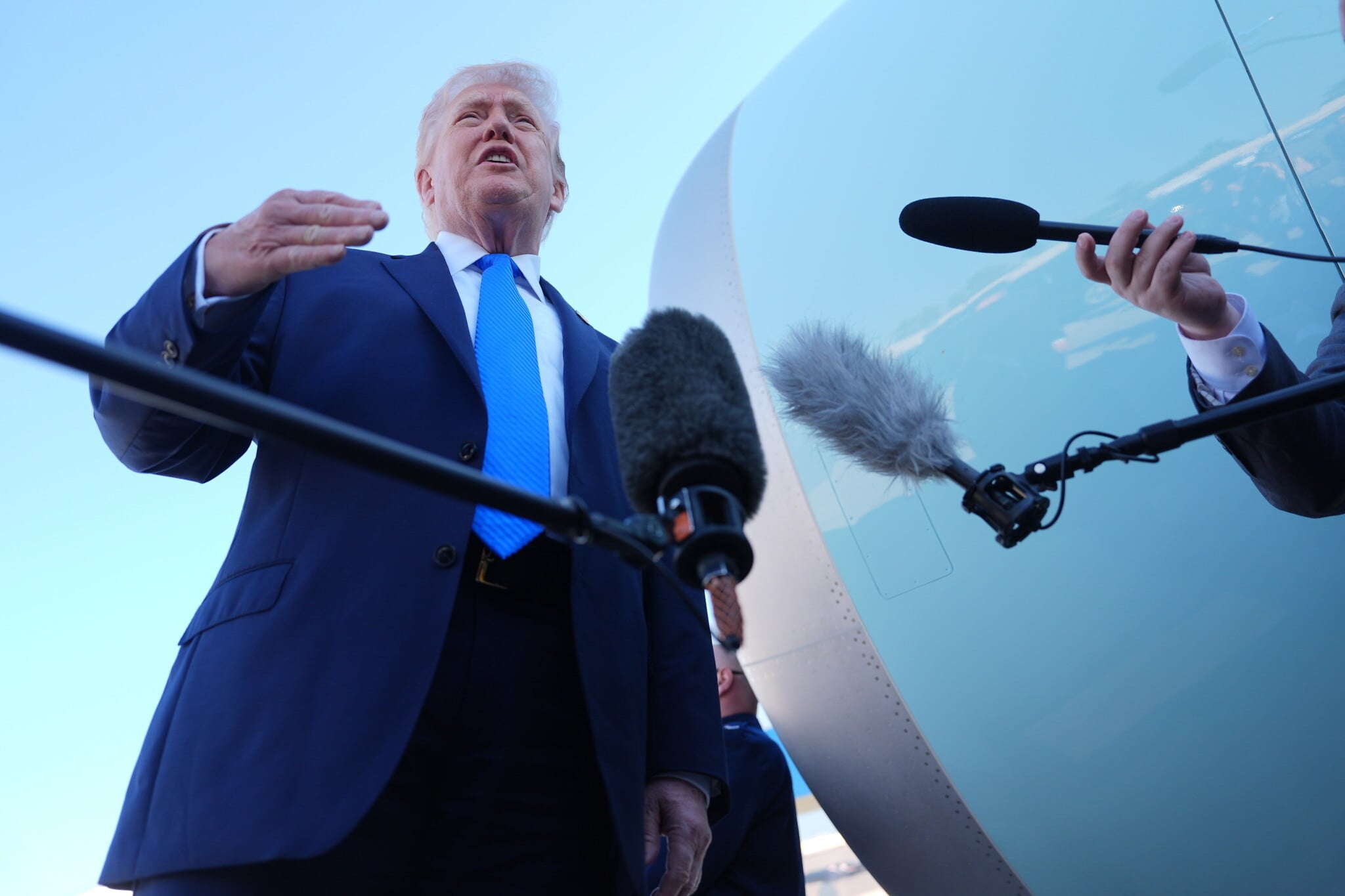
Trump: Iran deal close; US speaking to regime’s ‘most respected’ leader in Iran, who has agreed to no nukes, no uranium enrichment; Israel will be ‘very happy’
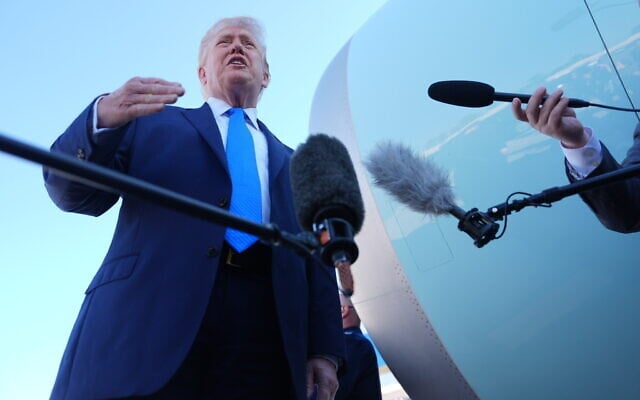
US President Donald Trump speaks with the media before boarding Air Force One, Monday, March 23, 2026, at Palm Beach International Airport in West Palm Beach, Fla. (AP Photo/Mark Schiefelbein)
US President Donald Trump claims the US has been having “productive” conversations with Iran that have led to “major points of agreement” on “almost all points” for a deal to “end that conflict.”
Asked by reporters before boarding Air Force One to respond to the Iranian foreign ministry’s denial of his description of the talks earlier today, Trump claims that there’s a communication breakdown in Tehran and that those involved in the talks aren’t necessarily able to contact other people in the regime.
Trump says his top envoys Steve Witkoff and Jared Kushner participated in the talks on behalf of the US, insisting that they went “perfectly” and that they took place Sunday and went into the evening.
“If they carry through with that, it’ll end that conflict very substantially. We have very much in mind our partners in the Middle East,” he says.
Trump claims Iran wants to make a deal “very much” and that the US does too.
He says the sides will likely reconvene later today over the phone because it is difficult for Iran’s negotiators to leave the country amid the war.
He says he had approved a Tuesday morning strike on Iran’s “largest electric generating plant” but that Iran then reached out to the US asking to make a deal.
“If it goes well, we’re going to end up settling this. Otherwise, we just keep bombing our little hearts out,” Trump says.
Asked who the US is speaking to if it is the case, as Trump claims, that Iran’s first and second tier leaders have been knocked out, the president says, “We’re dealing with the man who I believe is the most respected and the leader… We have people who are very representative of the country.”
He declines to identify this leader, saying “I don’t want him to be killed.” But he says it is not Mojtaba Khamenei, who is believed to have been injured in the war’s opening strike that killed his father and was subsequently selected to replace him. “We have not heard from the son… We don’t know if he’s living…[The Iranians] haven’t seen him there either… I don’t consider him really the leader.”
Trump claims the killing of Iran’s leaders in the war thus far has effectively led to “a very serious form of regime change.”
“We’re dealing with some people who I find to be very reasonable, very solid… maybe one of them will be exactly what we’re looking for,” Trump says, expressing his hope that the situation in Iran will develop similarly to how it did in Venezuela where the vice president is engaging with the US after Washington captured its president, Nicolas Maduro.
Pressed to detail the supposed points of agreement from negotiations with Iran, Trump claims Tehran has agreed to “15 points,” including not obtaining a nuclear weapon — something the Islamic Republic has long insisted it does not seek, despite enriching uranium to near weapons-grade. And he says it has agreed not to enrich any uranium — something Iran has long insisted is its right.
“We want to see no nuclear bomb, no nuclear weapon, not even close to it, no nuclear missiles, we want to see peace in the Middle East, we want the nuclear dust,” he says, referring to Iran’s stockpiles of 60%-enriched uranium. He then claims Iran has agreed to hand over that highly enriched material as well. “We want no enrichment. We also want the enriched uranium.”
Asked again about the uranium stockpiles, Trump says that if there is an agreement, “We’re going down and we’ll take it ourselves.”
“If this happens, it’s a great start for Iran to build itself back,” Trump continues. “It’s also great for Israel, and it’s great for the other Middle Eastern countries,” he says, listing Saudi Arabia, UAE, Qatar, Kuwait and Bahrain.
Trump says the US spoke with Israel about these developments recently and that Jerusalem will be “very happy.”
Asked if his administration is still going to request $200 billion from Congress for the war, Trump responds, “It’s always nice to have.”
“This will be peace for Israel. Longterm peace, guaranteed peace — if this happens. And I can’t guarantee it, but… I think this is something that’s going to happen. Why wouldn’t it happen?”
“They called. I didn’t call. They called,” he says. “They want to make a deal. We are very willing to make a deal. It’s got to be a good deal. And it’s got to be no more wars, no more nuclear weapons. They’re not going to have nuclear weapons anymore. They’re agreeing to that.”
Iran “wanted to take over the Middle East and they wanted to knock out Israel permanently,” he adds. “If they had a nuclear weapon, they would have been able to… They would have had a nuclear weapon within two weeks to a month” if they had not been hit.
“We have a very serious chance of making a deal,” he says. “We are in the throes of a real possibility of making a deal… but again I’m not guaranteeing anything.”
IDF says it targeted IRGC’s Quds Force member in Beirut
The Israeli military says it carried out a strike in Beirut targeting a member of the Quds Force, the extraterritorial arm of Iran’s Islamic Revolutionary Guard Corps.
No further details on the strike in Lebanon’s capital are immediately given by the IDF.
After fresh assessment, IDF lifts order for northern border residents to stay near shelters
Following a fresh assessment, the IDF says residents of communities near the Lebanon border no longer need to remain close to bomb shelters.
The IDF had issued the warning half an hour ago as it expected increased Hezbollah rocket fire.
WATCH: Trump tells reporters ‘very good chance’ of a deal with Iran; Israel will be very happy
US President Donald Trump is speaking to reporters about Iran, and says there is a very good chance of a deal.
He tells reporters the United States has held talks with Iran and that the two sides had “major points of agreement.”
Trump says the conversations that took place on Sunday will continue on Monday and that if the negotiations continues productively, there will be a deal very soon.
Trump adds that his Middle East envoy Steve Witkoff and son-in-law Jared Kushner held the talks.
He says Iran wanted the talks.
He also says if a deal is reached with Iran, the US will move to take Iran’s enriched uranium critical to its nuclear program.
He also says Israel “will be very happy” with what is unfolding.
Without referencing Trump message on Iran talks, Netanyahu says Iran is ‘down, we are up’
Prime Minister Benjamin Netanyahu says that Israel is working to bring both Israel and Iran to “places [they] have never been,” and asserts Jerusalem’s advantage over Tehran, in a Hebrew-language video of him speaking with Foreign Affairs and Defense Committee chairman MK Boaz Bismuth.
It is unclear if the filmed conversation took place before or after US President Donald Trump’s announcement that talks are underway with Iran to end the conflict.
In the video, Bismuth tells Netanyahu, “I’m hearing that the Iranians want to close the matter… There must not be a bad agreement [with them,]” reminding the premier of his past efforts to block undesirable nuclear deals between Washington and Tehran.
“We are working to bring Israel to places it has never been, and also Iran to places it has never been. They are down, we are up,” Netanyahu responds.
Jerusalem to open pre-Passover camps in kindergartens across the city
Pre-Passover camps will start tomorrow in preschools across Jerusalem, the Jerusalem municipality announces. The city requested and obtained permission to operate the programs for children ages 3-6 from the Home Front Command.
Camps are usually organized in kindergartens and the lowest grades of elementary schools during the education system’s vacations. Tomorrow marks the beginning of the Passover vacation (the Jewish festival itself will begin at sundown on April 1).
Under the Home Front Command color-coding system, “yellow” areas are considered to be at a lesser risk of being attacked by Iran or Hezbollah, while “orange” areas are considered at a higher risk, but the current outline determined by the Home Front Command and the Education Ministry for education activities allows also municipalities designated as orange, such as Jerusalem, to seek authorization to open their pre-Passover camps.
On Sunday, the Haifa municipality also said it would operate its informal education programs for kindergartens and grades 1-3 between 8:00 and 13:00. Haifa is designated as orange.
In Jerusalem, the pre-Passover camps will operate in kindergartens with shelters between 8:00 and 16:00, while kindergartens without a protected space will be assigned an alternate location.
Special education programs across Israel are also allowed to function in accordance with Home Front Command guidelines.
IDF tells northern border residents to stay near shelters due to expected Hezbollah rockets
Residents of communities on the Lebanon border have been instructed by the military to remain close to bomb shelters until further notice, as the IDF expects increased Hezbollah rocket fire in the coming hours.
“Movement in the area should be minimized and gatherings avoided. Upon receiving an alert, you must enter a protected space,” the military says.
Hezbollah has been bombarding the Kiryat Shmona area today, with one rocket strike wounding two people, including one seriously.
2 hurt, 1 seriously in Hezbollah rocket attack on Kiryat Shmona, medics say in updated toll
Two people are injured in the Hezbollah rocket attack on Kiryat Shmona, including one in serious condition, medics say.
Magen David Adom says a man in his 50s was hit in the face by shrapnel and is listed in serious condition. Initially, MDA listed him in moderate-to-serious condition. He is being taken to Rambam hospital in Haifa by helicopter.
Another man in his 80s is lightly hurt by shrapnel, and he is being taken to Ziv Medical Center by ambulance, MDA adds.
Lapid slams bill expanding power of rabbinical courts: Israel’s religious status quo ‘dead, buried’
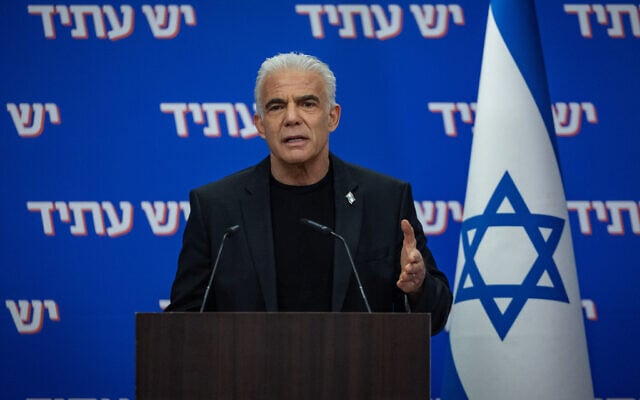
MK Yair Lapid leads a faction meeting at the Knesset on March 23, 2026 (Yonatan Sindel/Flash90)
Condemning the coalition’s wartime efforts to pass a a bill expanding the power of the rabbinical courts, Opposition Leader Yair Lapid declares that the state’s longstanding religious status quo is “dead, buried, eliminated [and] canceled.”
This legislation creates a “halachic state,” or a country governed by Jewish religious law, Lapid tells reporters ahead of his Yesh Atid party’s weekly faction meeting in the Knesset.
He further slams the coalition for pushing for additional funding for ultra-Orthodox school networks that fail to teach the full core curriculum, arguing that the Haredi parties’ legislative efforts have sent the rest of Israel the message that they “are our cash cow, and we will take advantage of every opportunity to extort and take advantage of you.”
“Remember this day when the next government comes, when we pass legislation stating there will be no more money for any education system that does not teach a full core curriculum… including civics and democratic studies,” he says.
Lapid says that if elected, the opposition will pass bills cutting off draft evaders from all government assistance; allowing mayors to “fire city rabbis, or to hire Reform and Conservative rabbis”; instituting civil marriage and establishing “public transportation on Shabbat in secular majority localities.”
They will also “establish a system that grants Kosher certification without going through the Rabbinate,” Lapid declares. “Remember this day, and do not come crying to us about the status quo, because you killed it.”
Pushing back against opposition criticism, coalition whip Ofir Katz (Likud) says that the opposition must not have noticed the Knesset advancing bills to benefit reservists, evacuees and business owners impacted by the war this week. “We are continuing to act for the Israeli public.”
Fresh sirens in Kiryat Shmona as Hezbollah pummels northern border town
The aftermath of a Hezbollah rocket attack on Kiryat Shmona on March 23, 2026 (Israel Police)
Amid a fresh Hezbollah attack, sirens sound in the northern city of Kiryat Shmona and nearby towns, as medics work to evacuate a man wounded in a previous attack to a hospital.
The alerts warn of rocket fire and a suspected drone infiltration.
Sirens have sounded in Kiryat Shmona multiple times in the past two hours.
7 arrested over attack on Palestinian hamlet in which settlers said to have sexually abused resident
Police say they have arrested seven suspects in connection to a settler attack on a West Bank Palestinian hamlet earlier this month, in which assailants are said to have sexually assaulted a resident.
One of the alleged attackers was released last night under restrictive conditions on a judge’s order. The others will remain in custody until at least Wednesday.
The attack on Khirbet Humsa, a Bedouin town in the northern Jordan Valley, took place before dawn on March 13 when a group of violent settlers broke into residents’ homes and forced them outside.
The attackers restrained the residents, beat them violently, and committed “indecent acts” on one of the victims, law enforcement says.
An American activist who witnessed the scene told Haaretz several days later that the settlers “pulled down the Palestinian man’s pants, poured water all over him and brutally beat him into the dirt.”
“All he could do was curl into a fetal position and scream when they beat him with their clubs,” she recalled. “It was one of the worst things I’ve ever seen.”
Police say the rioters damaged and stole villagers’ property, including a large number of sheep used as livestock. Several residents sustained injuries, including four who required medical treatment, according to the police statement.
The attack is being probed by the West Bank District’s investigations and intelligence unit “alongside additional security agencies.” According to Haaretz, the Shin Bet is involved in the ongoing investigation.
1 moderately-to-seriously wounded in Hezbollah rocket attack on Kiryat Shmona
One person is wounded by a Hezbollah rocket that struck the northern border city of Kiryat Shmona, medics say.
Magen David Adom says the man, in his 50s, was hit in the face by shrapnel, and he is listed in moderate-to-serious condition.
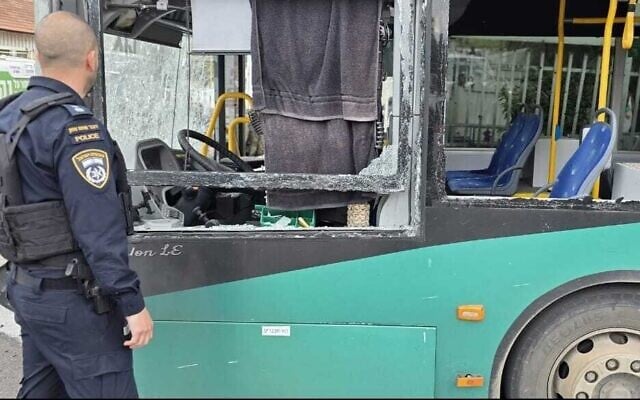
The rocket launched from Lebanon struck a road, causing damage to a bus and injuring the man standing near it.
Several other rocket impacts are reported in the city.
Trump: Iran wants to make a deal badly, could happen in next 5 days

US President Donald Trump speaks to reporters aboard Air Force One, March 15, 2026, en route from West Palm Beach, Florida, to Joint Base Andrews, Maryland. (AP Photo/Mark Schiefelbein)
US President Donald Trump says that Iran wants to make a deal “badly,” which could happen in the next five days, or even sooner.
Speaking to Fox Business, Trump says that talks with Iran took place as recently as last night, led by top White House envoys Jared Kushner and Steve Witkoff.
Trump’s first two interviews after announcing that he was in talks with Iran were with Fox Business and CNBC, both leading business channels, an indication that the president is eager to calm market jitters and bring energy prices down.
Reports of several rocket impacts as Hezbollah targets Kiryat Shmona
Medics are responding to reports of several rocket impacts in the northern border city of Kiryat Shmona.
Sirens had sounded in the city amid the Hezbollah attack, the fifth within an hour.
Medics are responding to reports of several rocket impacts in the northern border city of Kiryat Shmona.
Sirens had sounded in the city amid the Hezbollah attack, the fifth within an hour. pic.twitter.com/t5EEFxVbnQ
— Emanuel (Mannie) Fabian (@manniefabian) March 23, 2026
Source says Israel likely to follow US lead in suspending any potential strikes on Iranian energy sites
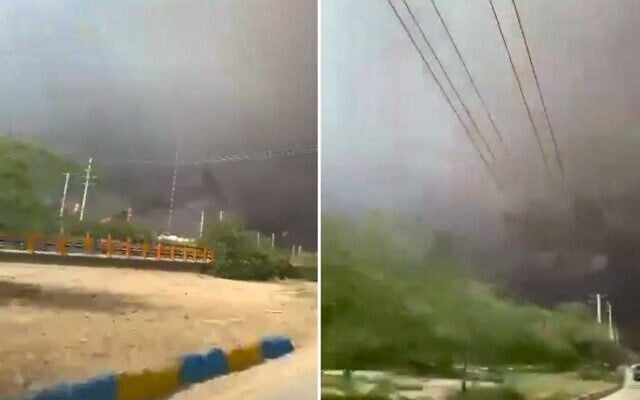
Footage shows the aftermath of an IDF strike on the South Pars gas field on the northern coast of the Persian Gulf, in Asaluyeh, Iran, on March 18, 2026. (Social media, used in accordance with Clause 27a of the Copyright Law)
A source briefed on Israel’s war plans says Washington kept it informed of its talks with Tehran, and that Israel was likely to follow Washington in suspending any targeting of Iranian power plants and energy infrastructure.
Israel has not explicitly threatened to hit Iranian energy sites, but Defense Minister Israel Katz said Sunday that strikes on Iran and on “the infrastructure it relies on will significantly escalate.”
Report: Trump’s announcement follows efforts by Egypt, Pakistan and Turkey to postpone Hormuz ultimatum, seek end to war, but no agreements yet
Channel 12’s Barak Ravid offers context on Trump’s bombshell announcement regarding ongoing discussions with Iran on ending the war, and his suspension of his ultimatum to bomb Iranian energy sites if the Strait of Hormuz is not opened.
Egypt, Pakistan and Turkey have been working desperately to buy time before that ultimatum was set to expire later today, says Ravid.
Yesterday, their foreign ministers spoke with Iran’s Foreign minister Abbas Araghchi and, separately, with Trump’s envoy Steve Witkoff. They reportedly discussed not only seeking a solution regarding the Strait of Hormuz, but also ending the war.
Trump agreed to a five-day postponement of his ultimatum, says Ravid, but that does not mean an agreement has been reached.
Liberman: Netanyahu leaving north unprotetected ‘solely out of political considerations’
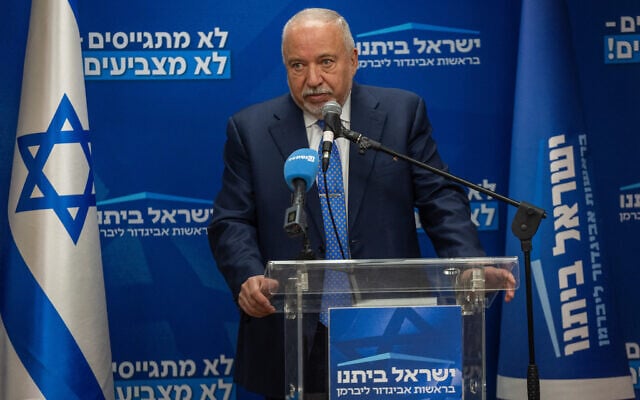
Yisrael Beytenu chairman Avigdor Liberman leads a faction meeting at the Knesset on March 23, 2026 (Yonatan Sindel/Flash90)
Yisrael Beytenu chairman Avigdor Liberman accuses Prime Minister Benjamin Netanyahu of leaving the north unprotected “solely out of political considerations,” stating that the premier twice rejected his plans to protect the north during his time as defense and finance ministers.
“Today, while millions of citizens are running to shelters several times a day… the Knesset will discuss the ‘most important’ thing for the State of Israel: expanding the powers of the rabbinical courts,” Liberman tells reporters ahead of his party’s weekly faction meeting, referring to a bill which would give the religious courts power to arbitrate civil disputes, including over child custody.
“This is absolute madness and moral bankruptcy. I don’t understand how the coalition leaders manage to sleep at night,” he says.
“Billions were found for the [draft] evaders, but several hundred million for the shelters were not found,” he continues, referencing a recent state comptroller report that some three million Israelis don’t have access to bomb shelters. “I really hope that in the end, the residents of the north will remember this conduct of the current government on election day as well.”
Asked about the possibility of the United States pulling out of the war with Iran, Liberman insists that “regardless of the United States’s announcement, regardless of Iran’s announcement, Israel should define the goal as clearly as possible: Toppling the ayatollah regime.”
“If the war stops, I’m not sure that the regime’s leaders will work to teach tolerance to the future generation of Iran,” he quips. “Therefore, from our perspective, overthrowing the regime is the solution and we must do it. Preferably in partnership with a superpower like the United States. But even if we have to do it alone, that’s our goal, because otherwise we’ll go back for more and more rounds [of fighting].”
IDF warns will bomb another Litani River bridge to prevent Hezbollah activities
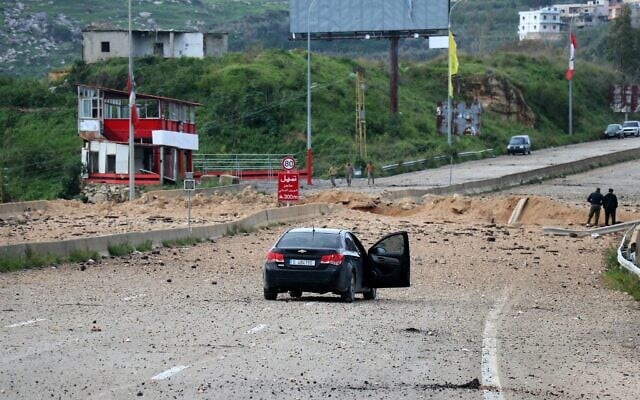
Two men stand near a crater the day after an IDF airstrike targeted the Qasmiyeh Bridge after Israel said it was being used by Hezbollah, in southern Lebanon on March 23, 2026 (Kawnat HAJU / AFP) /
The IDF warns it will bomb another bridge on the Litani River to prevent Hezbollah from moving operatives and weapons into southern Lebanon.
The military says it will strike the Al-Dalafa Bridge, located on the eastern portion of the river.
Israel has already warned that it would bomb all crossings on the Litani River over Hezbollah’s use of them.
‘This is regime change,’ Trump claims, after announcement of talks to end Iran war
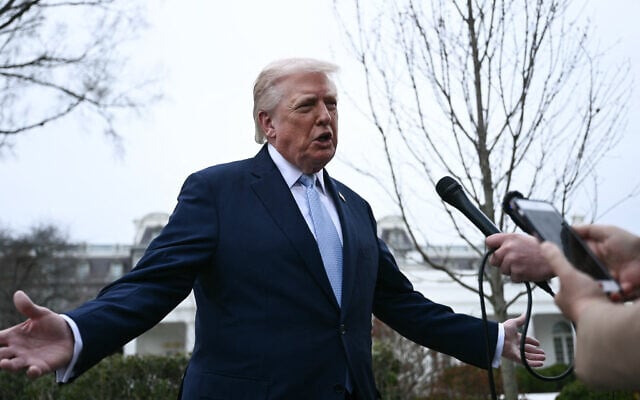
US President Donald Trump speaks to journalists before boarding Marine One as he departs from the South Lawn of the White House in Washington, DC, on March 20, 2026 for his Mar-a-Lago residence, where he will spend the weekend. (Photo by Brendan SMIALOWSKI / AFP)
After announcing that he has been involved in talks with Iran on a possible end to the war, US President Donald Trump tells CNBC that “this is regime change.”
According to the US outlet, Trump bases his assessment on the fact that many Iranian leaders have been killed and replaced.
He tells the outlet that “we are very intent on making a deal with Iran.”
“Great meeting, great conversations,” Trump says of contacts with Iran, calling the discussions “very intense.”
Asked who exactly the US has been speaking to, Trump says, “They have representatives.”
Rocket sirens sound in Kiryat Shmona for fourth time within an hour
Sirens sound in the northern border city of Kiryat Shmona for the fourth time in an hour, warning of a rocket attack from Lebanon.
The alerts are also activated in surrounding communities.
Knesset legal department says Finance Ministry illegally transferred funds to ultra-Orthodox schools
The Knesset legal department says that the Finance Ministry’s December approval of a NIS 1 billion ($315 million) transfer to ultra-Orthodox schools before receiving approval from the Knesset Finance Committee was illegal and that lawmakers and legal advisers were not informed the money had been distributed, in a statement ahead of a High Court of Justice hearing on the subject on Wednesday.
In a preliminary response to the High Court, the Knesset legal department says that “the manner in which the funds were transferred prior to Finance Committee approval is illegal.”
“The Knesset views with particular severity the fact that this was concealed from members of Knesset and from the legal advisory staff,” the letter continues.
The funds are at the center of an ongoing High Court case after petitions by the Yesh Atid party and the Hiddush religious freedom and equality organization argued the transfer was illegal because the ultra-Orthodox schools do not meet legal requirements to teach core subjects. The state admitted at a January High Court hearing that some 90 percent of the money had already been transferred before lawmakers formally approved the measure in late December.
The letter flatly rejects claims by the Finance Ministry that “the matter was understood by the committee” or that distributing funds before committee approval is “a common practice,” as also argued by the state’s representative at the High Court hearing.
The Knesset legal advisor notes that the Finance Ministry has not responded to repeated requests for information on the extent of the practice of distributing funds before committee approval.
In response to the letter, Yesh Atid MK Vladimir Beliak, one of the petitioners, says that, “The Netanyahu-Smotrich government acted in the shadows and used public funds as if they were its private coffers. This is blatant, systematic, and deliberate theft — corruption that cries out to the heavens.”
Israel launches fresh strikes in Tehran as Trump announces talks beng held with Iran on ending the war
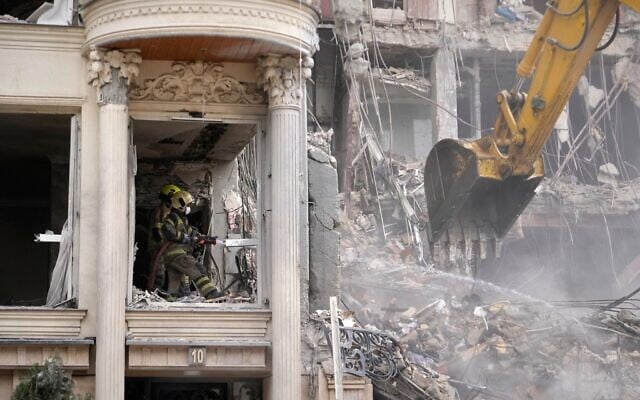
Rescue workers and first responders work at a residential building hit in an earlier strike in Tehran, Iran, March 23, 2026. (AP Photo/Vahid Salemi)
The Israeli Air Force has launched a new wave of strikes in Tehran, the military says.
The IDF says the airstrikes are targeting Iranian regime infrastructure sites.
Further details on the strikes, as well as a wave of overnight strikes, are expected to be provided by the military later.
The strikes come shortly after US President Donald Trump announced that his administration has been engaged in productive talks with Iran regarding a “complete and total resolution” of hostilities.
Iranian news agency: Trump backed down due to Tehran’s threats, no talks with US, Hormuz not opening
Iran’s Fars news agency, citing a source, says there are no direct or indirect communications with the United States, despite US President Donald Trump’s recent statement about “productive” talks with Tehran.
The semi-official outlet, citing an informed source, says Trump’s decision to backtrack will not bring the Strait of Hormuz back to its pre-war state. Iran has cut off access to the waterway, a key channel for about a fifth of the world’s oil.
The outlet, which is seen as a regime mouthpiece, says Trump backed down on targeting Iranian power plants after Tehran warned it would target power plants across West Asia in response, and the threat was deemed credible. It says economic concerns also played a role.
The source claims that Iran was approached by mediators about talks, but repeatedly rebuffed them, saying that it would continue its defense “until deterrence is achieved.”
Russia, Iran FMs hold call after Trump’s announcement of US-Iran talks on war
Iranian Foreign Minister Abbas Araghchi holds a call with his Russian counterpart Sergei Lavrov, after US President Donald Trump revealed Washington and Tehran had held “very good and productive conversations regarding a complete and total resolution of our hostilities.”
Russia’s Lavrov called for an “immediate cessation of hostilities and a political settlement that takes into account the legitimate interests of all parties involved, above all Iran,” the Russian foreign ministry says in a readout of the call, which it said was initiated by Tehran.
Oman’s FM: ‘Working intensively’ for safe passage in Strait of Hormuz
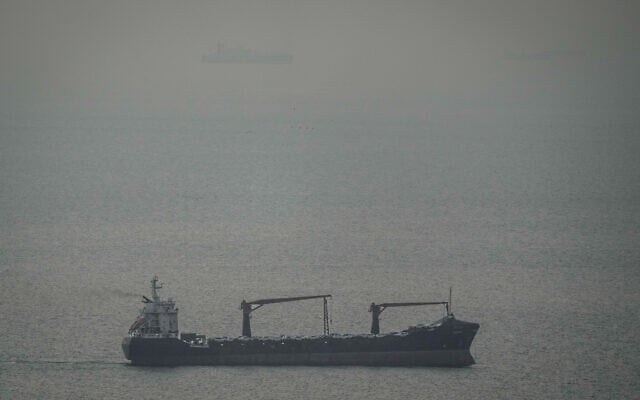
A cargo ship carrying vehicles sails through the Arabian Gulf toward the Strait of Hormuz in the United Arab Emirates, March 22, 2026. (AP Photo)
At exactly the same time as US President Donald Trump announces that the US has been holding talks with Iran on a possible end to the war, Oman’s foreign minister says that continuing the war will only cause more economic hardship, and that his country is “working intensively to put in place safe passage arrangements for the Strait of Hormuz.”
“Whatever your view of Iran, this war is not of their making,” writes FM Badr Albusaidi on X. “This is already causing widespread economic problems and I fear they promise to get much worse if the war continues.”
Netanyahu’s office has no immediate reaction to Trump’s announcement of talks with Iran on ending war
After US President Donald Trump announces he has been holding “very good and productive” talks with Iran on ending the war, and has postponed his ultimatum to bomb Iran’s energy sites if it didn’t allow the safe passage of ships through the Strait of Hormuz by Monday night, Prime Minister Benjamin Netanyahu’s office issues no immediate statement reacting to the news.
The PMO also does not respond to requests for comment.
Trump announces ‘very good and productive’ talks with Iran regarding ‘total resolution of our hostilities in the Middle East’; says he’s postponed plans to bomb energy sites
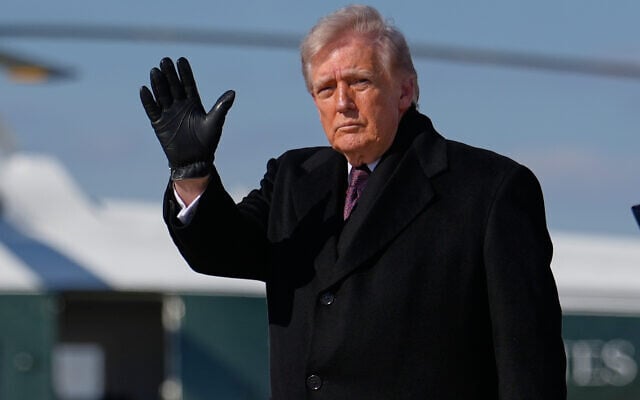
US President Donald Trump waves after arriving on Air Force One, March 18, 2026, at Joint Base Andrews, Maryland, after attending the casualty return at Dover Air Force Base, Delaware, for the six crew members of an Air Force refueling aircraft who died when their plane crashed in western Iraq while supporting operations against Iran. (AP/Julia Demaree Nikhinson)
In a bombshell announcement, US President Donald Trump reveals that his administration has been engaged in productive talks with Iran regarding a “complete and total resolution” of hostilities, leading him to postpone his pledge to bomb Iran’s energy sites if it didn’t allow the safe passage of ships through the Strait of Hormuz by Monday night.
“I am please to report that the United States of America and the country of Iran have had, over the last two days, very good and productive conversations regarding a complete and total resolution of our hostilities in the Middle East,” Trump writes in an all caps Truth Social post.
“Based on the tenor and tone of these in depth, detailed and constructive conversations, which will continue throughout the week, I have instructed the Department of War to postpone any and all military strikes against Iranian power plants and energy infrastructure for a five day period, subject to the success of the ongoing meetings and discussions,” Trump adds.
Trump: I AM PLEASE TO REPORT THAT THE UNITED STATES OF AMERICA, AND THE COUNTRY OF IRAN, HAVE HAD, OVER THE LAST TWO DAYS, VERY GOOD AND PRODUCTIVE CONVERSATIONS REGARDING A COMPLETE AND TOTAL RESOLUTION OF OUR HOSTILITIES IN THE MIDDLE EAST. BASED ON THE TENOR AND TONE OF THESE… pic.twitter.com/VO1x72jmEq
— Molly Ploofkins (@Mollyploofkins) March 23, 2026
USS Gerald R. Ford, aircraft carrier involved in Iran war ops, said to dock back in Crete
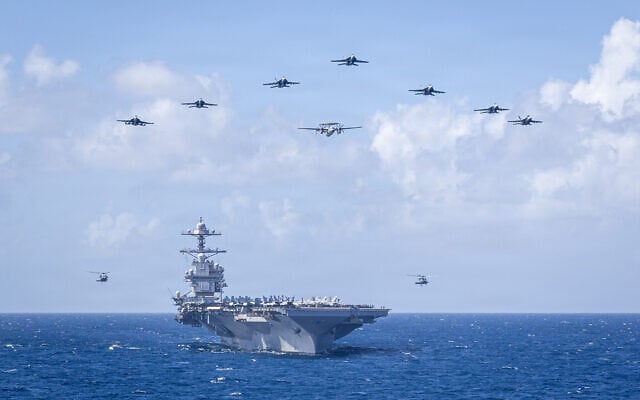
US Navy Carrier Air Wing 8 aircraft fly in formation over the world’s largest aircraft carrier, Ford-class aircraft carrier USS Gerald R. Ford (CVN 78), during Carrier Air Wing 8’s aerial change of command ceremony while underway in the Caribbean Sea, Jan. 19, 2026. (US Navy photo)
The USS Gerald R. Ford, the world’s largest aircraft carrier that has been part of Middle East war operations, has returned to a naval base in Crete, an AFP photographer says.
The vessel, which took on food, fuel and ammunition at the Greek island’s Souda Bay in February, reported a laundry fire on March 12 which injured two crew members.
Resident of Palestinian village attacked by settlers: ‘They tried to burn me and my family alive’
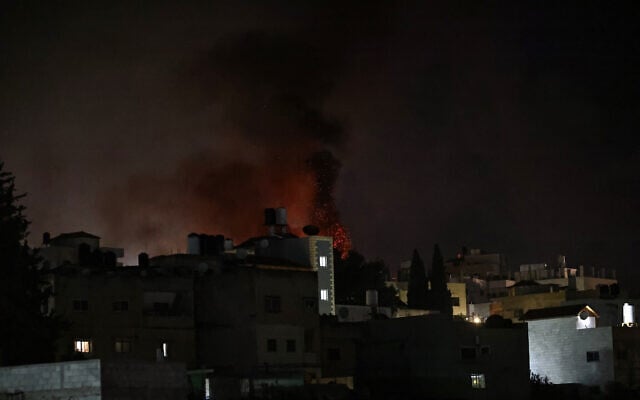
Flames and smoke rise from burning houses and vehicles amid reports of an attack by Israeli settlers in the village of Deir al-Hatab, east of Nablus in the West Bank, on March 22, 2026 (Zain JAAFAR / AFP)
Samer al-Amar, a resident of Deir al-Hatab, tells The Times of Israel that during a settler attack on the village last night, assailants tried to set his house on fire while he and his family — his wife and their four children aged 15 to 24 — were inside.
“My daughter, who was studying for her exams in a room closer to the outside of the house, came in and told me they were throwing stones. I went out and saw settlers surrounding the house, so we shut the door. They threw Molotov cocktails and poured fuel so that we would die inside. We escaped from the house via the stairway leading up to the roof — that was the only way out,” he says.
According to al-Amar, other villagers later arrived, prompting the settlers to flee, and the family was able to get out safely.
None of the family members was injured.
Al-Amar adds that he fears for the future: “These are things a person sees in TV series and films. Who will protect us? Only God. Only thanks to God there were no dead or wounded. The settlers are not willing to leave a single village without attacking it, and if they can kill — they kill. No one holds them accountable.”
#صور| منزل أحرقه المسـ'توطنون عقب هجومهم على قرية دير الحطب شرق نابلس مساء أمس. pic.twitter.com/VITS9t7Q9x
— فلسطين بوست (@PalpostN) March 23, 2026
UAE intercepts 7 Iranian missiles, 16 drones
The United Arab Emirates intercepted seven ballistic missiles and 16 drones fired by Iran today, says the Emirati defense ministry.
Since the start of the US-Israel campaign against Iran on February 28, the UAE has been the country most targeted by Iran, facing 352 ballistic missiles, 15 cruise missiles, and 1,789 drones. The number of daily attacks has been steadily dropping throughout the war.
IDF says Gaza strike yesterday targeted armed Hamas operatives
The IDF confirms carrying out an airstrike in the central Gaza Strip yesterday, targeting armed Hamas operatives.
According to the military, the Hamas gunmen who were riding in a pick-up truck posed a threat to Israeli forces stationed in the Strip.
After the gunmen were identified, the military says it struck the truck to “remove the threat.”
Palestinian media reported that the strike killed three Hamas police officers.
כוחות צה"ל חיסלו חוליית מחבלים חמושים מארגון הטרור חמאס במרכז רצועת עזה שהיוו איום על כוחותינו
כוחות צה״ל זיהו חוליית מחבלים חמושים מארגון הטרור חמאס שנסעו על טנדר במרכז רצועת עזה אתמול.
מיד לאחר הזיהוי, צה״ל תקף וחיסל את המחבלים החמושים במטרה להסיר את האיום על כוחותינו.
טרם… pic.twitter.com/nj02bacthR
— צבא ההגנה לישראל (@idfonline) March 23, 2026
China puts limits on fuel price hikes as oil costs surge amid Iran war
China has limited the amount by which the country’s fuel costs can rise, the government announces, as oil prices have surged due to the Middle East war.
China’s state planner, the National Development and Reform Commission (NDRC), says it hiked the maximum retail prices for gasoline and diesel by 1,160 yuan ($168) and 1,115 yuan per metric ton, respectively, starting from midnight.
Israeli embassy in UK says antisemitism ‘rampant’ in London after ambulance arson attack
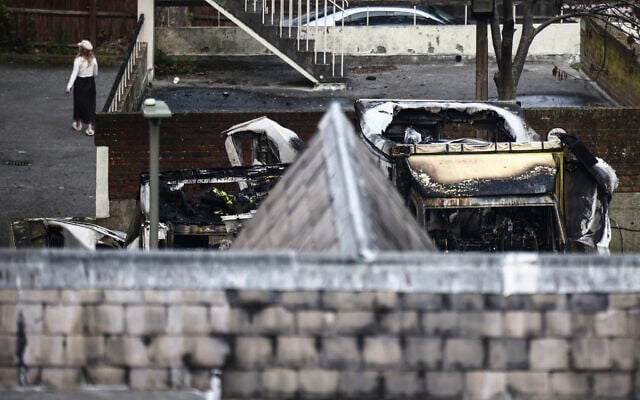
A woman walks next to damaged and burnt out ambulances (R) in the Golders Green area of north London on March 23, 2026, after volunteer ambulances run by a Jewish organization were set on fire overnight. (Photo by Henry NICHOLLS / AFP)
Israel’s embassy in Britain says “antisemitism is rampant on the streets of London” and says the firebombing of ambulances outside a synagogue is the consequence of years of hate being tolerated in plain sight.
“Enough is enough,” the embassy says on X. “There must be a thorough investigation and decisive action to put an end to this climate of intimidation before it spirals further. Silence and inaction are no longer an option.”
Four ambulances belonging to a Jewish community organization in north London’s Golders Green were set ablaze outside a synagogue overnight in an antisemitic hate crime, officials have said.
Russia calls for ‘political and diplomatic’ settlement to Iran war after Trump’s Strait of Hormuz ultimatum
Russia calls for “political and diplomatic” settlement to the Middle East war after US President Donald Trump’s ultimatum for Iran to reopen the Strait of Hormuz.
“We believe that the situation should have transitioned to a political and diplomatic settlement,” Kremlin spokesman Dmitry Peskov tells journalists at a briefing.
“This is the only thing that can effectively contribute to defusing the catastrophically tense situation that has now developed in the region,” Peskov says.
Sirens in north warn of suspected drone attack
Sirens are sounding in a number of communities close to the northern border, warning of a suspected drone attack by Hezbollah from Lebanon.
Knesset finance panel advances 2026 state budget to final readings required for it to become law
Following an overnight debate, the Knesset Finance Committee votes to advance the 2026 state budget to the final two readings necessary for it to pass into law.
The budget bill authorizes the state to spend approximately NIS 850.6 billion ($270.8 billion) over the course of the 2026 fiscal year, split into a regular budget of NIS 621.75 billion ($198 billion) and a development and capital account budget of NIS 228.83 billion ($72.8 billion).
According to a committee spokesperson, the budget for calculating the expenditure limit will be approximately NIS 699 billion ($222 billion), and debt payments (excluding payments to the National Insurance Institute) will stand at NIS 151.8 billion ($48.3 billion).
The updated wartime budget bill adds more than NIS 30 billion ($9.5 billion) to the Defense Ministry budget, bringing it to over NIS 142 billion ($45.2 billion). The Education Ministry will receive almost NIS 97 billion ($30.8 billion), the National Insurance Institute nearly NIS 64 billion ($20.3 billion) and the Health Ministry around NIS 63 billion ($20 billion).
Following the committee’s approval, Yesh Atid MK Vladimir Beliak says that the opposition “made it difficult for the coalition and stopped an attempt to steal NIS 5.8 billion ($1.8 billion) for sectoral politics.”
“Following the petitions we submitted, hundreds of millions of shekels for private Haredi education are in doubt and are under legal clarification in the Supreme Court. Later this week, we will continue the struggle in the Knesset plenum. We will not give up,” he says.
Beliak is referring to the government’s attempt to add a NIS 5.8 billion ($1.8 billion) “civilian emergency reserve” to the budget with no clear legal mechanism governing how the money can be spent.
Opposition lawmakers warned that this lack of safeguards left the funds vulnerable to misuse, particularly in an election year, raising concerns they could be diverted toward political or coalition spending.
IDF probe finds farmer killed in north yesterday was hit by Israeli shelling, not a Hezbollah attack

Ofer Moskovitz stands in his avocado grove on March 12, 2026, overlooking the border with Lebanon. (Courtesy)
A military investigation has found that 60-year-old Ofer Moskovitz, a farmer killed while driving in the northern border community of Misgav Am yesterday, was hit by errant Israeli artillery shelling, and not by a Hezbollah attack.
The IDF says that the investigation, led by Northern Command chief Maj. Gen. Rafi Milo and other senior officers, found that Moskovitz was killed by artillery shelling that was intended to assist troops operating in southern Lebanon.
The investigation found “several severe issues and operational errors” in the planning and firing of the artillery shells.
“The shelling was carried out at an incorrect angle and not in accordance with required procedures. As a result, five shells struck the Misgav Am ridge instead of enemy targets,” the military says.
The IDF says the investigation’s conclusions will be “reviewed by all of the relevant bodies.”
“Moskovitz was killed by our own forces’ fire during an operation whose entire purpose was to protect them,” Milo says, describing the case as a “very severe incident.”
The IDF says it informed his family of the findings, “expresses its regret over the incident and extends its deep condolences to the Moskovitz family and the Misgav Am community at this difficult time. ”
A further investigation into the incident is planned, which the military says will be presented “with full transparency” to Moskovitz’s family and later the public.
Read more: Ofer Moskovitz, killed close to Lebanon border, poured heart and soul into his beloved north
Rescue services say no sites of impacts located after Iran’s latest missile attack
Rescue services say no sites of impacts were located following Iran’s latest ballistic missile attack.
“After scans, no impact sites were found,” the Fire and Rescue Service says.
Magen David Adom says no injuries were reported.
Mojtaba Khamenei ‘isolated and not responding to messages’ — report
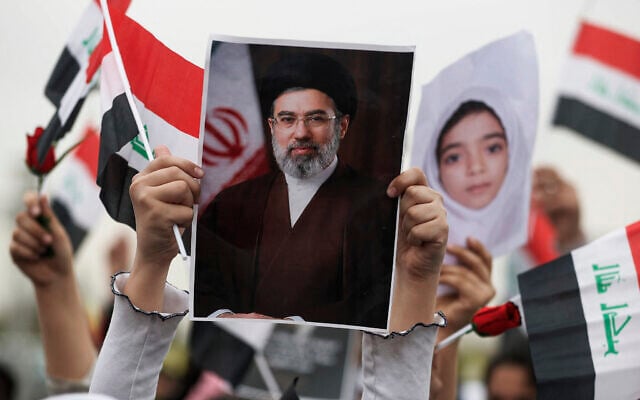
A schoolgirl holds up a poster of Iran's new supreme leader Mojtaba Khamenei during an anti-US and Israel demonstration in Baghdad, Iraq, on March 12, 2026. (AHMAD AL-RUBAYE / AFP)
Iran’s new Supreme Leader Mojtaba Khamenei is “wounded, isolated and not responding to messages being relayed to him,” American and Israeli security officials tell The Washington Post.
According to Israeli officials, the Islamic Revolutionary Guard Corps and some clerics have tightened their control over Iran.
The Axios news site reported Saturday that the US Central Intelligence Agency, Israel’s Mossad and other intelligence bodies are working to detect traces of Khamenei as he remains unseen since being declared the new supreme leader following the assassination of his father.
Iran threatens to mine Gulf marine routes if southern coast, islands attacked

This handout image taken by the European Space Agency, captured by the Copernicus Sentinel-2 satellite, shows a view of Iran's Kharg Island, which hosts the country's main crude export terminal and is responsible for the overwhelming majority of its oil shipments to the world, about 30 kilometers south of the mainland in the north of the Gulf, on March 7, 2026. (European Space Agency/AFP)
An attack on Iran’s southern coast and islands will lead to Gulf routes being cut with the laying of sea mines, the country’s Defense Council warns, according to state media.
The US is considering plans to occupy or blockade Iran’s Kharg Island, the country’s main oil export hub, to pressure Tehran to reopen the Strait of Hormuz to all shipping, according to Axios.
“Any attempt to attack Iran’s coasts or islands will cause all access routes in the Gulf… to be mined with various types of sea mines, including floating mines that can be released from the coast,” the statement reads.
“In this case, the entire Gulf will practically be in a situation similar to the Strait of Hormuz for a long time… One should not forget the failure of more than 100 minesweepers in the 1980s in removing a few sea mines.”
El Al ‘reviewing continued operations’ at Ben Gurion Airport as Israel slashes traffic amid missile fire
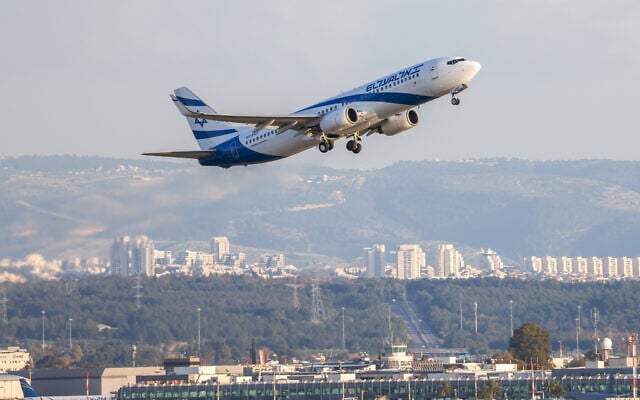
An El Al plane takes off at Ben Gurion International Airport, outside of Tel Aviv, March 5, 2026. (Yossi Aloni/Flash90)
El Al Israel Airlines says it is “reviewing its continued operations” at Ben Gurion Airport after the Transportation Ministry ordered a reduction of traffic.
Israel’s flagship carrier, which has been operating repatriation flights since the outbreak of the war with Iran on February 28, calls on authorities to open Ramon Airport near the Red Sea city of Eilat as an alternative to Ben Gurion.
From 5 p.m. today, the number of passengers permitted on a flight departing Ben Gurion Airport will drop to 50 from the current 120, the Transportation Ministry announced yesterday. There will be no restrictions on the number of passengers permitted for arriving flights, but the number of takeoffs and landings at Ben Gurion Airport will be restricted to one per hour.
Separately, Arkia says it is preparing to offer more flights from airports in Egypt’s Taba and Jordan’s Aqaba.
“Arkia will continue to operate responsibly in accordance with the guidelines, while maintaining the safety of its passengers and providing alternative and creative aviation solutions,” says Arkia CEO Oz Berlowitz. “However, under the current framework, regular aviation activity cannot be maintained, as it practically means the closure of Israel’s skies.”
“We will not choose between passengers who have already purchased tickets, and therefore we are preparing to transfer activity to the airports in Aqaba and Taba, to maintain aviation continuity as much as possible,” Berlowitz says.
Arkia says the flights from airports in Aqaba and Taba will be operated by foreign aircraft, as they were at the beginning of the war.
Arkia will also operate minimal traffic from Ben Gurion Airport, including flights to Larnaca and Athens.
Emergency services at 2 sites of impacts after Iranian missile attack; no immediate reports of injuries
Rescue forces and medics say they are responding to reports of two sites of impacts following Iran’s latest ballistic missile attack on Israel.
It is not immediately clear if the reports refer to direct missile impacts, submunitions from a cluster bomb warhead, or falling fragments following interceptions
There are no immediate reports of injuries, Magen David Adom says.
Sirens had sounded across the Jerusalem area and in parts of southern and central Israel amid the attack, the third from Iran since midnight.
An early warning had been issued by the Home Front Command for the Jerusalem area and the south, but not in some areas of the center where sirens sounded.
Starmer condemns ‘deeply shocking antisemitic attack’ after ambulances torched at London synagogue

Hooded people approch ambulances belonging to the Jewish Hatzola organization before torching them, in Golders Green, London, March 23, 2026. (Screenshot: X; used in accordance with Clause 27a of the Copyright Law)
British Prime Minister Keir Starmer says that the torching of London Jewish community ambulances overnight at a synagogue in Golders Green was a “deeply shocking antisemitic attack” and that such hatred had no place in society.
“This is a deeply shocking antisemitic arson attack,” Starmer says in a post on X.
“My thoughts are with the Jewish community who are waking up this morning to this horrific news. Antisemitism has no place in our society.”
IDF said to tell family of farmer killed in north that he was hit by Israeli shelling, not a Hezbollah attack

Ofer Moskovitz stands in his avocado grove on March 12, 2026, overlooking the border with Lebanon. (Courtesy)
The IDF has reportedly informed the family of 60-year-old Ofer Moskovitz, who was killed in the northern border community of Misgav Am yesterday, that he was hit by Israeli artillery shelling, and not by a Hezbollah attack.
Yesterday, the IDF said it was investigating the possibility that Moskovitz, an avocado farmer and a kibbutz spokesman, was hit by Israeli fire, despite Hezbollah claiming to have launched a barrage of rockets at the area.
Kan news reports that following an examination by the military, it was confirmed that Moskovitz was hit by Israeli artillery shelling that had mistakenly targeted the kibbutz instead of south Lebanon.
The IDF has not yet publicly released its findings.
Ballistic missile attack detected from Iran; sirens expected in Jerusalem area, south
A new ballistic missile attack from Iran has been detected by the IDF.
Sirens are expected to sound in the Jerusalem area and southern Israel in the coming minutes.
Bazan oil refinery says all activities to resume in Haifa in coming days after missile attack damage
Excess gas is burned at the Bazan oil refinery in Israel's northern city of Haifa late on March 19, 2026 (Odd Andersen / AFP)
The Bazan oil refinery in the northern city of Haifa advises the Tel Aviv Stock Exchange that following Thursday’s Iranian missile attack, an external infrastructure company that was hit by interception fragments restarted operations on Sunday, while all other activities disrupted by the strike are expected to resume in the coming days.
Initial estimates of the direct physical cost of the attack are negligible, Bazan goes on, while lost profits are expected to be “insignificant.”
That said, the company cautions that fully identifying all possible damages involve “complex procedures” including “many elements of uncertainty” requiring extreme caution and operational flexibility.
It adds that some malfunctions and damage may only become apparent during operations, and that returning to full capacity will depend on the availability of parts, equipment and manpower.
During last June’s war against Iran, Bazan was hit twice. Three workers were killed in a missile-related fire.
IDF struck a Litani River bridge that had been previously bombed, Lebanese media reports
Lebanese media reports that the Israeli Air Force struck a Litani River bridge that had been bombed several days ago.
Images purport to show that the Qaaqaait al-Jisr Bridge is now destroyed.
Israel has warned that it would bomb all crossings on the Litani River, accusing Hezbollah of using them to move operatives and weapons into southern Lebanon.
مراسلة «الأخبار»: العدو الإسرائيلي أعاد قصف جسر قعقعية الجسر ودمره كلياً بعد أن كان قد استهدفه قبل أيام pic.twitter.com/VTR2dJwK9Y
— جريدة الأخبار – Al-Akhbar (@AlakhbarNews) March 23, 2026
Hospital says condition of child wounded in Saturday missile attack has improved; 5 children, 1 adult still serious
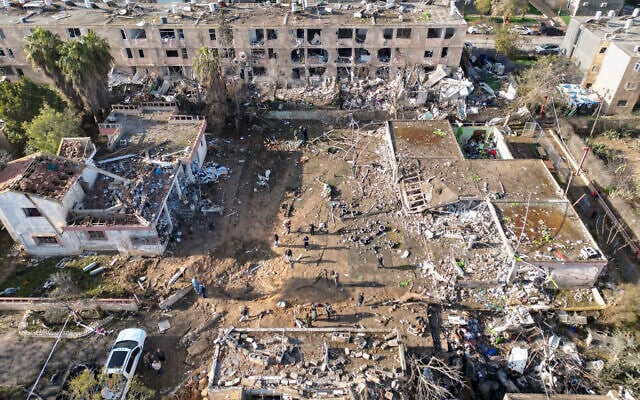
The scene where a missile fired from Iran toward Israel damaged residential buildings in the southern Israeli city of Dimona, March 22, 2026. (Chaim Goldberg/Flash90)
Soroka Medical Center says the condition of the 12-year-old boy seriously wounded after the Iranian missile strike in Dimona on Saturday night has improved. He has been transferred from the pediatric intensive care unit to the pediatric surgical department.
Five children and one adult who were injured in the strike in Arad soon after the Dimona strike are still hospitalized in serious condition, the hospital says.
Also at the hospital are four children and seven adults in moderate and good condition, suffering from injuries caused by cluster munitions and other falling fragments.
The Health Ministry reports that in the past 24 hours, 153 injured people were taken to hospitals as a result of the conflict with Iran and Hezbollah.
Two were in serious condition, two were in moderate condition, and 140 were in good condition. Eight people were treated for anxiety.
A total of 4,713 people have been taken to hospitals since the start of the conflict.
The ministry does not give a breakdown of the causes of injuries, and some might have been sustained by people trying to reach shelters, rather than as a direct result of missile fire.
Plane collides with ground vehicle at New York’s LaGuardia, closing the airport
An Air Canada Express CRJ-900 sits on the runway after colliding with a Port Authority fire truck at LaGuardia Airport in New York, on March 23, 2026 (ANGELA WEISS / AFP)
An Air Canada flight collided with a Port Authority vehicle after landing at LaGuardia Airport, according to authorities.
Authorities did not immediately provide details on casualties.
The New York Police Department confirms the collision but could not immediately offer additional information.
A spokesperson for the New York City Fire Department says firefighters responded to reports of a plane that crashed into a vehicle on the runway at 11:38 p.m.
The Federal Aviation Administration’s National Airspace System website reports LaGuardia has closed.
Photos show the jet with severe damage to the front of the aircraft.
Reports: Settlers attempted to set fire to clinic, vehicle in West Bank village
Palestinian media outlets report that settlers attempted to set fire to a vehicles and a clinic overnight in the village of Burqa in the Ramallah area.
No injuries have been reported.
According to additional reports, settlers also blocked a road for several hours overnight in the South Hebron Hills in an apparent attempt to prevent Palestinians from passing, and rocks were thrown at a Palestinian in the Nablus area.
חוץ מזה – מתנחלים ניסו להצית רכב ומרפאה בכפר באזור רמאללה הלילה וחסמו כביש בדרום הר חברון ורכב פלסטיני (חונה) נופץ באזור שכם. לא ידוע על נפגעים. https://t.co/AQcIC7cXtD pic.twitter.com/aYBJa7rpup
— Nurit Yohanan (@nurityohanan) March 23, 2026
The attacks came amid a surge in settler violence in the West Bank, with arrests rarer and indictments even rarer. Critics say that the overwhelming impunity enjoyed by the attackers demonstrates that the violence by extremists is sanctioned, if not encouraged by the government.
Official decries ‘chilling’ targeting of ambulances at London synagogue: ‘Beyond time for authorities to wake up’

Ambulances belonging to the Jewish Hatzola organization go up in flames in Golders Green, London, March 23, 2026. (Screenshot: X; used in accordance with Clause 27a of the Copyright Law)
A local official says that the arson attack on ambulances belonging to a Jewish organization and parked at a synagogue in Golders Green, is “utterly shocking, terrifying,” and says that authorities are not taking enough action against growing antisemitism.
“The targeting of life-saving vehicles stationed the the car park of a synagogue is particularly chilling and will send shockwaves through our community at a time of already heightened fears over antisemitism in the UK,” local Golders Green councillor Dean Cohen tells the Jewish News.
“It’s beyond time for the authorities to wake and and do more to tackle this hate running riot,” he says.
The ambulances belonged to the Hatzola volunteer organization that responds to medical emergencies.
CCTV footage showed three hooded individuals pouring gasoline on the vehicles and setting them on fire.
The ambulances were parked at the Machzike Hadath synagogue in Golders Green, a London neighborhood with a large Jewish community.
The Fire Service said the blaze ignited oxygen tanks on board the ambulances, causing them to explode and smash windows in nearby residential buildings.
Iran threatens to hit power plants in Israel, Gulf if its electricity sector is targeted
View of the Orot Rabin Power Plant at Sadot Yam beach, central Israel, May 20, 2023 (Yossi Aloni/FLASH90)
Iran will retaliate to an attack on its electricity sector by targeting Israel’s power plants as well as power plants supplying US bases with electricity in regional countries, a statement by the Revolutionary Guards says.
The statement seemingly retracts earlier threats to desalination plants in the region, which are crucial for providing drinking water in Gulf countries.
“The lying … US President has claimed that the Revolutionary Guards intends to attack the water desalination plants and cause hardship to the people of the countries in the region,” the statement shared on state media says.
On Saturday, US President Donald Trump warned that Iranian power plants would be targeted if Tehran failed to “fully open” the Strait of Hormuz to all shipping within 48 hours.
“We are determined to respond to any threat at the same level as it creates in terms of deterrence … If you hit electricity, we hit electricity,” the Revolutionary Guards says.
New Iran missile attack triggers sirens in northern Israel
The IDF says Iran has launched a fresh missile attack, with sirens sound in wide swaths of northern Israel.
CENTCOM chief: Iran military chiefs ‘in deep bunkers,’ targeting civilians in ‘sign of desperation’; campaign is ‘ahead or on plan’
Admiral Charles Bradford "Brad" Cooper II, Commander of US Central Command speaks during a joint press conference with US Secretary of Defense Pete Hegseth, at US Central Command (CENTCOM) headquarters at MacDill Air Force Base in Tampa, Florida, on March 5, 2026. (Octavio JONES / AFP)
The head of the US military’s Central Command says Iran is “operating in a sign of desperation” by targeting civilian sites in the war.
In an interview with the Farsi-language satellite network Iran International, US Navy Adm. Brad Cooper says: “They’re operating in a sign of desperation. … In the last couple of weeks, they’ve attacked civilian targets very deliberately, more than 300 times.”
In his first one-on-one interview of the war, Cooper says Iran’s continued attacks on Gulf Arab states and the wider Mideast put civilians at risk.
Cooper also notes the slowdown in Iranian incoming fire across the Mideast as the war has entered its fourth week.
“At the beginning of the conflict, you saw large volumes in the dozens of drones and missiles,” Cooper says. “You no longer see that. It’s all one or two at a time.”
Cooper says the US campaign against Iran is “ahead or on plan.”
He adds that the US and Israel are targeting missile and drone manufacturing sites.
“We’re also going after the manufacturing,” he says. “So it’s not just about the threat today. We’re eliminating the threat of the future, both in terms of the drones, the missiles, as well as the navy.”
Cooper also says it isn’t time for the Iranian public to come to the streets, although both Israel and the US have said they hope the Iranian public will topple the country’s theocracy as a result of the strikes.
“They’re launching missiles and drones from populated areas and you need to stay inside for right now,” Cooper says. “There will be a clear signal at some point, as the president has indicated, for you to be able to come out.”
Cooper says top leaders of Iran’s military are “in deep bunkers” while their frontline troops remain exposed to incoming American and Israeli airstrikes.
Iran International has been a preoccupation of Iran’s theocracy, with authorities repeatedly saying they’ve arrested people who allegedly gave footage to the network.
“I’d like everyone to note is I’ve watched this over the last week, this extraordinary contrast between the comfort and protection that you’re seeing with the senior generals in the Islamic Republic, at least those that are still alive, who are up in deep bunkers and facilities in and around Tehran,” Cooper says.
“And contrast that with the soldiers who are down on the ground who are unprotected. The generals are protected. The soldiers are not protected.”
In antisemitic hate crime, 4 ambulances belonging to Jewish organization torched in London
Hooded people approch ambulances belonging to the Jewish Hatzola organization before torching them, in Golders Green, London, March 23, 2026. (Screenshot: X; used in accordance with Clause 27a of the Copyright Law)
Four ambulances belonging to the Jewish Hatzolah organization have been set ablaze overnight in north London, UK police say, adding that the incident is being treated as an antisemitic hate crime.
The ambulances were parked at the Machzike Hadath Synagogue in Golders Green.
“An investigation has been launched after four ambulances belonging to the Jewish Community Ambulance service were set on fire in Golders Green,” Metropolitan Police say in a statement. “Officers remain on scene and the arson attack is being treated as an antisemitic hate crime.”
Hatzola is a not-for-profit volunteer organization that responds to medical emergencies.
Footage shows three hooded people pouring gasoline on the vehicles and setting them on fire.
🚨 BREAKING: Major antisemitic arson attack in Golders Green, London destroys all ambulances (at least 4) of Hatzola Northwest — a volunteer Jewish emergency service providing 24/7 medical aid. @Breaking911 has seen footage of the attackers. pic.twitter.com/GwCWXG38qB
— Breaking911 (@Breaking911) March 23, 2026
BREAKING: Video shows 3 hooded men poor gas, ignite the blaze and flee the scene of a massive Hatzolah ambulance arson attack in Golders Green, London. pic.twitter.com/STpJojH7tz
— KolHaolam (@KolHaolam) March 23, 2026
Global economy under ‘major threat’ from Hormuz crisis, no country is immune — IEA chief
The global economy is under “major threat” from the energy crisis caused by the war in the Middle East, International Energy Agency chief Fatih Birol says, warning that “no country will be immune” to its effects.
Speaking at the National Press Club in Australia’s capital, Birol compares the current energy crisis to those of the 1970s and the impact of Russia’s 2022 invasion of Ukraine.
“This crisis, as things stand, is now two oil crises and one gas crash put all together,” he says. “The global economy is facing a major, major threat today, and I very much hope that this issue will be resolved as soon as possible.”
“No country will be immune to the effects of this crisis if it continues to go in this direction. So there is a need for global efforts,” he says.
Birol adds that “at least 40… energy assets in the region are severely or very severely damaged across nine countries.”
IDF carrying out fresh wave of strikes on regime targets in Tehran
The IDF says it has launched a “wide-scale” wave of airstrikes in Tehran, targeting infrastructure of Iran’s “terror regime.”
One person hurt after missile interception in UAE
An Indian national living in the United Arab Emirates has been hurt by falling shrapnel after the interception of a ballistic missile over an industrial area near Al Dhafra Air Base in Abu Dhabi, authorities say.
The interception happened over the Al Shawamekh area of Abu Dhabi, authorities say.
Meanwhile, both Bahrain and Kuwait sound missile alerts over incoming Iranian fire, though it isn’t clear if there is any immediate damage from the barrages.
In Saudi Arabia, the Defense Ministry says it destroyed drones in the kingdom’s oil-rich Eastern Province.
Rocket alarms blare in Lebanon border towns
Incoming rocket sirens are triggered in the Lebanon border towns of Manara and Margaliot in the north, followed later by an alert in Metula.
Iran’s top diplomat blames US for closure of Strait of Hormuz, rejects threats
Foreign Minister Abbas Araghchi says maritime traffic isn’t passing through the Strait of Hormuz because insurance companies are concerned about the US-initiated war, not because of Iran’s actions.
“Freedom of Navigation cannot exist without Freedom of Trade. Respect both—or expect neither,” Araghchi writes on X. He adds that further threats will not sway Iranians nor insurers.
Iraqi pro-Iran group prolongs pause in US embassy attacks
Kataeb Hezbollah, an influential pro-Iran Iraqi armed group, announces it will extend a pause on its attacks on the US embassy in Baghdad by five days.
“The deadline given to the embassy of American evil will be extended by an additional five days,” the group says in a statement.
The group has warned that it will respond if it comes under attack, denying involvement in a drone strike that hit an Iraqi intelligence building on Saturday, killing an officer.
Trump reportedly says ‘sounds like’ he will travel to Israel next month to get Israel Prize
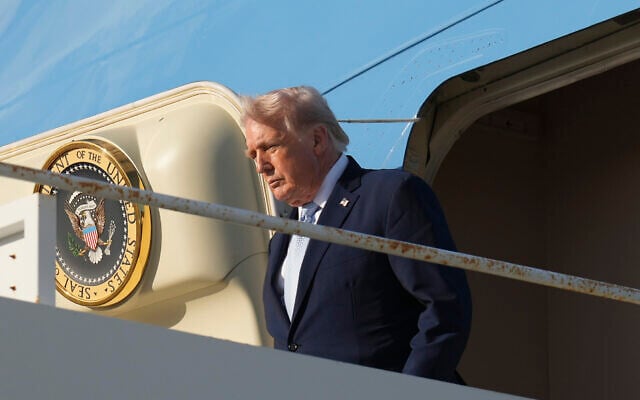
US President Donald Trump steps off Air Force One, March 20, 2026, at Palm Beach International Airport in West Palm Beach, Florida. (AP Photo/Mark Schiefelbein)
US President Donald Trump reportedly indicates he is leaning toward traveling to Israel next month to receive the Israel Prize.
“Yes, sounds like it,” Israel’s pro-government Channel 14 says Trump told it when asked whether he will come for the Independence Day ceremony on April 22.
Israel to cut down outbound flights at Ben Gurion Airport to 1 per hour, with only 50 onboard
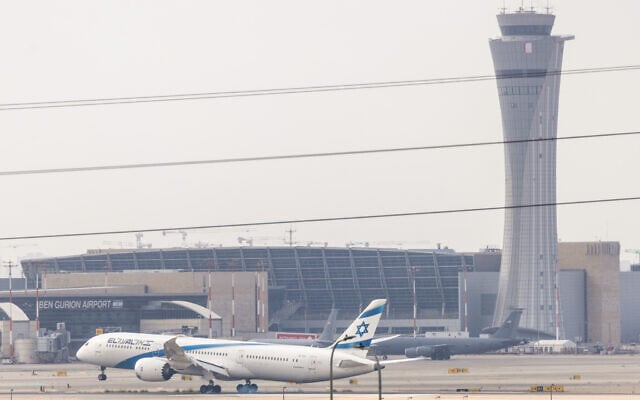
Airplanes depart from the Ben Gurion International Airport during the US-Israel war with Iran, March 16, 2026. (Yossi Aloni/Flash90)
Transportation Minister Miri Regev announces restrictions to flight operations at Tel Aviv’s Ben Gurion Airport, effective from today (Monday) in the late afternoon, following a security situation assessment and recommendations from security officials.
“In light of their recommendations and in order to prevent possible harm to human life, I have decided for the time being to reduce the number of takeoffs and landings and the number of passengers at Ben Gurion Airport,” Regev says in a statement issued before midnight. “Starting tomorrow (Monday) at 5 p.m., one flight per hour — an incoming plane with no passenger limit and a departing plane with a maximum of 50 passengers — will be operated.”
This means that the number of passengers permitted on a flight departing Ben Gurion Airport will drop to 50 from the current 120. In addition, only one flight will be permitted to take off per hour, and one will land per hour instead of two aircraft per hour that were allowed to arrive and depart per hour.
The decision comes after Iranian ballistic missiles targeted central and southern Israel over the weekend, with multiple impacts and people injured.
“This is an inconvenience, but our commitment to human life is our top priority, and this is where the decision is derived from,” says Regev. “At any given moment, in accordance with the recommendations of the security establishment and professional bodies, the guidelines may change.”
Since Ben Gurion Airport was gradually reopened, 140,000 Israelis have returned home on repatriation flights operated by Israeli airlines El Al, Arkia, Israir and Air Haifa, according to Regev.
Iran’s latest volley causes several impacts in central Israel; no injuries reported
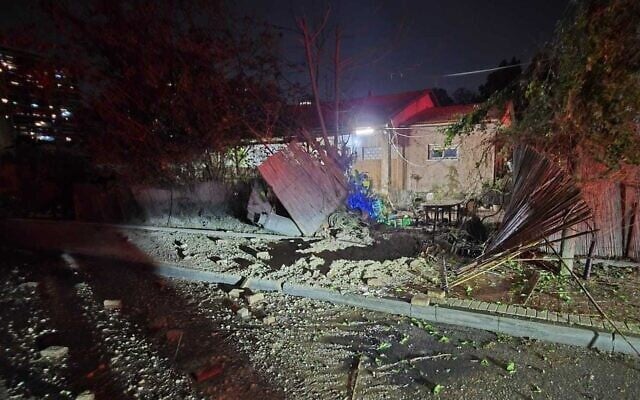
The site where a falling missile fragment or cluster munition impacted in Petah Tikva following an Iranian missile attack on central Israel, March 23, 2026. (Hatzalah Petah Tikva)
Damage was caused at several locations in central Israel by cluster munitions or other falling fragments following Iran’s latest ballistic missile attack, rescue services say.
There are no reports of injuries.
Damage was caused at several locations in central Israel by cluster munitions or other falling fragments following Iran's latest ballistic missile attack, rescue services say.
There are no reports of injuries. pic.twitter.com/Zsmp8yBDs2
— Emanuel (Mannie) Fabian (@manniefabian) March 22, 2026
IDF and police say 5 arrested, cop and Palestinians injured during response to settler attacks
Five Israeli citizens were arrested, and a police officer and several Palestinians were injured, as Israeli security forces responded to extremist settler attacks Sunday in the West Bank, according to a statement from the IDF and police.
Settlers reportedly set fire to several vehicles and structures in the village of Deir Khatab, following the death Saturday of an 18-year-old Israeli in a vehicle collision. That incident is being investigated as a possible terror attack.
According to the Palestinian Red Crescent, nine Palestinians were wounded in the extremist settler attacks.
The statement says IDF troops, police and Border Police responded to the reports of violent attacks, including arson and disturbance of public order.
Forces searched a suspicious vehicle near the town and found weapons, the statement says. Border Police then arrested five Israeli citizens who were taken for questioning.
In a separate incident near the settlement of Yitzhar, the statement says several Israelis attacked security forces, injuring a police officer and damaging a vehicle belonging to the forces.
Several Palestinians were also injured in the incidents and received medical care, the statement says.
The statement adds that the IDF and police condemn all acts of violence, saying they harm security.
Rescue forces head to possible impact sites after Iranian attack on central Israel
Rescue forces are responding to reports of several impacts in central Israel, possibly caused by cluster submunitions, following Iran’s latest ballistic missile attack.
No injuries are reported, Magen David Adom says.
At least one of the missiles that triggered sirens in central Israel and parts of the south carried a cluster bomb warhead.
No injuries reported as Iran fires cluster missile in latest salvo
One of the ballistic missiles launched by Iran at Israel a short while ago carried a cluster bomb warhead, footage shows.
Sirens sounded across central Israel and parts of the south amid the attack.
There are no immediate reports of injuries.
תיעוד התפזרות רסיסי טיל מצרר מעל שמי הארץ
(אורלי אלקלעי) pic.twitter.com/QVp9W9HDbj
— כאן חדשות (@kann_news) March 22, 2026
One of the ballistic missiles launched by Iran at central Israel a short while ago carried a cluster bomb warhead, footage shows. pic.twitter.com/qHysDob1zX
— Emanuel (Mannie) Fabian (@manniefabian) March 22, 2026
Iranian missile attack detected, sirens set to sound in central Israel
A new ballistic missile attack from Iran has been detected by the IDF.
Sirens are expected to sound in central Israel in the coming minutes.


read more: