Argentina’s government is moving closer to declaring armed Lebanese group Hezbollah a terrorist organization by announcing the creation of an official terror blacklist, a day before the 25th anniversary of a bombing of a Jewish center in Buenos Aires.
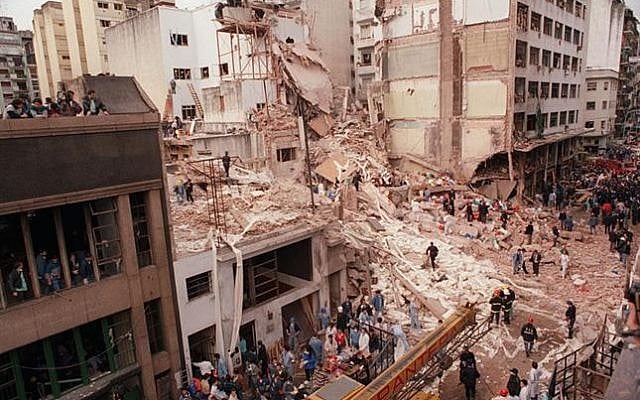
Hezbollah has been linked to the 1992 attack on the Israeli embassy in Buenos Aires, which killed 29, and the 1994 attack on the AMIA Jewish center in Buenos Aires that killed 85. Argentina believes the Iran-backed group is responsible for both attacks.
Media reports said the registry will allow the Justice Ministry to officially blacklist organizations and people linked to attacks in Argentina.
Last week, Argentina’s President Mauricio Macri said he was “moving forward” with efforts to blacklist Hezbollah, calling it a “rejection of terrorism” and violence.
The aftermath of the 1994 AMIA bombing in Buenos Aires. (Newspaper La Nación (Argentina/Wikipedia Commons)
The announcement by Macri’s government comes a day before the public memorial for the AMIA bombing and a visit by US Secretary of State Mike Pompeo, who has stepped up pressure on Hezbollah during his tenure.
Yesterday, a US official said that Pompeo would bring the same message that he delivered in March in Beirut — that the United States “will bring unprecedented pressure to bear on Iran until it ceases all malign behavior including that which is carried out by Hezbollah.”
The official said Latin American nations were expected to start their own system of blacklisting and imposing sanctions on “terrorists,” following the US model.
Help us report truthfully on social media
As a multimedia journalist, my job is to take the quality, fact-based journalism produced by The Times of Israel newsroom and make it accessible across every platform — from Instagram posts to podcasts to short-form videos.
This is how many, especially young people, consume news these days. But misinformation is rampant on social media. Our team at ToI produces accurate, responsible short-form reporting on Israel and the Jewish world.
If you believe in the importance of factual social media journalism, please consider joining our reader support group, The Times of Israel Community. Your financial support is essential to sustain responsible multimedia reporting.
We’re really pleased that you’ve read X Times of Israel articles in the past month.
That’s why we started the Times of Israel - to provide discerning readers like you with must-read coverage of Israel and the Jewish world.
So now we have a request. Unlike other news outlets, we haven’t put up a paywall. But as the journalism we do is costly, we invite readers for whom The Times of Israel has become important to help support our work by joining The Times of Israel Community.
For as little as $6 a month you can help support our quality journalism while enjoying The Times of Israel AD-FREE, as well as accessing exclusive content available only to Times of Israel Community members.
Thank you, David Horovitz, Founding Editor of The Times of Israel


 From the Liveblog of
Wednesday, July 17, 2019
From the Liveblog of
Wednesday, July 17, 2019
 Add ToI as a Preferred Source on Google