

Netanyahu tells Senate leadership he is ‘moved’ by support
After speech to Congress, PM meets with legislators, emphasizing than any nuclear agreement must include more restrictions
Lazar Berman is The Times of Israel's diplomatic reporter
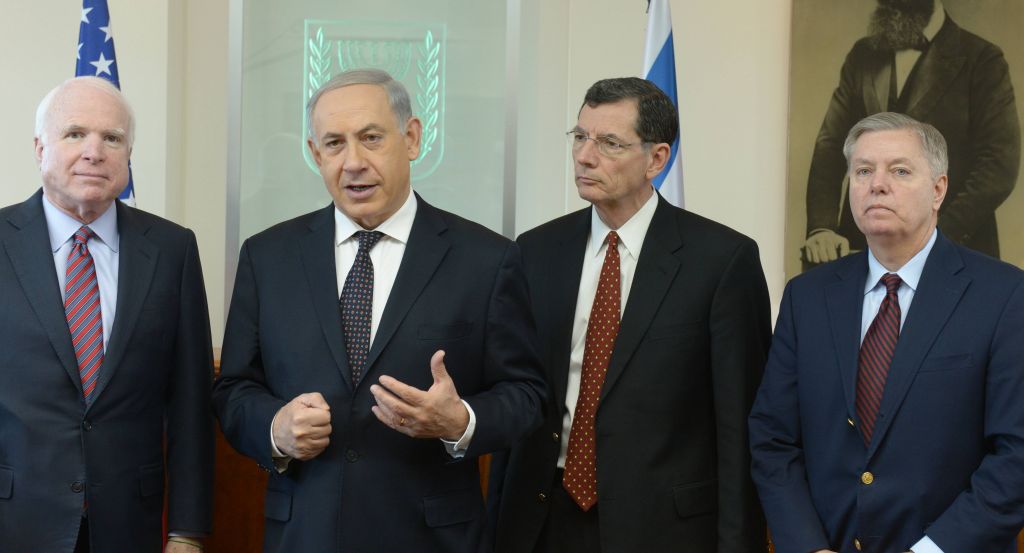
After his speech to the joint houses of Congress, Prime Minister Benjamin Netanyahu met Tuesday with the bipartisan leadership of the US Senate, saying he was “moved” by the response from both parties.
Senate majority leader Mitch McConnell (R-Kentucky) and minority leader Harry Reid (D-Nevada) had invited Netanyahu to the meeting.
“I do want to thank the leadership of the Senate, Republicans and Democrats, both sides of the aisle, for inviting me here, giving me an opportunity to state Israel’s concern about an issue that could be the most important issue of our times,” Netanyahu told the senators.
“I was very moved by the attention and the responses to the speech from both sides of the aisle, and it’s very clear to me and it was clear in that hall to anyone who was there that the support for Israel is strongly bipartisan, that there is a very broad support of the American people and its representative for the Jewish state and I’m very, very grateful for that,” he added.
Netanyahu said that an agreement with Iran must not automatically expire, but should lift restrictions only after Tehran stops supporting terrorism, halts aggression against neighboring countries, and ceases its promises to annihilate Israel. He also called for greater restrictions on Iran under the agreement.
Senators John Barrasso (R-Wyoming), John Thune (R-South Dakota), Dianne Feinstein (D-California), John McCain (R-Arizona), Al Franken (D-Minnesota), John Cornyn (R-Texas), Charles Schumer (D-New York), Richard Durbin (D-Illinois) and Bob Corker (D-Tennessee) were also in attendance.
Earlier in the day, Netanyahu warned in his landmark address that the nuclear deal taking shape between Iran and Western powers “paves the path for Iran” to a nuclear arsenal, rather than blocking it, and urged American leaders to walk away from what he called “a very bad deal.”
The emerging agreement, he told the assembled congressmen and senators, would leave Tehran with “a vast nuclear infrastructure” that placed it dangerously close to the ability to break out to a nuclear bomb. It “will not prevent Iran from developing nuclear weapons. It will all but guarantee that Iran will get nuclear weapons and a lot of them.”
“Iran has proven time and again that it cannot be trusted,” no matter what it says about permitting verification of the terms of any accord designed to prevent it from getting such weapons, he said. “This is a bad deal, it’s a very bad deal. We’re better off without it.”









The Times of Israel Community.