

Rotate and spin: 6 things to know for September 24
Throw four pundits and politicians in a room and you’ll get five ideas for a rotation government, but will any of them stick or is everybody just torquing around?
 Add ToI as a Preferred Source on Google
Joshua Davidovich is The Times of Israel's Deputy Editor
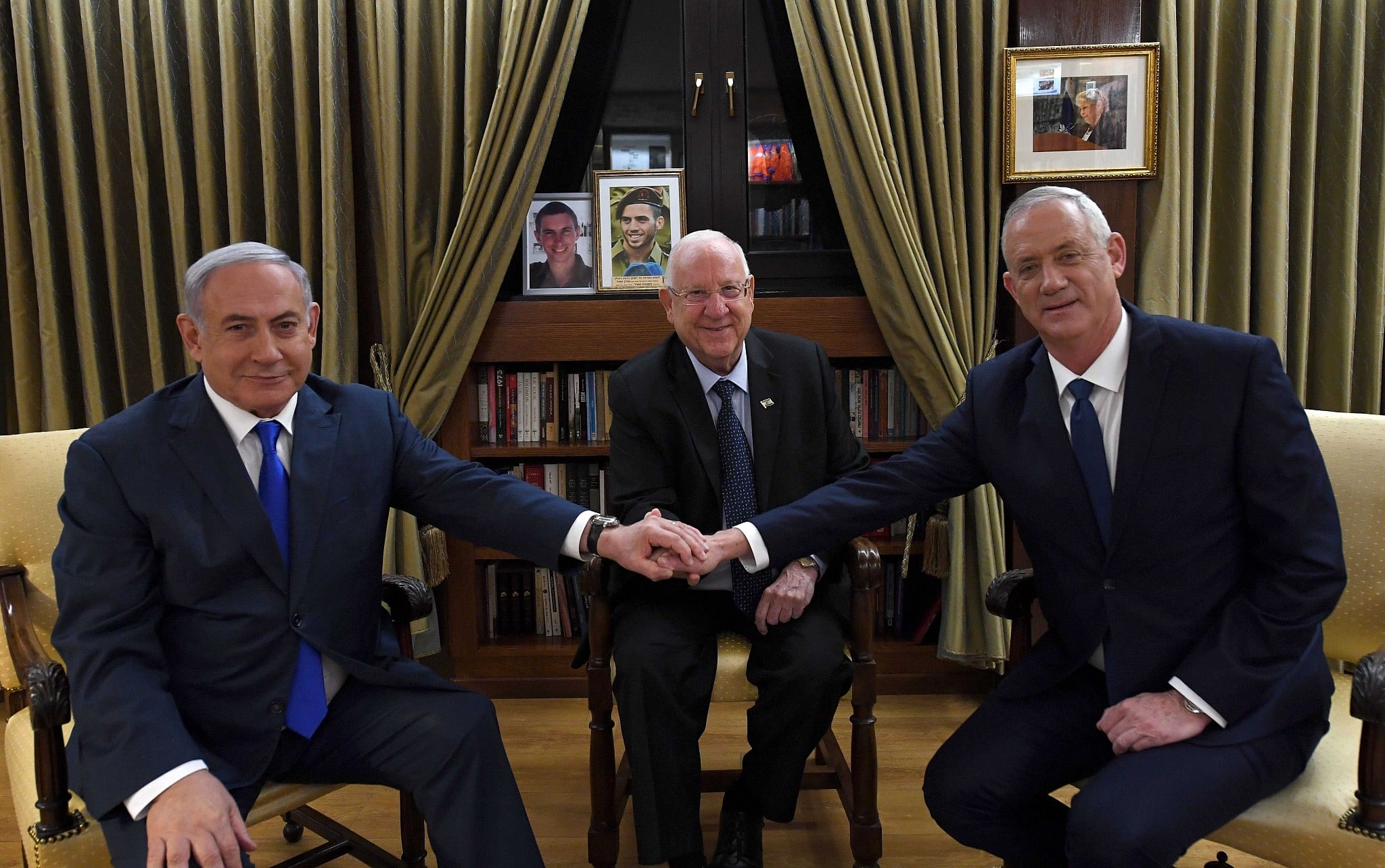
1. Grip and grimace: There’s more than a healthy amount of skepticism in the press following the news that Likud and Blue and White will launch unity talks, after party leaders Benjamin Netanyahu and Benny Gantz held a meeting at President Reuven Rivlin’s manse.
- Helping create the sense that unity is just another word for nothing left to say is the fact that each side went back to their respective camps with soothing words promising not to abandon them, first by Netanyahu to his religious-right block party and then by Gantz to his amalgamonster.
- “Unity or maneuvering?” reads the top headline of Yedioth Ahronoth, under the same picture of the two leaders gripping hands and smiling painfully that graces every major front page, and above a cartoon of Reuven Rivlin as cupid.
- “The joint statement was two steps forward; Netanyahu’s promise to his right-religious bloc was half a step back. If Netanyahu wanted to confuse everyone… he succeeded,” Yedioth Nahum Barnea writes.
- “Netanyahu is committed to the ultra-Orthodox and even signed a deal with them,” Channel 13 commentator Raviv Drucker writes on the channel’s website. “On the other hand, Gantz, despite his denials, is committed to [Yisrael Beytenu leader Avigdor] Liberman, even to the point of [promising him] ministerial posts. Neither side is ready to shunt their partners to the side.”
- According to Haaretz, the meeting was held “under an air of suspicion.”
- “An Oscar for fakery, or true unity?” asks Channel 12’s Amit Segal.
2. Spin the rotation wheel: Haaretz reports that even if they are down with unity, the two sides are stuck on who gets to be prime minister first in a rotational deal.
- According to Netanyahu-backing Israel Hayom, Likud is pursuing a deal that will give Netanyahu the first year, then two years for Gantz and another year for whoever is heading Likud by then.
- According to Yedioth, two other options are on the table, both with Gantz as prime minister until Netanyahu has his day in court. Should he be cleared, he will take over as prime minister, and should he be found guilty, some other Likudnik will be handed the post.
- Haaretz reports, however, that Likud is actually trying to squeeze the first three years for itself, throwing Gantz a bone with a last year.
- “Likud is insisting to be first in the rotation on account of ‘governmental continuity,’ in the words of a negotiation staff member from the right-wing bloc. The party’s talking point in upcoming interviews is that they have no preconditions and everything is on the table, but in practice, leading the rotation is a central demand of its joining,” the paper reports.
- TV reports also had a plethora of ideas, including one under which Netanyahu would serve as prime minister first, with the obligation to step down if he is indicted in any of the corruption cases against him.
- If this sounds like a whole lot of guesswork, guess what: It probably is. And it’s not even clear the party themselves are doing much more than throwing test balloons against the wall to see what sticks.
3. Unity poopers: On Tuesday morning, right-wing lawmakers take to the airwaves to push unity, knowing it’s the only way for them to stay in power.
- “It’s better to push unity now and not push it off for anything by another month,” Yamina MK-to-be Ofir Sofer tells Army Radio, even at the cost of his own party not being part of it.
- But MK Tamar Zandberg of Democratic Camp says nope to the idea of joining up with a bunch of right-wingers: “We recommend that Gantz to put together a center-left government, not to be part of a right-wing one.”
- Blue and White, meanwhile, is pushing the idea that Netanyahu is not interested in sticking to his right-wing partners and didn’t mention them in talks, which Channel 12 dutifully prints as a fact “confirmed” by Gantz.
- The channel also quotes sources within the right-religious bloc accusing Gantz of “trying to break us up.”
4. Punting punters: In the case that unity can’t be reached, Rivlin will have to choose one or the other to give the baton to.
- Channel 13 reports that Rivlin has not yet made up his mind about who to give it to, and it’s not clear that the parties have either.
- While reports Sunday indicated both parties wanted to let the other have first crack (and fail), Israel Hayom reports that actually Likud wants to be the first to fail.
- According to the report, citing senior party members, “If Gantz goes second, public pressure will force him to lower his demands quickly.”
- “Rivlin, forced to make his Solomonic decision, may be choosing between two candidates who may not have figured out if they even want to be chosen,” writes ToI editor David Horovitz.
- According to Haaretz, Rivlin is leaning toward giving the baton to Likud, which is backed by a 55-seat strong religious right bloc.
- The paper’s lead editorial savages Blue and White for wanting to punt rather than taking the rare support of Arab parties and running with it.
- “This move looks like a capitulation without a fight, an admission that the right wing’s long-standing tactic of delegitimizing parties representing Arab society succeeded,” the editorial reads.
- In Walla, Amir Oren writes that Netanyahu looks hungry while Gantz seems sated. “He is the prey,” he writes, counseling the Blue and White leader that “in politics, if you are not prime minister tonight, you cannot count on being one tomorrow or the day after.”
5. What Odeh meant: In the Forward, Sara Hirschhorn writes that liberal American Jews who are not fans of Netanyahu should not be so bold as to think the Joint List’s decision to endorse Gantz is about them in any way, even as they celebrate the move.
- “While we may be verklempt about a vision of Jewish-Arab cooperation and a new path towards peace, this is about the future of Israeli society — where we don’t get a vote,” she writes.
- Also writing about the Joint List decision, Gaza-native Muhammed Shehada says in Haaretz that it was not about backing Gantz, but pushing out Netanyahu.
- “Put simply, Arab MKs are risking everything to oust Netanyahu and advance Israel’s democracy. If Gantz doesn’t reciprocate that olive branch, it’ll only be a matter of time before more Arab MKs withdraw their support, so as not to fail their constituents and fellow Palestinians. Gantz now holds the key to this conundrum,” he writes.
6. Israel in transition: While Israel waits for its government to work itself out, the world is moving ahead at breakneck speed, especially with the UN General Assembly meeting in New York.
- While Netanyahu would normally be basking in the spotlight there, instead he was forced to send his foreign minister Israel Katz.
- “Netanyahu will not be representing Israel at the United Nations General Assembly this week, nor will he be meeting with Trump, seeking to play up his role as Israel’s essential leader. In fact, that strategy—pushing his indispensability and his relationship with Trump, in particular—is a principal reason he just lost the most important election of his life,” writes Anshel Pfeffer in the Atlantic.
- What can Netanyahu do as caretaker prime minister? Not much, according to experts.
- “The idea here is that a transitional government should not create facts on the ground when there is no Knesset that can provide oversight,” Suzie Navot, a professor of constitutional law at the Stricks Law School in Rishon Lezion, tells ToI’s Raphael Ahren. “Checks and balances means that parliament oversees the work of the government, and the Knesset so far hasn’t expressed confidence in the prime minister’s policies.”







The Times of Israel Community.