

The government isn’t just dodging the Haredi draft; it’s dodging the law
By ignoring the High Court’s ruling on military conscription, the coalition is stripping the judiciary of its power and risking a total breakdown of Israel’s democratic regime

 Add ToI as a Preferred Source on Google
Yuval Yoaz is the legal analyst at Zman Israel, The Times of Israel's sister Hebrew website. He practices law, specializing in public, constitutional and media laws, and is the founder of Israel Democracy Guard. He is a partner in the law office of Karniel & Co Yoaz-Bareket-Jonas.

In its failure to fulfill its obligation to draft members of the ultra-Orthodox public into the army, the government has been violating High Court of Justice rulings for years.
Until recently, however, the Attorney General’s Office and the State Attorney’s Office provided it with a measure of protection. They helped generate the legal cover necessary to extend deadlines for implementing the court’s rulings — requesting endless extensions, reporting on ostensible progress in policy formulation, and establishing committee after committee to feign compliance.
But no longer, as Attorney General Gali Baharav-Miara made clear on Monday in a damning notice filed with the court.
In a ruling handed down nearly two months ago, the High Court ordered the government to formulate a clear policy to ensure equal conscription, including criminal, economic, and civil measures.
Once the government stopped pretending it intended to do anything to implement that ruling, it also lost the protective shield provided by the attorney general.
If this is how the government behaves, state attorneys will no longer stand before the Supreme Court and struggle to defend the indefensible in the face of the justices’ rebukes.
The attorney general’s notice, submitted on Monday to the High Court in response to petitioners’ request to hold the government in contempt of court, is unprecedented in its severity.
The declaration that the government has not acted to implement the High Court ruling is not surprising; the same point had appeared in letters from Baharav-Miara to Prime Minister Benjamin Netanyahu that were made public by the Justice Ministry.
The surprise lies, however, in the harsh, dramatic description of the danger to the stability of Israel’s democratic system as a direct result of the government allowing itself to openly ignore a binding ruling.
“The government,” the attorney general wrote to the court, “did not act to carry out the ruling, nor did it express any intention whatsoever to comply… This conduct constitutes a real danger to the existence of the democratic regime in the State of Israel, including the principle of separation of powers.”
She continued: “The violation of judicial orders… particularly when the violators are the prime minister and the government of Israel — means emptying of content the ability… to conduct effective judicial review of government actions.”
The State Attorney’s Office, representing the attorney general, does not lightly write such sharp words in an official notice to the Supreme Court. If this wording was chosen, it is because the career professionals in the Justice Ministry know better than anyone the full scope of the executive branch’s dismantling of the rule of law.
It is impossible to exaggerate the severity of the situation. In the attorney general’s view, the refusal of the government to comply with an explicit court ruling constitutes a danger to the country’s democratic foundations.

This aligns exactly with the concerns expressed by hundreds of thousands of Israelis who took to the streets during the 2023 demonstrations against the planned judicial overhaul. They warned that the government sought to weaken the court precisely to allow for evasion of such court rulings. The danger, it seems, is indeed coming from above.
The attorney general’s assessment is stark, but accurate. Two and a half years have passed since the expiration of the temporary legal framework that had allowed the government to exempt Haredi yeshiva students from service. A government decision in June 2023 that ostensibly froze the legal situation to buy time for new legislation was declared illegal last year by the High Court.
This means that for at least a year and a half, the government has been shirking its duty to enforce existing law, which requires equal military conscription for all. The petitions submitted to the High Court by various protest groups are, in essence, demands for the implementation of the previous ruling — to require the government to obey the Security Service Law and draft the ultra-Orthodox.
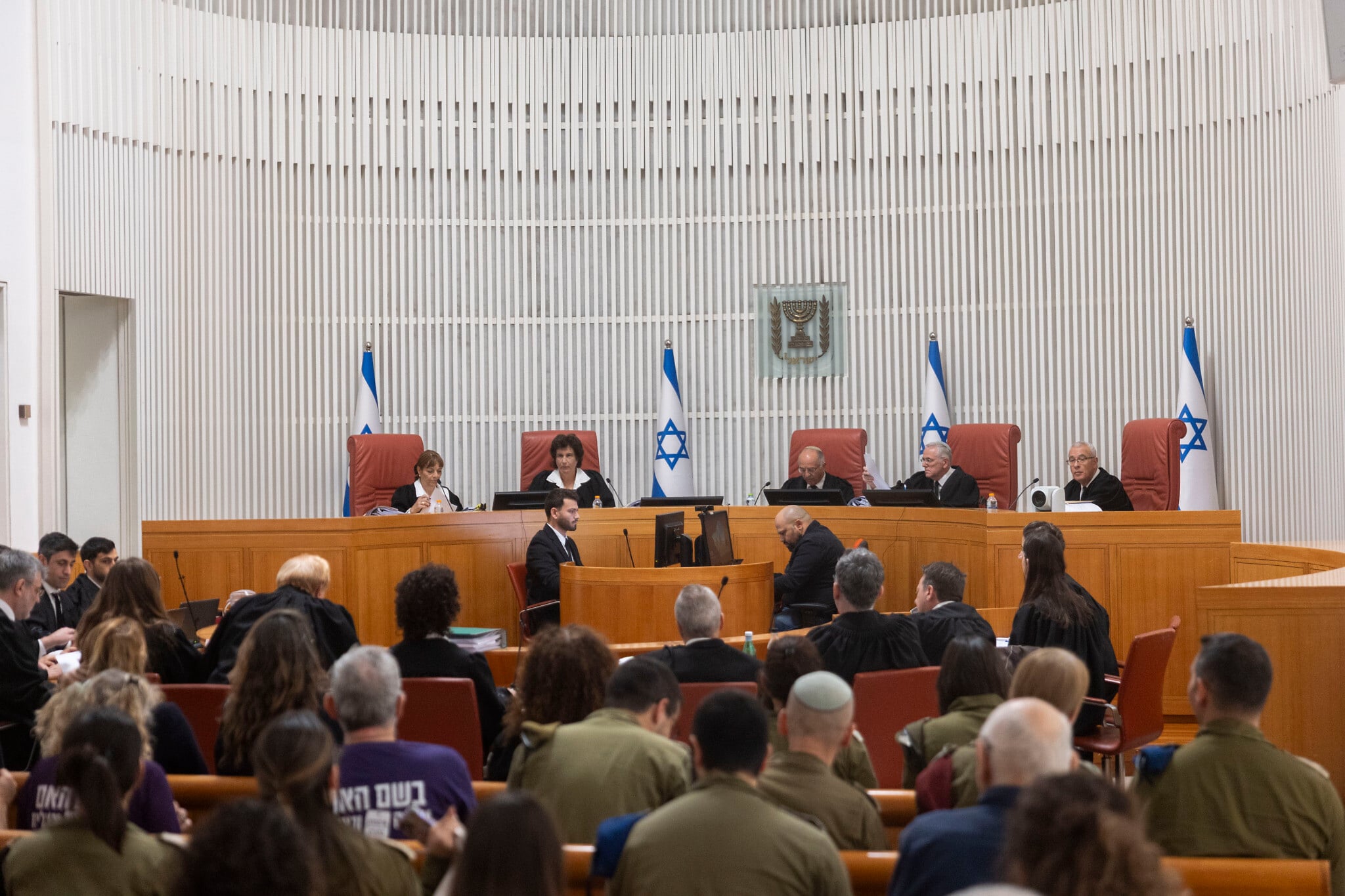
In the ruling handed down two months ago, a panel of five justices determined unanimously that “the state must act with appropriate diligence… for the purpose of taking real criminal proceedings against those declared draft evaders.”
On the economic level, the court ordered the government to formulate an “effective, equal, and proportionate enforcement policy” within 45 days. That obligation was the focus of Baharav-Miara’s repeated letters to Netanyahu. The prime minister did not bother to respond.
At the beginning of last week, the government discussed the economic measures it must take regarding the draft. Notably absent from the room were the key decision-makers: Netanyahu, Defense Minister Israel Katz, and Finance Minister Bezalel Smotrich.
When Deputy Attorney General Gil Limon informed the ministers present that the government was actively violating the court ruling, he was met with a barrage of shouting.
From the government’s perspective, the efforts to pass a new “exemption law” that would largely exempt the ultra-Orthodox from serving in the IDF is the “policy.” However, the High Court has ruled countless times that the government must act according to existing law, not potential future legislation. This is especially true regarding the draft, where it is entirely unclear whether the government has the political capital to pass such a law at all.
Baharav-Miara realized that the prime minister has no intention of acting and is simply stalling. Therefore, she decided to abandon the charade.
What can the High Court do in the face of this unprecedented situation? Not much. The contempt of court ordinance is a legal mechanism usually reserved for individuals or corporations who ignore orders. Using it against the state itself would be a constitutional earthquake — a precedent that has not been set since the founding of the state.

Until today, the court has left undecided the question of whether it’s even feasible to rule that the government is in contempt of court. But now, the justices may use the petitioners’ request, bolstered by the attorney general’s fierce response, to summon government representatives to provide answers in person, not just via written evasions.
It would be appropriate for the justices to summon the prime minister himself. Such a step could create the public impact needed to force Netanyahu to confront his legal obligations.
Of course, one must consider that the government’s actions — which amount to an explicit violation of the ruling — could be a “trial run.”
Later this week, the High Court is scheduled to hear the explosive petitions demanding the firing of National Security Minister Itamar Ben Gvir. Several coalition members are openly calling on Netanyahu to ignore any future court order that would require Ben Gvir’s dismissal.
The government’s disregard of its duty to implement the draft ruling may turn out to be a milestone on the road to a head-on constitutional collision between the executive branch and the judiciary. It is a crisis that could lead not just to a legal deadlock, but to a total breakdown of the governance of the State of Israel.










The Times of Israel Community.