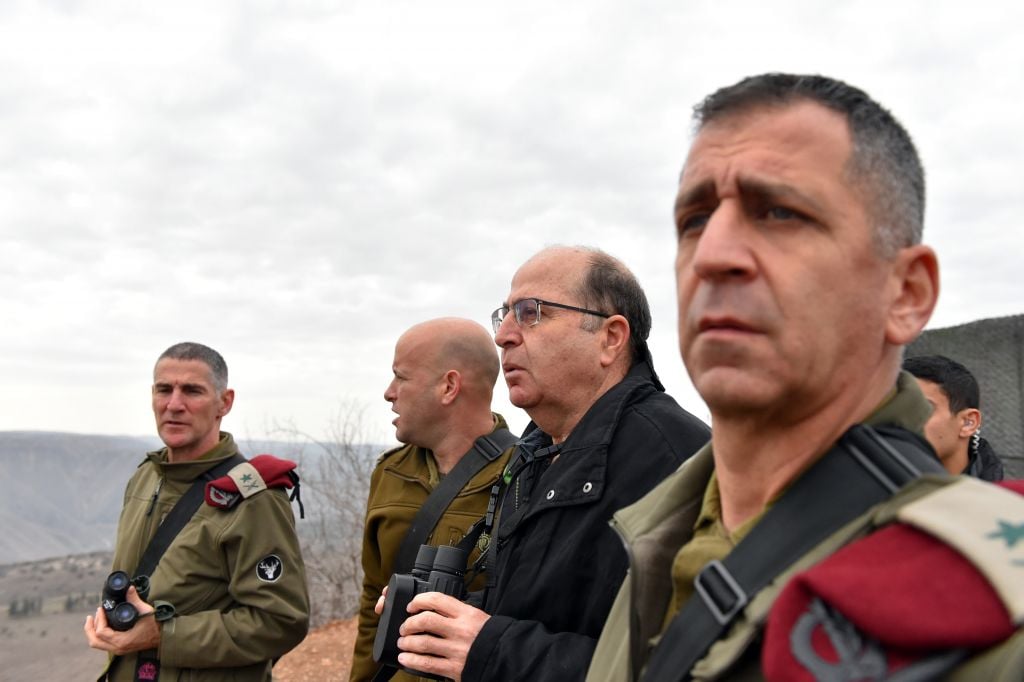
Former Deputy Chief of Staff Yair Golan speaks with then-Defense Minister Moshe Ya'alon (second from the right) and Northern Command head Aviv Kochavi (right) during a visit to Israel's northern border following a Hezbollah attack the day before, on January 5, 2016. (Ariel Hermoni/Defense Ministry)
Defense Minister Moshe Ya’alon visited Israel’s northern border on Tuesday to inspect the site of a Hezbollah attack on IDF soldiers, which occurred the previous day.
Touring the area near the Shebaa Farms, known in Israel as Mount Dov, Ya’alon said “the IDF is prepared to respond as necessary, as it responded yesterday harshly against the attack in the Har Dov area.”
On Monday, an improvised explosive device detonated near an Israeli army bulldozer and another vehicle near the border with Lebanon. No soldiers were injured in the attack.
Hezbollah took responsibility for the attack, saying it was carried out by a cell named for the terrorist Samir Kuntar, who was killed in a Damascus airstrike widely attributed to Israel on December 20.
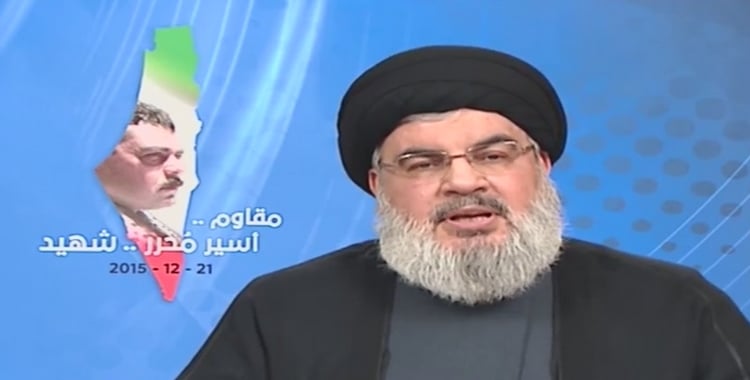
File: Hezbollah leader Hassan Nasrallah discusses the death of terrorist Samir Kuntar, allegedly at the hands of Israel, in a televised speech from Beirut on December 21, 2015. (screen capture: YouTube)
Hezbollah secretary-general Hassan Nasrallah had denounced the assassination in a speech in late December and vowed that retaliation for Kuntar’s death would “inevitably come.”
Get The Times of Israel's Daily Editionby email and never miss our top stories
Monday’s attacks were apparently Hezbollah’s first attempt since the assassination to exact revenge.
During Ya’alon’s visit, he spoke with Deputy Chief of Staff Maj. Gen. Yair Golan, of the Northern Command head Maj. Gen. Aviv Kochavi, and Brig. Gen. Yaniv Assor, head of the Bashan Division, which is responsible for the Golan Heights, his office said.
The defense minister praised the troops stationed along the border.
Advertisement
“I applaud the IDF and its Northern Command for both its preparedness for the attack and its response to that attack. We are prepared for any development.”
We can't do this work alone.
The war with Iran has been draining for all of us in Israel. But when I heard about a high casualty incident – ballistic missile impacts in Arad and Dimona that left nearly 200 people wounded – I drank a cup of coffee, packed a bag, and headed south.
There, I spoke with Shilgit, the head of an after-school program for underprivileged youth. Standing outside her destroyed center, Shilgit said it was a miracle that no children were hurt and spoke about the community coming together in the hours since.
As a Times of Israel reporter, I’m committed to telling stories of resilience like Shilgit’s. But my colleagues and I can't do this alone. If you value work like this,please consider joining our reader support group, The Times of Israel Community. Your financial support is essential to keep real human reporting like this going.
We’re really pleased that you’ve read X Times of Israel articles in the past month.
That’s why we started the Times of Israel - to provide discerning readers like you with must-read coverage of Israel and the Jewish world.
So now we have a request. Unlike other news outlets, we haven’t put up a paywall. But as the journalism we do is costly, we invite readers for whom The Times of Israel has become important to help support our work by joining The Times of Israel Community.
For as little as $6 a month you can help support our quality journalism while enjoying The Times of Israel AD-FREE, as well as accessing exclusive content available only to Times of Israel Community members.
Thank you, David Horovitz, Founding Editor of The Times of Israel