

Apocoalition now
The coalition talks are in their final stages, and the Syrian rebels take UNDOF hostage
 Add ToI as a Preferred Source on Google
Ilan Ben Zion is an AFP reporter and a former news editor at The Times of Israel.
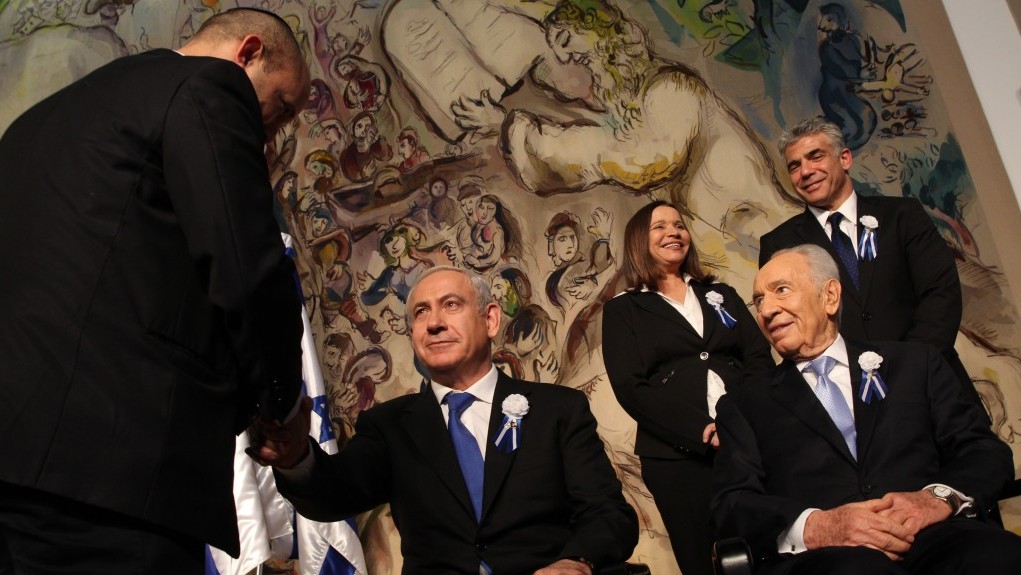
The coalition talks are in their final stage, according to Likud-Beytenu, and all that remains is hammering out the final details of the alliances with Jewish Home and Yesh Atid. On the northern front, however, the specter of chaos looms large as Syrian rebels capture a UN detachment near the Israeli border.
Maariv reports that Likud-Beytenu and Yesh Atid have nearly reached an agreement. The paper writes that Yesh Atid’s basic conditions for joining the government were accepted by Likud-Beytenu, including the requirement that ultra-Orthodox schools teach their students the core general studies curriculum. It quotes a senior Likud-Beytenu source saying that the only thing standing in the way of signing an agreement is Yesh Atid leader Yair Lapid’s insistence that he become foreign minister.
Maariv also runs a piece on Shas triumvir Aryeh Deri saying that he would quit the party if he does not get sole control of the Shas leadership that he currently shares with Eli Yishai and Ariel Atias.
Haaretz reports that Prime Minister Benjamin Netanyahu started dishing out ministerial portfolios, and is likely to give former chief of staff Moshe Ya’alon the Defense Ministry, and Jewish Home leader Naftali Bennett — who has not yet agreed to join the government — the Finance Ministry.
The paper quotes senior Likud-Beytenu officials saying that Netanyahu may renegotiate the terms of Tzipi Livni’s inclusion in the government “because of Lapid and Bennett’s opposition to the broad powers she was given in managing negotiations [with the Palestinians].”
In graph form, the paper summarizes who would head which ministry. Inter alia, either Lapid or Yisrael Beytenu leader Avigdor Liberman would run the Foreign Ministry; Lapid, his deputy Shai Piron, or Likud MK Gideon Sa’ar would helm the Education Ministry; and Jewish Home’s Uri Ariel would take the Housing Ministry.
The paper’s editorial calls on Lapid to remember his campaign promises not to join a government with more than 18 ministers despite Netanyahu’s urge to share the wealth with as many coalition partners as possible.
“So if Lapid — who would hold a government portfolio and, as leader of the second-largest faction, be deputy prime minister — joins a cabinet with more than 17 other ministers, he will violate an explicit commitment. It would make him just like the old-style politicians he said he meant to uproot,” it writes.
“The possibility that Netanyahu may have trouble dealing with a rebellion of disappointed members of his faction — especially former ministers left without a portfolio — is irrelevant when what’s at stake is the state’s welfare and the goal of setting up the best possible government.”
Yedioth Ahronoth reports that Jerusalem is concerned that the border incident may precipitate the dismantling of the UNDOF force and its abandonment of the border zone. It reports that the kidnapping took place approximately five kilometers from the Israeli and Jordanian borders near the village of Jamla, and was carried out by a group that identified itself as the Yarmuk Martyrs Organization.
It notes that because of the increasing risk of operating in the area, several of the UNDOF countries have pulled their troops from the force. It reports that the Japanese troops left, the Croatians are on their way out, and the remaining force is down to a mere 1,000.
Israel Hayom puts the right foot forward and leads with the kidnapping of UN observers on the Israel border by Syrian rebels. The paper draws a connection between the kidnapping on Wednesday and an incident a few weeks ago, in which a “senior adviser of the [UNDOF] commander was kidnapped in the Syrian Golan Heights in the beginning of February and until now it was not clear who held him.”
http://www.youtube.com/watch?feature=player_embedded&v=aQMEtlHAPro
In the same article, the paper mentions that the Arab League extended the offer of a seat at the league’s round table to the Syrian opposition.
Professor Eyal Zisser of Tel Aviv University’s Middle East department writes in the paper that the Syrian civil war is suddenly very close to Israel. He says that in the fight against President Bashar Assad, the al-Qaeda affiliated Jabhat an-Nusra features prominently, alongside which operates “a rabble of armed groups, most without a centralized leadership. They are local gangs of lawbreakers, youths seeking revenge, who have taken control of the village areas and periphery.”
“Israel must get used to [the fact] that these will now be its new neighbors,” he says. “The Syrian civil war has ceased, therefore, to be a theoretical matter… The Syrian civil war is already here and now.”
Yael Paz Melamed writes in Maariv that she is disgusted by what she regards as Israel’s plan to institute apartheid buses in the West Bank. “Israel the occupier is not fulfilling the elementary guidelines of international law imposed on occupying powers, to attend to the proper and ordinary quality of life of the occupied,” she writes.
“The world sees the images, hears the voice, and for it a Palestinian is also a human being,” she says. “Those who are silent are the politicians, excluding the left such as Meretz. In the eyes of [Labor Party leader] Shelly Yachimovich, for example, the suffering of Palestinians will never be part of her socio-democratic platform. Tzipi Livni is also silent, and Yair Lapid is silent.”









The Times of Israel Community.