

Oh, the inhumanity
Syria’s latest chemical weapon incident has the papers discussing Israeli intervention, Obama’s failures, and Trump’s burden
 Add ToI as a Preferred Source on Google
Ilan Ben Zion is an AFP reporter and a former news editor at The Times of Israel.
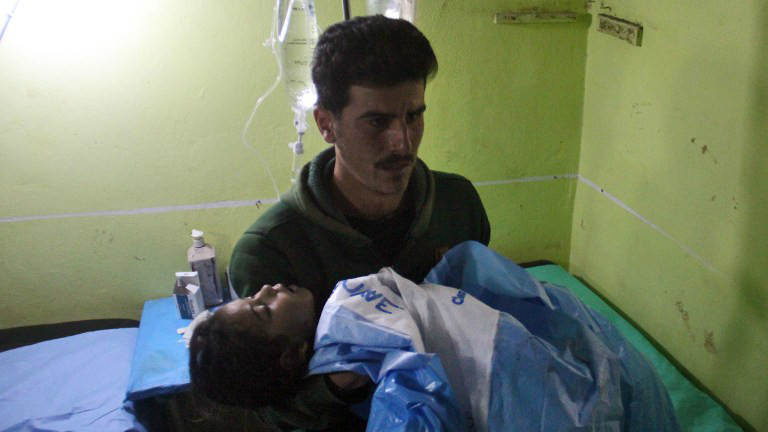
With headlines like Israel Hayom‘s “Assad’s hell” and Yedioth Ahronoth‘s “Murderer of children,” the Hebrew newspapers react with disgust and horror to Syrian President Bashar Assad’s use of chemical weapons (again) against civilians in Idlib. The front pages all depict the horrific images of the children who fell victim; a crush of op-eds cry out against fresh atrocities in the civil war that’s as old as some of the children killed in the latest gas attack.
Who better to convey the horrors of the latest chemical weapons attack to an Israeli audience than a member of the White Helmets, whose words were translated to Hebrew and appear in Yedioth Ahronoth.
Majid Khalfi, writing from Idlib, recounts the Assad government’s bombing and the gruesome work he and his fellow aid workers faced. “Already when we arrived in Idlib we were injured. Members of the team began to suffer from severe shortness of breath. Five of us were injured, three severely,” he says. Throughout the rescue operation, the attacks continued. “Four hours after the first attack, when the ambulance teams were operating, additional airstrikes began on the White Helmets treatment center and completely took us off the ground.”
“We demand that the international community fulfill its commitments to investigate this crime and bring those responsible to justice,” Khalfi says. “We may be volunteers but we have a stronger will to serve the country and save lives. Bravery isn’t in killing. Killing is an easy thing. To save lives of dying people is much more difficult.”
Israel Hayom’s Boaz Bismuth, who’s already proven his bona fide adoration for US President Donald Trump, jumps on the White House’s Obama-knocking bandwagon with his op-ed.
He accuses the United States — read Obama administration — of being “no less terrible” than Russia, Iran and Hezbollah for giving Assad a “green light to remain in the palace.” “Obama shares part of the responsibility for the chemical attacks on the Syrian people,” he says. The current tragedy, on the other hand, “can be Trump’s hour of greatness. He can return America to its natural place at the expense of Assad, Iran and Russia, too.”
He mocks the ex-president with snide remarks, calling him “a knight of human rights and Nobel Peace Prize laureate,” and “a man of words,” and rebukes Obama for not getting involved in Syria, while simultaneously saying that “to the misfortune of Syrian civilians there were too many states involved in their war.” No contradictions there.
Bismuth rounds off the op-ed with an entreaty to the Trump administration to intervene in Syria “for the sake of the surviving children.”
While Bismuth tugs at the commander-in-chief’s heartstrings, Haaretz keeps to the realpolitik. Even Amos Harel shares Bismuth’s critique that this latest chemical weapons attack reflects poorly on the Obama administration.
He not only advocates American intervention, he goes so far as to suggest Israeli action. “If indeed there was use of chemical weapons, Israel needs to reevaluate its defensive policies.”
Despite some Israeli officials calling for action, Harel writes that for the time being Netanyahu seems willing to condemn but not act, and the Trump administration, “which is capable of effecting an attack of this sort without substantive difficulty, prefers to focus on thrusting blame on his predecessor Obama.” Ultimately Assad’s success will spell disaster for Israel, Harel writes, particularly regarding the deployment of Hezbollah and Iranian troops along the border with the Golan Heights.
The lesson Yedioth Ahronoth’s Eitan Haber draws from the incident is that if the Arab states turn to wipe out Israel, nobody in the global community would bother lifting a finger, just as they aren’t when it comes to Syria. “The world shrugs its shoulders and is silent in the face of what happened yesterday in Syria,” he says. “That’s how it was in the Second World War when many Jews, and not just them, asked: where is the world? Why is it silent? Why doesn’t it bomb the tracks that brought millions to Auschwitz? Thus it will be in the future.”
“The role of the State of Israel in these moments is to be the global conscience,” he says. It might complicate things with Russia, Haber writes, but if Israel doesn’t do it, the world won’t either.
While Haaretz and Yedioth Ahronoth appear to advocate Israeli intervention in Syria, Israel Hayom’s Dan Margalit insists in his column that “The heart breaks — but we need to stay out.” Israel has never intervened in international crises that weren’t its own, he says, and “Israel doesn’t want to spill the blood of IDF soldiers in foreign conflicts.”
While Syria’s chemical weapons strike carries most of the agenda in the Wednesday papers, some local stories also make the cut. After reporting on Netanyahu condemning the Idlib incident, Israel Hayom runs a summary of an Arabic news report on Trump and Egyptian President Abdel-Fattah el-Sissi discussing a peace conference between Israel and Arab states in the US over the summer. According to the report, Trump’s special envoy Jason Greenblatt discussed it with Arab diplomats during his recent trip to the Middle East.
Yedioth Ahronoth’s next article at bat quotes Attorney General Avichai Mandelblit saying that he didn’t give his seal of moral approval to the deal struck by Netanyahu and Finance Minister Moshe Kahlon to defang the future public broadcasting corporation. With little else to report on, Haaretz reports that a five-year-old Israeli girl will be deported with her mother back to Ethiopia after her parents were divorced, before her mother’s status in Israel could be finalized.








The Times of Israel Community.