

Paris is Paris again
Just when it seemed things were getting back to normal, a major police raid puts terror in the city of lights back at the top of the news agenda
 Add ToI as a Preferred Source on Google
Raoul Wootliff is a former Times of Israel political correspondent and Daily Briefing podcast producer.
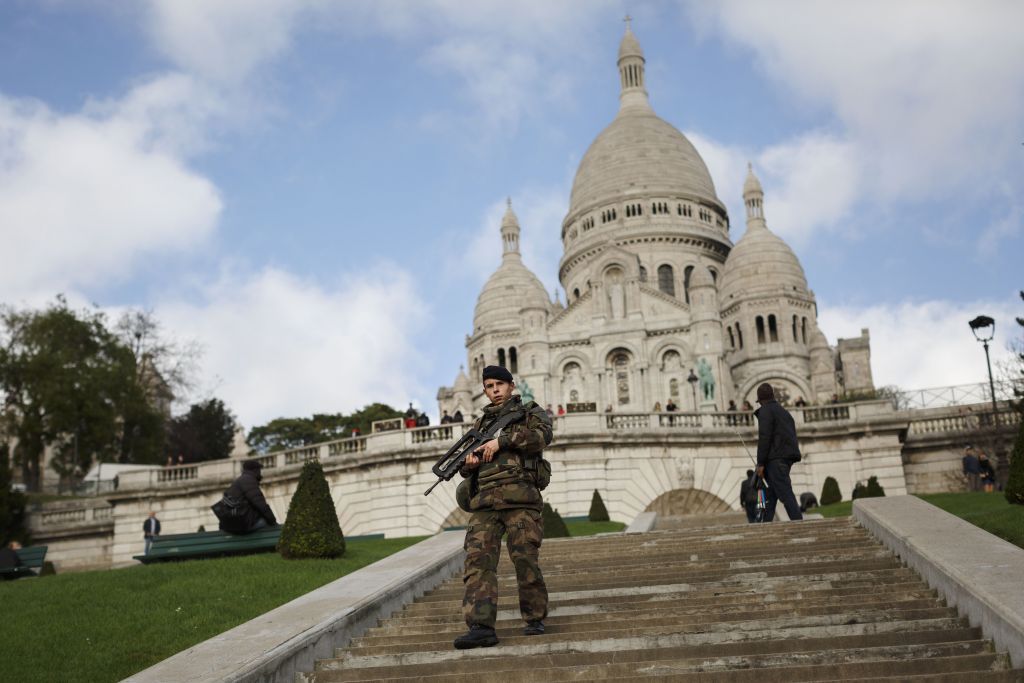
Nearly a week after Paris exploded on the international media stage with reels and reams filled with every detail of the carnage, stories of the victims, profiles of the perpetrators and scenes of the vigils, the Paris attacks are again the focus of the Israeli dailies following a dramatic seven-hour siege on a terror cell suspected of planning Friday’s attacks and preparing for more.
Framed by an austere banner declaring “Slaughter in Paris” and flanked by photos of armed French police and a distraught man draped in the tricolor, the tabloid Israel Hayom dedicates the first 15 pages of Thursday’s paper to the raids and other terror-related stories.
Leading the front page with the headline, “The target: The terror mastermind,” referring to suspected ringleader Abdelhamid Abaaoud — who, it was confirmed Thursday, was in fact killed in the raid — the paper then turns to its foreign editor, Boaz Bismuth to describe the operation “from the scene” in a two-page spread.
“Five horrific explosions at 4:20 in the morning woke the residents of the Parisian suburb of Saint-Denis… Helicopters circled in the air, shooting lasted nearly two hours… Neighbors were asked to stay in their homes, and those who were on the street were asked to lie down on the floor. It was war,” he said.
Bismuth follows up the account with two stories from Saint-Denis residents quoting, in one case, a neighbor who thought “they would come into my apartment and kill me on the spot,” and in another, Muhammed Mahdoor who believes “Jerusalem is the root of all these problems.”
“Muslims cannot accept the humiliation of the Palestinian people. There are over a billion Muslims around the world, and if there’s one thing that unites us all it’s al-Quds [the Arabic name for Jerusalem]. Until Jerusalem is returned to the Muslim world as it has always been, Muslims will feel humiliated. Before Israel there were not any problems between Muslims, Christians and Jews,” Mahdoor told Bismuth.
The paper fills the next 12 pages with a range of stories loosely connected to the “Slaughter in Paris” including the stabbing of a Jewish teacher in southern France, terror alert levels being raised across Europe and the Islamic State group announcing it had smuggled a bomb on board the Russian airliner that went down last month in Egypt’s Sinai Peninsula.
Yedioth Ahronoth also links the IS announcement to the Paris attacks, featuring on its front page a picture of the can of pineapple-flavored Schweppes in which the group claims it hid explosives.
“As the aftershocks of the Paris attacks continue to shudder, Islamic State revealed yesterday the smoking gun from its previous terror attack, the blowing up of a Russian plane over Sinai that took the lives of 224 people,” the paper reported. “The photo in the group’s English-language magazine Dabiq showed a can of Schweppes Gold soft drink and what appeared to be a detonator and switch on a blue background. It also published a photo of what it said were passports belonging to dead Russians ‘obtained by the mujahideen.'”
The terror group, which has a powerful affiliate in the Sinai, had previously claimed to have downed the plane without offering further details.
While allocating considerably less column space to the Paris raid than Israel Hayom, Yedioth also gives a detailed account of the siege, mainly quoting Paris prosecutor Francois Molins who said the jihadi cell was capable of staging a fresh attack and was ready to act.
The paper’s round-up of the incident made prominent mention of Diesel, the French police dog who was killed in Wednesday’s raid and gained sympathy on social media with the hashtag #JeSuisChien (I am a dog) trending on Twitter for most of the day. The paper featured a photograph of Diesel with the caption “four-legged hero.”
Haaretz offers various analyses of the aftermath of and response to the Paris attacks.
Columnist Ari Shavit berates “the West” for trying to “defeat” Islamic fundamentalists, instead proposing a broader, and detail-lacking policy of engagement, “We must work with the region, not against it. We must listen, not coerce,” he says.
Claiming that some tried to “pretend the Arab world doesn’t exist” Shavit says, “the Arab world is alive and kicking and hurting, shouting and bleeding. And it’s a terror attack away from Europe. This is why the judgment year 2015 arrived. Anyone who still thinks that more vigorous intelligence work, more hermetic security and heavier airstrikes will solve the problem doesn’t understand the problem.”
The paper also draws a comparison between the way Europe and others are dealing with the terror threats and the Israeli decision to outlaw the Northern Branch of Israel’s Islamic Movement.
Netanyahu told the press, “The Northern Branch of the Islamic Movement … incites to violence against the innocent and is establishing close ties with the Hamas terror group and it undermines the state in order to set up in its place an Islamist caliphate.”
But Haaretz said the move, like those of other countries trying to deal with terror, will do little to curb fundamentalists.
“The outlawing of the northern branch fosters the dangerous illusion that its shutdown will significantly reduce Palestinian terror. This is what the president of Egypt thought when he banned the Muslim Brotherhood, defining it as a terror group,” said the editorial.
“Even without the Israelis’ decision, the government and security agencies have enough tools to act against anyone breaking the law by inciting or committing a terror act. The government’s decision is flawed, dangerous and nondemocratic. It should be reversed immediately.”




The Times of Israel Community.