

Somewhere between sadness and despair
As Israel prepares to mark Holocaust Remembrance day, papers feature stories memorializing the dead and offering scant hope for the future
 Add ToI as a Preferred Source on Google
Joshua Davidovich is The Times of Israel's Deputy Editor
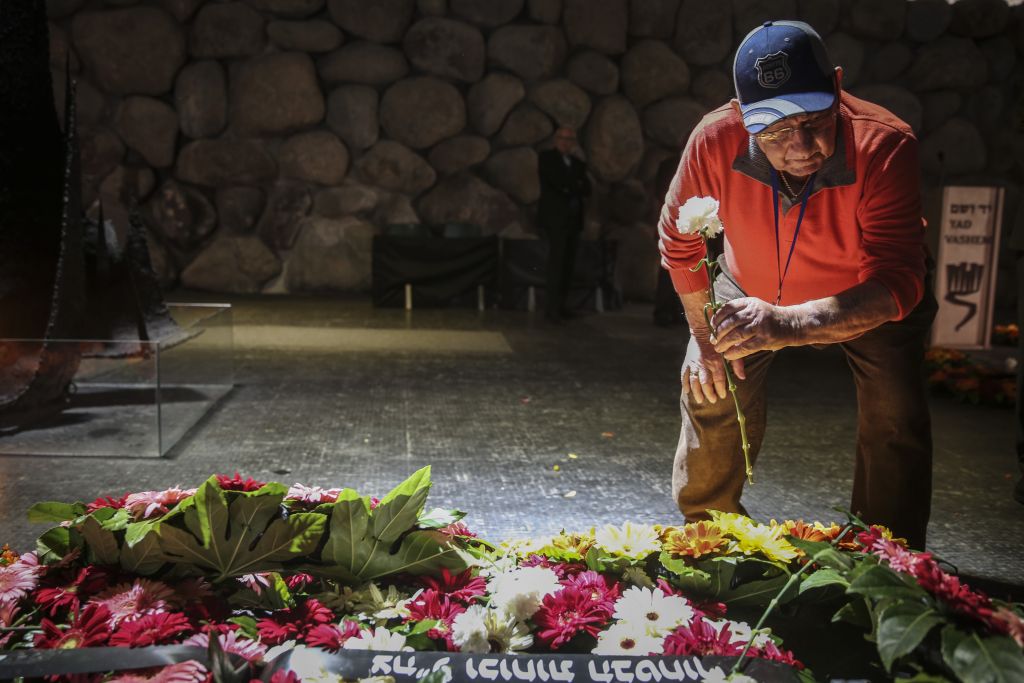
Like a derecho on an otherwise clear and sunny day, memories of the horrors of the Holocaust, and the continuing nightmare for many survivors, hit the press with full force Wednesday morning as the country prepares to mark 24 hours of Shoah remembrance Wednesday night and Thursday.
All three major dailies feature tales of remembrance, tales of loss, tales of triumph and tales of hopelessness emerging nearly 80 years after the greatest tragedy to befall the Jewish people, showing that after all these decades, and trillions of words written, spoken and sobbed, the story is not yet fully told.
Yet seemingly as a reminder that history did not end with the liberation of the camps, actual news also sneaks into the newspaper, including the possible re-emergence of Palestinian-driven violence after what looks now to have just been a lull, the upgrading of Israel’s ties with NATO, and the American presidential race.
It’s remembering the Holocaust, though, that dominates the news pages, and in what may be the only way to even begin to think about such a massive tragedy, stories walk a strange tightrope between the personal and the cold hard numbers, and between memorializing the six million dead and remembering the hundreds of thousands still alive.
Yedioth Ahronoth, for instance, runs a large picture on its front page of an elderly survivor embracing his granddaughter in IDF uniform, who supports his arm showing the indelible Nazi-tattooed numbers, under the headline “We have been victorious.”
Inside, though, the paper casts doubt on whether a symbolic victory of that sort is a win, reporting that of the 194,468 survivors living in Israel, tens of thousands of them are in poverty and need help from the government and from private organizations to scrape by.
“They are still here, next to us. Living, remembering and telling the story that it is forbidden to stop telling. But their hardships are our disgrace,” the paper writes before going on to detail some of those hardships, and survivors’ grievances.
“We gave a lot to make this country, and it’s difficult to see the forlorn state of survivors today,” one survivor who gets help from a private charity tells the paper. “We have towers of 40-50 stories worth billions – but on the other hand there are Holocaust survivors who are living on NIS 2,000 ($530) [a month]. It’s impossible to live like this. In another 10 years there won’t be who to will be able to tell about [the Shoah], we need to account for these amazing people who are still living.”
Haaretz marks the day by zooming in on one story that approaches the uncounted horrors of the Nazi death machine from an incredibly personal angle, reporting on hundreds of letters sent by a Jewish man named Daniel Israel from a prison in Italy before he was deported to Auschwitz, and which have been preserved by his sons and recently donated to Yad Vashem.
While the letters, which the paper calls an “archival treasure,” veer between hope and despair, some profound and some pedestrian, the last, smuggled out of a railcar approaching Auschwitz, is the most haunting.
“Here is where hell is, you see the smoke from afar,” the letter reads.
“When we got that letter, there was silence,” his son Vittorio is quoted telling the paper. “We understood that he hadn’t gone to [a work camp].”
Israel Hayom’s coverage mostly follows the tried and true formula of recounting what politicians and other officials are doing and saying to mark the day, under the front page headline “Never again.”
As in years past, remembrance has been swirled with politics and fears of resurgent anti-Semitism in Europe getting in mixed in with anti-Zionist sentiments.
Without mentioning former London mayor Ken Livingstone and the scandal erupting in Britain’s Labour Party, the tabloid’s Dan Margalit addresses his claim that Hitler was a Zionist based on an agreement to transfers Jews from Germany to Palestine, and draws a direct line between Holocaust denial and anti-Zionism.
“The core of all these measures, designed to minimize the harm done to the Jews, is so that the right of Israel to exist as a sovereign state in secure borders can be undermined,” he writes. “Distortion in all these areas is part of an overall effort — though not necessarily organized — to question the justice of creating the State of Israel, and in some places it has taken flight. This was the evil formula for the claim that there was a joint effort between the Nazis and the Zionist. The claim is based on the Haavara Agreement, which was in practice deportations of German Jews from their lands and the appropriation of most of their property in exchange for their migration to other countries. This is coordination? It’s an interim deal between enemies.”
In Yedioth, Ben-Dror Yemini tries to open readers’ eyes to a more classical form of Holocaust denial, or at least anti-Semitism, which he says still rages in Poland and other Eastern European countries, rattling off a list of statistics from a two-year-old poll showing that many Poles believe Jewish conspiracy theories, including that Jews rule the world, and nearly half don’t want to live near Jews.
“But the most worrying number in these polls are that they show a rise in anti-Semitic sentiments from years past. If in Western Europe one could link anti-Semitism to Muslims or anti-Israel feelings, in Poland, we are talking about classical anti-Semitism, which is also found among many of today’s youths,” he writes from Krakow.
What would a Jewish day of grief be without a reminder that Jews are hogging all the suffering. Alongside a less-than PC cartoon showing a man draped in an Israeli flag leading UK Labour chief Jeremy Corbyn and another British man who is likely Livingstone into Auschwitz in chains, Haaretz correspondent Amira Haas pens an op-ed titled “Holocaust of others.” Can you guess who the others are?
If you guessed Palestinians, you are only partially correct. It’s Palestinians and American blacks.
“Unlike another Shoah (which Nazi Germany and its allies committed), the American one continues to spread institutionalized oppression and exploitation, discrimination and racism, humiliation and contempt for the surviving descendants,” she writes from New York. “There is no African American whose own country and its white citizens have not caused him and his family a terrible disaster in the recent or more distant past − and for many others in the present as well. There is no Palestinian that Israel and its citizens have not caused a terrible disaster in the past and present − expulsion from the homeland; the killing of friends and relatives; the stealing of land, home and livelihood; the lacerating of roots and the rewriting of history; the attempt to wipe out identities; the breaking up of families. … The United States is the land of unlimited opportunity and liberty − individual progress for anybody who wants to and can. Just not for the masses of blacks, to whom it owes so much of its accumulation of capital and prosperity. Israel is rebirth and miracle, democracy, startup nation, honey − for every Jew in the world and just not for the Palestinians, the original people of the land.”








The Times of Israel Community.