

Touting aid deal, Obama says true Israeli security requires Palestinian statehood
US president says military package will help Israel defend itself but ‘long-term security’ depends on creating ‘an independent and viable Palestine’
 Add ToI as a Preferred Source on Google
Raoul Wootliff is a former Times of Israel political correspondent and Daily Briefing podcast producer.
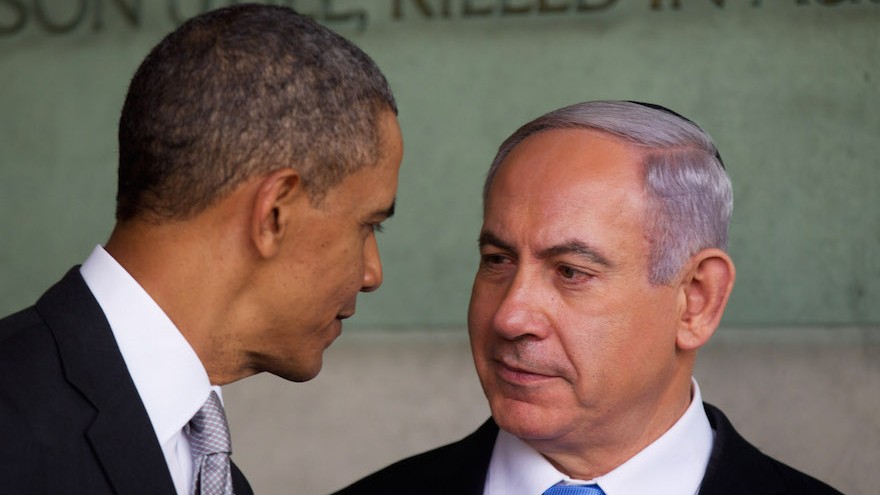
US President Barack Obama said Wednesday that while the massive new military aid deal for Israel — Washington’s largest defense package to any country in history — would help Israel defend itself, “long-term security” can only be achieved by the creation of “an independent and viable Palestine.”
Signed at a State Department ceremony earlier on Wednesday, the new package will grant Israel $3.8 billion annually — up from the $3 billion pledged under the previous agreed-upon MOU — starting in 2018 and through 2028.
In a statement released shortly after the signing, Obama described the agreement, known as the memorandum of understanding, as “just the most recent reflection of my steadfast commitment to the security of the State of Israel,” citing billions of dollars already provided by his administration over the past eight years.
“Over the past eight years, my administration has time and again demonstrated this commitment in word and deed,” he said, stressing that this deal will help Israel address its defense needs.
“Both Prime Minister Netanyahu and I are confident that the new MOU will make a significant contribution to Israel’s security in what remains a dangerous neighborhood. The continued supply of the world’s most advanced weapons technology will ensure that Israel has the ability to defend itself from all manner of threats.”
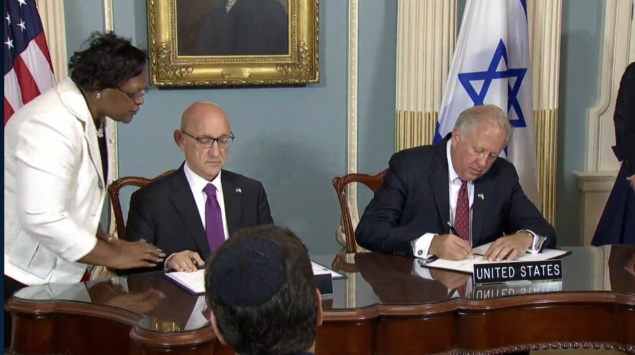
But the US president said a bolstered military was not enough to secure long-term stability for the Jewish state. He said America’s commitment to Israel’s security meant more than just giving military aid.
“It is because of this same commitment to Israel and its long-term security that we will also continue to press for a two-state solution to the longstanding Israeli-Palestinian conflict, despite the deeply troubling trends on the ground that undermine this goal,” he said.
“As I have emphasized previously, the only way for Israel to endure and thrive as a Jewish and democratic state is through the realization of an independent and viable Palestine. Ultimately, both this MOU and efforts to advance the two-state solution are motivated by the same core US objective that has been shared by all administrations, Democratic and Republican, over the last several decades — ensuring that Israelis can live alongside their neighbors in peace and security.”
Speaking before the ceremony, Prime Minister Benjamin Netanyahu thanked the United States for what he described as the “unprecedented” and “historic” defense aid package.
“This agreement will ensure an unprecedented level of defense aid for Israel in the next decade,” Netanyahu said in a video. “This is the largest military aid package the US has ever given out to any nation.”
“The agreement will help us continue building our armed forces, improve our missile defense systems,” he added. “I want to thank President Obama and his administration for this historic agreement.”
Writing on Twitter, Israeli ambassador to the US Ron Dermer thanked Obama directly for “forging this historic agreement.”
Thx to @POTUS for forging this historic agreement for bipartisan support in Congress& for the American people's broad and deep support for????????
— Ron Dermer – רון דרמר (@AmbDermer) September 14, 2016
Democratic nominee Hillary Clinton released a statement praising the deal saying that it “sends a clear message to the region and the world that we will always stand shoulder-to-shoulder with Israel.”
“The agreement will help solidify and chart a course for the US-Israeli defense relationship in the 21st century as we face a range of common challenges from Iran’s destabilizing activities to the threats from ISIS and radical jihadism, and efforts to delegitimize Israel on the world stage,” she said.
Under the terms of the deal, Israel pledged not to seek additional funding from Congress for the next decade. The agreement also includes a provision curtailing Israel’s ability to spend the funds on its own arms industry over the next six years — a key area of dispute during talks. Washington had wanted Israel to spend a larger amount of the funds on American-made products. Currently, Israel can spend 26.3 percent of US military aid buying from its own domestic defense companies.
The US also reportedly wanted to remove a clause in the memorandum that allows Israel to spend $400 million a year on “military fuels.”
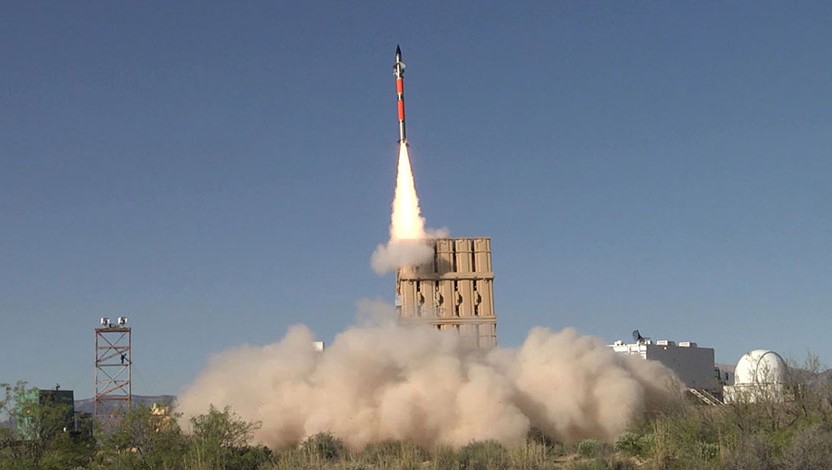
According to earlier reports, Israel had asked for a separate, $400 million deal for missile defense spending — which could have raised the total amount to more than $4 billion annually. However, the final figure was set without that provision.
In his statement, Netanyahu acknowledged the recent diplomatic disputes between Jerusalem and Washington, but said they “had no effect whatsoever on the great friendship between Israel and the US.”
“These are disputes you have between family,” Netanyahu said. “This agreement demonstrates the simple truth that the relationship between Israel and the US is strong and powerful.”







The Times of Israel Community.