

2 years after Paris supermarket attack, darkness engulfs memorial candles
Although the French government has made security strides, Paris Jews are convinced terror will strike again
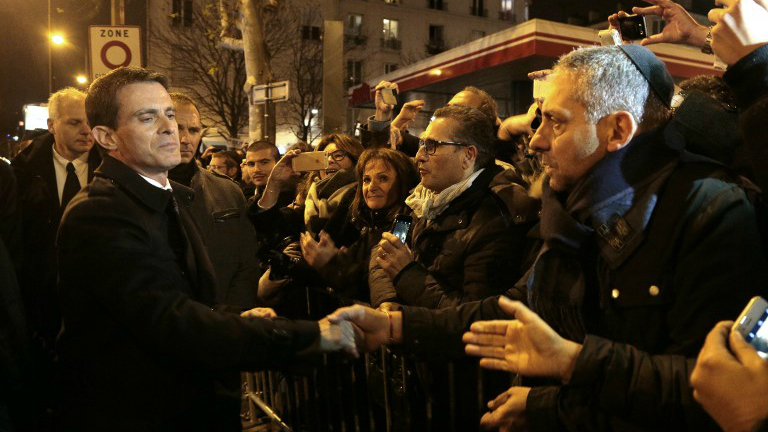
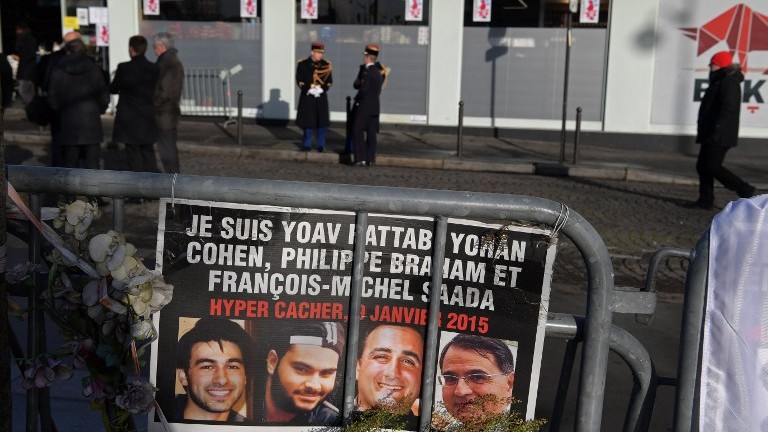
PARIS — Could it happen again? Two years ago, four people were murdered in a terror-driven hostage standoff at a kosher supermarket in Paris. For the roughly 250 people who gathered in front of the Hyper Cacher supermarket Monday evening, the answer seemed to be a resounding “yes.”
While many Parisians agree the French government has done a good job ramping up security amid the terror outbreak of the last few years, they do not rule out future instances of violence.
“Nobody is fully protected from another attack because the targets are no longer only members of the Jewish community,” said Lassana Bathily, a young Malian Muslim employee of the supermarket who saved about a dozen people during the hours-long standoff in January 2015.
“The Islamic radicals have twisted Islam, my religion and that of my fathers, to justify killing whomever they want,” he told The Times of Israel, speaking from the middle of the crowd. “So, yes, I am afraid sometimes, and we must all be careful.”
Bathily succeeded in hiding the distraught customers in the storeroom downstairs when terrorist Amedy Coulibaly started shooting. Bathily then managed to escape the store and give police valuable information. Considered part of the “family” of store employees, he was named a hero after the survivors were rescued and the terrorist killed. Eventually he was given a French passport.
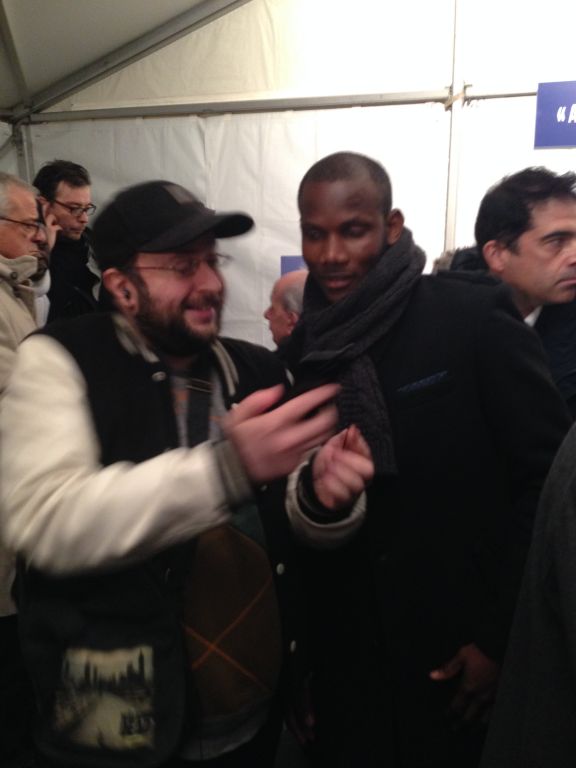
At Monday’s memorial, despite his attempts to shrug off his heroics, people were lining up to have their photos taken with Bathily. Meanwhile, candles were lit for Philippe Braham, Yohan Cohen, Yoav Hattab and François-Michel Saada, the four victims.
High-ranking French government officials present at the memorial tent ceremony included Interior Minister Bruno Le Roux, as well as presidential candidates François Fillon and Manuel Valls. After the shooting two years ago, Valls made the now-famous statement, “Without its Jewish community, France would not be France.”
Francis Kalifat, president of the CRIF Jewish umbrella group, described the changes in security that have been implemented since the attack.
Until the series of shootings on November 13, 2015, which left more than 100 people dead, most French were convinced that radical Islamic terrorists targeted only Jews and militant press groups such as Charlie Hebdo. As such, security measures were focused on Jewish schools, synagogues and community centers.
“The downside of the situation, if you like, is that after November 15, 2015, the police and soldiers began to protect churches, press offices and other secular French institutions,” explained Kalifat. “The Jewish community no longer has a monopoly on protection by security forces from attacks. As the threat of attacks spread to the general population, so did the security measures.”
The government and police went from stationary protection structures to incognito mobile units, and they “are doing a good job,” he said, “but now the whole country is under threat. And as a byproduct of that, many people now compare the situations in France and Israel.”
“There has been a political awakening among the Gallic French people,” said Samuel Lejoyeux, an activist in the Jewish Student Union. “French Jews feel less solitary in their fear of attacks by radical Islamists.”




The Times of Israel Community.