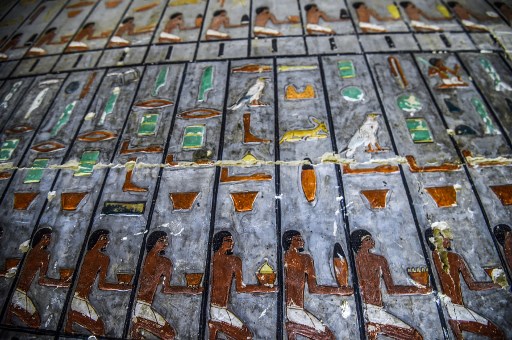
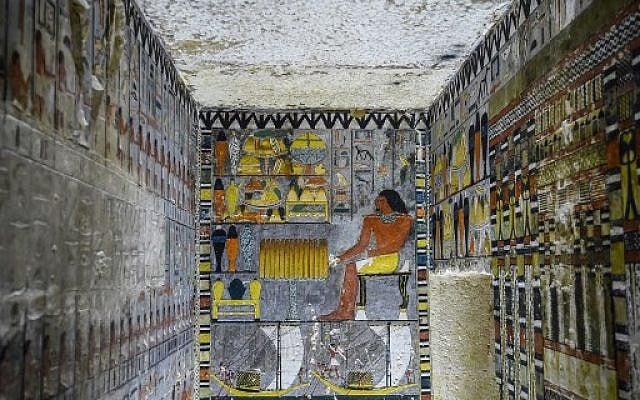
This picture taken on April 13, 2019 shows a view inside the newly-discovered tomb of the ancient Egyptian nobleman "Khewi" dating back to the 5th dynasty at the Saqqara necropolis in Egypt. (Mohamed el-Shahed / AFP)
CAIRO, Egypt — In a major archaeological discovery, Egypt on Saturday unveiled the tomb of a Fifth Dynasty official adorned with colorful reliefs and well preserved inscriptions.
The tomb, near Saqqara, a vast necropolis south of Cairo, belongs to a senior official named Khuwy who is believed to have been a nobleman during the Fifth Dynasty, which ruled over Egypt about 4,300 years ago.
“The L-shaped Khuwy tomb starts with a small corridor heading downwards into an antechamber and from there a larger chamber with painted reliefs depicting the tomb owner seated at an offerings table,” said Mohamed Megahed, the excavation team’s head, in an antiquities ministry statement.
Flanked by dozens of ambassadors, Antiquities Minister Khaled al-Enani said the tomb was discovered last month.
This picture taken on April 13, 2019 shows a view inside the newly-discovered tomb of the ancient Egyptian nobleman “Khewi” dating back to the 5th dynasty at the Saqqara necropolis in Egypt. (Mohamed el-Shahed / AFP)
It is mostly made of white limestone bricks.
Get The Times of Israel's Daily Editionby email and never miss our top stories
Ornate paintings boast a special green resin throughout and oils used in the burial process, the ministry said.
The tomb’s north wall indicates that its design was inspired by the architectural blueprint of the dynasty’s royal pyramids, the statement added.
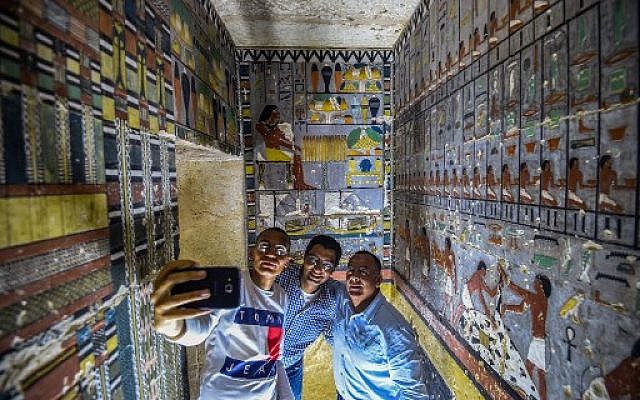
Mohamed Mujahid, head of the Egyptian mission which discovered the tomb, posing for a “selfie” photograph on a cell phone inside the newly-discovered tomb of the ancient Egyptian nobleman “Khewi” in Saqqara necropolis in Egypt on April 13, 2019. (Mohamed el-Shahed / AFP).
The excavation team has unearthed several tombs related to the Fifth Dynasty.
Advertisement
A photographer looks through the entrance of the tomb of Maia, the wet-nurse of legendary Egyptian boy king Tutankhamun, in Saqqara, Egypt, on December 20, 2015. (AFP/KHALED DESOUKI)
Archaeologists recently found an inscription on a granite column dedicated to Queen Setibhor, who is believed to have been the wife of King Djedkare Isesis, the eighth and penultimate king of the dynasty.
Egypt has in recent years sought to promote archaeological discoveries across the country in a bid to revive tourism that took a hit from the turmoil that followed its 2011 uprising.
Help us report truthfully on social media
As a multimedia journalist, my job is to take the quality, fact-based journalism produced by The Times of Israel newsroom and make it accessible across every platform — from Instagram posts to podcasts to short-form videos.
This is how many, especially young people, consume news these days. But misinformation is rampant on social media. Our team at ToI produces accurate, responsible short-form reporting on Israel and the Jewish world.
If you believe in the importance of factual social media journalism, please consider joining our reader support group, The Times of Israel Community. Your financial support is essential to sustain responsible multimedia reporting.
We’re really pleased that you’ve read X Times of Israel articles in the past month.
That’s why we started the Times of Israel - to provide discerning readers like you with must-read coverage of Israel and the Jewish world.
So now we have a request. Unlike other news outlets, we haven’t put up a paywall. But as the journalism we do is costly, we invite readers for whom The Times of Israel has become important to help support our work by joining The Times of Israel Community.
For as little as $6 a month you can help support our quality journalism while enjoying The Times of Israel AD-FREE, as well as accessing exclusive content available only to Times of Israel Community members.
Thank you, David Horovitz, Founding Editor of The Times of Israel


 Add ToI as a Preferred Source on Google