
 Add ToI as a Preferred Source on Google
LONDON — If there was ever a metaphor for British Jews’ ambivalence about emigrating to Israel, it was on full display at the Aliyah Day fair in London on Sunday.
Visitors to the event, held at StoneX Stadium, a north London rugby venue, passed through airport-style security under the watchful eye of Metropolitan Police officers, volunteers for the Jewish nonprofit Community Security Trust, and burly Israeli guards.
Inside, the mood shifted.
“Come home,” beckoned a blue-and-white sign at the entrance to the event space. Beyond it was a one-stop shop for those considering a new life in Israel, with representatives offering advice on citizenship, Hebrew lessons, universities, jobs, taxes, schools and choosing a city or community.

More than 1,200 people passed through the doors throughout the day, a high compared with previous years. It was even more notable given the rally against antisemitism taking place outside Downing Street that afternoon, which an estimated 20,000 attended.
Britain’s Jewish community has been on edge amid a wave of antisemitic violence, including the stabbing of two Jewish men in Golders Green, an arson attack on four ambulances belonging to the Hatzola volunteer EMT service in the same heavily Jewish neighborhood, and the deaths of two worshipers during Yom Kippur services in a terror attack targeting a Manchester synagogue in October.
The fair was organized by the Jewish Agency for Israel, Keren Hayesod, Israel’s Aliyah and Integration Ministry, Ofek Israeli — a World Zionist Organization company that works to encourage immigration to Israel — and the WZO’s Department for the Promotion of Aliyah. Representatives from the groups, along with service providers and Israeli municipal officials, offered practical advice on the process of moving to Israel.
Organizers said the goal was not to encourage people to leave Britain, but to put the options in front of those already considering life in Israel.
Among those in attendance were Hezzie Raymond and Tamara Sireling Raymond, both 35, together with their 9-month-old son. Sireling Raymond had previously moved to Israel from London but got “stuck here” in her hometown during the 2019 coronavirus pandemic while visiting family. It was then she met the man she would go on to marry.
“From the beginning, I asked him what it’s going to take to make him move to Israel,” she said.

He replied that it wouldn’t be much, as his siblings and grandparents already live there. Now the pair are planning to go and introduce their son to his family.
“They haven’t met him yet, which has been tough,” said Raymond, adding that it has been harder to travel since their son was born. “Even though I still love England, I want the family to be together.”
Sireling Raymond agreed, saying she “loves England” and “you can’t beat” the British countryside. But having a child has strengthened her resolve to return to Israel, where she spent 12 years.
“I want to raise my son in Israel,” she said. “I think he’ll have a sense of freedom there to be who he wants to be.”
“I feel like in Israel you’re just one happy, very dysfunctional family, but at the end of the day, it’s still family. I want to raise him with that — I think it’s something beautiful that you just can’t get anywhere else,” she said.
‘I feel like in Israel you’re just one happy, very dysfunctional family, but at the end of the day, it’s still family’
Also making a longstanding dream a reality are Achinoam and Gidon Blake, who will make the move with their two teenage children this summer. They are getting a leg up through Israela, an originally French initiative now specializing in the absorption of families from around the world.
The couple has considered moving to Israel before, but personal circumstances, including an illness in the family, kept them in the UK. Going with Israela feels right, they say, as the organization ensures you have an almost ready-made community.
“So you’re not making Aliyah by yourself,” said Gidon Blake, using the Hebrew term for moving to Israel. “It’s incredible.”

The Israeli-born Blake, an accountant, moved to Britain as a child, but met his Argentine wife, a teacher at a Jewish school, in Israel.
“We always said we wouldn’t make Aliyah out of fear — we wanted to make it from a positive perspective,” he said.
The fear factor
There is, of course, no avoiding the negative. The terror threat in Britain was raised to “severe” following the recent string of violent attacks, and UK Prime Minister Keir Starmer belatedly held a summit to deal with skyrocketing antisemitism following the bloody Hamas-led invasion of Israel on October 7, 2023, and the subsequent war in Gaza, in which he called the tidal wave of Jew-hatred a “crisis.” In its most recent report, the CST said 3,700 antisemitic incidents were recorded last year, the second-highest tally since 2023.
“Do I feel that antisemitism has removed its mask from the UK and has become very blatant and very open?” asked Blake. “Yes, I do. Do I see the UK recovering in the near future from it? No, I don’t. I think the UK’s going to suffer from what’s going on, but we’re not going because of that. I’m going because my entire extended family is in Israel.”
‘Do I feel that antisemitism has removed its mask from the UK and has become very blatant and very open? Yes, I do’
“Also, Israel being the startup nation and the chutzpah of the Israeli culture is what I feel gets people moving forward, and I think my son and daughter would benefit immensely from that,” he said.
His wife agreed, although she stressed that recent events had strengthened their resolve.
“That was a very difficult thing because I walk the streets of Golders Green,” said Achinoam Blake. “It’s too close and it’s not okay.”
“I’m not saying everything is perfect in Israel — I’m not naive,” she said, but added that she believes moving as part of a group of families will help smooth the transition “because they can understand what we’re going through right now.”
Selling Israel as one option among many for Jews
The situation in Britain is not unique, with violent antisemitism surging in many countries, including the United States, France, Canada and Australia. For this reason, some people see Israel as the safest alternative — despite the Jewish state having been at war for much of the last two-and-a-half years.

A recent report from the Institute of Jewish Policy Research shows younger people, Orthodox Jews and those most affected by antisemitism are most likely to say they’re considering moving to Israel in the next five years.
According to the report, 742 people moved from Britain to Israel last year — the highest number since the mid-1980s, but far from a wave. When added together with the previous two years, the average number of those leaving for Israel — 566 — is closer to the average of the last 20 years, JPR found.
Eran Berkovich, director of Aliyah at the Jewish Agency, said the aim of events such as this “isn’t to pull [people] away from this community. It’s to put the options in front of their eyes.”
“We show them that it can be much easier than how they might have thought about it before,” Berkovich added.
‘I don’t want to live in a country where I have to be scared every day hearing new things’
Having a family connection can be a significant pull factor, said Shelli and Adam, who asked not to give their full names. The couple hopes to join Shelli’s parents and sister in Israel in the near future.
“We always said we would retire there, but the situation brought it forward,” Shelli said. “The writing’s been on the wall for the last couple of years. I don’t want to live in a country where I have to be scared every day, hearing new things.”
Adam was not raised Jewish and has always lived in London. He said family and sunshine are big draws, adding: “It’s something we always wanted to do anyway.”
But he also believes there is a “two-tier police system” in Britain where “antisemitic incidents are not being dealt with properly.”

“These things make me question how reliable the system will be when it really matters. It’s another reason why we’re moving,” he said.
The security situation is also affecting Israelis who have spent years living in Britain. Two women, who asked not to be named, said they never reveal that they’re Israeli in public.
‘I feel the time has come for Jewish people to make some tough decisions, as it really feels like just before World War II’
One, in London for a decade, said: “I feel the time has come for Jewish people to make some tough decisions, as it really feels like just before World War II. It’s important to find that point before it’s too late.”
She said that although she has not personally been impacted by antisemitism, she and her husband are serious about leaving and are considering their options.
Her friend, who has been in London for over 40 years, said she’s been thinking a lot about her father, who left Iraq for Israel in 1950.
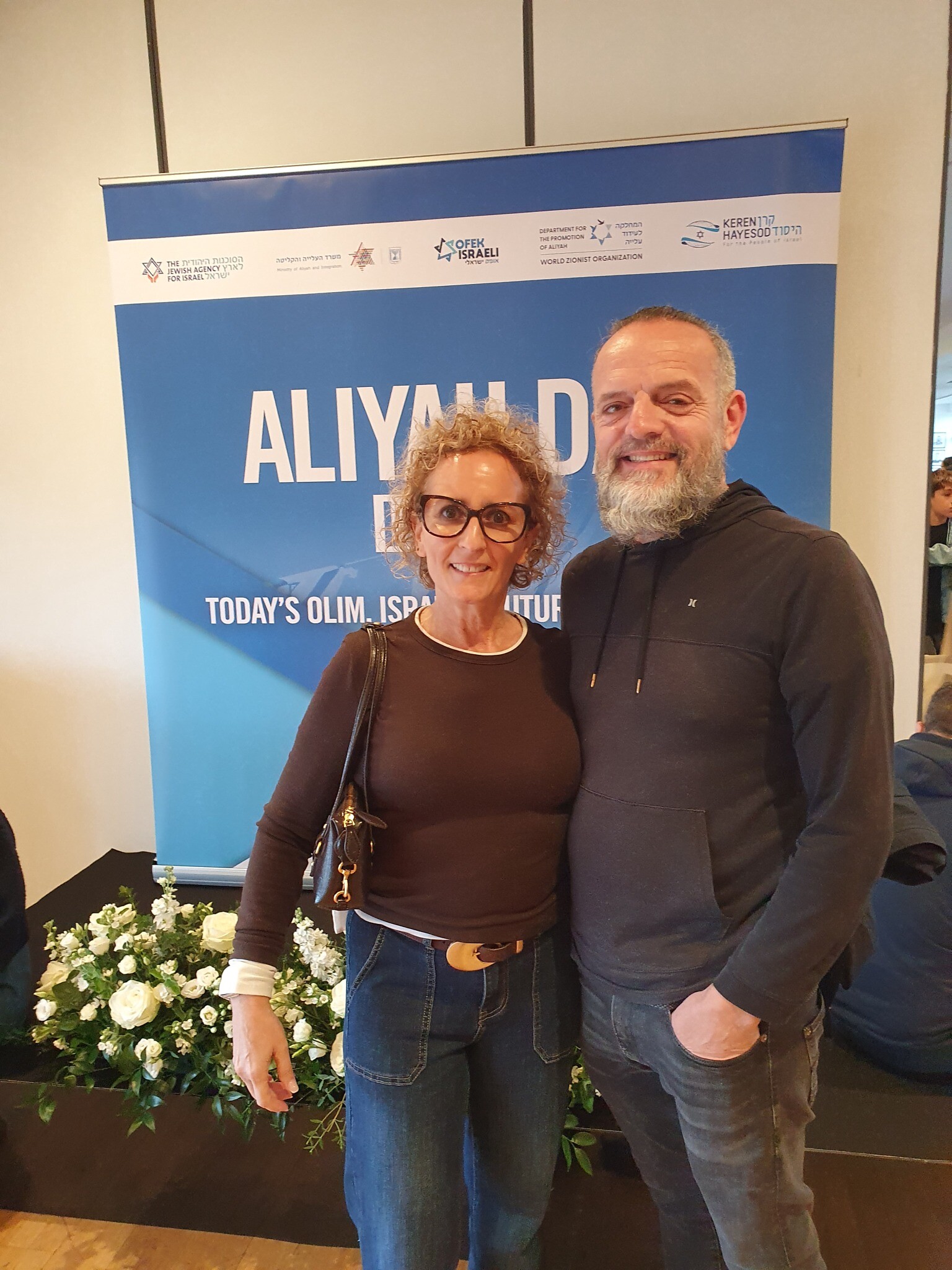
“Their decision was much harder as they had to leave everything behind — they came empty-handed,” she said. “I don’t want it to come to that — that at the last minute we have to pack everything up and go.”
Russell Lowy said he was prepared to move to Israel immediately, but his wife Janine wants to wait until their two children finish university.
“I really want to go. I think now’s the time to start investigating,” he told The Times of Israel. “October 7 wasn’t a trigger for me — it’s when you see things on the doorstep here.”
“I think Jews fall into three categories in England,” he added. “The ones who think there’s no problem whatsoever, the ones that have already gone, and the ones that have to plan to go. We’re the ones that have to plan to get out of here when the shit hits the fan.”
Janine Lowy, whose father arrived in Britain as a refugee from Belgium in the late 1930s, came to the event to learn more, but said she was “more on the fence.”
“I love Israel and I would consider it, but I also love it here and wouldn’t go without the kids,” she said.
‘I love Israel and I would consider it, but I also love it here and wouldn’t go without the kids’
Emigrating anywhere is complex, with a multitude of factors to explore. The Lowys run a successful business, so they would have to consider whether they could make it work in Israel.
And then there’s the Tottenham Hotspur, the UK soccer team that Russell Lowy has long held season tickets for. How would he manage without his regular trips to see his team play — and usually lose — at their north London stadium?
“That’s the main reason I want to go,” he laughed.

The Times of Israel Community.