

Ma’asiyahu Prison blues
As history is made with Ehud Olmert’s entrance to prison for corruption, 3 newspapers opt for identical headlines
 Add ToI as a Preferred Source on Google
Judah Ari Gross is The Times of Israel's religions and Diaspora affairs correspondent.
History has been made: an Israeli prime minister has been sent to Israeli prison. A day later, some in the local media gloat at Ehud Olmert’s comeuppance, others look for a silver lining or defense of the disgraced former leader. Everyone loves that Olmert now has an Israel Prison Service number — 9032478.
For the second day in a row, Israel’s tabloids Israel Hayom, Yedioth Ahronoth and the smaller Maariv yell jinx as they use the same headline for their daily editions. On Monday, all three used “Bus of death” to describe Sunday’s horrific traffic accident, in which six people were killed when their bus swiped a truck near Ramle.
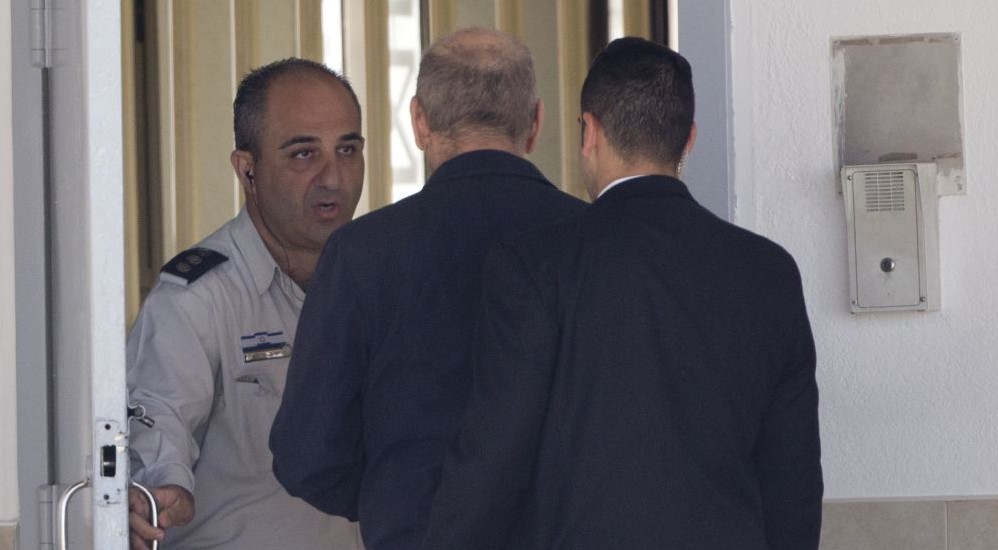
ON Tuesday the three use “Prisoner number 9032478,” which was splashed across the same terrible photograph of Olmert’s back and a slack-jawed guard as the ex-prime minister enters the prison where he has been sentenced to live for the next 19 months. Maariv, in fairness, changes it up a little bit: “Prisoner no. 9032478.”
Haaretz, instead, opts for the driest possible headline for the dramatic event: “Former prime minister Olmert begins his sentence in Ma’asiyahu prison.” The left-leaning broadsheet does, however, include 9032478 in its lede.
The IPS film department — long overshadowed by the Israel Police’s and IDF’s Spokesperson Units — finally has its day, with photographs from inside the special wing where Olmert will stay appearing in every major Israeli daily.
Yedioth Aharonoth offers a firsthand account of a reporter, Oded Shalom, watching the scene as Olmert entered the prison.
“It was a weird morning outside the walls of the prison. Dozens of photographers and writers standing on the side of the road leading to the jailhouse,” he describes.
In addition to the journalists, prison guards and Shin Bet officers, who provided security for the former prime minister, three “curious civilians” were on the scene as well, come to gawk at the spectacle, Shalom writes.
Mordechai Gilat, writing in Israel Hayom, tells Olmert that he must atone for his sins and recognize where he went wrong, in his article “A modest bed for soul searching.”
“You weren’t [suddenly] given a label, Mr. Prisoner, you have been like this for years. Don’t lie to yourself and to the public for the umpteenth time. Your problem isn’t appearance, but your corrupt actions, court decisions, state comptroller reports and the war you waged with the gatekeepers,” Gilat writes.
“Now is the time to repent, to change direction, to ask forgiveness from the public. Without that, it’s safe to say, you won’t receive atonement,” he says.
On the other hand, Uzi Baram, a former Knesset member, tells Haaretz readers “not to forget Olmert’s good.”
Yes, Baram readily and repeatedly admits, Olmert is guilty. He committed a crime and he deserves to pay the price for his transgressions. But Baram laments the glee with which the public and the media sees Olmert’s incarceration.
“My armor cracked when I heard the community of writers going into the nitty gritty details of his incarceration conditions, in which they stressed again and again that jailers would treat him as they would any other prisoner,” Baram writes.
“Suddenly, I felt bad,” he says.
“I asked myself, why do I feel this ambivalence towards my convicted political opponent going into prison?” Baram writes.
“There’s something special in Olmert, he isn’t condescending,” he says. “Indeed, he deserves to sit in prison. But it’s wrong for everyone to go into details about his conviction, how many socks and underwear he can bring with him on his hard path to Ma’asiyahu Prison.”










The Times of Israel Community.