

Tel Aviv University says exchange program for kids fights racism
Empathy training had effects that lasted over a year, organizers say, despite uptick in Palestinian-Israeli violence
 Add ToI as a Preferred Source on Google
Shoshanna Solomon was The Times of Israel's Startups and Business reporter
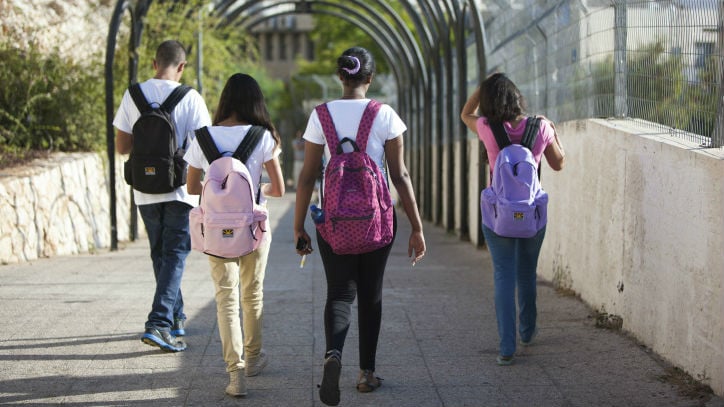
Researchers at the Tel Aviv University say they have set up a program for third- and fourth-grade Israeli and Palestinian school children that is able to create “sustainable tolerance while combating racism and prejudice.”
The Extended Class Exchange Program (ECEP) held bimonthly meetings and classes that enable students to have direct and structured contact with each other; a curriculum that promotes mutual respect and acceptance of the “other,” and skills training that teaches the students how to empathize with others and put things in perspective, making them more sensitive to understanding other people’s thoughts, feelings, desires, motivations and intentions.
The program, led by Dr. Rony Berger of the Stress, Crisis and Trauma Program at TAU’s Bob Shapell School of Social Work and Dr. Hisham Abu-Raiya, also of the Shapell School, was held in collaboration with the Arab-Jewish Community Center (AJCC) in Jaffa and the Tel Aviv Municipality to respond to growing tensions resulting from the continued escalation of the Israeli-Palestinian conflict.
“We’ve taught Israeli Jewish and Israeli Palestinian children to be compassionate and empathetic — not only toward their friends in the program, but also toward people outside the classroom,” said Berger. “It’s very hard to bring people together technically, logistically and emotionally. People don’t want to interact with people they feel uncomfortable around. In this research, we targeted various skills such as perspective-taking, empathy and compassion that can be taught to promote sustainable tolerance.”
The Tel Aviv University study was published in the August 2016 issue of the Journal of School Psychology.
“Contact alone is not enough,” said Abu-Raiya. “You need a system that includes a variety of different approaches. We demonstrated that giving the children direct contact with each other, providing unbiased knowledge about the children and their communities and building perspective-taking and empathy-nurturing skills have long-term positive effects.”
The effects of the program were maintained 15 months after the program ended, when the region was engulfed by violence, Abu-Raiya said. “This highlights the ‘hate-preventative’ potential of the program to prevent stereotyping, prejudice and discrimination than often lead to hostilities between ethnic groups,”
The program featured bimonthly schooldays of third- and fourth-grade Israeli Jewish and Israeli Palestinian students led by six facilitators. The program included art activities, classes promoting respect and acceptance of the “other,” and empathy and perspective-taking training directed by the students’ homeroom teachers and the ECEP facilitators.
“We have no doubt that the ECEP helped reduce prejudice and discrimination and enhanced positive contact between different ethnic groups and could be translated to any region characterized by ethnic tension and violent conflict,” said Berger.
The team conducted two studies. The first, conducted on 262 fourth-grade students from Tel Aviv and Jaffa, found a dramatically higher inclination to interact with students from other ethnic groups, more positive thoughts about “the other,” and less emotional prejudice. The second, conducted on 322 third- and four-grade Israeli Jewish and Israeli Palestinian students, included new sessions on empathy and perspective-taking training and assessed the extended impact of the program.
“All of our results showed that the ECEP decreased stereotyping and discriminatory tendencies toward the other and increased positive feelings and readiness for social contact with the other upon termination of the program,” said Berger.
“Empirical support for the ECEP is particularly important in the context of the Israeli-Palestinian conflict, given the evidence that negative views and stereotypes held by both Arab and Jews fuel the animosity between these ethnic groups,” said Abu-Raiya.








The Times of Israel Community.