

PM says ‘too early’ to ease closure; reports say no change likely before Oct. 18
Cabinet talks lockdown exit strategy as virus rate sees slight drop; Likud’s Katz, Blue and White said pushing to start reopening soon, but no decision expected before next Monday
 Add ToI as a Preferred Source on Google
Ministers of the “coronavirus cabinet” convened on Monday to discuss the state of the pandemic in the country, while reportedly reviewing plans to gradually reduce the ongoing lockdown, as the rate of infection ebbs.
In a video released by Prime Minister Benjamin Netanyahu on Twitter, he said that while Israel is seeing infection numbers drop off, the experts recommend waiting a week to see if the trend continues.
“It’s too early to say if it will hold,” he said.
No decisions were made during the session of the coronavirus cabinet — a small forum of ministers whose portfolios touch on the virus outbreak — which also dealt with the possibility of increasing enforcement measures in the shorter-term, according to Hebrew media reports. The ministers will meet again next Monday to reexamine the situation.
Channel 12 news reported that any removal of restrictions was unlikely before October 18.
Netanyahu said that while Israel was the first to lockdown a second time, many European countries are preparing to follow in its footsteps, and the country needs to be able to emerge from the lockdown first as well.
Media reports indicated Blue and White ministers, as well as Finance Minister Israel Katz of Likud, were pushing hard to start reopening as soon as possible, allowing businesses that do not receive customers to return to work, as well as bringing back care facilities for children aged 0-6, in order to allow parents to return to work.
Prior to entering the meeting of the coronavirus cabinet, Defense Minister Benny Gantz said in a statement that “if the morbidity rate continues to decrease, we will work to reduce the restrictions, open businesses that do not receive customers, and open early childhood education after the Sukkot holiday” which ends on Friday.
The number of confirmed carriers declined on Monday morning, with fewer than 3,000 new cases confirmed the previous day, the Health Ministry said, but testing was down as well, at some 26,000 tests — about half of the average rate last week.
The IDF’s Coronavirus National Information and Knowledge Center reiterated its position on Monday that the positive test rate was still relatively high, at around 11-12 percent, and indicated “a much wider scope of morbidity than actually detected,” adding that more time was needed to see if there was an actual downward trend.

Nonetheless, reports indicated that the coronavirus cabinet discussed a Health Ministry-recommended “exit strategy” that would be carried out in several stages, with two weeks required between each phase, subject to public compliance and declining morbidity rates, rather than pre-determined dates.
The ministers also discussed imposing additional penalties on businesses that violate the guidelines, including the denial of additional government grants slated to be handed out to businesses struggling as a result of the COVID-19 restrictions.
The Health Ministry recommended carrying out a situational assessment on October 12 next Monday. If the R-nought, the number of people each infected person infects, drops below 0.8, and the number of daily cases is 2,000 or lower, it recommended proceeding with the first stage of the exit strategy.
This would see businesses that do not receive customers in-person allowed to open, childcare for children between the ages of 0 and 6 resume, and Ben Gurion Airport allowed to serve passengers going on business trips only, according to Channel 12.
If the R-nought rises above 0.9, then additional restrictions would be recommended.
The number of daily new cases reached an all-time high last week, with 9,053 on Wednesday. It moved down to 7,031 on Friday, then 2,581 on Saturday — when the numbers are always lower, due to reduced testing over the weekend — and 2,905 on Sunday, according to Health Ministry figures.
The percentage of positive tests went down from 13.4% on Wednesday to 11.8% on Sunday — a less dramatic drop.

In the second stage of the exit plan, Channel 12 reported that grades one through four would be allowed to return to schools and the public sector would be allowed to operate in-office at a 50% capacity.
During the third stage, in-person customers would be allowed at businesses, in line with the government’s “purple badge” health protocols. Hair salons would be allowed to open, and cafes and restaurants would be allowed to serve customers outside, along with offering take-away services.
In the fourth phase, professional sports teams would be allowed to return to full operation, and gyms, hotels, sports clubs, and public swimming pools would be allowed to open.
In the fifth stage, Ben Gurion Airport would gradually increase operations, restaurants and cafes would be allowed to serve customers indoors, in accordance with updated health guidelines, and cultural events would also be allowed to go forward in accordance with updated health guidelines.
In the sixth phase, grades six through eight would be allowed to return to classes in-person.
In the seventh stage, the entire education system would return to in-person classes, while the country would move to operating fully under the “traffic light” protocol, which assigns restrictions based on the level of morbidity of a particular locale.
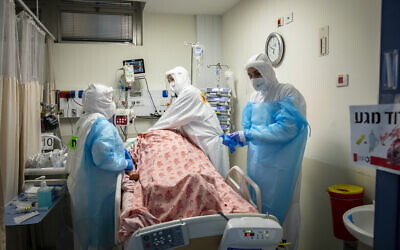
Last week, Netanyahu said the lockdown would last at least a month, and many of its restrictions could be in place for as long as a year.
According to Kan news, the official leading the charge against lifting restrictions is the government’s coronavirus czar, Ronni Gamzu, who is expected to recommend to the cabinet that elementary schools and Haredi yeshivas remain closed at least for the coming month.







The Times of Israel Community.