

Interior Ministry delays powder-keg Druze home demolitions
5 of 20 homes slated for removal in villages of Isfiya, Maghar and Yarka belong to families of fallen IDF soldiers
 Add ToI as a Preferred Source on Google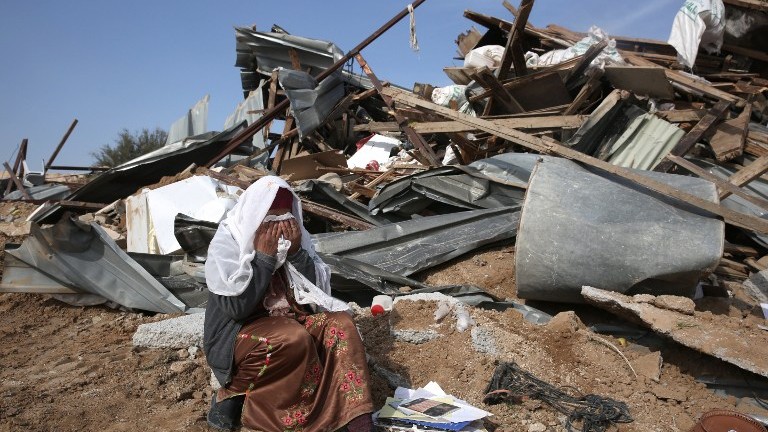
The Interior Ministry on Tuesday backed away from the planned demolition of 20 homes in Druze communities around the country after Druze leaders warned that the actions could spark violence.
Since November, some 20 families in the northern Druze villages of Maghar, Yarka and Isfiya have received demolition orders, the Haaretz daily reported on Monday.
Five of those orders, especially in the village of Maghar, were reportedly sent to families of fallen Israel Defense Forces soldiers.
Druze community leaders have warned that carrying out the orders against illegally built structures would create a breach between the minority community and the state. Unlike most other Arabic-speaking minorities, the Druze serve in the IDF and take a prominent role in the country’s security establishment.

There are thousands of outstanding demolition orders against homes in Druze communities, but these orders have gone largely unenforced. A report issued last year by a government committee found that enforcement of planning and construction statutes is particularly difficult in Arab and Druze communities.
The orders issued for homes in the Druze villages come amid a wave of government-ordered home demolitions in Bedouin and other Arab towns at the request of Prime Minister Benjamin Netanyahu, who has sought in recent weeks to crack down on illegal construction in Arab communities.
Arab Israelis counter that a discriminatory planning process makes receiving building permits nearly impossible and that the illegal construction is the result of natural growth.
“There are efforts to accelerate the planning processes in Druze towns in order to bring order to the [illegal] construction issue,” a statement from the Interior Ministry said Tuesday.
“To that end, many meetings were held with [local] council leaders, on whose shoulders lies the responsibility for [carrying out] the accelerated planning.
“As for the village of Maghar” — an apparent reference to the homes of the families of fallen soldiers — “an agreement was reached with the prosecution, the State Attorney’s Office and Deputy Attorney General Erez Kamenitz that there would not be any demolition, and the orders would be frozen in order to provide an opportunity to [put in place] a proper planning process,” the statement added.
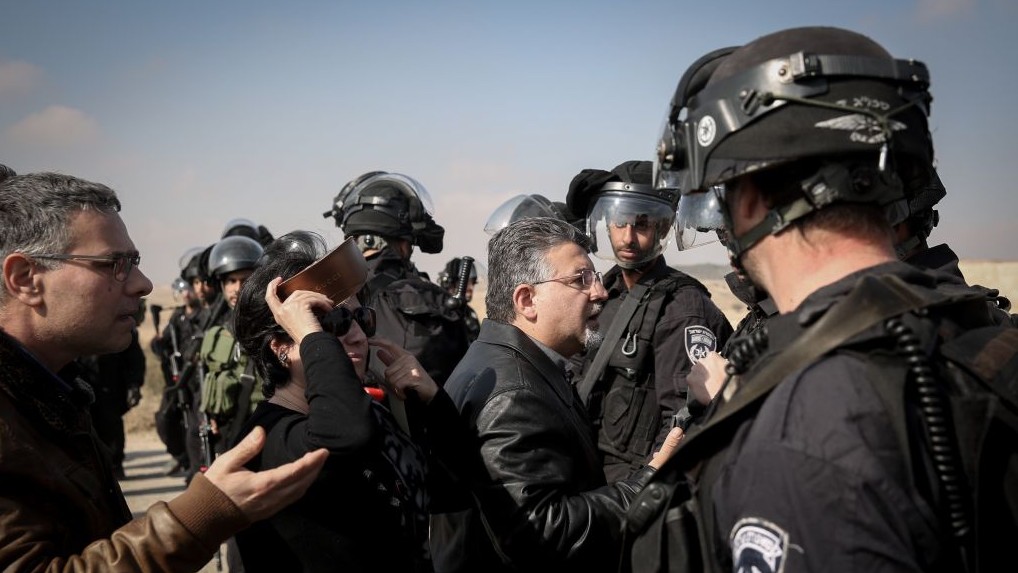
Last week, home demolitions in the Bedouin village of Umm al-Hiran in the Negev sparked violent clashes and a suspected deliberate car-ramming that killed a policeman. The driver, a local resident, was shot by police and killed.
In the days that followed, thousands of Arab Israelis took to the streets to protest the policy, claiming state-sanctioned racism and excessive police force against Arabs led to the deadly incident.
The demolitions in Umm al-Hiran followed Netanyahu’s instructions in December to Public Security Minister Gilad Erdan to step up enforcement measures against illegal construction among Israeli Arabs.
The prime minister’s call to crack down on such construction came as authorities prepared to demolish Amona, an illegal West Bank outpost, by a February 8 deadline.
In a Facebook video in Hebrew addressed to Amona’s residents, Netanyahu vowed that home demolitions “must be egalitarian. The same law that necessitates the evacuation of Amona necessitates the removal of illegal construction elsewhere in our country,” he said.









The Times of Israel Community.