

Live updates (closed)
 Add ToI as a Preferred Source on Google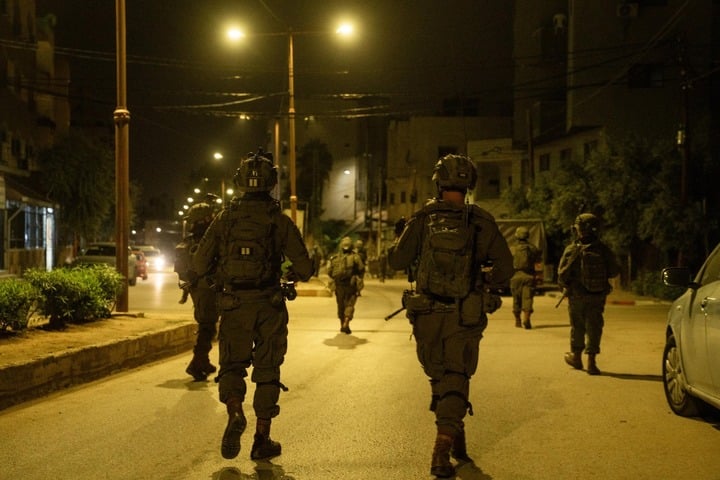

The Times of Israel liveblogged Sunday’s events as they unfolded.
Police say they arrested 45 Bedouins over the weekend amid attempted crackdown on crime epidemic
Law enforcement arrested 45 suspects in the Negev over the weekend, as part of a sweeping operation to combat crime in southern Bedouin towns, police say.
In a statement summing up this past weekend, police say Southern District officers raided a home in Tel Sheva and arrested four suspects who tried to prevent officers from searching the premises. Police found and seized parts of stolen army-grade weapons, drugs and tens of thousands of shekels, they add.
Further east, in Hura, police quelled a brawl that broke out between feuding families in the town, raiding two homes and arresting seven suspects. Bad blood had existed between the families for several years due to the murder of a teenage relative, but recently resurfaced after a dispute between children from the rival clans.
Police also seized a drone carrying weapons and ammunition during their operation, likely part of an arms smuggling attempt. The nine handguns and 19 magazines were dealt with by police sappers, law enforcement says.
Operation “New Order,” which aims to crack down on illegal weapons possession, violent crime and traffic violations in the Negev, was launched three weeks ago by order of National Security Minister Itamar Ben Gvir and police chief Danny Levy.
The operation has frustrated many Bedouin residents and local politicians, who say that police are going over their heads in the fight against crime and conducting indiscriminate, aggressive raids that so far have not managed to deter surging violence in the area.
Since the start of the year, 238 Arab Israelis have been killed in violent incidents, in what is on track to be the most deadly year for Arab society to date.
Many have blamed Ben Gvir, who oversees police, for failing to stamp out violent crime, an issue he heavily campaigned about ahead of the last election. When he took office in 2023, the annual homicide rate in Arab society doubled from its previous years.
Last weekend saw 44 suspects arrested in the New Order operation, police said at the time.
Police also announced later last week that over 40 indictments had been filed against suspects arrested in the operation, though they did not specify on which charges.
Man stabbed and critically wounded in Bedouin town of Segev Shalom
Paramedics are trying to resuscitate a young man after he was stabbed and critically wounded tonight in Segev Shalom, a Bedouin town in southern Israel.
The victim, a man in his 20s, is unconscious and has no pulse, having sustained “severe penetrative injuries” in the shooting, according to Magen David Adom.
Medics are “fighting for his life” while rushing him to Soroka Medical Center in Beersheba, the emergency service says.
The young man is shot while large police forces operate in the Negev as part of “New Order” — a crimefighting operation initiated last month by National Security Minister Itamar Ben Gvir.
Violence has been continuing unabated in the region despite the operation, with this year on track to be the deadliest for Arab citizens to date.
Many Bedouin residents have also expressed frustration with aggressive police raids on establishments unconnected to violent crime.
Senior Saudi diplomat: It’s Israel, not the PA, that most needs reform to secure peace
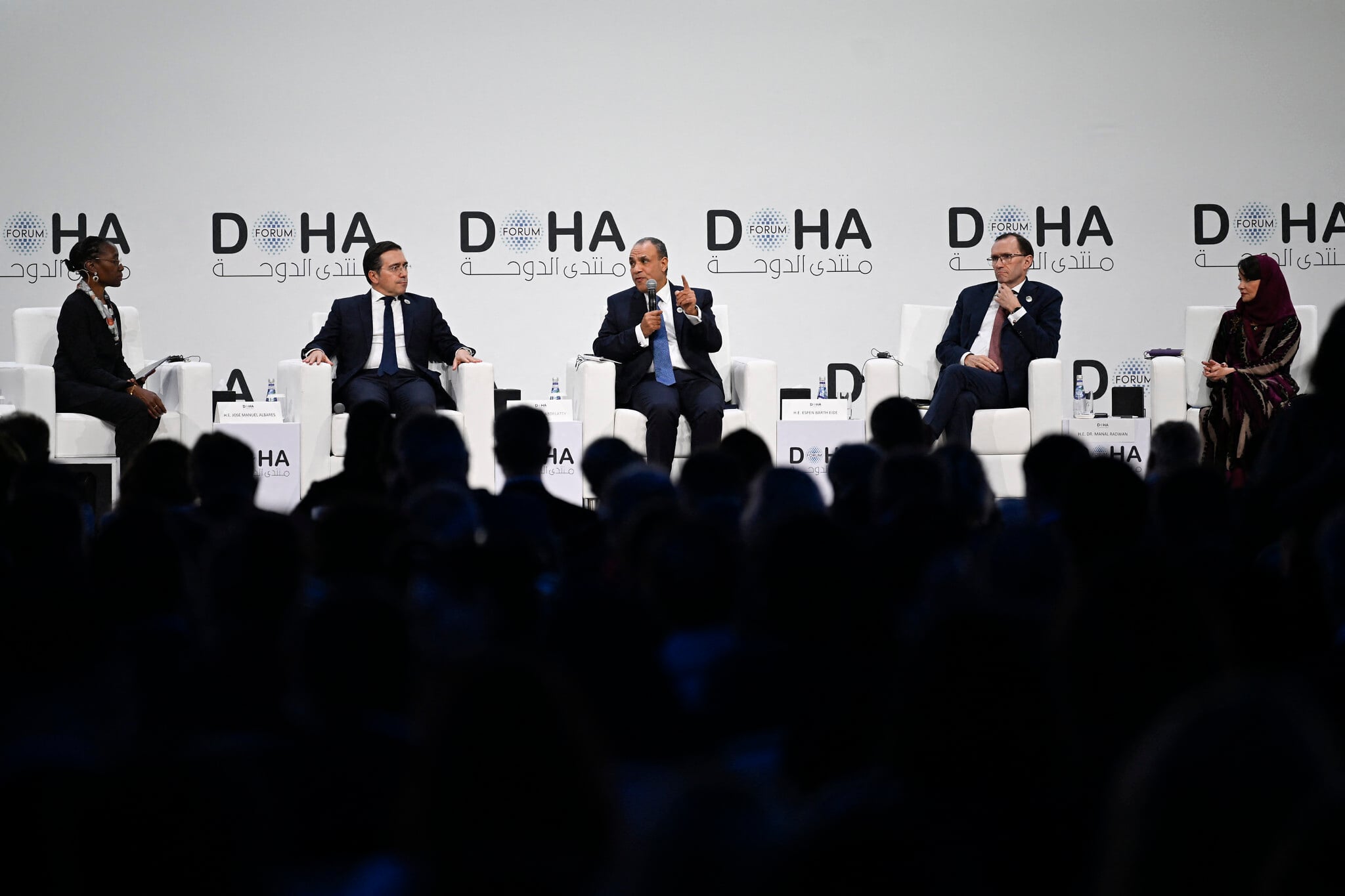
(From L) CEO and President of the International Crisis Group Comfort Ero, Spain's Foreign Minister Jose Manuel Albares, Egypt's Foreign Minister Badr Abdelatty, Norway's Foreign Minister Espen Barth Eide and Saudi Cabinet of the Minister of Foreign Affairs's minister plenipotentiary Manal Radwan attend the opening day of the Doha Forum, an annual diplomatic conference, in Doha on December 6, 2025. (Photo by Mahmud HAMS / AFP)
DOHA — A senior Saudi diplomat says that while there is much focus in the international community on the need for the Palestinian Authority to engage in a comprehensive reform process, a reform of the Israeli government is what is most needed for peace in the region.
“The Palestinians have been reforming for the past 30 years. President Mahmoud Abbas had put [forward] a robust reform plan that he committed himself to, because this is good for the Palestinians,” says Manal Radwan, a minister in Saudi Arabia’s foreign ministry, during an onstage panel discussion at the Doha forum.
“Saudi Arabia, of course, is committed, and we work on a daily basis with the PA to help in its reform plan, but what we need to really get a sustainable peace and security and an end to this conflict and to implement President Trump’s 20 peace plan and to implement the Security Council Resolution is a reformed Israeli government,” she says.
“We have an Israeli government that opposes the two-state solution. We have an Israeli government that has officials continuously inciting against Palestinians, against Arabs, against Muslims,” Radwan continues. “We don’t see that we have a partner for peace, not even a partner for a sustainable ceasefire. So that is the actual and the important reform that we are hoping to see.”
It is the latest biting criticism of Israel by a senior Saudi figure, coming just hours after the country’s former intelligence chief and Royal family member Prince Turki al-Faisal asserted that Israel is the most destabilizing country in the region, due to its ongoing military actions in Gaza, the West Bank, Syria and Lebanon.
Radwan’s defense of the PA and its ongoing reform process stands out, given that Riyadh has been one of the most aggressive stakeholders privately urging Abbas to engage in a comprehensive reform amid years of corruption and mismanagement allegations.
Saudi Arabia fumed upon learning last month that the PA’s then-finance minister had signed off on illicit payments to security prisoners under the old so-called “pay-for-slay” mechanism, a US official told The Times of Israel. Abbas fired the minister in a move that was convincing enough to Washington that it decided to shelve plans to personally sanction the PA president and other senior officials, and the response appeared to satisfy Riyadh as well, a Palestinian official said.
Man stabbed in Bedouin town of Segev Shalom dies of his wounds — police
Police say a man who was stabbed and critically wounded tonight in the Bedouin community of Segev Shalom has died of his wounds.
The man, who police say was around 20 years old, is said to have been killed as part of a dispute between cousins.
Two people have been arrested, according to police.
Egypt’s FM accuses Israel of violating Gaza truce ‘every day,’ urges deploying peacekeepers ASAP
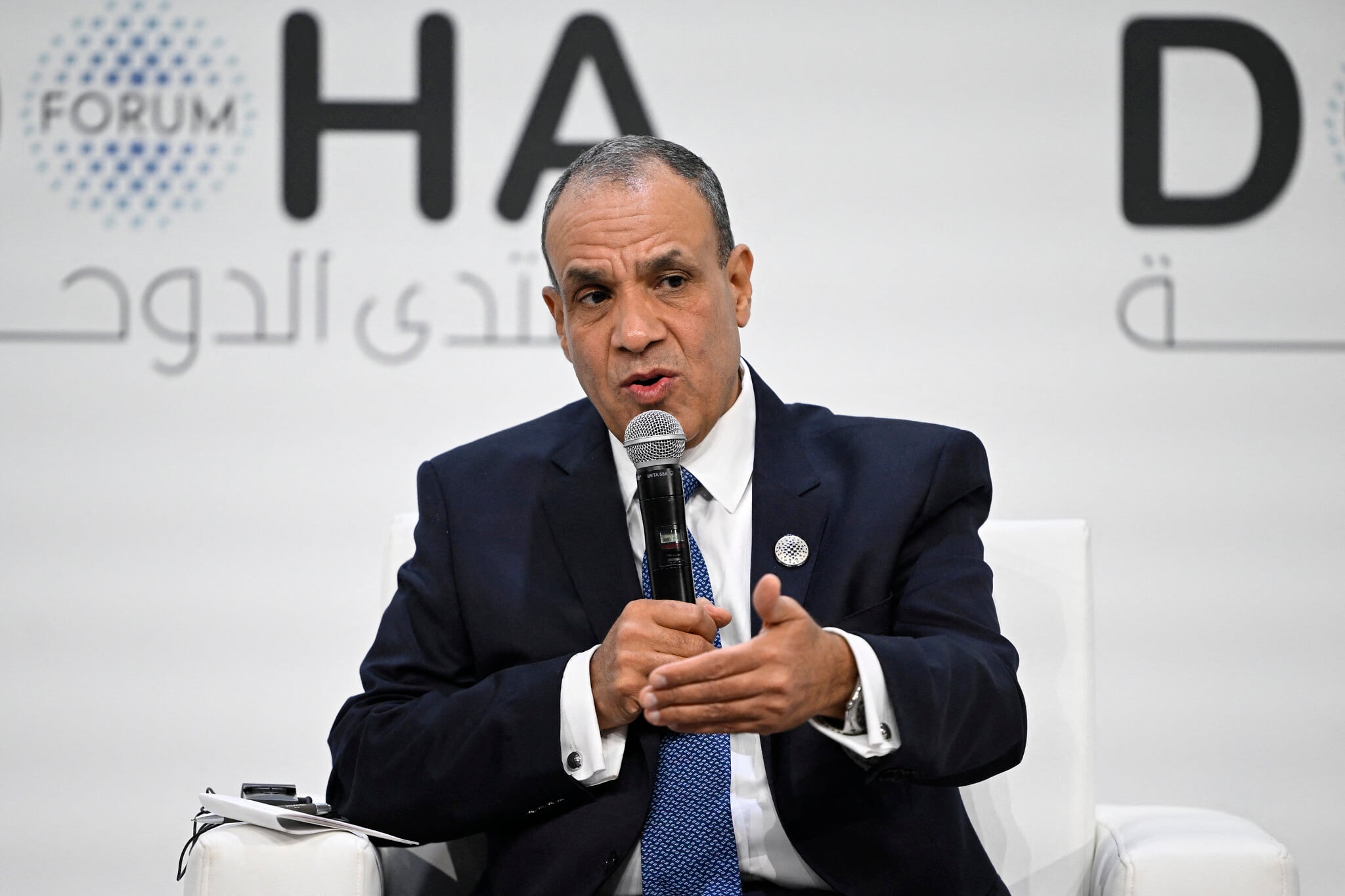
Egypt's Foreign Minister Badr Abdelatty speaks during the opening day of the Doha Forum, an annual diplomatic conference, in Doha on December 6, 2025. (Photo by Mahmud HAMS / AFP)
DOHA — Egyptian Foreign Minister Badr Abdelatty calls for deploying the International Stabilization Force (ISF) in Gaza “as soon as possible,” claiming that Israel is using the absence of international monitors on the ground in Gaza to violate the ceasefire on a daily basis.
“As for the International Stabilization Force, we need to deploy this force as soon as possible on the ground because one party, which is Israel, is every day violating the ceasefire and claiming that the other side is violating [it], so we need monitors,” Abdelatty says during a Saturday onstage panel at the Doha Forum.
Israel insists that its forces have only responded to what it says are daily violations by Hamas operatives, including the opening of fire on IDF troops. The IDF also says it has shot dead Palestinian suspects daily who have approached the Yellow Line, which roughly divides Gaza into eastern and western halves controlled by Israel and Hamas, respectively.
Abdelatty reveals that Egypt wants the ISF to deploy along the Yellow Line, to which Israel withdrew at the start of the ceasefire on October 10. That line of deployment appears to be the growing consensus among stakeholders, as countries aren’t willing to permanently station their troops inside what has become known as the red zone — the western, coastal side of Gaza under de facto Hamas control.
The Egyptian foreign minister also takes another increasingly popular position among potential ISF contributors, which is that the force should be engaged in peacekeeping, not peace-enforcing. This would likely contradict the US desire that the ISF play a key role in the disarmament of Hamas, unless the terror group agrees to willingly give up its weapons as part of a negotiated settlement — something that currently appears unlikely.
On the Rafah Crossing, which has been closed since May 2024, Abdelatty claims that Israel is to blame as it is only willing to open it on the condition that it be a one-way transit route for Palestinians exiting Gaza.
Egypt won’t allow Rafah to be used “as a gate for displacement or for putting people out of their homeland,” he says. “There is no ethical or moral justification to displace the Palestinians.”
The only exception he gave for Palestinians who should be allowed to leave is those who need medical treatment, and even they should be expected to return after that treatment has concluded, he said.
Turkish FM: Indonesia, Azerbaijan and others want to see us join the ISF amid Israeli veto
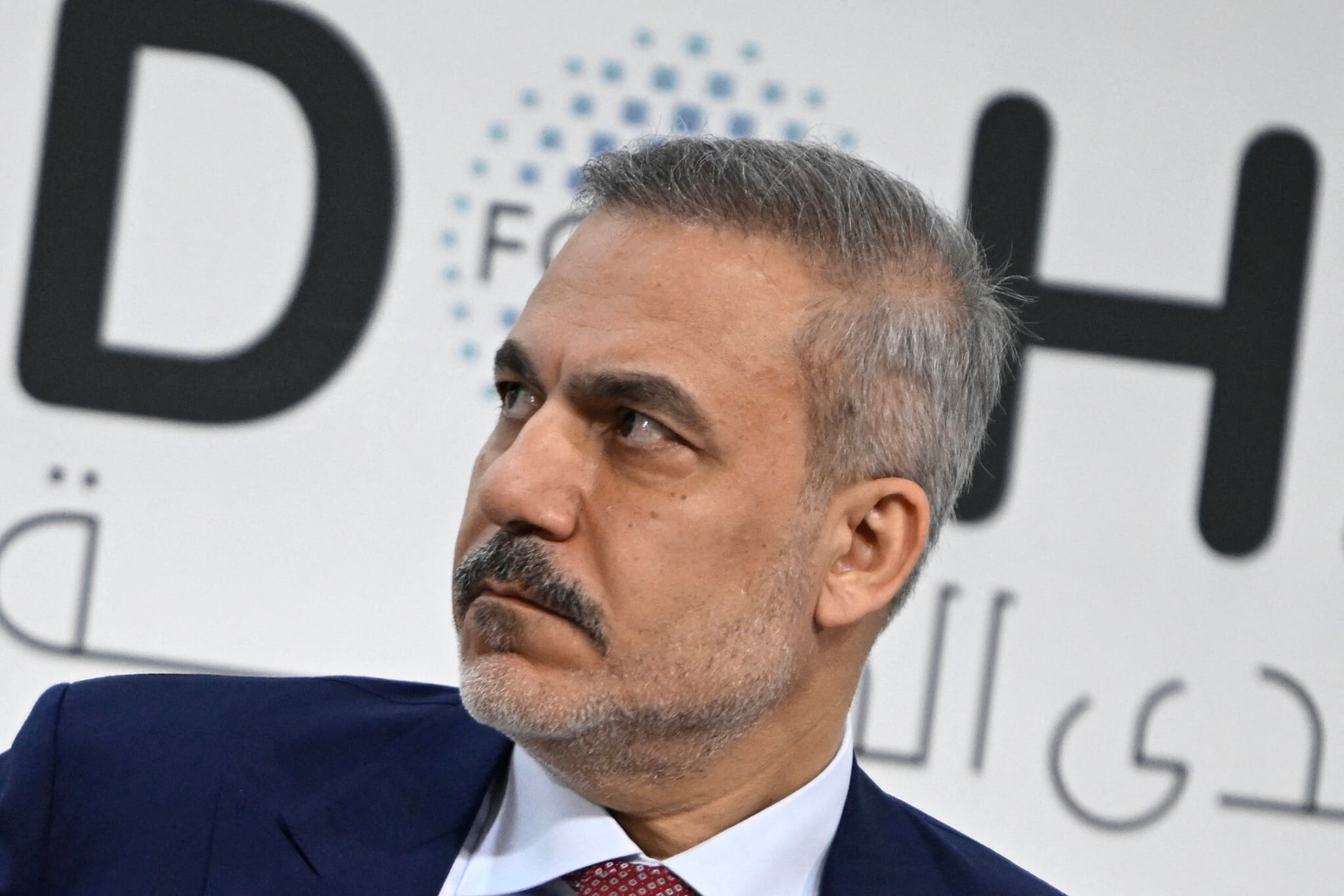
Turkish Foreign Minister Hakan Fidan looks on as he attends a session on the opening day of the Doha Forum, an annual diplomatic conference, in Doha, December 6, 2025. (Mahmud Hams/AFP)
DOHA — Turkish Foreign Minister Hakan Fidan says US President Donald Trump will have to intervene to stop what he says are daily ceasefire violations by Israel if Washington doesn’t want its Gaza deal to collapse.
“At some point, President Trump should have a very substantial conversation with [Prime Minister Benjamin] Netanyahu… If they don’t intervene, I’m afraid that there is a risk that the plan can fail because of the daily violations of the ceasefire by the Israelis,” Fidan says during a Saturday onstage interview at the Doha Forum.
Israel insists that its forces have only responded to what it says are daily violations by Hamas operatives, including the opening of fire on IDF troops. The IDF also says it has shot dead Palestinian suspects daily who have approached the Yellow Line, roughly dividing Gaza into eastern and western halves controlled by Israel and Hamas, respectively.
He insists that Hamas has just about completely “delivered what they’ve been asked of” by returning all but one of the bodies of deceased hostages. They were supposed to do so within 72 hours of October 10, but the ceasefire agreement did offer some wiggle room for the possibility that it takes longer to find remains buried deep under Gaza’s rubble.
“I think [Trump] is going to have a good discussion with Netanyahu before the end of the year,” Fidan says, suggesting that Trump will lean hard on Netanyahu when the latter travels to Washington to meet the president in late December.
Fidan acknowledges the veto Israel has been exercising on Turkey being part of the International Stabilization Force for Gaza and confirms The Times of Israel’s reporting that this has upset other potential contributing countries who view Ankara’s presence as somewhat of an insurance policy.
Asked specifically about Indonesia and Azerbaijan, Fidan says, “They want [Turkey] to be part of the ISF because they know that we can play a leading role, and we can make their lives easier in terms of getting more legitimacy and support from the public.”
“Indonesia, Azerbaijan, and some other Muslim and Arab countries that we are working closely with — [Turkish inclusion in the force] is what they want to see, for their troops to be sent,” he claims.
While the US is looking to solve the issue of disarmament in the coming weeks, Fidan argues that the priority should be deploying the ISF along the Yellow Line in Gaza to separate Israeli forces and Hamas fighters in order to stop the near-daily deadly clashes.
The US is hoping that Hamas will agree in the coming weeks to a process that sees the terror group gradually give up its weapons, but Hamas has not given any indication that it is prepared to do so under the current political context.
In notably frank comments that softly criticize the US, Fidan says one of the issues that has complicated efforts to advance the Gaza deal is the lack of US bandwidth.
“One of the practical problems about this subject is that the people on the US side, who are in charge of mediation of the Gaza file, are also in charge of mediating between Ukraine and Russia,” Fidan says, referring to Trump’s top aides Steve Witkoff and Jared Kushner. Fidan is careful to praise their efforts while acknowledging that the pair is simply stretched too thin by trying to solve two major conflicts at the same time.
Fidan clarifies that while Turkey doesn’t mind holding the responsibilities of a guarantor to the deal, the actual document it signed gives it such a role, and it is limited in what it can do to maintain the ceasefire, given that Israel does not allow it to be on the ground in Gaza.
Asked about prominent Palestinian security prisoner Marwan Barghouti’s family’s claim that he has been beaten again by Israeli guards, Fidan laments that this is one of “thousands” of cases in which Palestinians are allegedly being tortured in Israeli prisons. Israel has adamantly denied these claims and asserts that those in its custody are treated according to international law, but an audit conducted by Israel’s own Public Defender’s Office found that Palestinian security prisoners have been held in increasingly dire conditions since October 2023, with many suffering from severe hunger.
Fidan claims Israel is acting with impunity because it knows “that the international community is helpless in stopping them using force.”
“But there are other things that the international community can do,” he continues, pointing to the growing protest movements against Israel led by young people across the globe, along with the recent wave of Palestinian statehood recognitions.
“Mr. Netanyahu is harming in a very bad way, the future of Israel,” he claims.
Police arrest 18 soccer fans over rioting at October Tel Aviv derby
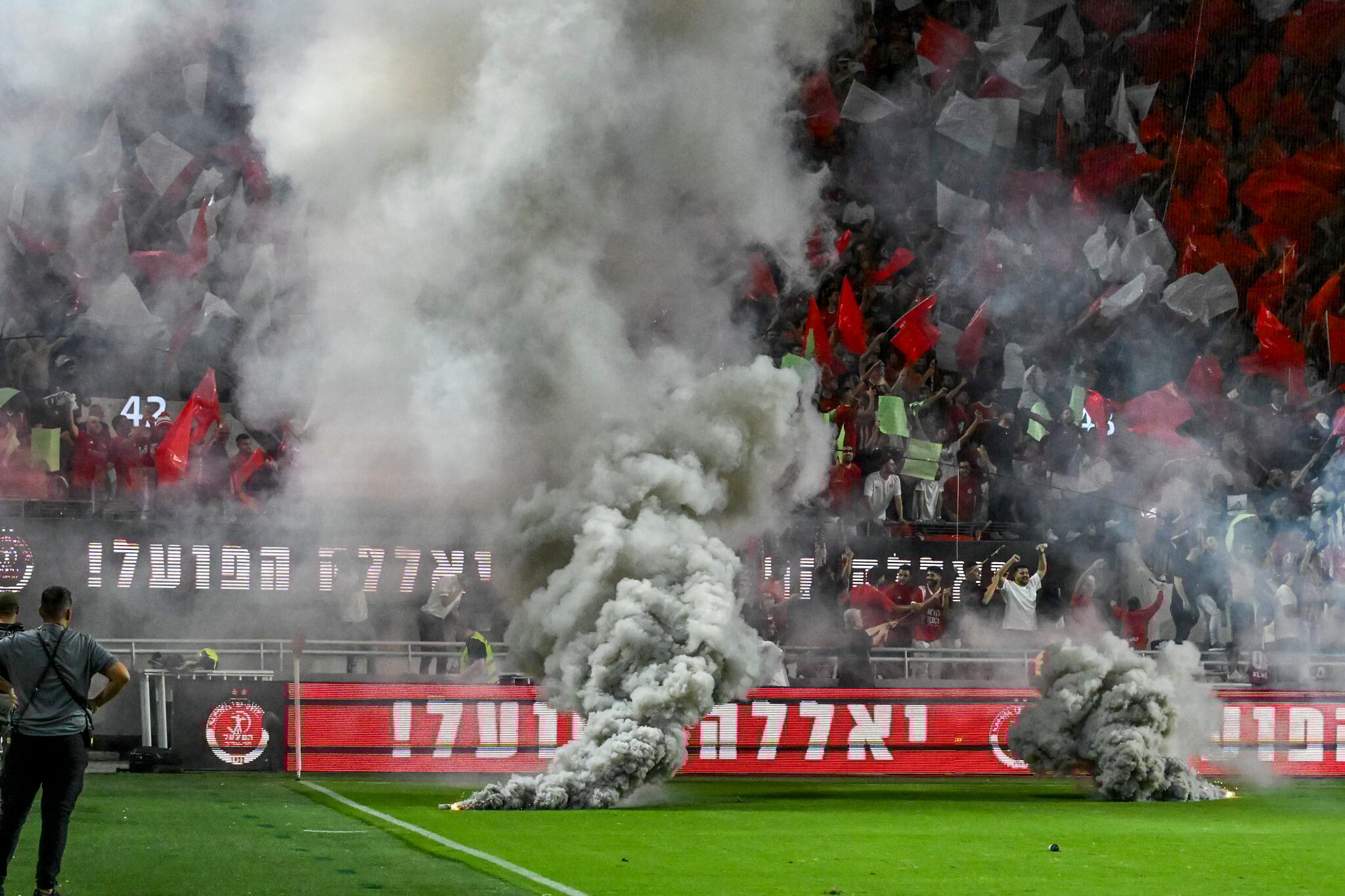
Police stand guard after the Israeli Premier League match between Hapoel Tel Aviv and Maccabi Tel Aviv was canceled at Bloomfield Stadium in Tel Aviv, on October 19, 2025. (Flash90)
Police say it arrested around 20 Hapoel Tel Aviv soccer fans suspected of throwing smoke grenades and other objects at the field at Bloomfield Stadium in October.
Police canceled the much-anticipated derby match between Tel Aviv’s rival soccer teams — Hapoel and Maccabi — after riots broke out in and around the stadium, wounding at least four people.
The arrests come after a week-long undercover investigation into the incident, which included the collection of video footage of the canceled game.
Israel said to believe Hamas has lead on location of body of final hostage, as search set to resume
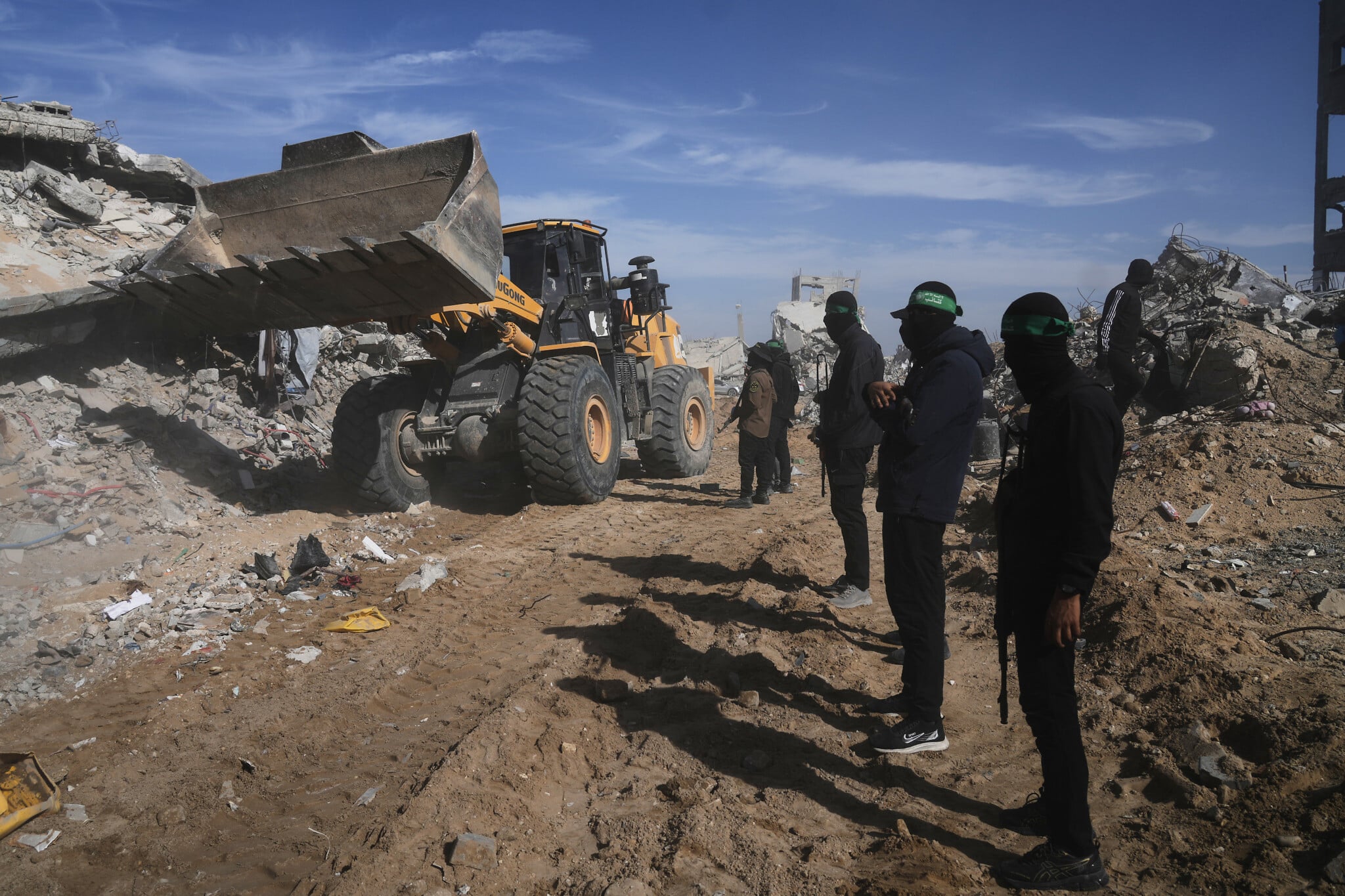
Islamic Jihad and Hamas gunmen search for the remains of deceased hostages in Beit Lahiya, northern Gaza Strip, December 3, 2025. (AP Photo/Jehad Alshrafi)
Hamas and the Red Cross are set to renew their search today for Master Sgt. Ran Gvili, the final hostage body held in the Strip, Kan radio reports.
According to the report, the search is being conducted in the Zeitoun neighborhood in Gaza City, and Israel believes that the Gazan terror group has a lead on his location.
Hamas leader Khalil al-Hayya told Al Jazeera yesterday that the terror group and the Red Cross would be searching in areas that have yet to be covered.
Netanyahu held unpublicized meeting with UK’s Blair on postwar Gaza plans, source tells ToI
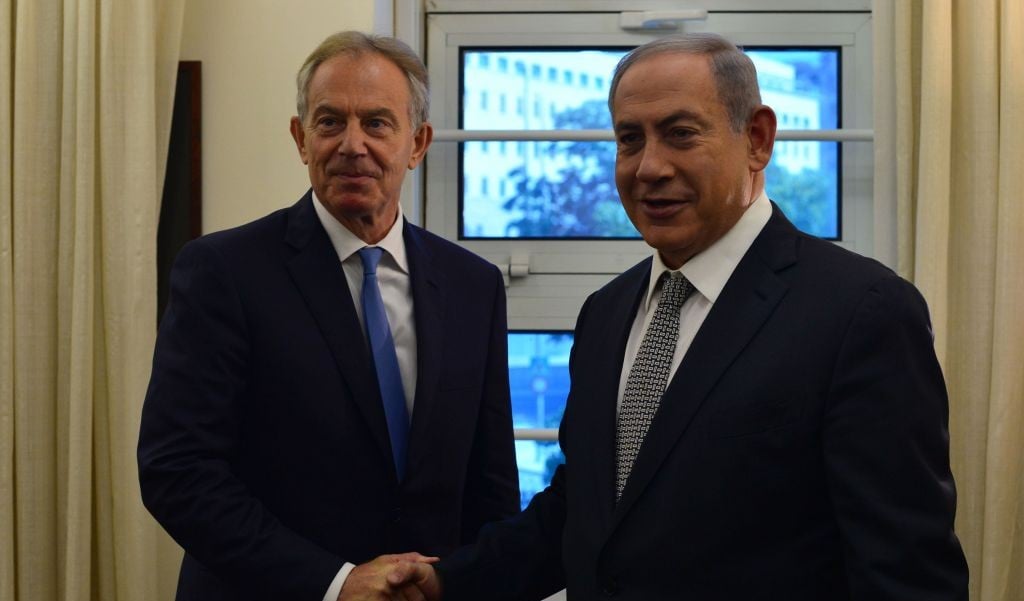
File: Prime Minister Benjamin Netanyahu and former British PM Tony Blair meet in Jerusalem, on July 11, 2016. (Kobi Gideon/GPO)
Prime Minister Benjamin Netanyahu held an unpublicized meeting with former UK prime minister Tony Blair in late November to discuss the Trump administration’s plans for the postwar management of Gaza, a source familiar with the matter tells The Times of Israel.
Blair has been working closely with US President Donald Trump’s top aide Jared Kushner to advance the transitional Palestinian governing body that will administer the Strip in place of Hamas.
The source flatly denies a Kan public broadcaster report claiming that Blair used the meeting to present a plan for the immediate, phased return of the Palestinian Authority to Gaza.
‘The end of Hamas is close’: Khan Younis militia chief says Abu Shabab killing won’t deter struggle
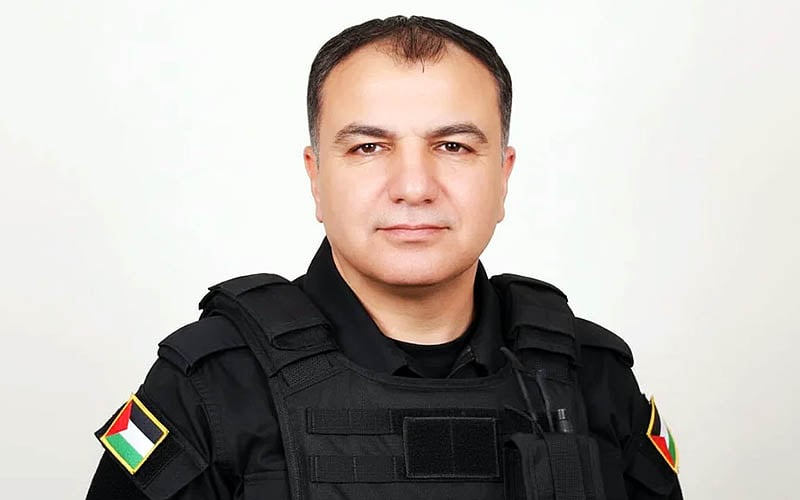
Hossam al-Astal, in a photo from the early 2000s, when he served in the Palestinian Authority’s security forces in Gaza. (Hossam al-Astal/Facebook)
Hossam al-Astal, the leader of the Strike Force Against Terror militia based out of Gaza’s Khan Younis, tells Kan radio that the killing of the leader of allied militia Abu Shabab will not deter him in his fight against Hamas.
“Hamas is trying to send people to infiltrate us, but we will reveal them quickly,” he tells Kan.
“Even though Abu Shabab was killed, there are hundreds of us in different organizations operating in the Strip. Hamas is trying to diminish our value and claim we are only dozens, but that is not the case. We will not change our ways,” he adds.
Astal insists that “the end of Hamas is close.”
Yesterday, the Israeli-backed Abu Shabab militia appeared to confirm that its namesake and commander Yasser Abu Shabab was killed last week in a gunfight with members of the Abu Sanima family. Both groups belong to the Bedouin Tarabin tribe.
Iran executes man convicted of leading massive investment scam
TEHRAN, Iran — Iran executes the ringleader of a vast investment scam that defrauded tens of thousands of people through a car-buying network, the judiciary says.
Mohammad Reza Ghaffari, owner of the Rezaayat Khodro Taravat Novin company, is hanged after the Supreme Court upheld his death sentence for “large-scale disruption of the country’s economic system” and network fraud, the judiciary’s Mizan Online portal says.
The scheme, launched in 2013 in northern Qazvin province, promised cars at below-market prices and later expanded into real estate and investment plans.
Prosecutors accused Ghaffari and his associates of taking “vast sums from the public” and using new deposits to pay returns to early clients.
The judiciary says the scheme involved sums equivalent to around $350 million at current exchange rates.
Only “around four percent” of customers received a vehicle, the judiciary says, adding that a court found Ghaffari guilty of undermining the national economy.
The case drew more than 28,000 complainants and involved 28 defendants.
Turkey’s Jewish community installs David Sevi as chief rabbi
Turkey’s Jewish community has recognized David Sevi as its new chief rabbi, nearly a year after the death of longtime leader Ishak Haleva.
Sevi, 70, was officially installed into the position on Thursday at a ceremony at Istanbul’s Neve Shalom synagogue, after serving as the country’s acting chief rabbi since Haleva died in January. According to Hebrew media reports, he was elected unanimously in September in an internal vote with no opposing candidates.
Sevi becomes the fourth hakham bashi since the founding of the Republic of Turkey in 1923. Born into a family with deep roots in Turkey, Sevi has worked for decades to promote Jewish education and preserve the traditions of the country’s dwindling Jewish community. He previously served as a shochet, or ritual slaughterer, and as hazzan, or cantor, at Neve Shalom.
Turkey, a Muslim-majority country whose relationship with Israel has often been tumultuous, has a Jewish population of approximately 15,000.
Netanyahu’s testimony tomorrow canceled over emergency diplomatic meeting, Knesset debate
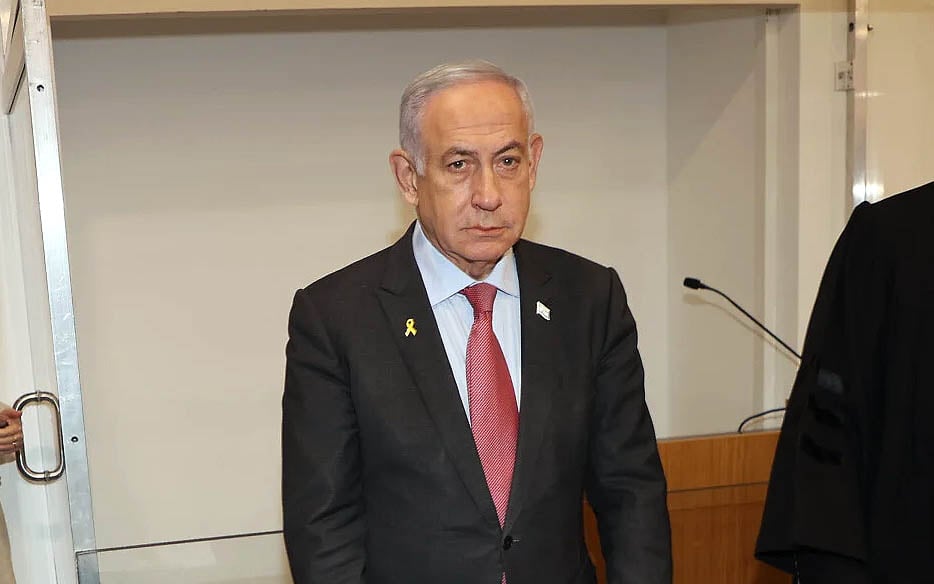
Prime Minister Benjamin Netanyahu arrives at the Tel Aviv District Court to testify in his criminal trial, January 27, 2025. (Yariv Katz/POOL)
The Jerusalem District Court accepts Prime Minister Benjamin Netanyahu’s request to cancel his cross-examination scheduled for tomorrow for an “emergency” diplomatic meeting and a 40-signature debate in the Knesset.
Hostages Families Forum demands return of final body before transition to phase two of ceasefire
The Hostages Families Forum demands that the government make clear that the ceasefire in Gaza will not transition to phase two until the final body held in the Strip is handed over to Israel.
Hamas has yet to return the body of Master Sgt. Ran Gvili, despite committing to do so in the first phase of the ceasefire-hostage release deal signed in October.
“The return of 27 fallen hostages until now proves unequivocally what we said the whole time — Hamas knows the location of all hostages and is using this information as a bargaining chip and to deceive the entire world,” the forum says in a statement.
“Hamas must return everyone, and the government and mediators must demand that it stand by its commitments in full,” it says.
US President Donald Trump’s administration is aiming to announce the transition to the second phase of its Gaza peace plan in about two weeks, as Washington aims to maintain a fragile ceasefire it brokered.
Gallant on Haredi draft bill: Likud has ‘never represented such an anti-Zionist position’

Former defense minister Yoav Gallant arrives for a hearing at an internal Likud tribunal in Tel Aviv to present his defense against a move to expel him from the party, September 29, 2025. (Avshalom Sassoni/FLASH90)
Former defense minister Yoav Gallant says his Likud party “has never represented such an anti-Zionist position” as over the advancement of a bill to regulate ultra-Orthodox draft exemptions.
“The gap between those who are representing the voters, between Knesset members and ministers and voters, has never been so wide,” he tells Army Radio.
He says members of the party who have children serving in the army tell him that the law currently being advanced is “unacceptable to them.”
Gallant reiterates that his opposition to the proposed bill was the main reason for his sacking by Prime Minister Benjamin Netanyahu last year.
Netanyahu meets German chancellor in Jerusalem, will hold joint presser
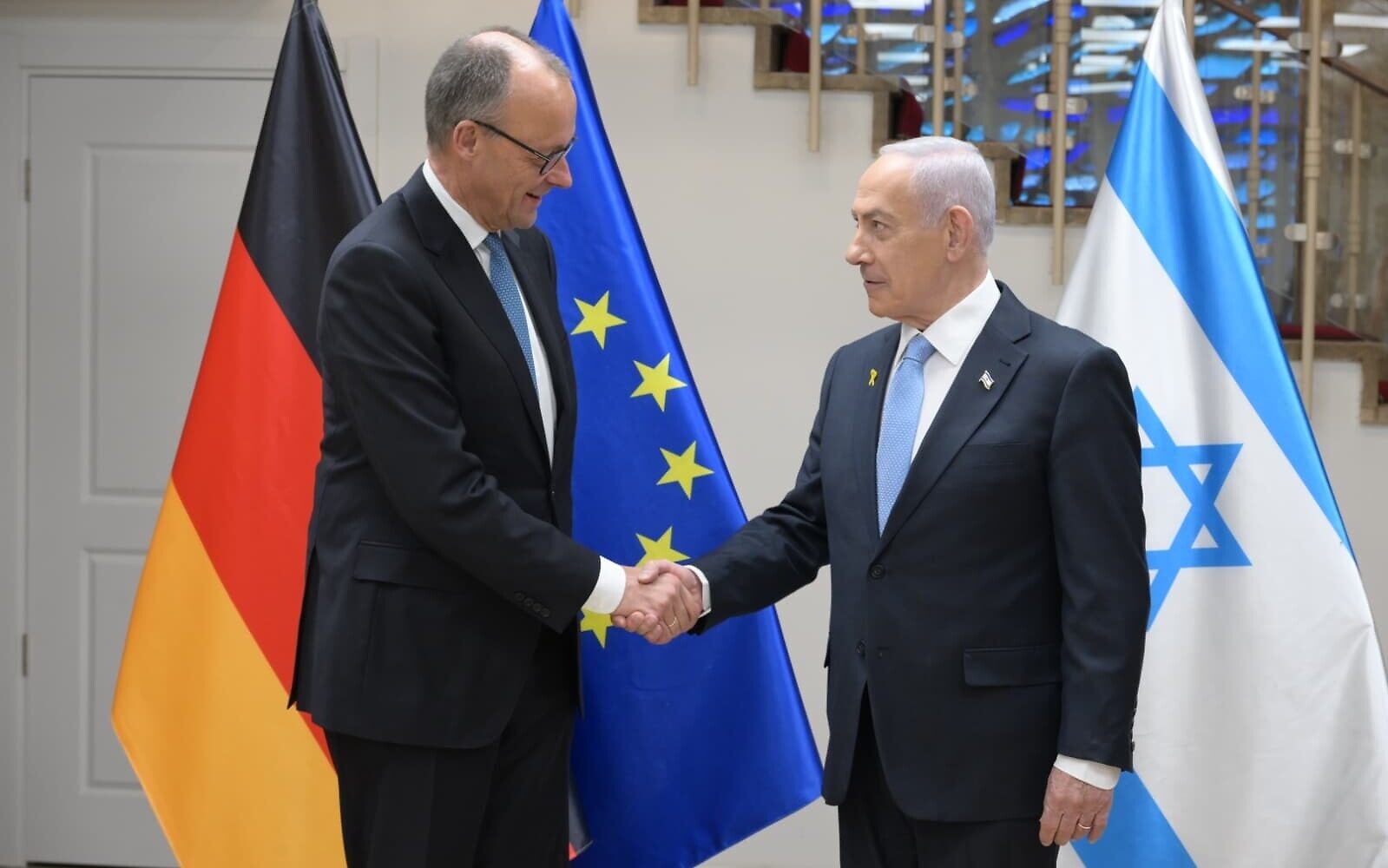
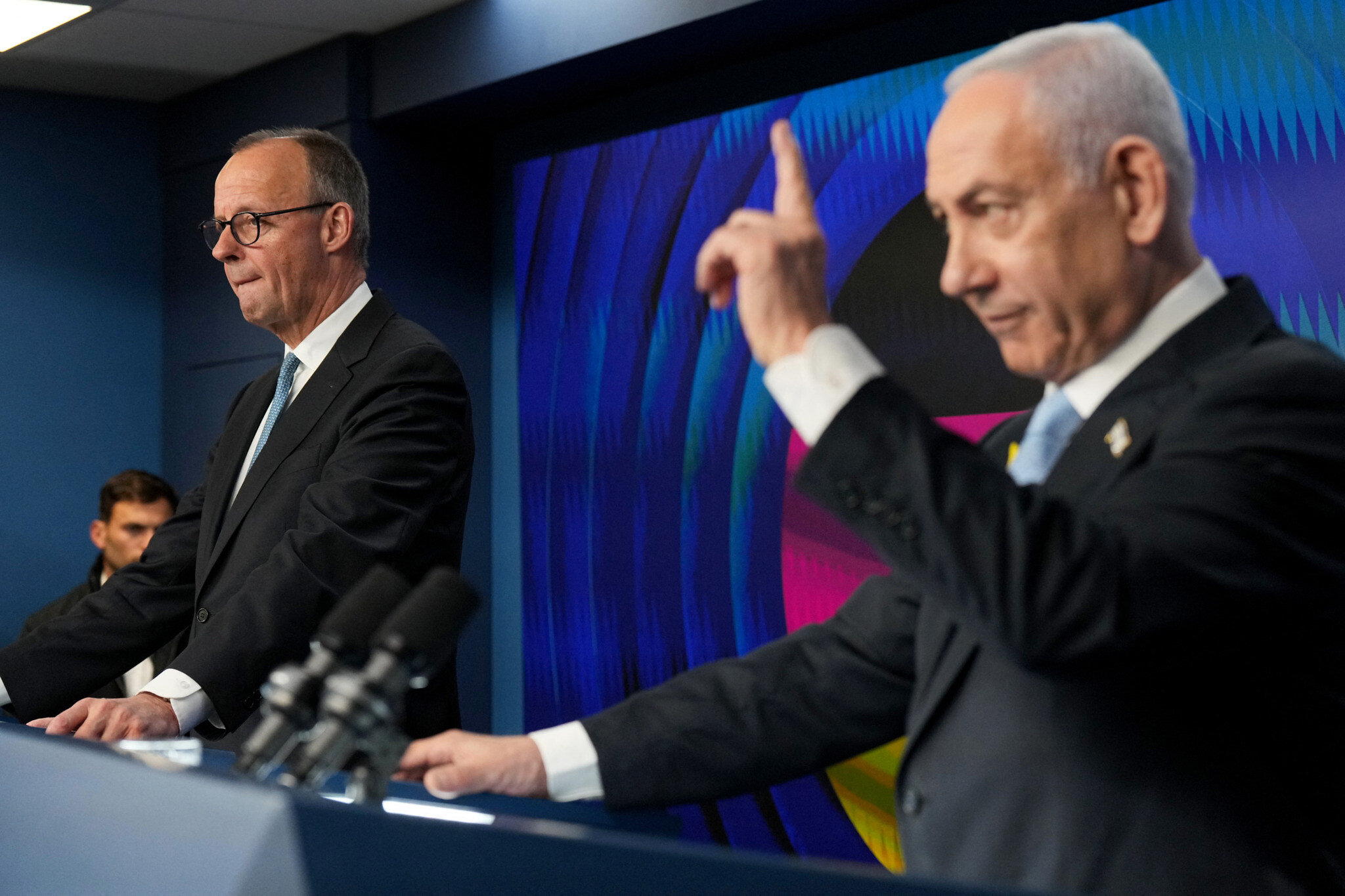
German Chancellor Friedrich Merz (L) and Prime Minister Benjamin Netanyahu shake hands, in Jerusalem, on December 7, 2025. (Amos Ben Gershom/GPO)
Prime Minister Benjamin Netanyahu and German Chancellor Friedrich Merz are currently meeting in the premier’s Jerusalem office during the chancellor’s first visit to Israel since being elected in May.
The two leaders will hold a joint press conference after their meeting.
Merz met Foreign Minister Gideon Sa’ar and President Isaac Herzog last night, kicking off a two-day visit focused on improving bilateral ties, supporting Washington’s Gaza peace plan, and other regional issues.
Police arrest senior school administrator in Jaffa suspected of sexually harassing students
Police this morning arrested a senior school administrator in Jaffa on suspicion of sexually harassing students over the past two years.
He was detained for interrogation by the Ayalon region’s crime-fighting unit, police say in a statement announcing the investigation.
The suspect will be brought today before the Tel Aviv Magistrate’s Court, where officers will request to extend his detention.
Merz at Yad Vashem: ‘Germany must stand up for the existence and security of Israel’

Yad Vashem chairman Dani Dayan (R) stands with German Chancellor Friedrich Merz at the museum's Hall of Names in Jerusalem on December 7, 2025. (JOHN WESSELS / POOL / AFP)
German Chancellor Friedrich Merz reaffirmed Berlin’s support for Israel during a visit to the Yad Vashem Holocaust memorial in Jerusalem, before talks with Prime Minister Benjamin Netanyahu.
During the visit to Yad Vashem, Merz said “Germany must stand up for the existence and security of Israel,” after acknowledging his country’s “enduring historical responsibility” for the mass extermination of Jews during World War II.
“I consider it a great honor and a truly great distinction to be here and to reaffirm that standing by this country is and will remain the unchanging core principle of the Federal Republic of Germany’s policy,” Merz said.
London police arrest man suspected of pepper spraying people at Heathrow
LONDON — London police say they arrested a man for suspected assault after people were attacked with a “form of pepper spray” at a multistory car park at Heathrow Airport’s Terminal 3.
The city’s Metropolitan Police says the incident was sparked by an argument between a group of people known to each other and was not being treated as terrorism.
Heathrow says on social media its teams were “responding to an incident involving the emergency services” and advised passengers to allow extra time when traveling to Europe’s busiest airport.
Police raid warehouse belonging to Tel Aviv Hapoel fans, seize clubs and tear gas

Graffiti in central Tel Aviv calling for "death to the Israel Police," in reaction to mass arrests of Hapoel Tel Aviv soccer fans over rioting in October, found on December 7, 2025. (Israel Police)
Police raid a warehouse belonging to Hapoel Tel Aviv soccer fans, after arresting around 20 people suspected of rioting during an October match.
Officers entered the Tel Aviv warehouse with a key seized from one of the fans detained this morning. They confiscated dozens of extendable clubs and tear gas canisters, police say.
At the same time, police are investigating graffiti put up on Tel Aviv’s Allenby Street that reads: “Death to the Israel Police” in the team’s colors of red, white and black.
In October, police canceled a much-anticipated derby match between Tel Aviv’s rival soccer teams — Hapoel and Maccabi — after rioting that wounded four people in and around Bloomfield Stadium.
Police say they are continuing to crack down on the soccer club and detaining more suspects from the rioting, following a weeklong undercover investigation.
Qatari PM: We won’t write check to rebuild what Israel destroyed

Qatar's Prime Minister Sheikh Mohammed Abdulrahman Al Thani attends a session on the opening day of the Doha Forum, an annual diplomatic conference, in Doha, December 6, 2025. (Mahmud Hams/AFP)
DOHA — Qatari Prime Minister Mohammed Abdulrahman Al Thani indicates that his country will not foot the bill for rebuilding Gaza, despite speculation that Doha would be the main reconstruction backer.
“We are not the ones who are going to write the check to rebuild what others destroyed,” Al Thani says during an onstage interview at the Doha Forum.
He indicates that Qatar will limit its funding to humanitarian aid, declaring that Doha will continue supporting the Palestinian people and do what it can to alleviate their suffering.
“Our payments will only go to help the Palestinian people if we see that the help coming to them is insufficient,” he says without elaborating.
If Qatar decides not to back reconstruction projects in Gaza, it is even more unclear who would be willing to do so, as Doha had been seen to place fewer conditions on its support, whereas other wealthy Gulf countries such as the UAE and Saudi Arabia have insisted that they won’t offer funds absent a clear pathway to the establishment of a Palestinian state, which Israel rejects.
At the end of the interview by Tucker Carlson, the conservative commentator announces that he’ll be purchasing a home in Qatar tomorrow. Carlson explains that while he has never taken money from the Gulf state, he deeply admires its mediation efforts. He acknowledges that he is regularly accused of being bought by Qatar but jokes that now he will be the one paying Qatar, and Doha will have to serve as his mouthpiece in return.
Netanyahu and Merz hold expanded meeting with Israeli ministers, senior officials

Prime Minister Benjamin Netanyahu (3rd R) German Chancellor Friedrich Merz (C) hold an expanded meeting with Israeli ministers in Jerusalem, December 7, 2025. (Amos Ben Gershom/GPO)
Prime Minister Benjamin Netanyahu and German Chancellor Friedrich Merz are holding an expanded meeting with senior officials at the Prime Minister’s Office in Jerusalem, following their one-on-one meeting this morning, the PMO says in a statement.
Participating in the meeting are Defense Minister Israel Katz, Foreign Minister Gideon Sa’ar, Acting National Security Adviser Gil Reich, Defense Ministry Director General Amir Baram, and the countries’ respective ambassadors, the statement says.
WATCH: Netanyahu and Merz hold press conference in Jerusalem
Prime Minister Benjamin Netanyahu and visiting German Chancellor Friedrich Merz hold a press conference in Jerusalem following their meetings this morning.
Netanyahu says he expects phase 2 of Gaza ceasefire to begin soon, in press conference with Germany’s Merz
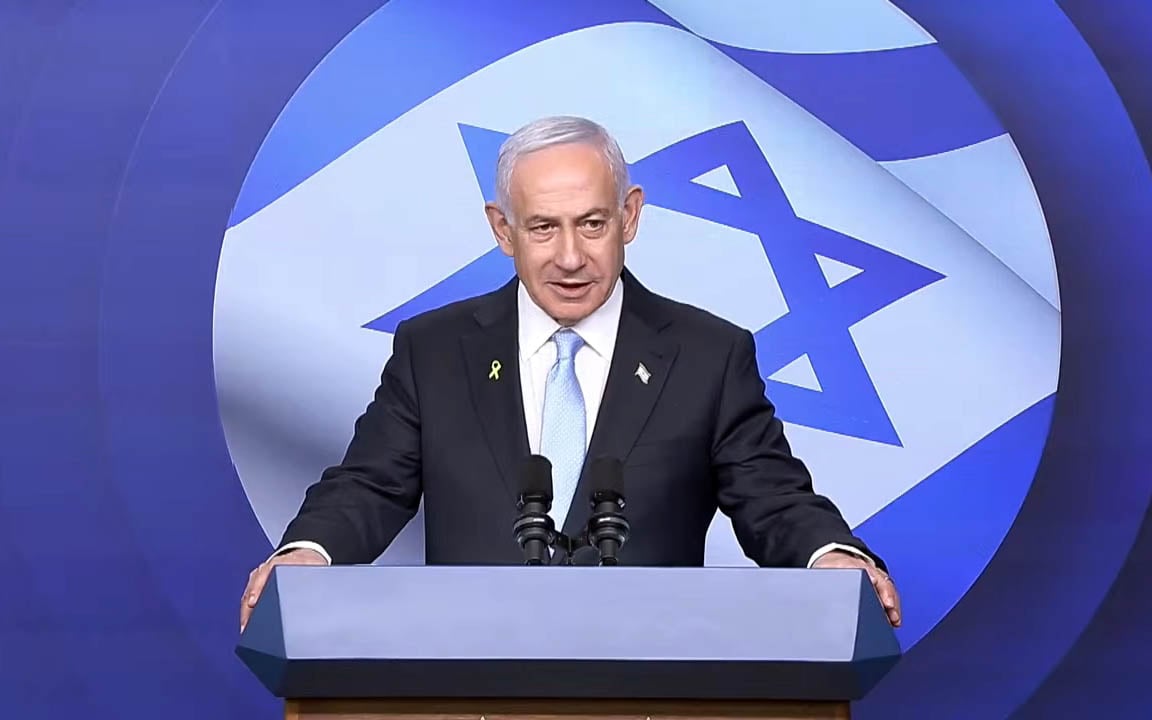
Prime Minister Benjamin Netanyahu holds a press conference with German Chancellor Friedrich Merz (not seen) in Jerusalem, December 7, 2025. (GPO screenshot)
Prime Minister Benjamin Netanyahu says he believes the first phase of the ceasefire in Gaza is almost at an end, and expects to move on to the second phase soon, at a joint press conference with German Chancellor Friedrich Merz.
Netanyahu says “peace opportunities are at hand” after Israeli military operations battered Iran’s Axis of Resistance over the past few years in wars in Gaza, Lebanon, and against the Islamic Republic itself.
“I’m going to discuss them with President [Donald] Trump when I meet him later on this month,” he says, adding he will discuss “how to bring an end to the Hamas rule in Gaza, because that’s an essential part of ensuring a different future for Gaza and a different future for us facing Gaza.
“We finished the first part, as you know, phase one. We’re almost there.”
After the hoped-for return of the body of the final hostage, Master Sgt. Ran Gvili, “then we shortly expect to move into the second phase,” Netanyahu says, adding he believes that phase will be more difficult.
He says the third phase will be to “deradicalize Gaza,” which he notes “was done in Germany” following World War II.
“I speak to many world leaders, but when I speak to Merz, it’s an honest and open conversation, even when we have disagreements,” Netanyahu says.
Netanyahu dismisses idea of Palestinian state ‘committed to our destruction at our doorstep’
Prime Minister Benjamin Netanyahu acknowledges disagreements with Germany’s Chancellor Friedrich Merz, dismissing the idea of a state “committed to our destruction at our doorstep.”
“We have a different point of view, obviously, because the purpose of a Palestinian state is to destroy the one and only Jewish state,” Netanyahu says alongside Merz at a press conference in Jerusalem.
“They already had a state in Gaza, a de facto state, and it was used to try to destroy a one and only Jewish state. We believe there’s a path to advance a broader peace with the Arab states, and a path also to establish a workable peace with our Palestinian neighbors, but we’re not going to create a state that will be committed to our destruction at our doorstep,” he says.
Netanyahu insists Israel will maintain security between the Mediterranean Sea and the Jordan River. He says that annexation of the West Bank remains a subject of discussion, with the status quo expected to remain for the foreseeable future.
Netanyahu says he won’t quit in exchange for pardon in corruption trial, won’t take plea bargain
Prime Minister Benjamin Netanyahu says he will not retire from politics in exchange for a pardon in his corruption trial.
“Do you intend to retire from public life if you receive a pardon?” Netanyahu is asked at the tail end of his joint appearance with German Chancellor Friedrich Merz.
“No,” he replies.
“Are you open to a plea bargain?” comes the follow-up question.
“No,” he replies again.
“They’re very eager. They’re very concerned with my future,” Netanyahu then says. “Well, so are the voters, and they’ll decide, obviously.”
“But we have big tasks to do, including with Germany in historic cooperation that will actually… in many ways, tower over our previous cooperation, which was quite amazing. But that’s not surprising, because, as you can see, Chancellor Merz is a towering figure,” Netanyahu jokes, referring to the German leader’s height.
He and Merz then leave.
Syrian transition fragile, cycle of violence must end, UN panel says
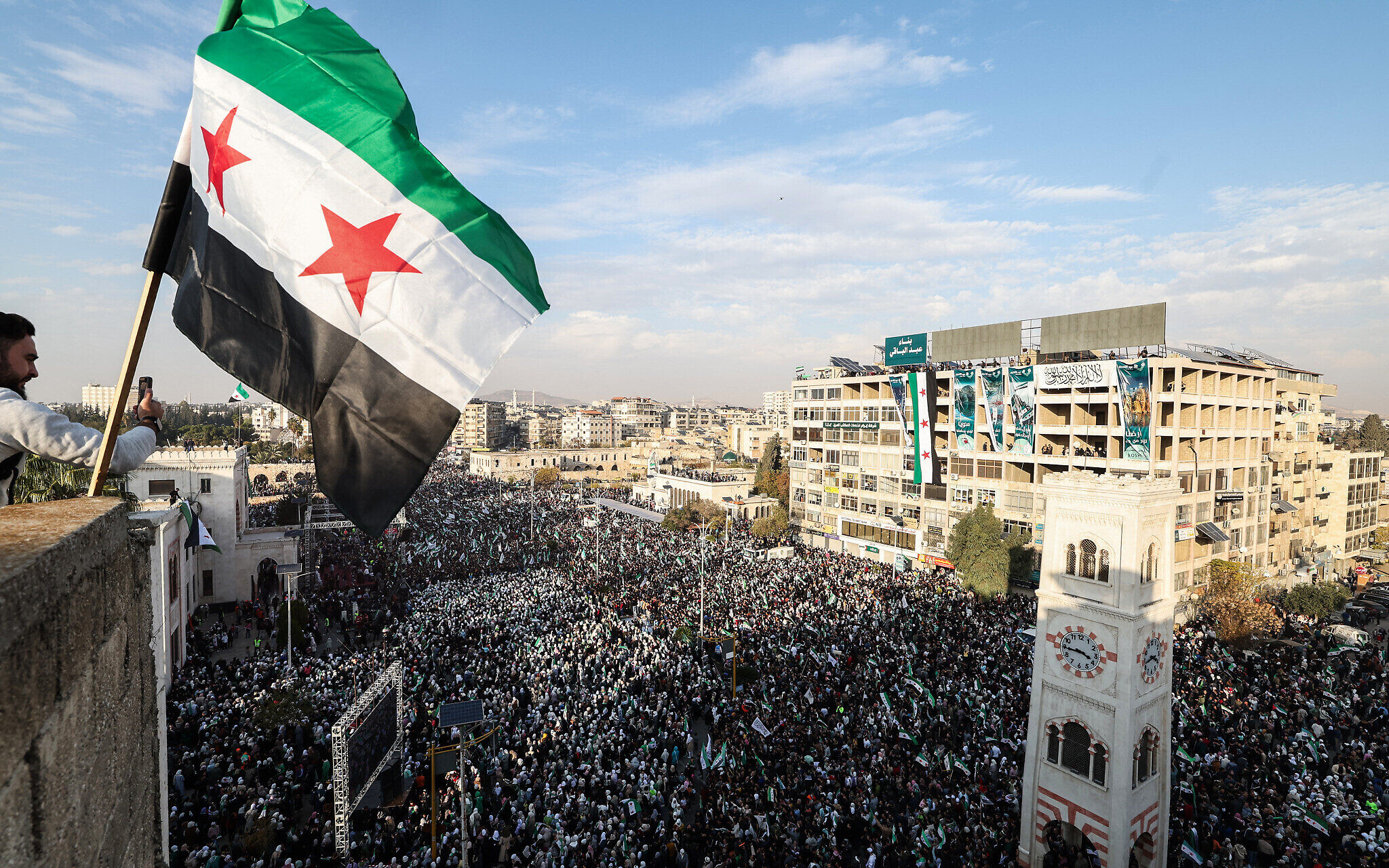
A Syrian flag flutters above crowds gathering during celebrations marking one year since the overthrow of the Assad regime, in central Hama, Syria, on December 5, 2025. (OMAR HAJ KADOUR / AFP)
GENEVA, Switzerland — Syria’s transition is fragile, one year on from the overthrow of ruler Bashar al-Assad, and the country’s cycles of vengeance and reprisal need to end, United Nations investigators say.
The UN Independent International Commission of Inquiry on Syria investigates and records all international human rights law violations since March 2011 in the country.
The panel congratulates Syria on the steps it has taken so far to address the crimes and abuses inflicted during previous decades.
But it says violent events since Assad’s downfall had caused renewed displacement and polarization, “raising worries about the future direction of the country.”
The commission says the “horrific catalogue” of abuse inflicted by Assad’s regime “amounted to industrial criminal violence” against Syria’s people.
“The cycles of vengeance and reprisal must be brought to an end, so that Syria can continue to move toward a future as a state that guarantees full respect for the human rights of all its people, with equality, the rule of law, peace and security for all in name and in deed,” the commission says.
“Syria’s transition is fragile. While many across the country will celebrate this anniversary, others are fearing for their present security, and many will sleep in tents again this winter. The unknown fate of many thousands who were forcibly disappeared remains an open wound.”
The commission says moving beyond the legacy of war and destruction would take “great strength, patience and support.”
“The Syrian people deserve to live in peace, with full respect for rights long denied, and we have no doubt they are up to the task,” it says.
Lufthansa Cargo says it halted military deliveries to and from Israel due to British order, sanctions
German air freight carrier Lufthansa Cargo says it has suspended the transport of military and security-related goods and equipment to and from Israel until further notice.
“Lufthansa Cargo fully complies with all applicable laws and regulations,” a Lufthansa Cargo company spokesman says in an emailed statement. “Due to the UK Export Control Order and relevant sanctions, the transport of military equipment and components to and from Tel Aviv is currently not possible for Lufthansa Cargo, independent of the routing.”
“We are working on a solution to enable respective shipments,” the company spokesman says.
The move comes as German Chancellor Friedrich Merz arrived in Israel on Saturday. Last week, Israel handed over its Arrow 3 long-range missile defense system to the German Air Force in a ceremony at an airbase south of Berlin, completing a 4 billion euro ($4.6 billion) sale, the largest defense export deal in Israel’s history.
IDF says troops shot dead terrorist who crossed Gaza ceasefire line
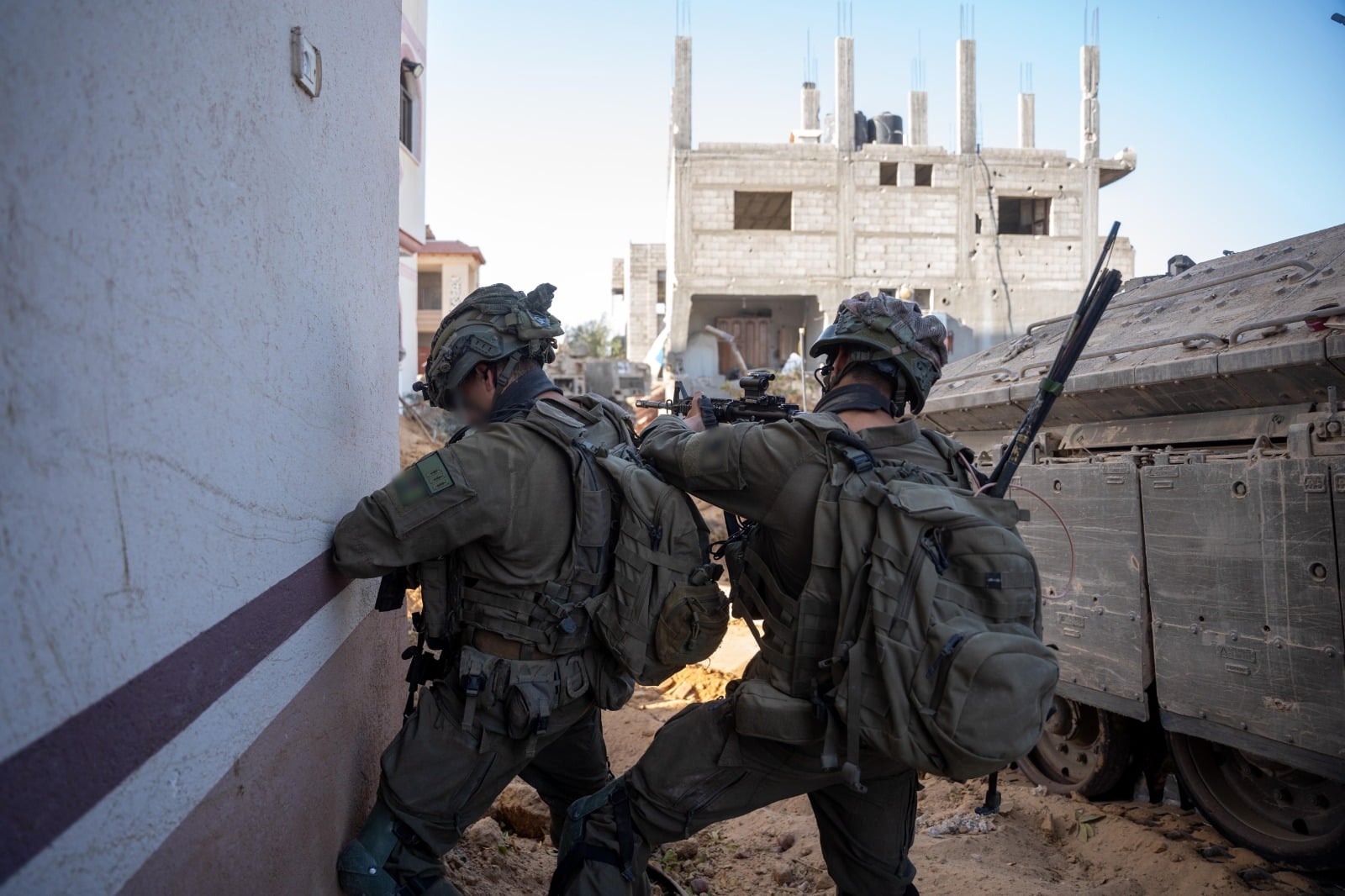
IDF troops operate on the eastern side of the Yellow Line in southern Gaza's Khan Younis, in a handout photo issued on November 9, 2025. (Israel Defense Forces)
IDF troops shot dead a Palestinian terror operative who crossed the Gaza ceasefire line in the Strip’s south, the military says.
According to the IDF, the operative was identified by troops of the 7th Armored Brigade approaching the forces, “in a way that posed an immediate threat.”
Upon being identified, the soldiers “eliminated the terrorist,” the military says.
Lapid meets with Germany’s Merz, discusses postwar ‘regional opportunities’
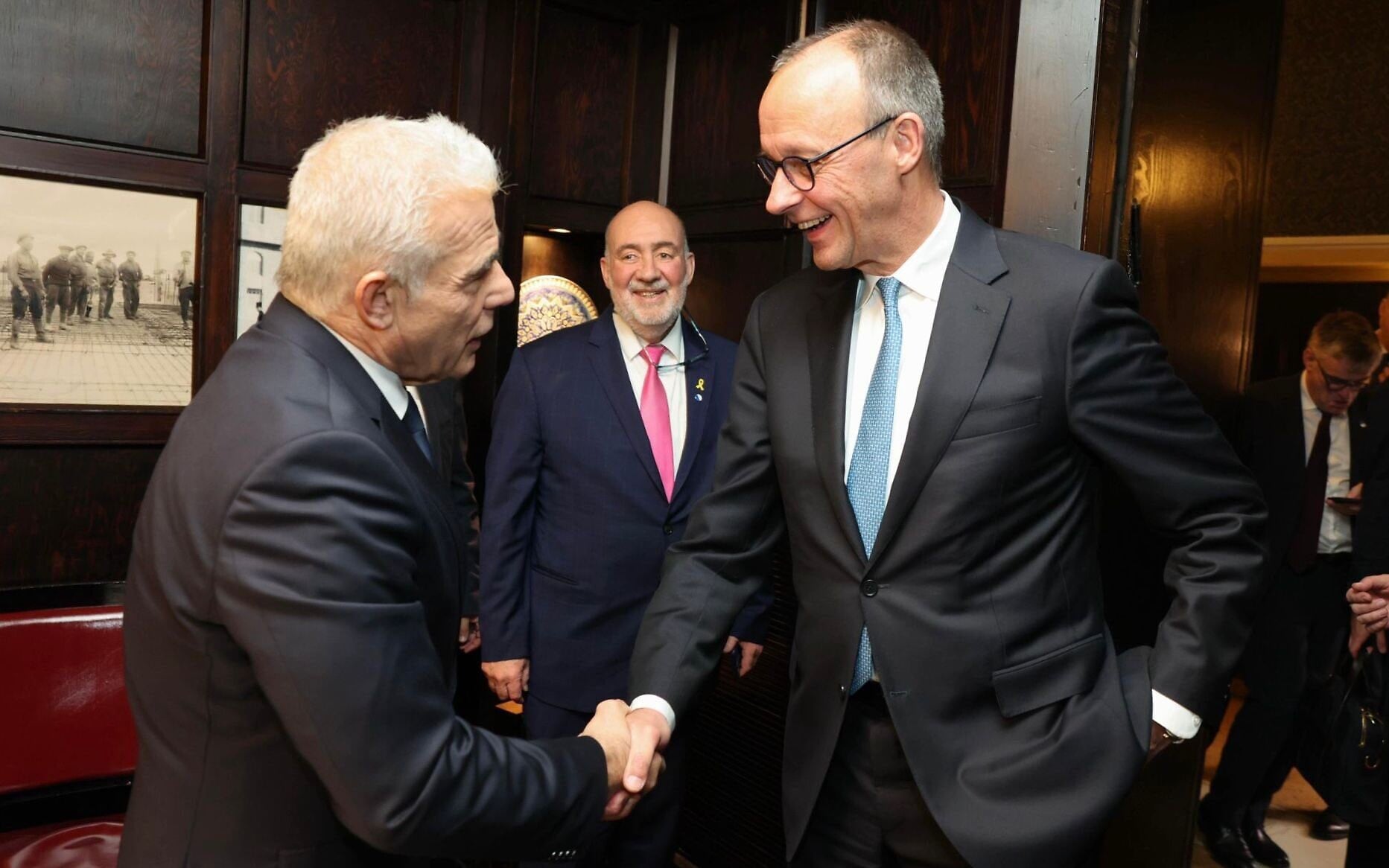
Opposition Leader Yair Lapid (L) meets Germany's Chancellor Friedrich Merz in Jerusalem, December 7, 2025. (Yair Lapid/X)
Opposition Leader Yair Lapid meets with German Chancellor Friedrich Merz in Jerusalem.
Lapid says he spoke to the visiting German leader “about regional opportunities after the end of he war in Gaza and the strengthening of bilateral relations.”
“I thanked him for his support in efforts to return the hostages and for lifting the arms embargo on Israel,” Lapid adds.
Girl, 3, said killed by IDF fire in Gaza
A 3-year-old girl was killed by apparent IDF gunfire in southern Gaza’s coastal area of Mawasi, near Khan Younis, the Al Jazeera network reports, citing local medics.
The incident took place on the Hamas-controlled side of the Gaza ceasefire line, according to Al Jazeera.
The victim is identified in Palestinian media as Ahed al-Bayouk.
There is no immediate comment from the IDF.
#صور | استشهاد الطفلة عهد البيوك بنيران الاحتلال في مواصي رفح جنوبي قطاع غزة.
تصوير : رمضان الاغا pic.twitter.com/9ua9rfX6an
— شبكة فلسطين للحوار (@paldf) December 7, 2025
Report: White House looking to broker summit between Netanyahu and Egypt’s Sissi
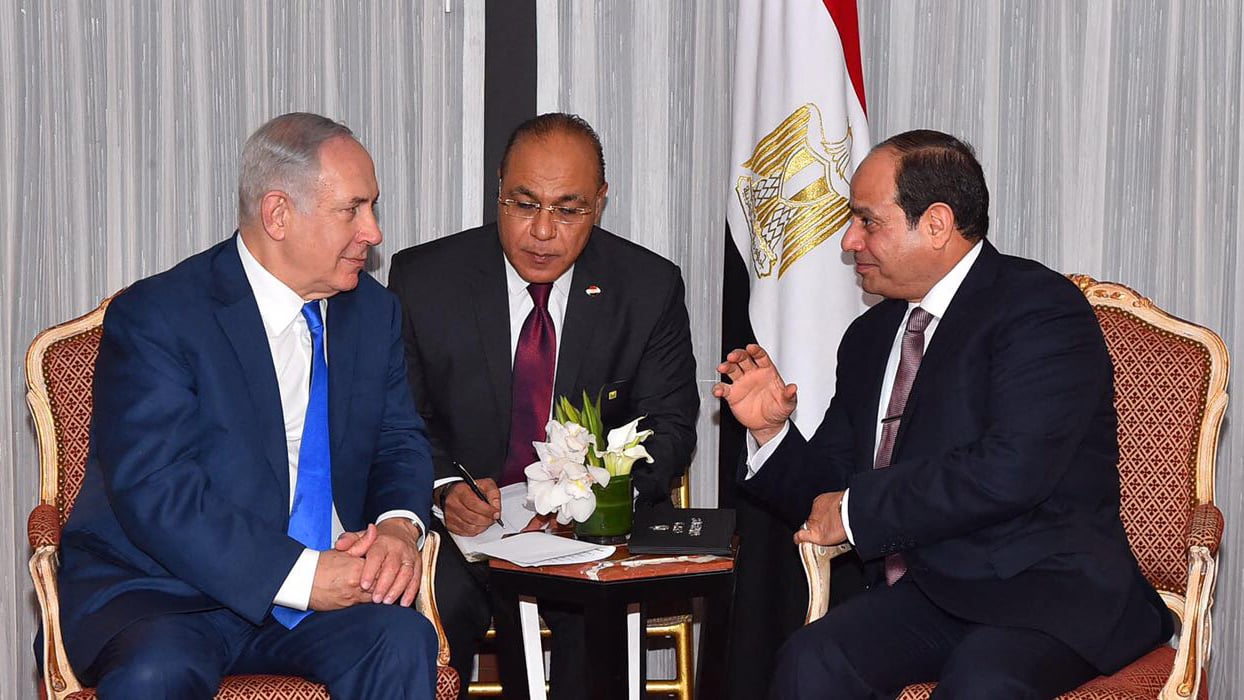
A handout released by the Egyptian Presidency shows Israeli Prime Minister Benjamin Netanyahu (L) meeting with Egyptian President Abdel Fattah al-Sissi in New York on September 18, 2017. (HO/AFP)
The White House is looking to broker a summit between Prime Minister Benjamin Netanyahu and Egyptian President Abdel-Fattah el-Sissi, Axios reports.
While Egypt has played a key role in mediating between Israel and Hamas over Gaza, relations between the two leaders are frosty. Sissi had avoided speaking to Netanyahu throughout the Gaza conflict and the two have not met in public since 2017.
The report, citing a US official and an Israeli source, says the deal is part of a wider push by the US to improve Israel’s ties with the Arab world.
However, Israel will need to make a range of concessions to Egypt, including signing a strategic gas deal between the countries, to entice Sissi to the meeting, Axios reports.
“This is a huge opportunity for Israel. Selling gas to Egypt will create interdependence, get the countries closer together, create a warmer peace and prevent war,” a US official tells Axios.
The report says the US believes that Israel needs to show the world that it has more to offer than just acting as a counter to Iran.
The Israeli source says that Netanyahu has put together a team that is looking at building a package of incentives to offer Sissi.
“What we told Bibi is that he needs to turn it into a warm peace and then work together to de-escalate things in the region. If it works with Egypt we can then do the same thing with Syria, Lebanon and Saudi Arabia,” the US official says.
IDF says troops demolished Hezbollah tunnel, arms depot during Lebanon raids
During recent raids in southern Lebanon, the IDF says it demolished a Hezbollah tunnel shaft and an arms depot.
The tunnel, located near the Lebanese town of Houla, and the arms depot, in Ayta ash-Shab, were “old infrastructures that are no longer active,” the army says.
The IDF says it demolished the sites “to prevent any possibility of future use.”
Police question ex-IDF legal chief after release from hospital

Former IDF military advocate general Yifat Tomer-Yerushalmi is released to house arrest outside Neve Tirtza Women’s Prison in Ramle, November 7, 2025. (Flash90)
Former military advocate general Maj. Gen. Yifat Tomer-Yerushalmi is being questioned by police investigators two days after her discharge from the hospital, Hebrew outlets report.
The ex-prosecutor and central suspect in the Sde Teiman leak affair spent nearly a month in Tel Aviv’s Sourasky Medical Center after she overdosed on sleeping pills while under house arrest.
Police in the Lahav 433 major crimes unit are keeping details of her interrogation under tight wraps, Ynet reports. Tomer-Yerushalmi’s defense attorney, Dori Klagsbald, tells the outlet that he is not conducting any interviews on the matter.
When police launched their investigation into the leak, Tomer-Yerushalmi resigned from her post and confessed to having leaked surveillance footage of IDF troops purportedly abusing a Gazan detainee at the Sde Teiman detention facility, while the incident was under investigation.
She later went missing off the coast of Tel Aviv and was detained by police after an hours-long search. They suspected she had attempted to dispose of evidence that was on her phone, which had also disappeared that night.
Deputy FM vows to march to Jerusalem to stop Haredi draft exemption bill
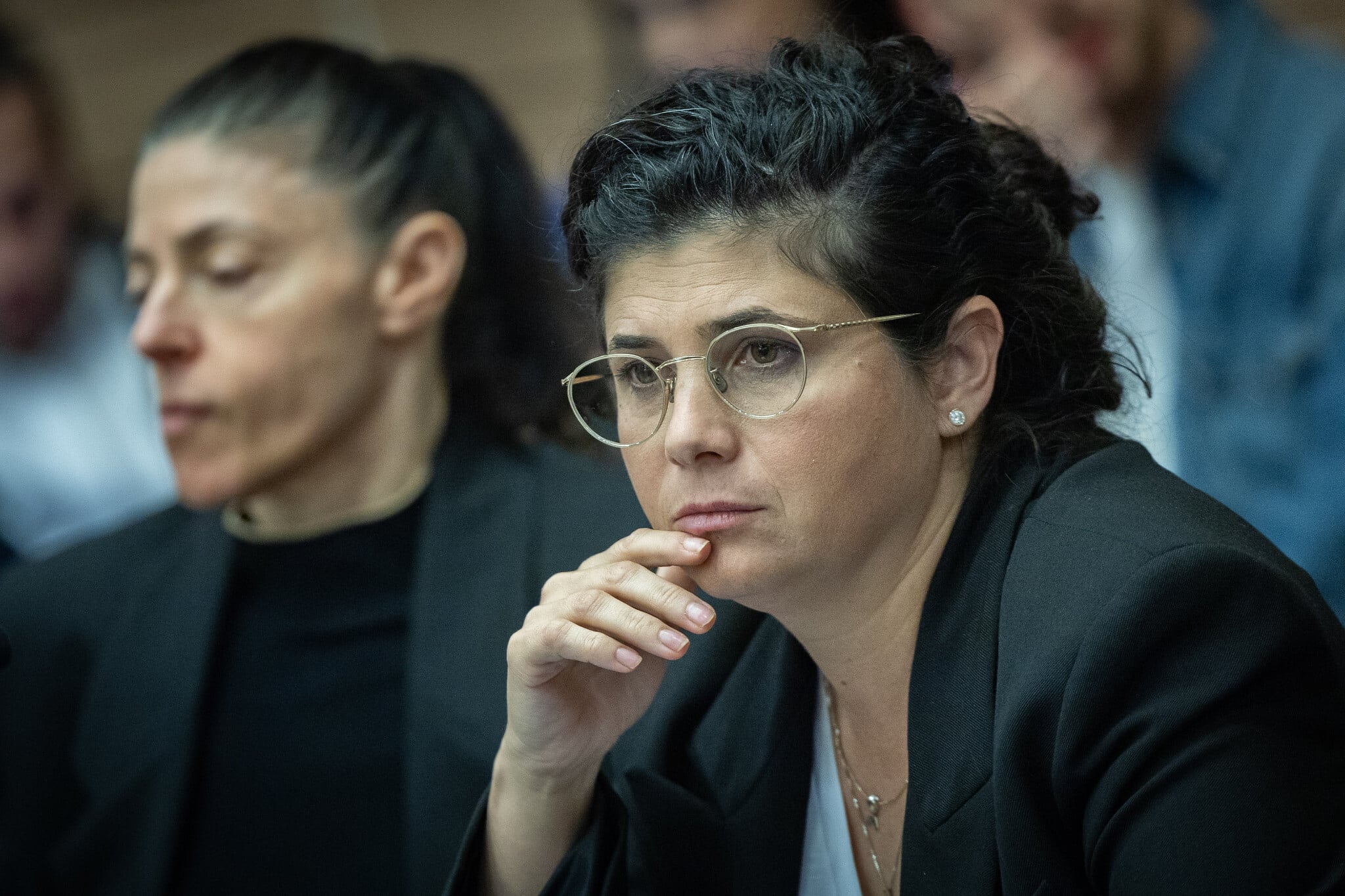
Deputy Foreign Minister MK Sharren Haskel attends a Foreign Affairs and Defense Committee meeting at the Knesset in Jerusalem, December 2, 2025. (Yonatan Sindel/Flash90)
Deputy Foreign Minister Sharren Haskel says she will march from her hometown of Kfar Saba to Jerusalem carrying an Israeli flag as an act of protest against the proposed bill regulating ultra-Orthodox draft exemptions.
Haskel calls on reservists to join her on the march.
“We can’t allow this law to pass,” Haskel says in a statement. “We can’t have a political solution to a security problem.”
Haskel is one of several coalition members who have expressed opposition to the bill that is currently being debated in a Knesset committee.
For the past year, the Haredi leadership has been pushing for the passage of a law that would largely keep its constituency out of the IDF, after the High Court ruled that decades-long blanket exemptions from army duty informally afforded to full-time Haredi yeshiva students were illegal.
Some 80,000 ultra-Orthodox men aged between 18 and 24 are currently believed to be eligible for military service, but have not enlisted. The IDF has said it urgently needs 12,000 recruits due to the strain on standing and reserve forces caused by the war against Hamas in Gaza and other military challenges.
Israel IDs 3 Hamas members said to be funneling cash to terror group from Iran via Turkey
The IDF and Shin Bet identify three Hamas members who are said to be involved in smuggling money to the terror group from Turkey, under the directives of Iran.
According to the military and Shin Bet, Hamas operates a network of money changers made up of Gazans residing in Turkey, “exploiting the country’s financial infrastructure for terror purposes.”
“The Gazan money changers work in full cooperation with the Iranian regime and transfer hundreds of millions of dollars directly to the Hamas terror organization and its leadership,” says the IDF’s Arabic-language spokesman, Col. Avichay Adraee, in a post on X.
He says that the money changers “run extensive economic activity in the heart of Turkey, including receiving Iranian funds, storing them, and transferring them to Hamas.”
Adraee names three Palestinians from Gaza who are part of the network based in Turkey: Tamer Hassan, a senior official in Hamas’s finance ministry, who works directly under political bureau member Khalil al-Hayya, and money changers Khalil Farauna and Farid Abu Dayr.
“The Hamas terror organization, with support and encouragement from the Iranian regime, after having caused the destruction of the Gaza Strip, continues to pursue terror schemes against the State of Israel and attempts to rebuild its capabilities, including outside the territory of the Strip,” Adraee says.
Touring the Strip, IDF chief Zamir says Gaza ceasefire line ‘a new border’
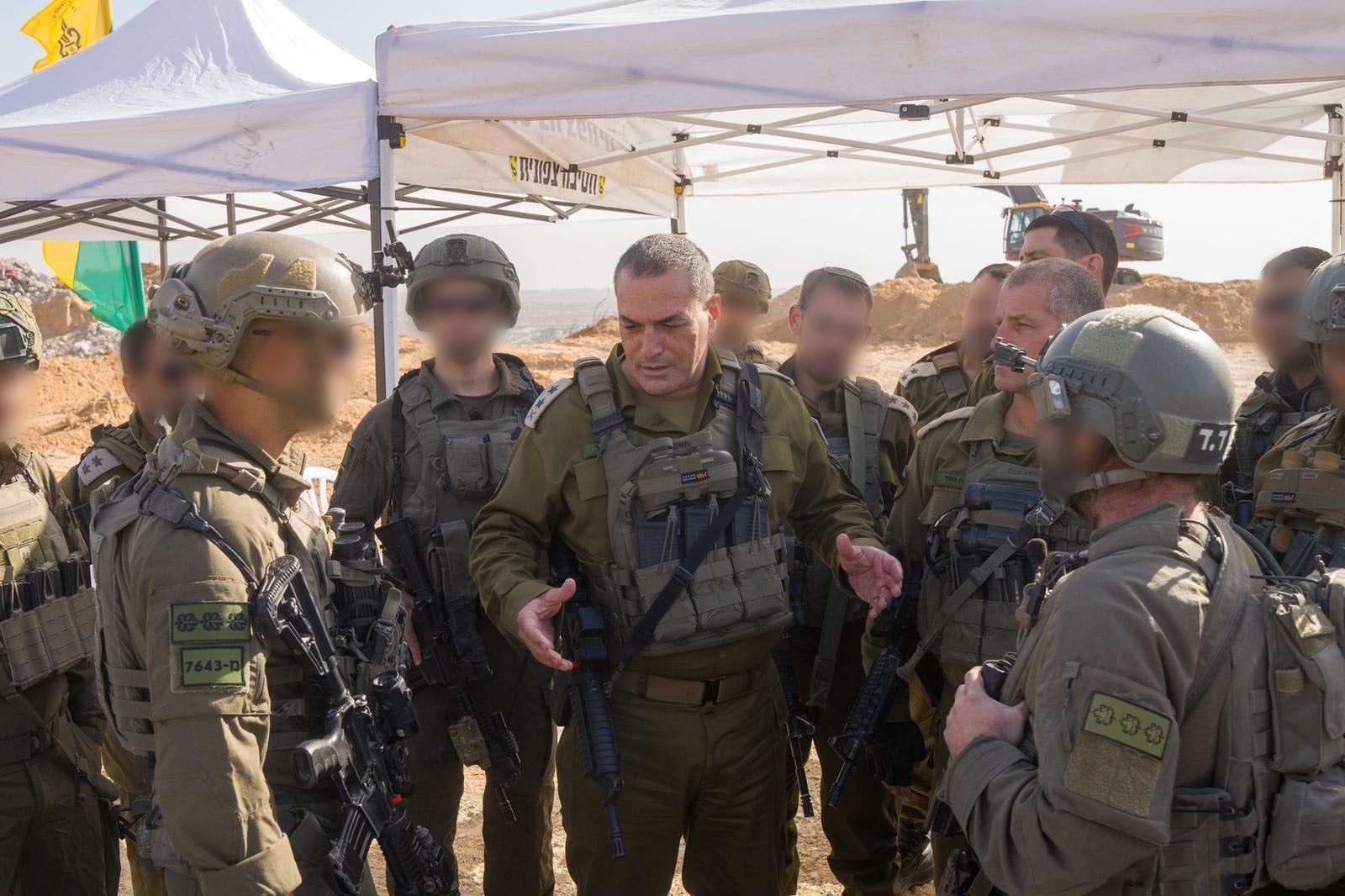
IDF Chief of Staff Lt. Gen. Eyal Zamir (unblurred) speaks to troops in the Gaza Strip, December 7, 2025. (Israel Defense Forces)
During a visit to the Gaza Strip today, IDF Chief of Staff Lt. Gen. Eyal Zamir says the Yellow Line, demarcating where the Israeli military withdrew to as part of the ceasefire, is “a new border line.”
“We will not allow Hamas to reestablish itself. We control large parts of the Gaza Strip and stand along [strategic] lines. The Yellow Line is a new border line, a forward defensive line for the communities and an offensive line,” he says during a tour of Beit Hanoun and Jabalia, according to remarks provided by the IDF.
Prime Minister Benjamin Netanyahu said earlier that Israel would soon enter phase two of the ceasefire deal, once the last hostage’s body is returned. In phase two, the IDF is supposed to gradually withdraw from its current lines if and when Hamas begins disarming.
Zamir also highlighted that Israel was waiting for the return of the final deceased hostage.
“The vast majority of our hostages have returned, but our mission will not be complete until the final fallen hostage, Master Sgt. Ran Gvili, is brought back,” Zamir says.
The IDF chief tells forces that the military “must not be complacent; we must prepare across all arenas and maintain readiness and vigilance alongside adherence to operational norms.”
“The IDF is preparing for the scenario of a surprise war; this is one of the cornerstones of the upcoming multi-year plan,” Zamir adds.
Settler activists removed from at least four illegal West Bank outposts
Border Police forces and personnel from the Civil Administration department of the Defense Ministry remove settler activists from illegal outposts and encampments they had established in closed military zones in the West Bank.
MK Limor Son Har Melech of the ultra-nationalist Otzma Yehudit party arrived at one of the encampments to protest its evacuation, and strongly criticized the enforcement action.
According to a spokesperson for the activists, the inhabitants of four such outposts were removed and their inhabitants forced to leave the closed military zone.
The Civil Administration denied, however, that any illegal settlement outposts had been “evacuated” during the course of Sunday, saying instead merely that the closed military zone orders had been enforced and that no buildings had been demolished.
A spokesperson for the Civil Administration declined to say how many such orders had been enforced during the course of the day.
Outpost “evacuation” typically includes the destruction of any buildings at the site. The spokesperson for the settler activists said that at the “majority” of the four sites today, the inhabitants of the outposts had been removed but buildings had not been knocked down, describing Sunday’s enforcement action as a preliminary step before demolition.
Son Har Melech went to an encampment close to the Gur Aryeh illegal settlement outpost in the Benjamin region in the central West Bank and claimed that the police were removing the settlers from the closed military zone but not Palestinian Bedouin she alleged were dwelling in the same area.
She claimed that after she left, the security forces used knives to destroy sheets and mattresses belonging to the settler activists.
According to the activists, long-term closed military zone orders were imposed at four sites, including the outpost next to Gur Aryeh as well as the outposts of Mikne Avraham in the Gush Etzion district, Mevaser Shalom in the Samaria district, and Kol Mevaser in the Benjamin District.
Sunday’s enforcement action comes following a report by Channel 12 News that Prime Minister Benjamin Netanyahu recently ordered the evacuation of 14 illegal settlement outposts.
A spokesperson for Netanyahu and a senior government official both denied the report, however.
15 IAF pilot cadets jailed for drinking alcohol, receiving visits in breach of rules
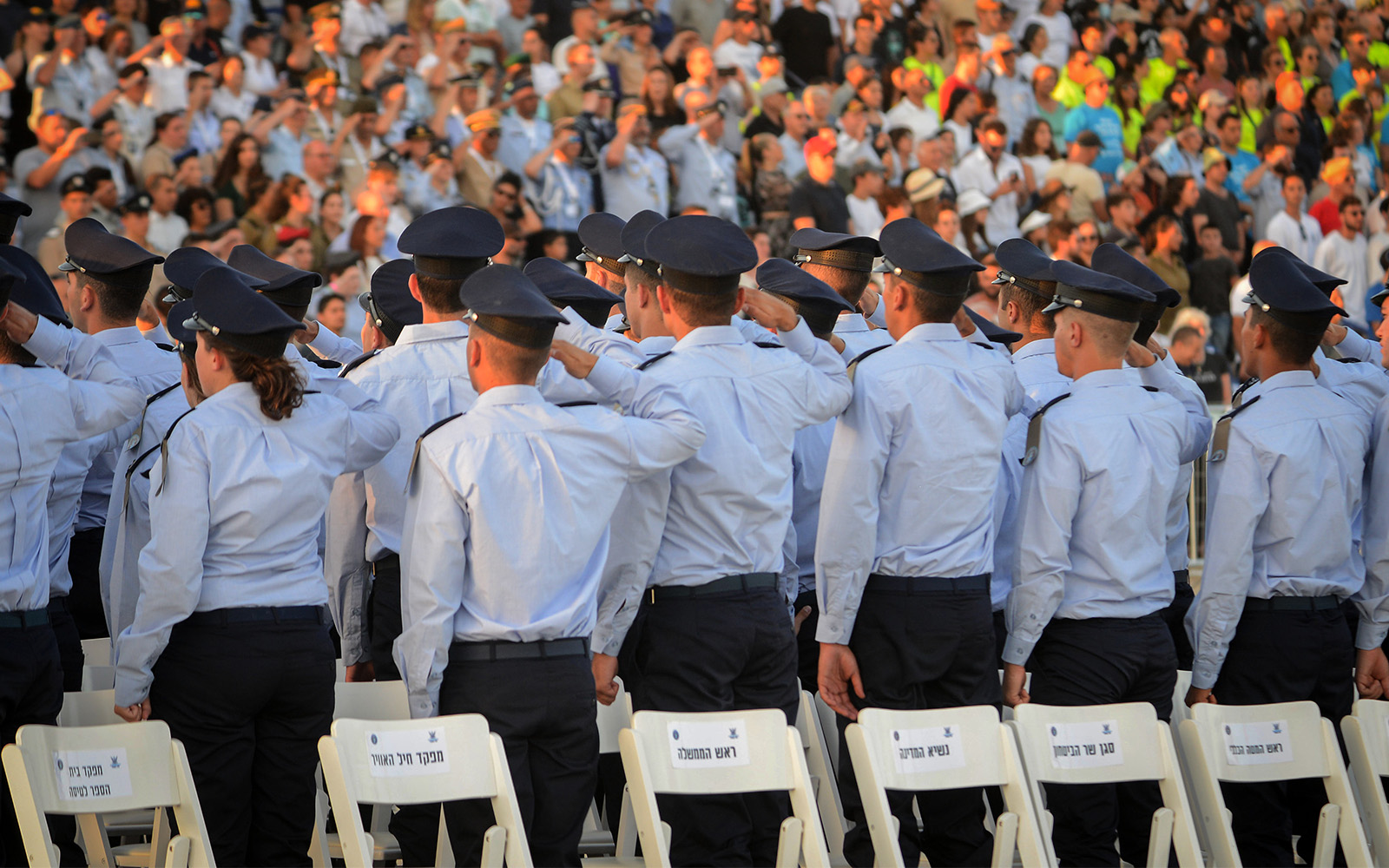
A graduation ceremony for cadets who have completed the Israeli Air Force pilots training, at the Hatzerim Air Base in the Negev desert, June 23, 2022. (Flash90)
Fifteen Israeli Air Force cadets at the end of their three-year pilot course have been jailed over a “disciplinary incident,” during which they had visits from family and friends and drank alcohol while they were supposed to be in solitary.
An officer also involved in the incident may be dismissed from his role.
The incident took place two weekends ago, at an “isolated section” of a civilian hotel, where the cadets were supposed to review their training and rest, following an intensive week-long course simulating enemy captivity.
An IAF investigation found that one of the commanders in the flight course “deviated from procedures” and allowed the cadets to drink alcohol during the learning session. In addition, some of the cadets brought family members and their girlfriends to what was supposed to be an isolated part of the hotel.
The military says 15 cadets were sentenced to 3-6 days in military prison, in accordance with the severity of their actions.
The flight school commander, who holds a rank of major, will be summoned by the chief of the Air Personnel Group for a “discussion regarding the continuation of his role.”
Additional cadets who violated the guidelines over that weekend are also facing disciplinary actions, but not jail sentences.
The military says the cadets acted contrary to the values of the IAF, and the visits and alcohol drinking disrupted the training. The military also emphasizes that there is no concern of harm to the IAF’s operational readiness.
The cadets are not automatically being dismissed from the pilot course, which will end at the end of the month. Rather, all cadets undergo a screening by a committee at the end of the three-year course to determine whether they completed the training properly.
Mossad chief said meeting Qatari official in NYC in bid to patch ties after botched Doha strike on Hamas leaders
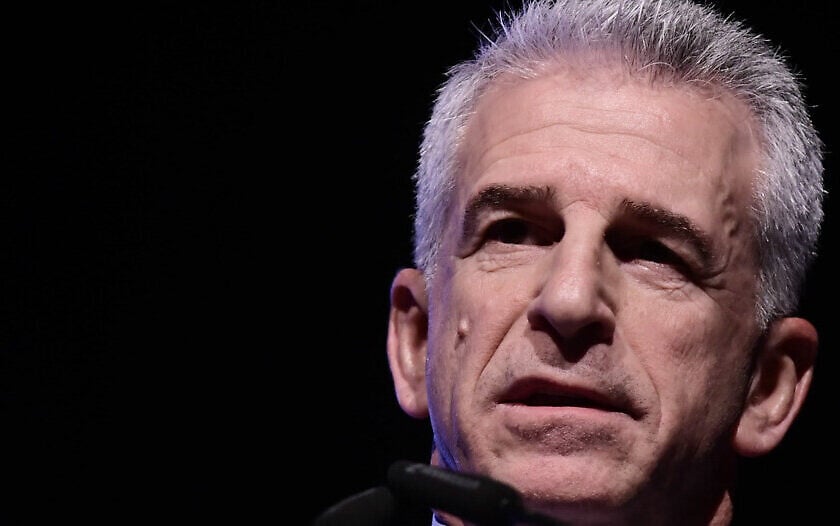
Mossad chief David Barnea in Tel Aviv, on February 25, 2025. (Tomer Neuberg/ Flash90)
Mossad chief David Barnea is meeting with a senior Qatari official in New York at the behest of US envoy Steve Witkoff in a bid to mend ties that were frayed by the botched Israeli strike in Qatar on September 9, which targeted a meeting of the Hamas terror group’s political leadership, Axios reports.
According to the report, which cited two unnamed sources, this is the first meeting of a trilateral mechanism designed to improve the relationship between Jerusalem and Doha. Even though the countries do not have diplomatic relations, Qatar played a key role in mediating with Hamas.
The meeting is the highest-level meeting between the countries since the strike.
In late September, Prime Minister Benjamin Netanyahu apologized to his Qatari counterpart, Mohammed bin Abdulrahman bin Jassim al-Thani for violating Qatari sovereignty.
Though the strike failed to kill the key Hamas leaders it was targeting, it did kill several lower-level members in the terror group, along with one Qatari guard. Following the attack, Qatar — which had until then played a key role in negotiations between Israel and Hamas amid the war in Gaza — refused to serve as a mediator.
Axios says today’s meeting is likely to focus on how to move forward to the next phase of the Gaza ceasefire.
US envoy: Israel can claim it’s a democracy but benevolent monarchy is what works in Mideast
DOHA, Qatar — US special envoy for Syria Tom Barrack says, “Israel can claim that it’s a democracy but in this region really what has worked the best… is a benevolent monarchy.”
Barrack makes the comments during an onstage panel at the Doha Forum while arguing against Western attempts to import democracy in Syria following the fall of Bashar Assad’s regime.
“The first thing that has to happen is that we have to allow them — Syria — to define it themselves without going in with Western expectations and saying, ‘We want a democracy in 12 nights.’ We’ve never had a democracy — I don’t see a democracy anywhere — Israel can claim that it’s a democracy, but in this region, really what has worked the best, whether you like it or don’t like it, is a benevolent monarchy,” Barrack says.
It is unclear whether he is suggesting that he does not believe that Israel is a democracy.
Barrack has become known to offer more philosophical and analytical on-the-record statements, and it is not always clear whether they represent a broader administration approach.
Israeli Navy holding joint drill with US Navy’s 5th Fleet

An Israeli Navy Sa'ar 5 Corvette approaches a US Fifth Fleet replenishment tanker in the Red Sea, in an image published by the military on April 5, 2022. (Israel Defense Forces)
A week-long bilateral drill between the Israeli Navy and the US Navy’s 5th Fleet began today, the Israeli military says.
The IDF says it sent dozens of sailors to the Intrinsic Defender drill, which also took place in 2023 and 2022.
“The purpose of the exercise is to strengthen strategic and operational cooperation between the two navies and practice dealing with various regional threats,” the IDF adds.
State Comptroller’s Office summons two former senior Shin Bet officials to meet over October 7 probe
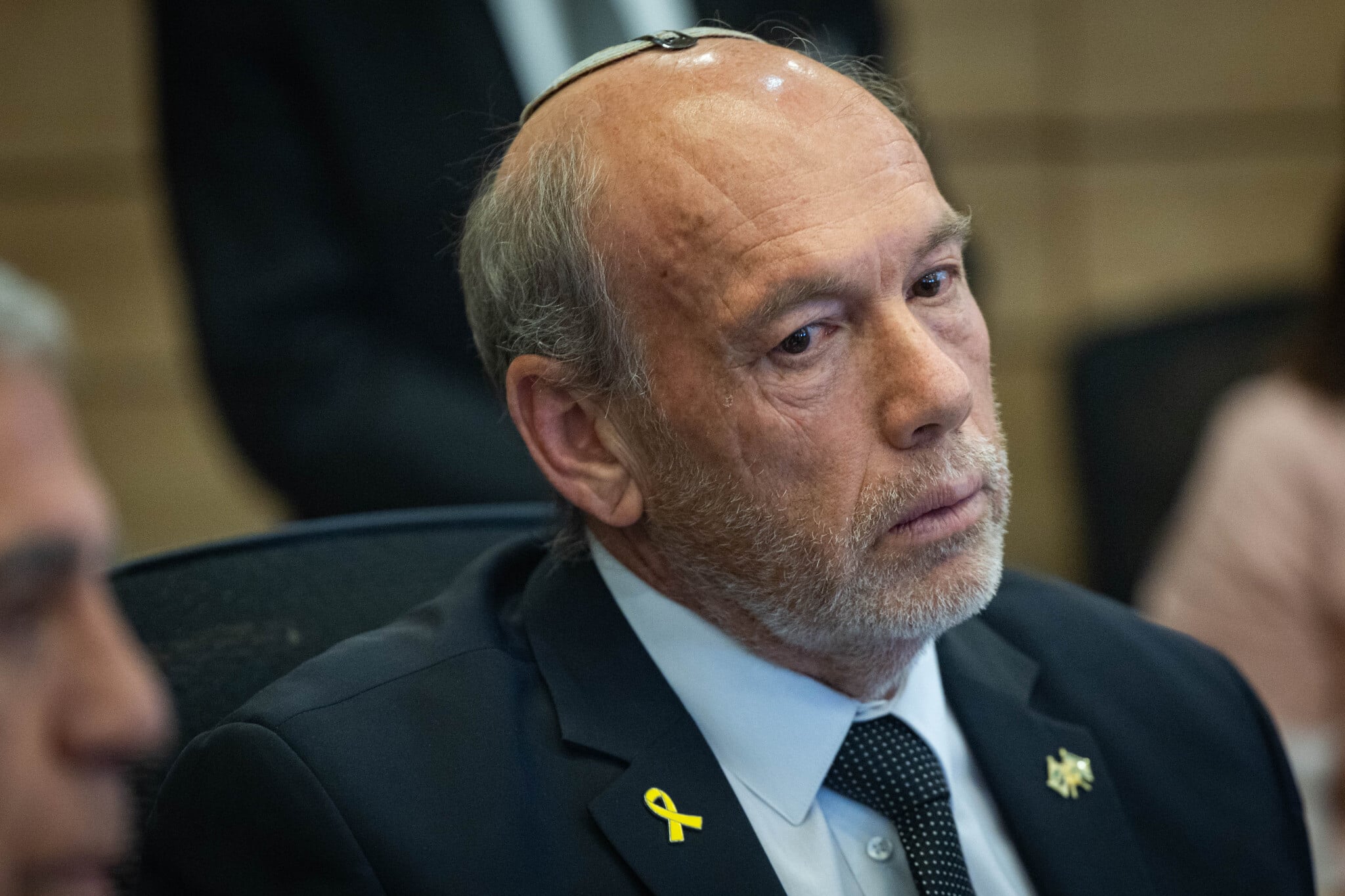
State Comptroller Matanyahu Englman attends a State Control Committee meeting at the Knesset in Jerusalem, May 12, 2025. (Yonatan Sindel/Flash90)
The director of the State Comptroller’s Office Yishai Vaknin issues a summons to two former senior officials in the Shin Ben for them to meet with State Comptroller agents and present documents relating to the office’s wide-ranging probe into the multi-level failures surrounding the October 7, 2023, Hamas invasion and massacre.
State Comptroller Matanyahu Englman and his office have been conducting a broad investigation into these failures, and says in a statement to the press that this includes examining the role of the Shin Bet domestic intelligence and security agency.
The agency says it has written to the lawyers of the two former senior officials protesting their failure to answer previous requests for meetings, and issues the new summons under a clause of the Law for the State Comptroller empowering that office to impose sanctions on an individual failing to comply with such a summons, which includes a prison sentence of up to two years.
According to the State Comptroller’s Office, requests for meetings were sent to the two former officials in July this year, but the two failed to coordinate with the agency’s officials, despite an agreement worked out by the High Court of Justice with the IDF and the Shin Bet enabling the State Comptroller’s probe into those two security bodies.
Sa’ar at summit of Israeli envoys: We cannot succeed without improved public diplomacy

Foreign Minister Gideon Sa'ar addresses a gathering of Israeli ambassadors in Jerusalem on December 7, 2025. (Shlomi Amselam/GPO)
Delivering remarks at a Foreign Ministry conference of 108 Israeli ambassadors and heads of diplomatic missions from around the world, Foreign Minister Gideon Sa’ar says that Israel “cannot succeed” without intensifying its public diplomacy efforts.
Sa’ar says that he and Prime Minister Benjamin Netanyahu “spoke a great deal today about public diplomacy — about the fact that Israel’s ambassadors today must possess sets of skills that include public diplomacy in all its aspects.”
“This requires profound change – change in training, starting from the cadets and upward. Because the arenas today – social media, the press, civil society in every country, interactions with communities, including friendly communities, and not only Jewish ones but also Christian ones – this is an essential part of an ambassador’s role,” he says at the conference, which is supposed to take place annually but has not occurred for six years due to the 2019 global pandemic and the war in Gaza.
“It may not be relevant in most countries for other states, but for Israel, without this, we cannot succeed,” Sa’ar continues.
In November last year, Sa’ar announced a NIS 545 million ($163 million) budget for the ministry’s public diplomacy efforts. There is an unprecedent allocation of some NIS 2.35 billion ($725 million) for public diplomacy.
Throughout its war with Hamas, Israel has faced mounting global condemnation and strained relations with allies over its wartime conduct in Gaza, drawing greater attention to its handling of public diplomacy and ability to effectively communicate its policies.
Sa’ar adds that Israel carried out public diplomacy campaigns “with great success” during the war with Iran in June, and says he sees “far more exposure on social media” to material shared by Israel’s official diplomatic channels.
“Of course, this is only a small part of the work we will need to do in 2026,” he adds, noting that the government “set the direction” for this by approving its state budget on Friday. He says the ministry must “prepare the optimal plan, based both on the lessons of the past year and on many things we have not yet done, some of which are already underway.”
In meeting with Israeli diplomats, Netanyahu touts strength as key to making peace
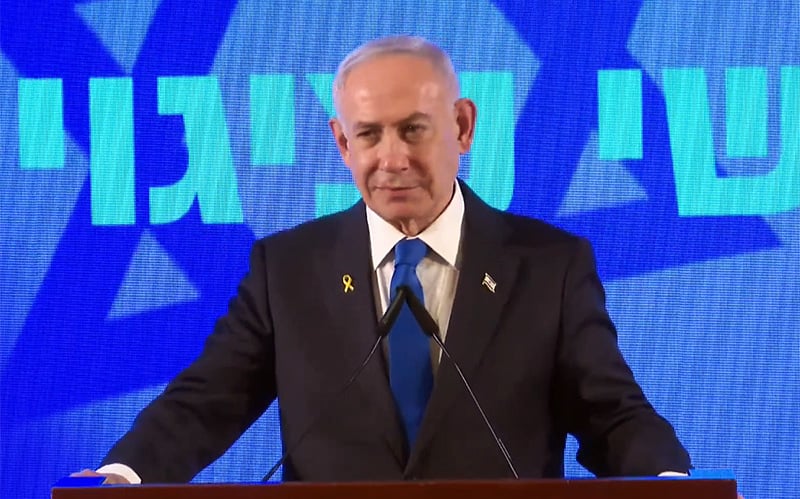
Prime Minister Benjamin Netanyahu addresses a gathering of Israeli ambassadors in Jerusalem on December 7, 2025. (Screen capture/GPO)
In a rapidly changing world, there is one simple rule, Prime Minister Benjamin Netanyahu tells a meeting of Israel’s ambassadors in Jerusalem, “You have to be strong. You have to be very strong.”
“With the strong, pacts are made. With the strong, peace is made,” he says.
Israel’s strength is a key factor in other countries’ decision to make peace with Israel, he argues.
“Israel is stronger than ever,” Netanyahu continues. “It is a superpower – certainly regional, in several fields, it is a world power.”
Israel has become stronger military and economically since the October 7, 2023 attacks, Netanyahu insists. “As a result, we have increased our diplomatic strength.”
He says that there were a series of important decisions he made in the immediate aftermath of the attack — to declare war, to call up all the reservists, and whether to attack Hezbollah in Lebanon. Netanyahu says he decided not to attack Hezbollah because it would have happened when both Hamas and Hezbollah “were at the height of their power.”
Amid an ongoing political fight in Israel over how many ultra-Orthodox soldiers will be drafted into the IDF, Netanyahu says in his speech – without mentioning the draft issue – that “we have a very, very big army compared to our population.”
Netanyahu says that during the first days of the war, he made the decision to deal with Hamas first, then turn to Hezbollah, then other Iranian proxies, and finally Iran itself. He takes the diplomats through the campaigns against those enemies, stressing that he did not trust the US Biden administration enough to tell them that Israel was going to take out Hezbollah secretary-general Hassan Nasrallah.
Turning to the new government in Syria that replaced Bashar Al-Assad, Netanyahu says that “We are very much hoping that we will be able to come to a disarmament agreement in southwest Syria and also to take care of our Druze brothers,” he says, adding that Israel will “keep the high ground” in Syria.
Netanyahu says Trump repeatedly expressed admiration for Israeli public and soldiers

US President Donald Trump speaks at the Knesset in Jerusalem on October 13, 2025. (Chip Somodevilla / POOL / AFP)
US President Donald Trump told Prime Minister Benjamin Netanyahu many times how impressed he is with the Israeli public and its soldiers, the premier tells Israel’s ambassadors at a meeting in Jerusalem.
“He was also amazed by the decisions we took” during the war, says Netanyahu.
“All of these things made it clear to him that there is a very strong country here,” he continues, “and a very strong army” which brings Israel’s allies closer to it. “Israel revealed that it’s not only a strong country, but an unusually strong country.”
Israel is embarking on an independent military build-up through its defense industries, says Netanyahu. He stresses that it will not be an “autarkic economy” – after saying recently that Israel would have to become a “super Sparta” – but Israel has to be “as independent as possible.”
Israel is “flooded” with requests from foreign countries for Israel weapons, he says.
Netanyahu says he will meet Trump “at the end of the month,” confirming reports about the date of his fifth trip to the US this year and sixth meeting with Trump.
Turning to the rise of antisemitism in the world, he says part of the problem is that hostile countries are using bots on social media and that there will be innovations in the public diplomacy fight.
Netanyahu says willing to give international force a chance to disarm Hamas, but is skeptical
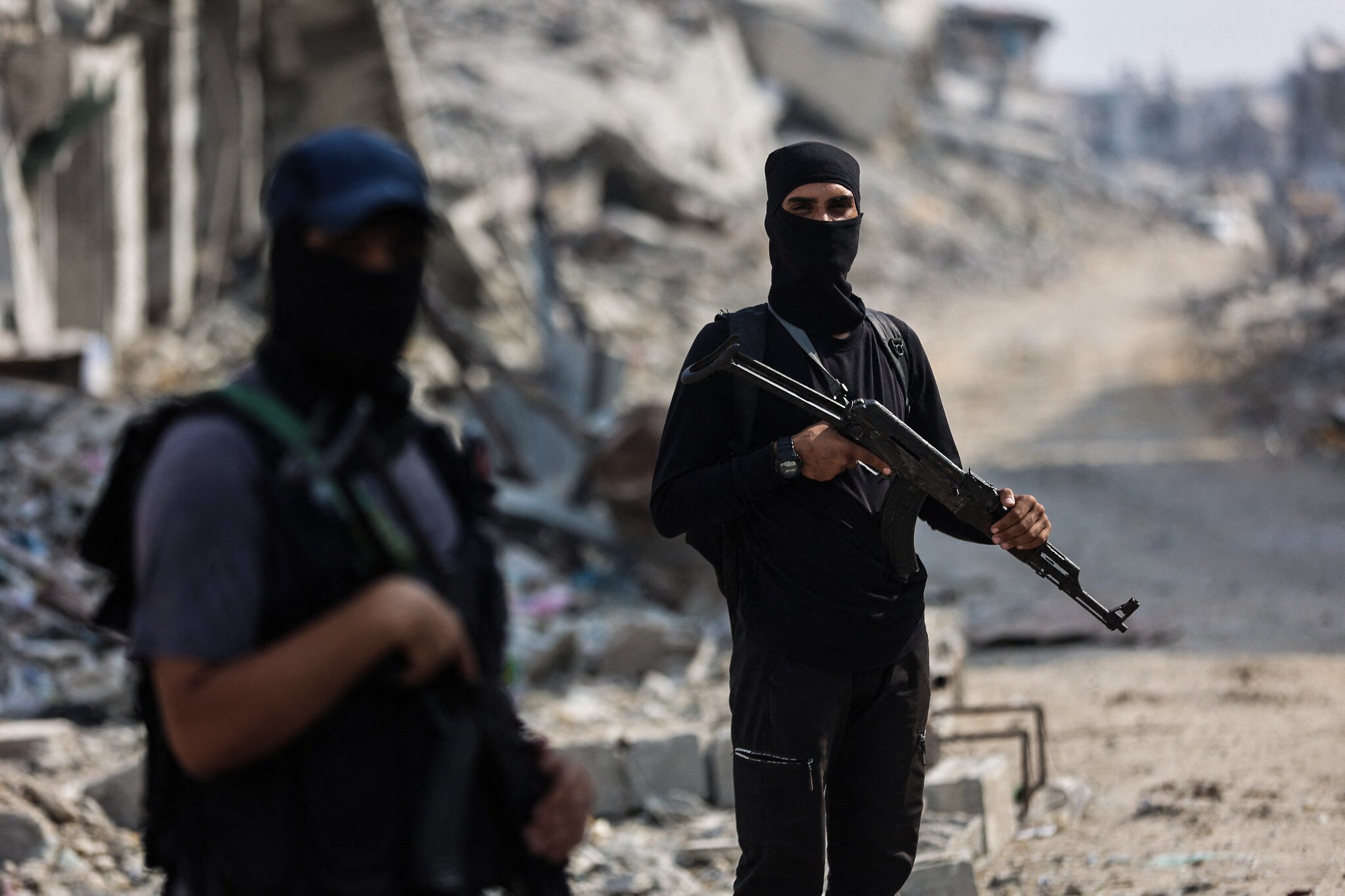
Armed Hamas members are seen guarding an area in Gaza City on November 3, 2025. (Omar AL-QATTAA / AFP)
Israel “will bring back Rani [Gvili] as well,” Prime Minister Benjamin Netanyahu tells Israel’s ambassadors, referring to the last slain hostage in Gaza who were returned under the first phase of the ceasefire with Hamas. “We are bringing back all the hostages, until the very last one.”
“In the second phase, we are moving to disarmament and demilitarization,” he says.
The US wants to create an international force to accomplish the task, says Netanyahu. “I said, go ahead,” he continues.
“We know that there are certain missions that this force could do,” he says. “There are certain things they can’t do, maybe the main task they can’t do, but we will see.”
“We can do it the easy way, or the hard way,” he says about disarming Hamas. “But in the end it will be done.”
Turning to normalization, he dismisses media reports that certain peace deals cannot happen without Israel doing things first – a likely reference to the Saudi demand that Israel commit to an eventual Palestinian state. “The opportunities are there because of the tectonic changes we made in the balance of power in the Middle East,” he says.
“We no longer have a policy of containment,” says Netanyahu. “We identify a threat, and we act.”
In a possible reference to a potential threat from Turkey in Syria and in the broader region, Netanyahu says, “One power goes down, another rises. I won’t say who I’m referring to, but you can guess. You know very well.”
IDF says troops killed Palestinian throwing stones at motorists on West Bank highway
The IDF says troops killed a Palestinian who was throwing stones at motorists on a highway in the West Bank this evening.
Soldiers of the Paratroopers Brigade’s 890th Battalion were on patrol near the Palestinian town of Azzun when they identified three suspects hurling stones, the army says.
The military says the soldiers opened fire, killing one and wounding a second. The third suspect was detained and taken for questioning, according to the IDF.
Judge orders 5 Hapoel Tel Aviv soccer fans suspected of rioting to be held until Thursday
Police stand guard after the Israeli Premier League match between Hapoel Tel Aviv and Maccabi Tel Aviv was canceled at Bloomfield Stadium in Tel Aviv, on October 19, 2025. (Flash90)
Five Hapoel Tel Aviv soccer fans suspected of rioting before a match two months ago will remain in custody until Thursday this week, a Tel Aviv Magistrate’s Court judge rules, as police continue to crack down on the team’s ultras.
Police earlier today arrested 20 fans suspected of lighting flares and other pyrotechnics before a much-anticipated derby match in October, and say they are continuing their search for suspects.
Officers had been conducting an undercover investigation into the unrest for around a week, but this morning raided suspects’ homes and a warehouse belonging to the soccer club, going public with the probe dubbed “Bright Red.”
In today’s raid on the warehouse, police say they seized tear gas canisters, extendable batons and handheld radios.
The detainees are suspected of lighting flares in Tel Aviv’s Bloomfield Stadium the day of the match in a commotion that left four injured. Police seek to charge them with various weapons offenses as well as assault of a police officer.
Hamas official says the group ready to discuss ‘freezing or storing’ its weapons
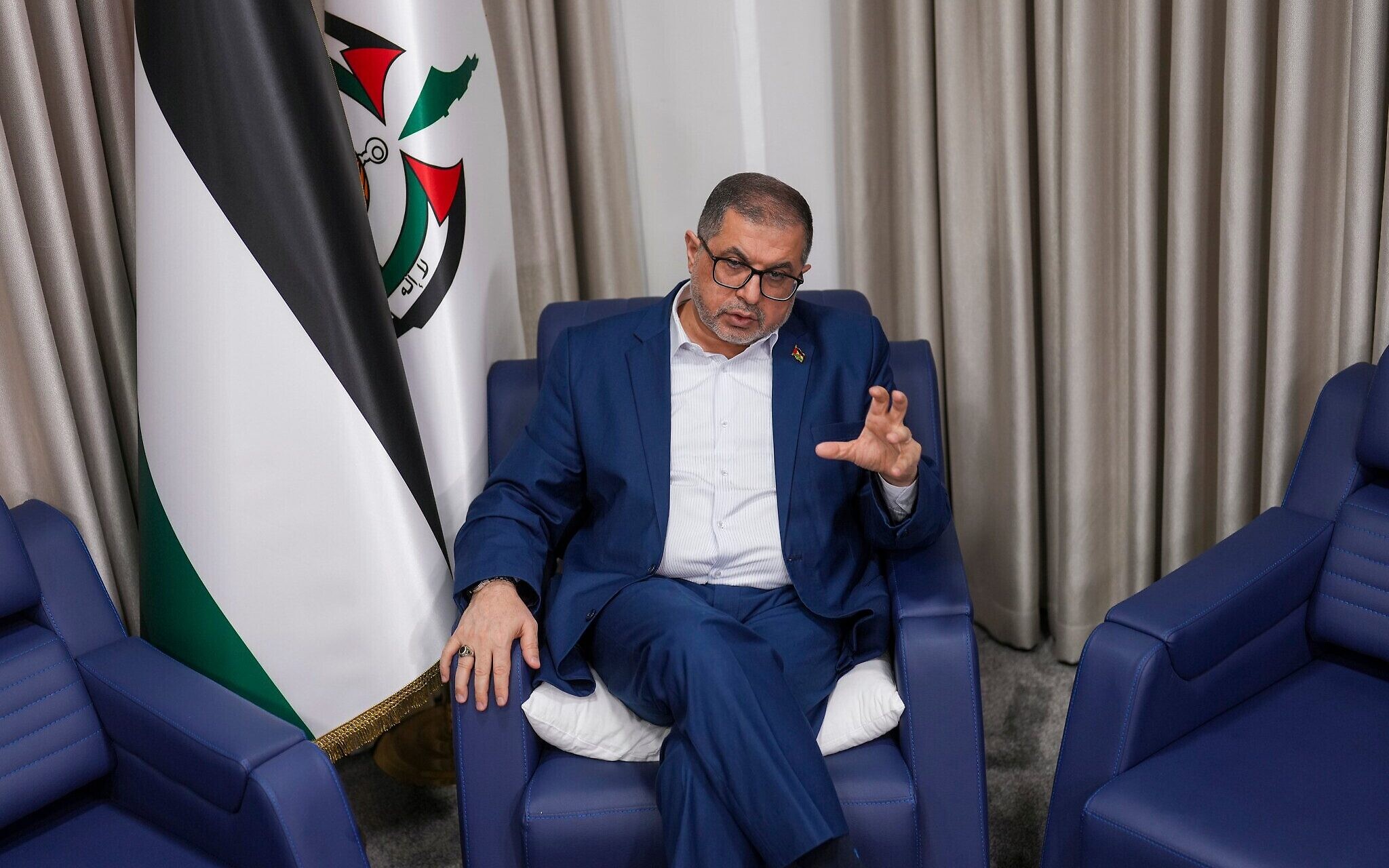
Bassem Naim, an official in Hamas's political wing, speaks in Istanbul, Turkey, December 5, 2024. (AP/Francisco Seco)
Hamas is ready to discuss “freezing or storing” its arsenal of weapons as part of its ceasefire with Israel, a senior official says, offering a possible formula to resolve one of the thorniest issues in the US-brokered agreement.
Bassem Naim, a member of Hamas’s decision-making political bureau, speaks as the sides prepare to move into the second and more complicated phase of the agreement.
“We are open to have a comprehensive approach in order to avoid further escalations or in order to avoid any further clashes or explosions,” Naim tells The Associated Press in Qatar’s capital, Doha, where much of the group’s leadership is located.
Naim says Hamas retains its “right to resist,” but said the group is ready to lay down its arms as part of a process aimed at leading to the establishment of a Palestinian state. He gave few details on how this might work but suggested a long-term truce of five or 10 years for discussions to take place.
“This time has to be used seriously and in a comprehensive way,” he says, adding that Hamas is “very open minded” about what to do with its weapons.
“We can talk about freezing or storing or laying down, with the Palestinian guarantees, not to use it at all during this ceasefire time or truce,” he says.
It is not clear whether the offer would meet Israel’s demands for full disarmament.


read more: