

Live updates (closed)
 Add ToI as a Preferred Source on Google

The Times of Israel liveblogged Friday’s events as they happened.
After government missed deadline, High Court threatens to issue injunction Sunday against new method to fire AG
After the government missed a deadline today for replying to a request for an injunction against a new method it seeks to introduce to fire Attorney General Gali Baharav-Miara, the High Court of Justice says if a reply isn’t filed by Sunday morning, it will issue such an injunction.
The request for an injunction was made by the Movement for Quality Government.
The government was previously told to respond by noon today. According to the Walla news site, not only did it not reply — it didn’t even appoint an attorney to represent it in the court case, after receiving approval to be represented by private counsel rather than by the attorney general.
“If a reply isn’t submitted by Sunday at 10 a.m., I will see this as acceptance of, or at least lack of objection to, the request,” writes Justice Noam Sohlberg. “In accordance, an injunction will be issued as requested, without taking a stance on the subject matter of the arguments made in the request.”
Netanyahu once tried to get Germany’s Merkel to fire her top adviser over pro-Palestinian demands, report reveals

German Chancellor Angela Merkel (R) chats with her foreign policy adviser Christoph Heusgen before the opening session of the North Atlantic Council during the NATO Summit on May 20, 2012, at McCormick Place in Chicago. (Mandel Ngan/AFP)
Prime Minister Benjamin Netanyahu tried to get Germany’s leader to fire a top adviser more than a decade ago, a new German report reveals.
The incident happened during negotiations for a submarine deal between the countries, a deal that has since become mired in a major corruption probe that has ensnared top Netanyahu advisers, but not the premier himself.
According to the Panorama TV magazine, during talks in 2010 and 2011 between Israel and German conglomerate Thyssenkrupp, then-German chancellor Angela Merkel’s top foreign policy adviser Christoph Heusgen demanded that any deal to supply the Jewish state with submarines be conditioned on Jerusalem halting all settlement construction in the West Bank and agreeing to the establishment of a Palestinian state — conditions that angered Netanyahu.
The report cites multiple sources, including Heusgen himself, former Israeli ambassadors to Germany Yacov Hadas-Handelsman and Yoram Ben-Zeev, and former senior Israeli Defense Ministry official Amos Gilad.
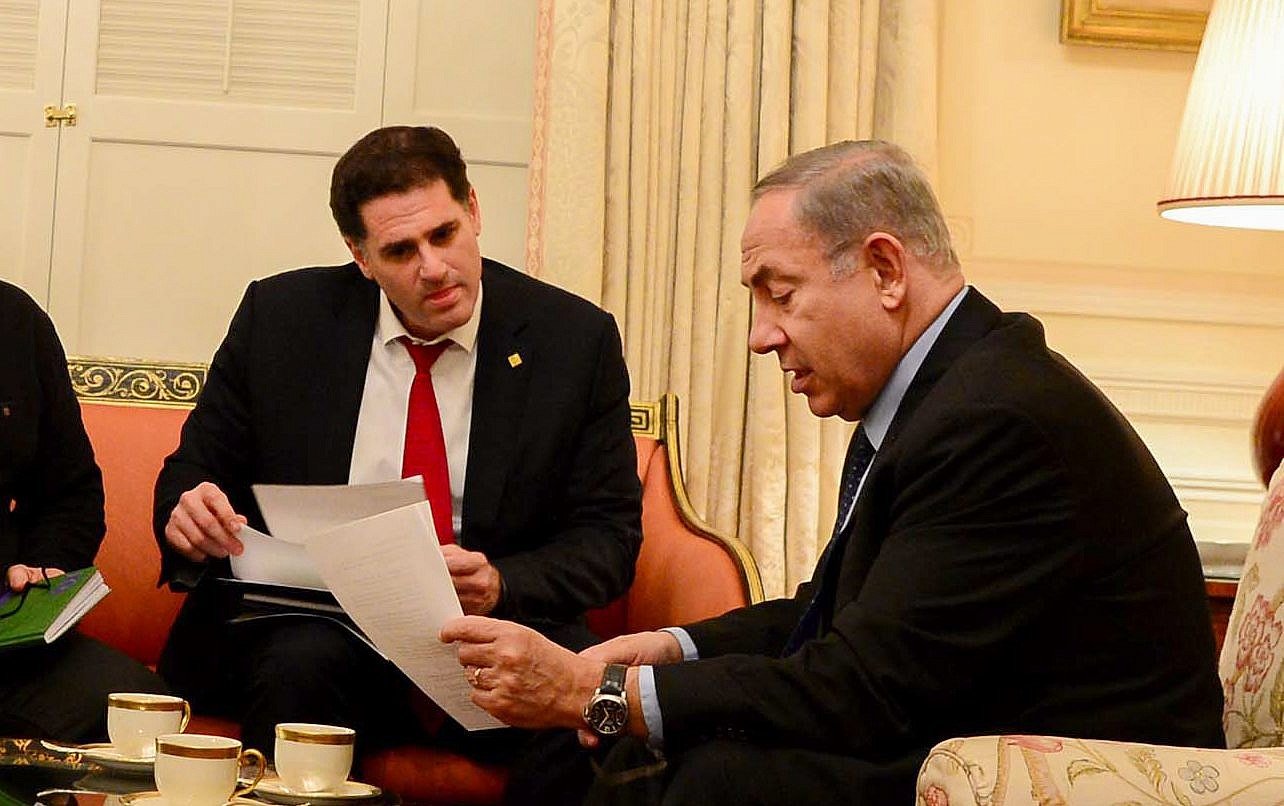
It says Netanyahu’s top confidant Ron Dermer — then a staffer in the Prime Minister’s Office and today the strategic affairs minister — approached Berlin’s then-ambassador to Israel, Harald Kindermann, and demanded that Merkel fire Heusgen. Dermer reportedly stressed at the time that he was acting on orders and not of his own initiative.
The pressure campaign reached new heights when Germany’s Bild tabloid published a story in December 2012 in which an unnamed Israeli government official was cited as blasting Merkel for leaving too much of the policy-making to Heusgen, who “only wants to talk about settlement policy.”
Panorama says it isn’t known who that official was, but the program implies it might have been Dermer, noting that in 2011, Dermer was given authority to act as a liaison to Germany’s Axel Springer Group, which publishes Bild.
Merkel didn’t heed the demand to sack Heusgen, who remained her adviser until 2017 when he became Berlin’s envoy to the UN.
But the report says Germany did end up dropping the demand for concessions to the Palestinians as conditions for the submarine deal, which was followed up by more deals for submarines and corvettes.
Slovakia festival starring Kanye West canceled amid backlash over ‘Heil Hitler’

Ye, the US rapper formerly known as Kanye West, leaves federal court during the trial of Sean "Diddy" Combs in New York, June 13, 2025. (AP/Larry Neumeister)
The Slovakia festival due to welcome Kanye West next week has called off the event following the uproar over the US rapper’s May release of a song glorifying Nazi leader Adolf Hitler.
Before the July 20 gig was canceled, Bratislava’s Rubicon hip hop festival was set to be West’s only confirmed live performance in Europe this year.
Though he has won 24 Grammy Awards over the course of his career, the erratic rapper has become notorious in recent years for his increasingly antisemitic and hate-filled rants.
West, who has legally changed his name to the shorthand “Ye,” released the song “Heil Hitler” on May 8, the 80th anniversary of the defeat of Nazi Germany in World War II.
In the wake of the announcement of West’s appearance at Rubicon, thousands of people signed a petition against the gig.
In a statement on Instagram, the festival’s organizers say the decision to cancel the event is “due to media pressure and the withdrawal of several artists and partners.”
“This was not an easy decision,” the organizers say, without drawing a direct line between the rapper’s planned appearance and the cancellations.
Contacted by AFP, the Rubicon festival doesn’t offer further explanations.
Netanyahu says hoping hostage deal can be finalized ‘in a few days’
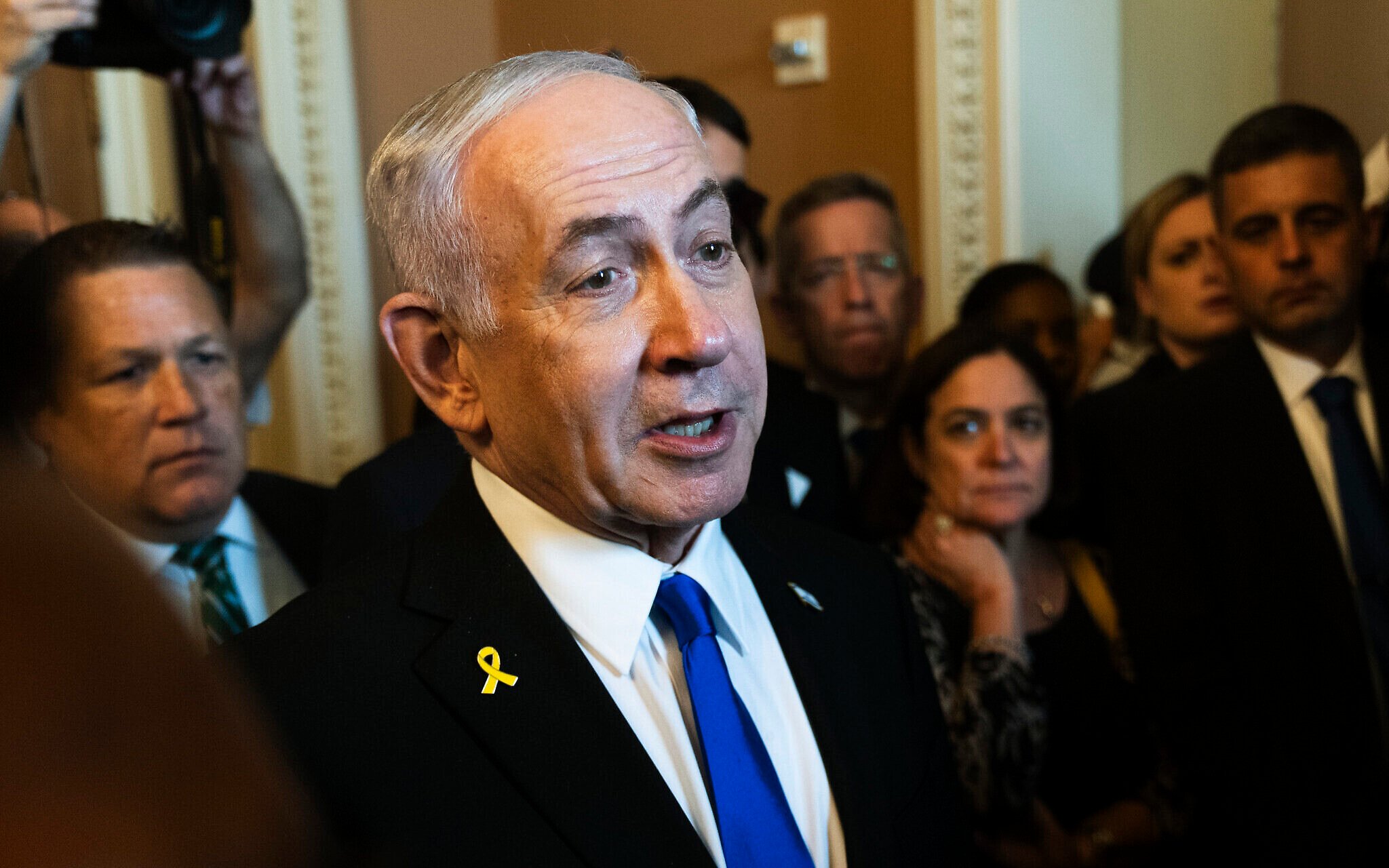
Prime Minister Benjamin Netanyahu speaks to reporters before a meeting with lawmakers at the Capitol in Washington, July 9, 2025. (AP Photo/Manuel Balce Ceneta)
Prime Minister Benjamin Netanyahu expresses optimism that a hostage release deal with Hamas can be sealed in the near future.
“I hope we can complete it in a few days,” he tells Newsmax’s Greta Van Susteren in an interview before flying back to Israel.
“We’ll probably have a 60-day ceasefire. Get the first batch out and then use the 60 days to try to negotiate an end to this,” he says on the last day of a four-day visit, during which he met US President Donald Trump twice. “And this could end tomorrow — today, if Hamas lays down its arms.”
“We think we can bring it to completion,” continues Netanyahu. “So I wouldn’t tell you that we have a war goal that is unachievable. We’re going to defeat these monsters and get our hostages back.”
Netanyahu gets the number of hostages taken on October 7 wrong, saying it was 255 instead of 251. Four hostages, two dead and two alive, were already held by Hamas at the time of the 2023 attack.
The premier says Hamas is using violence to prevent civilians from escaping combat zones in Gaza.
“It is a fighting force and a governing force in Gaza that oppresses its people, targets our people, our civilians, and uses their civilians as human shields,” says Netanyahu. “And then they complain that the civilian losses are because of us. No, we say to the civilians, ‘Leave. Leave the war zone.’ … And Hamas says, ‘You don’t go. You try to leave the war zone, we’ll shoot you.'”
“And they shoot them because they want the pictures of dead civilians that they are causing put on Israel’s head. And that’s what you get in TikTok and the social media: ‘Israel is deliberately killing civilians.’ No, we’re not. Hamas is deliberately killing its own people, preventing them from escaping the war zone. So they’re monsters.”
Netanyahu says that he sees signs that Hamas is cracking: “There are Palestinians fighting Hamas because we weaken them to this point. We see something that never happened before. Palestinians in Gaza are fighting Hamas. Palestinians in Gaza are defying Hamas. Palestinians in Gaza are saying, ‘We don’t want them We don’t want to be tyrannized and subjugated by these monsters.”
He says that working with Trump is “extraordinary.”
“Look at what our cooperation produces,” he says. “Look at what happens when there’s no daylight between an American president and an Israeli prime minister.”
Netanyahu says that he and Trump are “achieving a common doctrine. It’s called peace through strength. First comes strength, then comes the peace.”
“There are several countries waiting in the wings” to make peace, he also says.
He stresses that Iran also took hostages as one of the first acts of the Islamic Republic. “This is part of the Iranian doctrine. This is part of the Iranian evil axis.”
Traveling press pool boards Wing of Zion ahead of Netanyahu’s scheduled departure from DC
In a sign that Prime Minister Benjamin Netanyahu will indeed take off this evening, the traveling press pool boards the Wing of Zion plane at Joint Base Andrews.
Netanyahu is officially slated to depart for Israel at 8:30 p.m. after four days in Washington.
Netanyahu returns to Israel after 4-day visit in Washington
After visiting Thomas Jefferson’s historic home at Monticello, Prime Minister Benjamin Netanyahu arrives at Andrews Joint Base on Marine One, US President Donald Trump’s helicopter.
He and his wife Sara board Wing of Zion for the return flight to Israel after four days in Washington, with the plane taking off minutes later.
Iraqi Kurdish forces say they downed explosive drone in Kirkuk province
An explosive drone was shot down near Kurdish Peshmerga forces in Iraq’s oil-rich province of Kirkuk early on Friday, the Iraqi Kurdistan’s counter-terrorism service says in a statement.
After meeting in DC, hostage’s brother-in-law says not convinced the captives are PM’s main priority
After taking part in Prime Minister Benjamin Netanyahu’s meeting with hostage families in Washington on Wednesday, the brother-in-law of captive Omri Miran says he’s “not convinced” that the Israeli premier has placed the hostages at the top of his priorities.
Moshe Lavi publishes the critique in response to an X post from Netanyahu, which summed up the meeting the prime minister held with the hostage families.
“Their pain is the pain of an entire nation,” Netanyahu wrote, adding that he made sure that the issue remained on the agenda throughout his meetings with Trump in Washington.
“We are working with all our might to return all the hostages — both living and dead. We will not rest until we bring everyone home,” the premier wrote.
In his response to Netanyahu, Lavi shares what he told the prime minister during their Wednesday meeting: “the fate of the hostages and our social contract are at stake if you choose a partial [hostage deal] again, and not the formula that the Trump administration claims is possible — the return of all 50, even at the cost of ending the war.”
Trump officials have not publicly come out against the partial ceasefire framework that Netanyahu prefers in order to hold onto the option of resuming the war. However, hostage families have told The Times of Israel that US officials have told them that they believe Israel is in a position to end the war and deal with what is left of Hamas’s military capabilities at a later period.
Hamas officials have said they would release all remaining Israeli hostages in one batch if Israel agrees to a permanent ceasefire.
Netanyahu has rejected the exchange, insisting that he will only end the war if a varying list of conditions are met, namely Hamas surrendering and giving up its arms. He also faces pressure from far-right coalition partners who have threatened to collapse his government if he agrees to end the war.
UNICEF says 1-year-old killed in IDF strike on Gaza medical clinic spoke first words hours before
Among the children killed in a Thursday Israeli strike on a medical clinic in central Gaza’s Deir al-Balah was a 1-year-old boy who spoke his first words hours earlier, says the United Nations Children’s Fund (UNICEF).
The boy was with his mother, who UNICEF says was critically injured in the strike and “now lies in a hospital bed clutching [her son’s] tiny shoe.”
UNICEF says it is “appalled” by the “unconscionable” Israeli strike that reportedly killed 15 Palestinians, including nine children and four women.
The IDF said it targeted a Hamas operative who took part in the October 7 onslaught. Footage of the strike verified by Reuters showed the bodies of women and children lying in pools of blood amid dust and screaming. One clip showed several motionless children lying on a donkey cart.
The medical aid that the victims were seeking to pick up was provided by Project Hope, a UNICEF partner organization.
“These were mothers seeking a lifeline for their children after months of hunger and desperation.”
“The lack of aid means children are facing starvation while the risk of famine grows. The number of malnourished children will continue to rise until life-saving aid and services are resumed at full scale,” the UN agency adds.
“We call on Israel to urgently review its rules of engagement to ensure full compliance with international humanitarian law, notably the protection of civilians, including children, and to conduct a thorough and independent investigation of this incident and all allegations of violations,” UNICEF says, reiterating its call for a ceasefire and release of all hostages.
IDF officer killed in apparent accidental explosion in southern Gaza

Cpt. Reei Biran (Israel Defense Forces)
An IDF officer was killed in an apparent accident in the southern Gaza Strip yesterday, the military announces.
The slain soldier is named as Cpt. Reei Biran, 21, a team commander in the Golani Brigade’s reconnaissance unit, from Shorashim.
According to an IDF probe, the incident took place during an ongoing offensive in Khan Younis.
Troops were operating in buildings suspected to be used by Hamas for terror activity, rigging them up with mines in order to demolish them.
Around two hours after the buildings were mined, an explosion occurred, and Biran was hit, possibly by shrapnel or debris. He was declared dead a short while later.
The IDF says the incident is under further investigation.
Report: Syria changes civil registry terminology for descendants of Palestinian refugees in the country
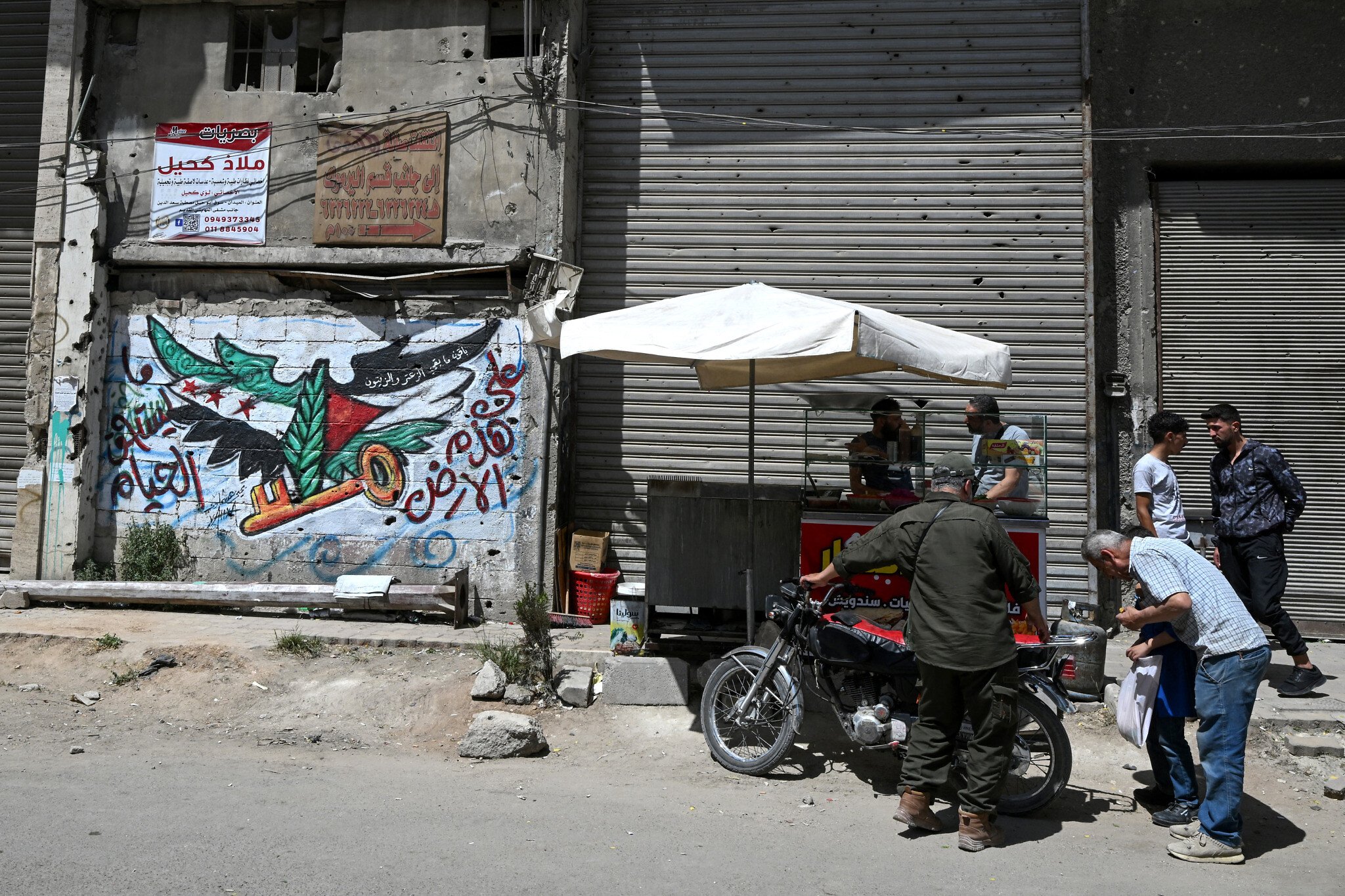
Men check a motorbike next to a mural painting bearing an image of the Syrian and Palestinian flags with a key symbolising a lost Palestinian home in what is now Israel, in the Yarmuk camp for Palestinian refugees in southern Damascus on May 22, 2025. (Louai Beshara/AFP)
The Syrian newspaper Zaman al-Wasl reports that Syria’s civil registry has begun altering the official documentation of Palestinians residing in the country—apparently referring to the descendants of Palestinian refugees who fled or were expelled from Israel in 1948.
According to the report, the term “Syrian Palestinian,” which had been used for decades, has been replaced with “Palestinian resident.”
Additionally, instead of indicating which Syrian province the person resides in, as was previously the case, the designation now reads “foreigner.”
The rationale behind the change remains unclear.
IDF chief visits scene of deadly terror attack at Gush Etzion Junction
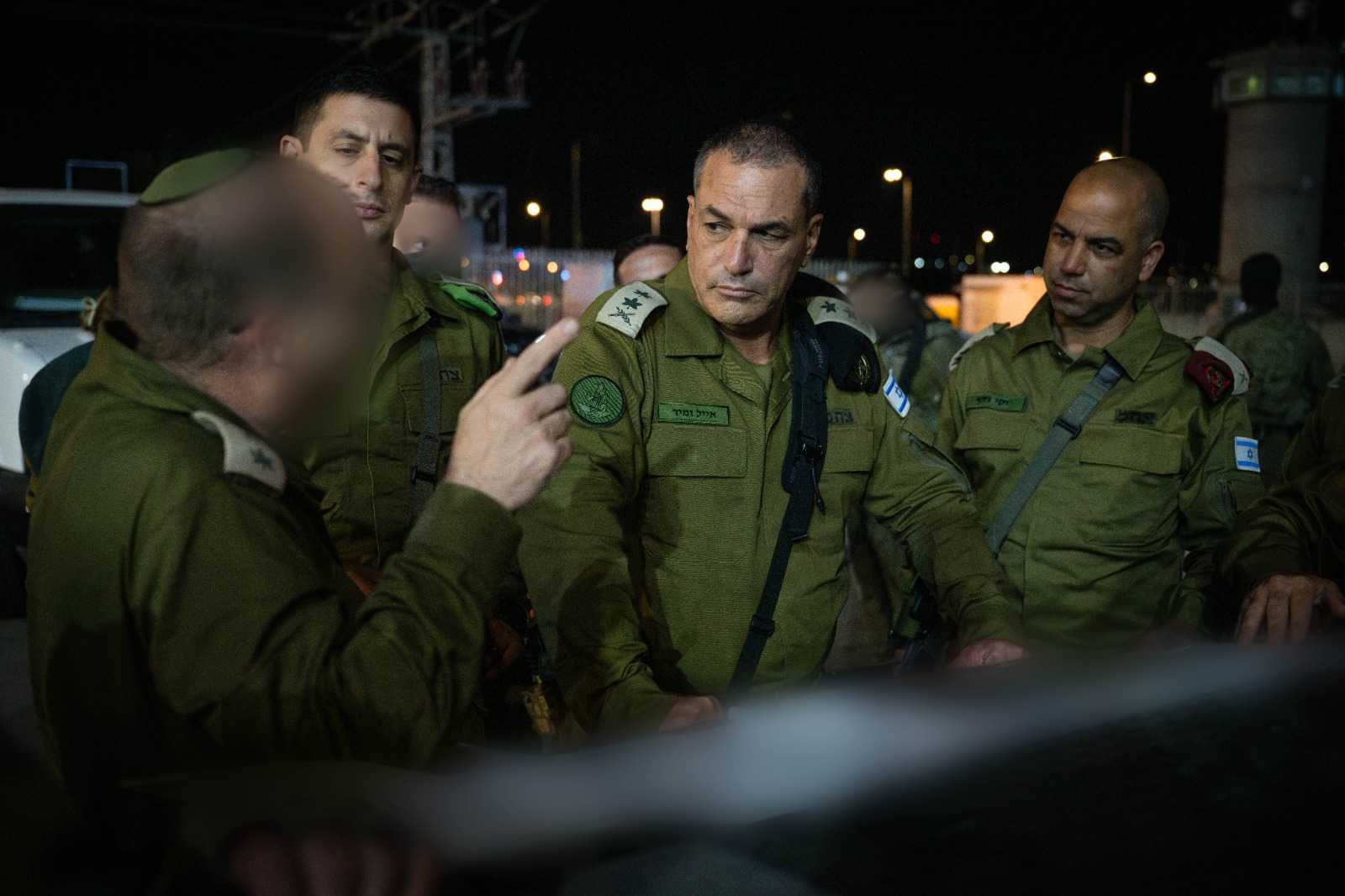
IDF Chief of Staff Lt. Gen. Eyal Zamir (center) at the scene of a terror attack at Gush Etzion Junction in the West Bank, July 10, 2025. (Israel Defense Forces)
IDF Chief of Staff Lt. Gen. Eyal Zamir visited the scene of the deadly terror attack at Gush Etzion junction in the West Bank last night with senior officers, the military says.
In the attack yesterday, civilian Shalev Zvuluny was killed by two Palestinian terrorists, who were then shot dead.
The military says Zamir held an assessment at the scene with Central Command chief Maj. Gen. Avi Bluth and West Bank division commander Brig. Gen. Yaki Dolf.
“The chief of staff noted that this was a grave terror incident and sent condolences to the family of the murdered man,” the IDF says in a statement.
The statement says Zamir instructed forces to “continue intense counterterrorism activity” in the West Bank, and emphasized that thanks to the rapid response, vigilance, and alertness of the IDF troops and civil security personnel, a larger and more severe attack was prevented.”
Two teens arrested on suspicion of damaging graves near Old City of Jerusalem

A damaged grave is seen in a cemetery near the Old City of Jerusalem, after two teens were arrested on suspicion of vandalizing and damaging the graveyard, on July 11, 2025. (Israel Police)
Two teens were arrested overnight in Jerusalem on the suspicion that they had vandalized and damaged tombstones in a cemetery near the Old City of Jerusalem, the Israel Police says in a statement.
The pair, both 14, were arrested after police officers from the nearby David Precinct control tower caught two suspects in the act of vandalizing graves. They deployed forces to the scene, where there were clear signs of the graves and their surroundings having been damaged.
The two are suspected of vandalizing tombstones and causing damage to the surrounding area, police say.
They will be brought to court for a hearing later today.
Police postpone questioning of journalist Aviad Glickman, suspected of ‘shoving’ employee of PM’s wife, after AG intervenes — report

Channel 13 reporter Aviad Glickman arrives at the Supreme Court in Jerusalem for a hearing, July 25, 2024. (Chaim Goldberg/Flash90)
Attorney General Gali Baharav-Miara has stepped in amid a police investigation into Israeli journalist Aviad Glickman, the Kan public broadcaster reports, and instructed them not to proceed with questioning him under caution until she has a chance to meet with police officials on the matter.
Glickman, Channel 13’s legal correspondent, received a police summons earlier this week on suspicion of having shoved an employee of Prime Minister Benjamin Netanyahu’s wife, Sara, during a court case in late May.
Police had planned to question Glickman yesterday, but postponed the session after Baharav-Miara requested a joint meeting on the matter, the report says.
Channel 13 had sent a letter to the attorney general after Glickman received the summons, urging her to intervene in the investigation, which the news outlet claimed was “an infringement of freedom of the press.”
Glickman, who is known as a critic of the prime minister, was covering a hearing in a libel countersuit filed by Sara Netanyahu against Sylvie Genesia, a former worker at the Prime Minister’s Residence, when the incident under investigation occurred.
Footage showed him jostling Gal Dabush, an employee of the prime minister’s wife, while trying to push through a crowded doorway at the Tel Aviv Magistrate’s Court, apparently in order to film Netanyahu as she left the court. Immediately afterward, Likud spokesperson Guy Levy shouted at Glickman that he would file a police complaint for assault. Glickman was then sent away from the court by officials as Levy filmed him and hurled insults at him.
In further footage circulated on social media shortly after the incident, Dabush told the camera that Glickman “pushed my back,” adding, “It now hurts me.”
She claimed the incident left her bruised and in pain.
IDF publishes footage of drone strike, demolition of Hamas tunnel in Khan Younis, southern Gaza
The military releases footage showing a recent drone strike on what it says is a cell of terror operatives in southern Gaza’s Khan Younis.
The IDF says the armed cell was spotted approaching forces of the 188th Armored Brigade during operations in the area in recent days.
In the same area, the military says the brigade, along with the Yahalom combat engineering unit, located and demolished a kilometer-long Hamas tunnel.
Father of hostage Eitan Mor warns against partial deal, says those left behind will be in ‘the greatest danger’

Tzvika Mor in an undated photo with his son Eitan, who is being held captive by Hamas in Gaza. (Courtesy)
Zvika Mor, the father of hostage Eitan Mor and co-founder of the right-wing hostage advocacy group Tikva Forum, tells the Kan public broadcaster that if Israel moves forward with another partial hostage release deal, the few that are left behind will be “in the greatest danger.”
The framework for the hostage release and ceasefire deal currently being negotiated stipulates that Hamas will release 10 living hostages and return the bodies of 18 slain hostages during a 60-day truce. Unless something changes, this will leave 22 hostages behind in Gaza, 10 of whom are believed to be alive.
“Everyone understands that the hostages who remain until the end are in the greatest danger,” Mor says in an interview on Kan radio. “What will happen to the final group?”
He says that the price Israel will be required to pay for the final 22 hostages “will be the highest price” of all the deals made thus far.
As has been the case with other hostage families, Mor says Prime Minister Benjamin Netanyahu told him that Hamas will be the ones who determine which hostages will be released, and that Israel will have no control over the list.
Netanyahu told hostage families as much during a meeting with them in Washington yesterday, a source present in the conversation had told the Times of Israel.
“The prime minister told me in a one-on-one conversation that Israel has no influence over the list,” says Mor. “He may have told me that so that we stop getting on his nerves, but there is also a logic to Hamas releasing whomever it wants, to leave us disoriented and in a fog.”
Hamas airs video of killing, attempted abduction of soldier that appears to contradict IDF version of events
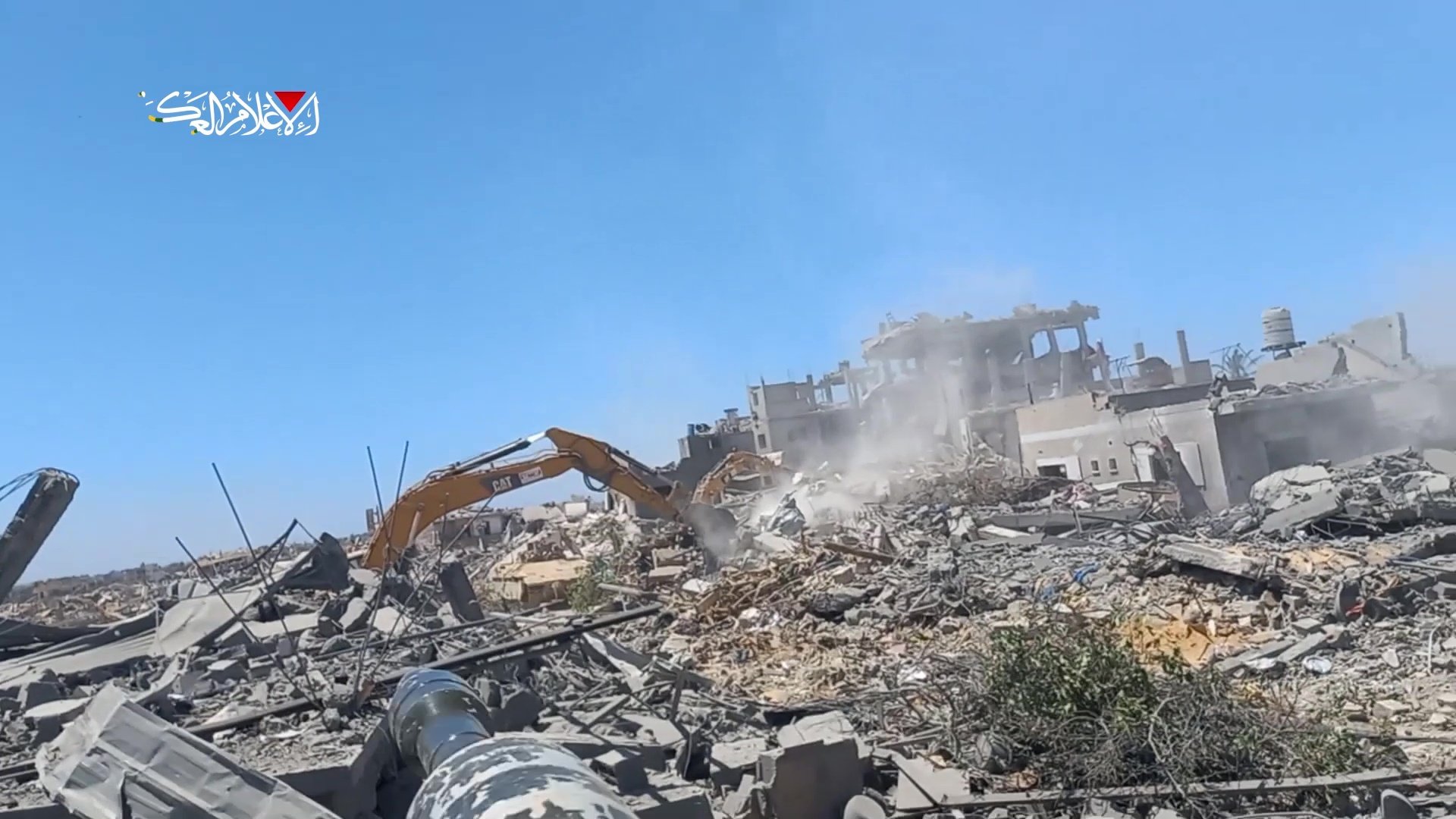
This screenshot from a Hamas video published July 10, 2025, shows terror operatives attacking Israeli troops carrying out demolition work in southern Gaza's Khan Younis, on July 9, 2025. (Hamas, via Telegram)
A video released by Hamas of the killing and attempted abduction of a soldier in southern Gaza’s Khan Younis on Wednesday appears to contradict the army’s version of events.
The IDF said earlier this week that several Hamas operatives had emerged from a tunnel and attacked Israeli troops. During the attack, the gunmen attempted to abduct Master Sgt. (res.) Abraham Azulay, who had been operating an excavator.
Azulay “struggled with them and the terrorists shot and killed him,” said the military, adding that other Israeli forces guarding the area opened fire on the operatives, thwarting an attempt to abduct his body.
The video published by Hamas shows a squad of terror operatives hiding in a damaged building and observing Israeli forces carrying out demolition work.
The squad then sneaks up to the troops, as one launches an RPG at the excavator Azulay was operating. The soldier is seen jumping out of the unarmored construction vehicle while coming under fire from the operatives from over a dozen meters away. The video then shows two operatives reaching the excavator where Azulay’s body lies on the ground.
The operatives are then seen taking Azulay’s weapons, shooting him again, while gunfire is heard in the background, possibly from the Israeli forces returning fire.
Hamas said that its gunmen had attempted to capture the soldier, but that the “field conditions did not allow for it, so they killed him and seized his weapon.”
The Hamas video is edited, and it is unclear if any of the operatives were hit by the Israeli gunfire.
The IDF says it is investigating the incident further, including the deployment of troops who were supposed to be guarding the demolition work.
IDF says Islamic Jihad commander who invaded Israel on Oct. 7 killed in recent strike
The commander of the Palestinian Islamic Jihad’s Shejaiya sector, who had invaded Israel during the October 7 onslaught, was killed in a recent strike in the Gaza Strip, the military and Shin Bet announce.
Fadl Abu al-Ata, according to the IDF and Shin Bet, previously served as the deputy commander of the Shejaiya sector, and during the war was promoted to head the Islamic Jihad regional unit.
“Abu al-Ata was one of the key coordinators between terror organizations in the Shejaiya sector, and he directed numerous terror attacks against IDF troops,” the military says, adding that he infiltrated Israel on October 7, 2023.
A separate strike killed Hamed Kamel Abd al-Aziz Iyad, who the IDF says was responsible for engineering and explosives in Islamic Jihad’s Turukman Battalion.
The military says he was “responsible for planning and executing terror and explosive attacks against IDF troops.”
UN says at least 798 people killed while seeking food aid in Gaza since May
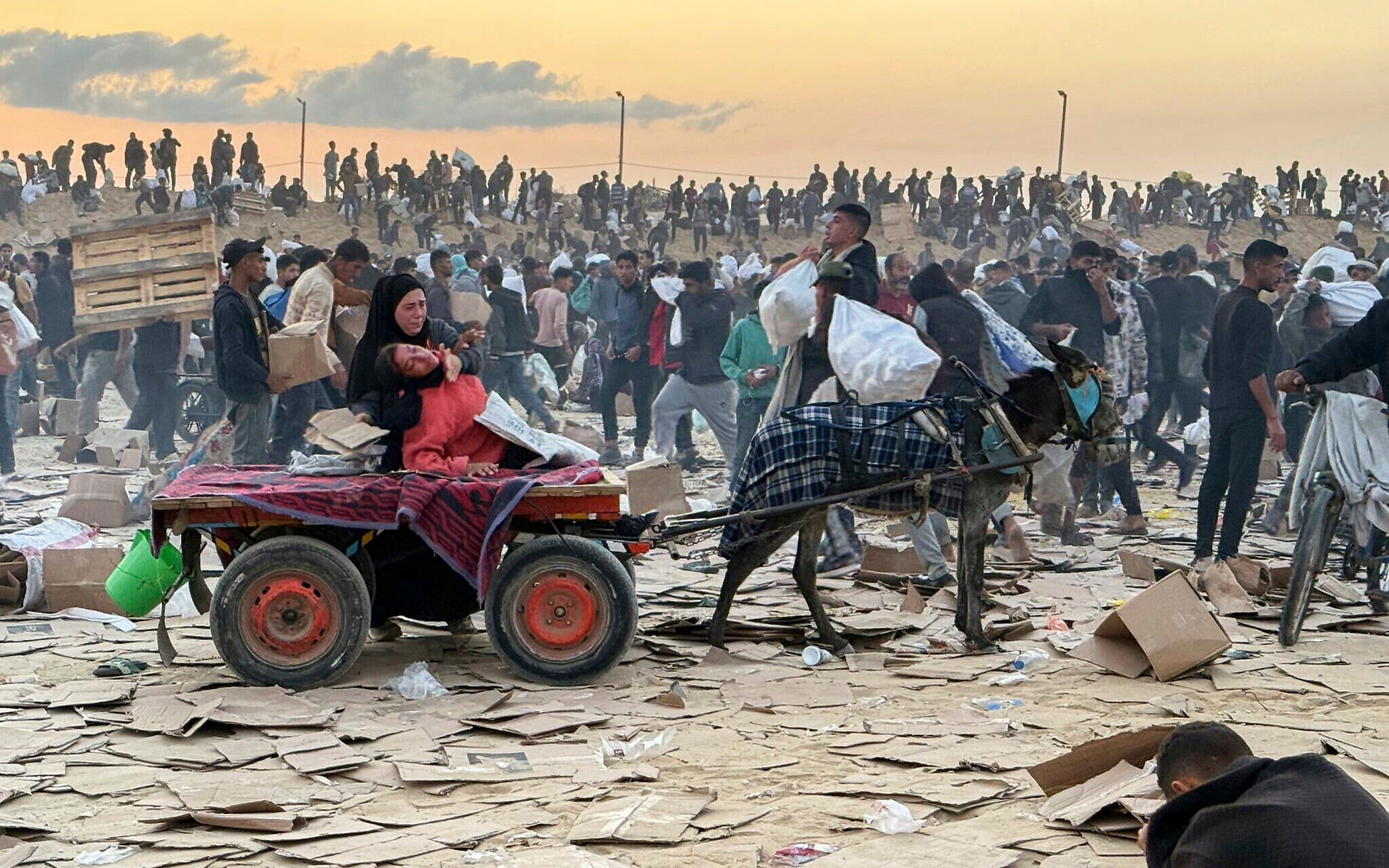
This photo, provided by an American contractor on condition of anonymity because they were revealing their employers’ internal operations, shows a woman slumped over in a donkey cart after the contractor said she was hit in the head with part of a stun grenade at a food distribution site in Gaza run by the Gaza Humanitarian Foundation in June 2025. (AP Photo)
At least 798 people have been killed while trying to receive food aid in Gaza since the end of May, the United Nations Human Rights Office says.
Of the total number of people killed while receiving food assistance since May 27, 615 were in the vicinity of sites operated by the controversial US- and Israel-backed Gaza Humanitarian Foundation, a spokesperson for the Office of the High Commissioner of Human Rights (OHCHR) tells reporters.
The other 183 were killed on the routes of aid convoys, the spokesperson says.
The controversial GHF has faced harsh criticism from the UN and other aid organizations, which charge that it fails to meet the needs of Gaza’s population.
Gazans have reported near-daily incidents in which groups trying to reach GHF facilities are shot at by Israeli forces, leading to mass casualties.
Israel has accused Hamas of attacking Gazan aid seekers and falsifying death tolls, but has also acknowledged that “several” Palestinian civilians have been killed by the IDF near GHF aid distribution sites. The IDF says troops have been issued new instructions following what it called “lessons learned.”
Iranian Nobel laureate Narges Mohammadi says Tehran issuing death threats

Narges Mohammadi, the Iranian women's rights campaigner imprisoned by Iran who won the Nobel Peace Prize, on October 6, 2023. (AFP/ Narges Mohammadi Foundation/ File)
Iranian activist Narges Mohammadi, who won the 2023 Nobel Peace Prize for her fight for women’s and human rights in Iran, has received death threats from Tehran, the Nobel Committee says.
Committee chairman Jorgen Watne Frydnes received an “urgent phone call” from Mohammadi, the Norwegian Nobel Committee says, and “the clear message, in her own words, is that ‘I have been directly and indirectly threatened with ‘physical elimination’ by agents of the regime'” if she doesn’t stop advocating for democracy and human rights.
IDF says troops measured homes of terrorists behind Gush Etzion Junction attack, ahead of possible demolitions

IDF troops measure the home of a Palestinian terrorist in the West Bank, July 11, 2025. (Israel Defense Forces)
Overnight, the military says troops measured out the homes of the two Palestinian terrorists who carried out yesterday’s deadly attack at the Gush Etzion Junction, ahead of their possible demolition.
The forces operated in Halhul, near Hebron, and Bazariya, near Nablus, where the two assailants, Mahmoud Abed and Malik Salem, hailed from.
Both terrorists were shot dead after killing Shalev Zvuluny, 22.
As a matter of policy, Israel demolishes the homes of Palestinians accused of carrying out deadly terror attacks.
“The mapping was carried out in preparation for examining the possibility of demolishing the terrorists’ homes,” the IDF says.
Toddler found unconscious in Hadera car last week dies in hospital
A two-year-old girl who was found unconscious in a car in Hadera last week and had remained in critical condition since has died.
The toddler was being treated at Rambam Medical Center in Haifa, where she was later pronounced dead.
Toddlers dying after being forgotten in vehicles is a repeated occurrence in Israel, where temperatures in locked cars can soar to 70°C (160°F) — a level that can prove dangerous to children even over brief periods.
Two IDF soldiers wounded by anti-tank fire in northern Gaza’s Jabalia overnight
Two IDF soldiers were wounded, moderately and lightly, by anti-tank fire on a tank during operations in northern Gaza’s Jabalia last night.
The military says the pair were taken to a hospital and their families were notified.
EU ‘deeply regrets’ US decision to sanction anti-Israel UN rapporteur Albanese
The EU says it “deeply regrets” the US decision to impose sanctions on United Nations rapporteur on Palestinian rights Francesca Albanese after she criticized Washington’s policy on Gaza.
“The European Union strongly supports the United Nations human rights system and we deeply regret the decision to impose sanctions on Francesca Albanese,” says EU spokesman Anouar El Anouni.
US Secretary of State Marco Rubio said Washington was sanctioning Albanese, an outspoken critic of Israel who has been accused of antisemitic and pro-terror rhetoric, in light of “her illegitimate and shameful efforts to prompt International Criminal Court action against US and Israeli officials, companies and executives.”
Netanyahu lands back in Israel after four-day visit to Washington
Prime Minister Benjamin Netanyahu has touched down at Israel’s Ben Gurion Airport following a four-day visit to Washington.
Lebanon’s president says no interest in pursuing normalization with Israel at present
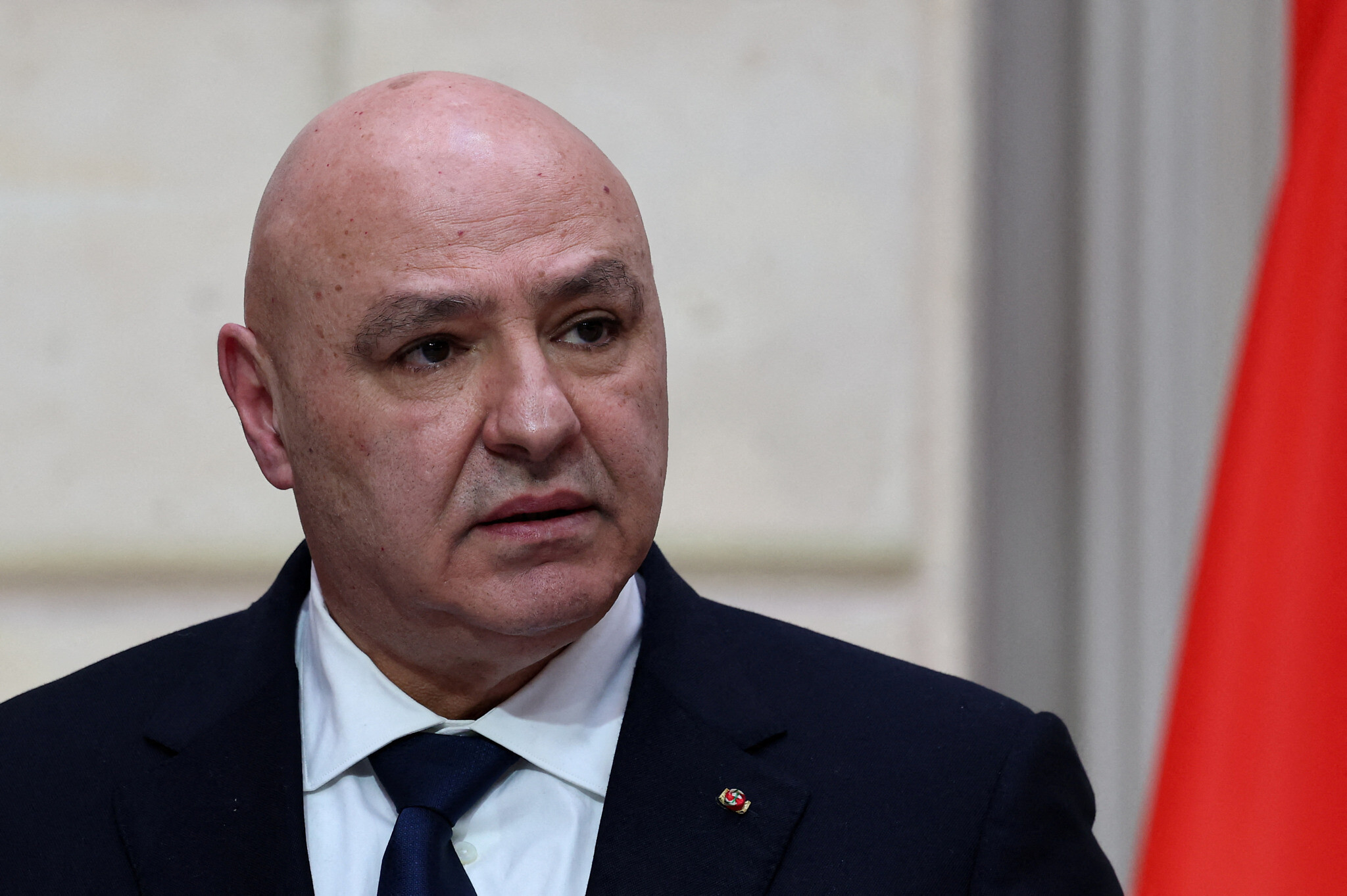
Lebanon's President Joseph Aoun attends a press conference after a multilateral meeting 'Mediterranee orientale MEDOR' at the Elysee Presidential Palace in Paris on March 28, 2025. (Sarah Meyssonnier / POOL / AFP)
Lebanese President Joseph Aoun told a recent meeting of foreign diplomats that Beirut has no interest in pursuing normalization with Israel at present, LBCI Lebanon reports.
According to the report, Aoun shot down the possibility of a peace agreement with Israel, saying: “Peace, for us, is the absence of war, and that is our current priority.”
He also told the diplomats that normalization with Israel “is not on the table in Lebanon’s current foreign policy.”
Senior Haredi lawmaker Gafni was told about plans for Iran attack days in advance — report

MK Moshe Gafni chairs a meeting of the Knesset Finance Committee, July 2, 2024. (Yonatan Sindel/Flash90)
Prime Minister Benjamin Netanyahu informed senior Haredi lawmaker Moshe Gafni about Israel’s plans to attack Iran three days ahead of time, in a bid to have him drop his threat of dissolving the Knesset over the failure to pass a law exempting yeshiva students from conscription, The New York Times reports.
The report is part of a lengthy item by the Times examining Prime Minister Benjamin Netanyahu’s grip on power in the wake of the October 7, 2023, Hamas assault and the subsequent war in Gaza.
On June 9, according to the report, Gafni — who leads the Degel Hatorah faction of the ultra-Orthodox United Torah Judaism party — was summoned by Netanyahu for a meeting at the IDF headquarters in Tel Aviv.
The summons from the premier came two days before a vote on an opposition-backed bill to disperse the Knesset and call early elections, which ultra-Orthodox parties had initially said they would support due to a lack of progress on the Haredi conscription legislation.
At the start of the meeting, Gafni was told by Netanyahu to sign a confidentiality agreement and, upon doing so, was given the details of Israel’s planned attack on Iran’s nuclear and military targets, which would be launched four days later, on June 13.
According to the Times, Gafni left the meeting suspecting that Netanyahu may have been attempting to manipulate him into dropping the threat to dissolve the government, but also worried that if the bill passed, it could interfere with Israel’s planned operation in Iran.
Ultimately, the Degel Hatorah faction withdrew its support for the bill to dissolve the Knesset, and it failed to garner enough votes to pass.
Gafni is not the only Haredi lawmaker said to have been told about the Iran strike in advance, as days into the 12-day war last month, Shas leader Aryeh Deri appeared to confirm that he too had known about it.
Writing in HaDerech, Shas’s official newspaper, Deri said that the decision to launch the Iran operation “was the most difficult decision that any cabinet in the State of Israel has ever made.”
Long months of discussions, hundreds of hours of security reviews, analyses and risk assessments – everything boiled down to one charged, fateful moment: whether to approve the military attack plan against Iran,” he had written.
IDF bolstering posture in West Bank with two more battalions after Gush Etzion attack
The IDF says it is bolstering its posture in the West Bank with two additional battalions, following a fresh assessment.
The move comes following yesterday’s deadly terror attack at Gush Etzion Junction.
EU pressing Israel to improve Gaza humanitarian situation, top diplomat says

European Union High Representative for Foreign Affairs and Security Policy, Kaja Kallas, speaks during a debate at the European Parliament in Strasbourg, eastern France, on June 18, 2025. (FREDERICK FLORIN / AFP)
The European Union is seeking ways to put pressure on Israel to improve the humanitarian situation in Gaza, its top diplomat says, as member states weighed action against Israel over what they see as potential human rights violations.
The EU’s diplomatic service on Thursday presented 10 options for political action against Israel after saying it found “indications” last month that Israel breached human rights obligations under a pact governing its ties with the bloc.
In a document prepared for EU member countries and seen by Reuters, the options included major steps such as suspending the EU-Israel Association Agreement – which includes trade relations – and lesser steps such as suspending technical projects.
EU foreign policy chief Kaja Kallas says the options were prepared in response to member states that wanted stronger pressure on Israel to rectify the suffering of civilians in Gaza’s now 21-month-old war.
“Our aim is not to punish Israel in any way,” she says after meeting with Asian foreign ministers in Kuala Lumpur, amid growing global jitters arising from US President Donald Trump’s tariff offensive.
“Our aim is to really improve the situation on the ground (in Gaza), because the humanitarian situation is untenable.”
EU members have voiced concern over the large number of civilian casualties and mass displacement of Gaza’s inhabitants during Israel’s war against Hamas in the enclave, and alarm about restrictions on access for humanitarian aid.
Kallas said on Thursday Israel had agreed to expand humanitarian access to Gaza, including increasing the number of aid trucks, crossing points and routes to distribution hubs.
Struck down by malnutrition, pregnant Gazan woman can only pray for a healthy baby

Fatima Arfa, a pregnant and displaced Palestinian woman, undergoes a medical check-up at Al-Helou hospital, in Gaza City, in the northern Gaza Strip, July 10, 2025. (Ebrahim Hajjaj/Reuters)
At six months pregnant, displaced Palestinian woman Fatima Arfa wishes she could be buying cute clothes and toys for the special day when she delivers a healthy, safe child.
Instead she spends much of her time seeking medical help in war-ravaged Gaza, weak and fearful that malnutrition will sabotage her pregnancy as Israel presses on with a military campaign that has led to widespread hunger among children and adults and reduced the enclave to rubble.
She longs for simple foods like milk, eggs and red meat that could improve her health and increase the chances of delivering a healthy baby. But just trying to deal with deficiencies is exhausting and highly risky under steady bombardment.
“I’m coming from a faraway place, and on foot too, because I need to have a blood transfusion because of a very big deficiency, malnutrition,” says Arfa, 34, staring at medical imaging of her unborn baby.
In June, the United Nations Office for the Coordination of Humanitarian Affairs (OCHA) warned an estimated 55,000 pregnant women in Gaza face growing health risks such as miscarriage, stillbirth and undernourished newborns.
Tackling those grim realities is challenging for doctors who face severe shortages of medicine and fuel to keep overwhelmed hospitals running as the nearly two-year war between Israel and Hamas rages.
Arfa is getting weaker by the day and generating enough energy on a meagre diet is a huge challenge.
“It is very difficult, and in the middle of the heat. I leave small children at my house, and until now they may not have had breakfast, and neither have I,” she said, sitting in a makeshift tent near her children, wondering how she will be able to support them, and husband Zahi.
Zahi, 40, laments that much of Gaza’s population relies on mostly lentils.
Sometimes he wanders around flattened neighborhoods desperate for flour, anything that could give his wife the strength to produce life in a strip where Israeli strikes have killed tens of thousands.
“More than once, I was exposed to death. I failed every time I tried to even get a can of tuna or a can of peas for the children. I couldn’t,” said Zahi.
PM reportedly shelved Gaza truce plan he planned to present in April 2024 after Smotrich threatened to collapse gov’t
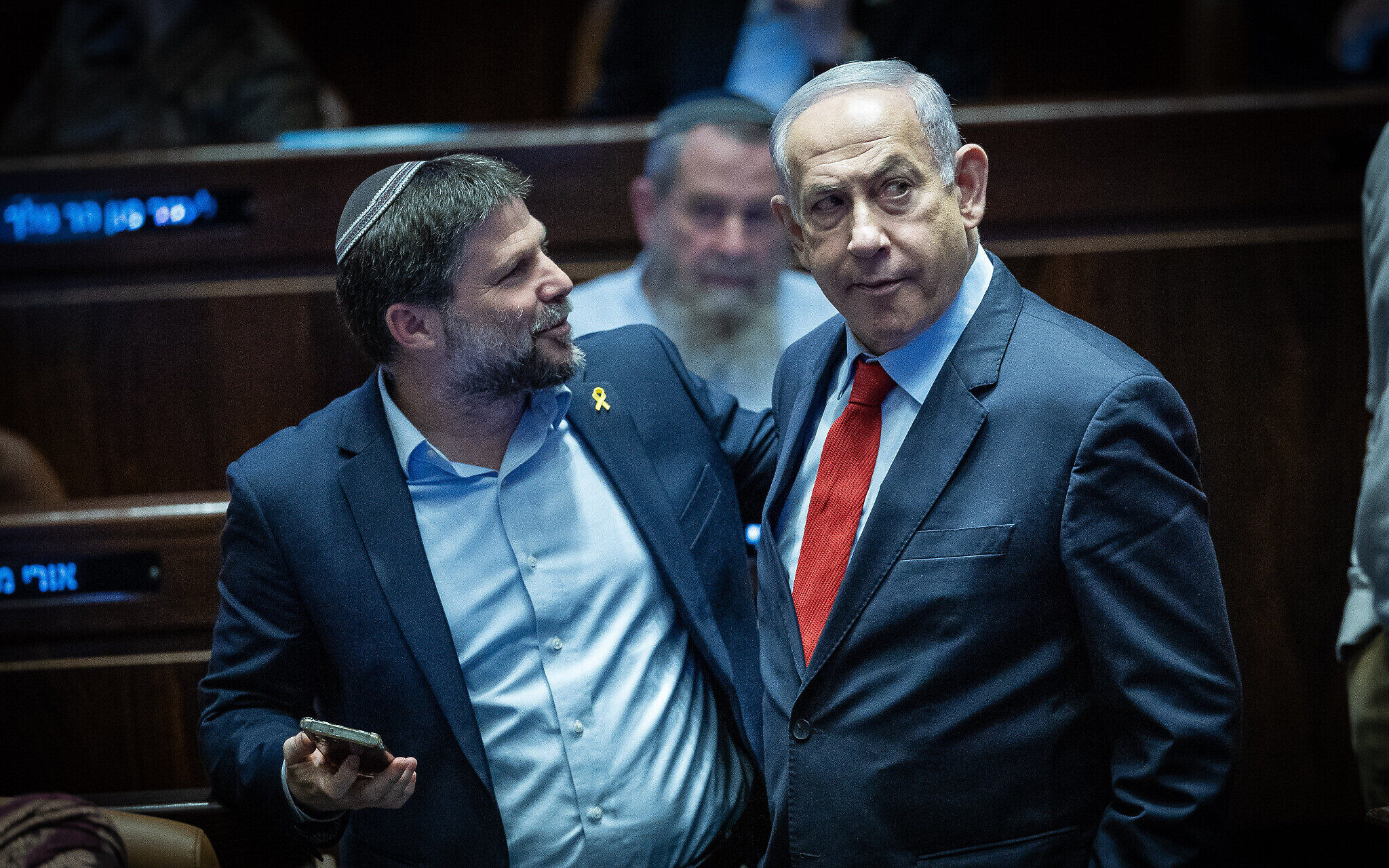
Prime Minister Benjamin Netanyahu, right, and Finance Minister Bezalel Smotrich at the Knesset in Jerusalem, March 13, 2024. (Yonatan Sindel/Flash90)
Prime Minister Benjamin Netanyahu in April 2024 reportedly shelved a truce plan his aides had crafted that would have secured the release of at least 30 hostages due to a threat from far-right Finance Minister Bezalel Smotrich to collapse his government.
Similar to the framework currently under discussion, the truce Netanyahu planned to push would have created a window to permanently end the war and release the remaining hostages, The New York Times reports in an exposé revealing how the Israeli premier extended the Gaza war for political gain.
Moving forward with the deal would have raised the chances for a normalization deal with Saudi Arabia, whose leadership had been secretly signaling its willingness to accelerate peace talks with Israel as long as the Gaza war ended, the NYT says.
But ending the war then would have risked toppling Netanyahu’s government, made up of far-right factions determined to establish settlements in Gaza and clear the Strip of as many of its Palestinian residents as possible.
Netanyahu kept the truce plan from his government until the last minute, hoping to push it through the cabinet before his far-right coalition partners had time to organize against it.
As the cabinet convened for a meeting in April 2024, one of Netanyahu’s aides brought him a text summarizing the truce proposal for the premier to present.
But before he could, Smotrich entered the room, declaring that he had gotten wind of the plan, branding it a “surrender agreement” and warning Netanyahu that he wouldn’t have a government if it went through, The Times reports, citing minutes from the cabinet meeting.
Spooked by Smotrich’s response, Netanyahu assured the finance minister that no such plan was on the table.
The premier then quietly whispered to his security advisers, “Don’t present the plan,” and the meeting proceeded to discuss other matters.
That same month, the NYT reports that officials in then-US president Joe Biden’s administration highlighted to Netanyahu during one conversation polls showing that over 50 percent of Israelis support a hostage deal over continuing the war.
“Not 50 percent of my voters,” the paper quotes Netanyahu as having replied.
IDF issues evacuation warning to Palestinians in Gaza City ahead of strikes on Hamas targets
The IDF issues an evacuation warning to Palestinians residing in an area of Gaza City, ahead of strikes on Hamas targets.
“In light of the Hamas terror organization using civilian areas for terror activities, the IDF will attack the area with great force. For your safety, evacuate the area immediately,” says the IDF’s Arabic-language spokesperson Col. Avichay Adraee in a post on X.
Palestinian civilians are instructed to head south and “avoid returning to dangerous areas.”
#عاجل ‼️الى سكان منطقة مدينة غزة في بلوكات 783, 784
⭕️في ضوء استخدام منظمة حماس الارهابية للمناطق المدنية لأعمال ارهابية، سوف يهاجم جيش الدفاع المنطقة بقوة شديدة جداً
????من أجل امنكم، أخلوا المنطقة بشكل فوري????
⭕️تقع المسوؤلية الكاملة عن معاناة السكان على عاتق المنظمات الإرهابية… pic.twitter.com/auHsvWsqnn— افيخاي ادرعي (@AvichayAdraee) July 11, 2025
IDF says it killed 6 top members of Hamas naval commando forces in recent Gaza strikes
Six top members of Hamas’s naval commando forces were killed in a series of recent operations in the Gaza Strip, the military and Shin Bet announce.
The Hamas naval commanders were targeted during the ongoing offensive in Gaza, which began in mid-May. The military says the operations were led by the Israeli Navy, the Intelligence Directorate, the Southern Command and the Shin Bet.
The IDF says the Hamas operatives had advanced sea-borne attacks against troops and Israeli civilians, and some had participated in the planning of the October 7 onslaught.
They are named by the IDF and Shin Bet as: Ramzi Salah, the naval forces commander in northern Gaza; Jamal al-Baba, the naval forces commander in central Gaza; Ratab Abu Sahiban, the naval forces commander in Gaza City; Omar Abu Jalala, the naval forces commander in Khan Younis; Mohammed Qashta, the naval forces commander in Rafah; and Ahmad Ali, the successor to Abu Sahiban as commander of the naval forces in Gaza City.
The IDF already announced Salah’s death earlier this month, in a strike on a cafe that reportedly killed 24 people.
Footage released by the IDF on July 11, 2025, shows strikes on Hamas naval commanders in the Gaza Strip. (Israel Defense Forces)
Army says it has learned lessons after repeatedly opening fire on Gazans en route to aid centers
Israel’s military says it learned lessons following a probe into reports of “harm to civilians,” after the UN said nearly 800 people had died trying to access handouts in Gaza since late May.
“Following incidents in which harm to civilians who arrived at distribution facilities was reported, thorough examinations were conducted… and instructions were issued to forces in the field following lessons learned,” an Israel army statement says, adding the incidents were under review.
UN rights office spokeswoman Ravina Shamdasani said 798 killings had been recorded from May 27 to July 7, including 615 near sites run by a US- and Israel-backed Gaza Humanitarian Foundation.
NYT report details how Biden admin sought to leverage potential Saudi deal to end Gaza war

File: Saudi Arabia's Deputy Defense Minister Khalid bin Salman (L) and US National Security Adviser Jake Sullivan meet at the White House on May 18, 2022. (Khalid bin Salman/Twitter)
The New York Times details how the Biden administration sought to advance a normalization agreement between Israel and Saudi Arabia in the spring and summer of 2024, hoping that such a prized agreement would convince Prime Minister Benjamin Netanyahu to end the war in Gaza.
While Netanyahu initially appeared on board with the idea and revived a truce proposal in May that he had shelved a month earlier due to pushback from his far-right coalition partners, by the end of July, he added new demands for a Gaza truce that torpedoed the negotiations, the NYT reports.
The renewed US effort to broker an Israel-Saudi deal began on May 18, 2024, when then-US national security adviser Jake Sullivan traveled to Dammam in eastern Saudi Arabia to meet Saudi Crown Prince Mohammed bin Salman.
Even though hostility toward Israel was peaking in the Arab world due to the brutal war in Gaza, bin Salman arrived at his meeting with Sullivan determined to advance a series of agreements with the US that would include an Israel normalization deal.
“Let’s finish this,” the NYT quotes him as having told Sullivan at the time.
The US and Saudi teams made significant progress on the bilateral security, economic and energy-related agreements with the US, with many of the outstanding issues resolved.
The main obstacle left was buy-in from Netanyahu, who Saudi Arabia wanted to end the war in Gaza and agree to establish a pathway to a future Palestinian state.
On May 19, Sullivan flew from Saudi Arabia to Israel in order to convey the message to Netanyahu. The premier initially responded positively to the US initiative, and on May 22, approved the truce plan that he had decided not to even present a month earlier due to a threat from Smotrich to collapse the government.
On May 27, the Israeli proposal was sent to Egyptian and Qatari mediators, who were enthusiastic about the chances for a deal.
Four days later, then-US president Joe Biden gave a speech publicizing the key details of the proposal and urging Hamas to accept it.
But the deal didn’t guarantee that the temporary truce offered by Israel would turn permanent and Hamas dragged its feet for over a month.
Still enticed by the prospect of a Saudi normalization deal, Netanyahu authorized Strategic Affairs Minister Ron Dermer to hold secret talks with UAE Foreign Minister Abdullah bin Zayed about the post-war management of Gaza — something he had been refusing to do for over six months due to concerns that it risked collapsing his government.
In early July, Hamas agreed to soften its position, forgoing its demand for an up-front Israeli commitment for a permanent ceasefire, thereby opening a window for an agreement.
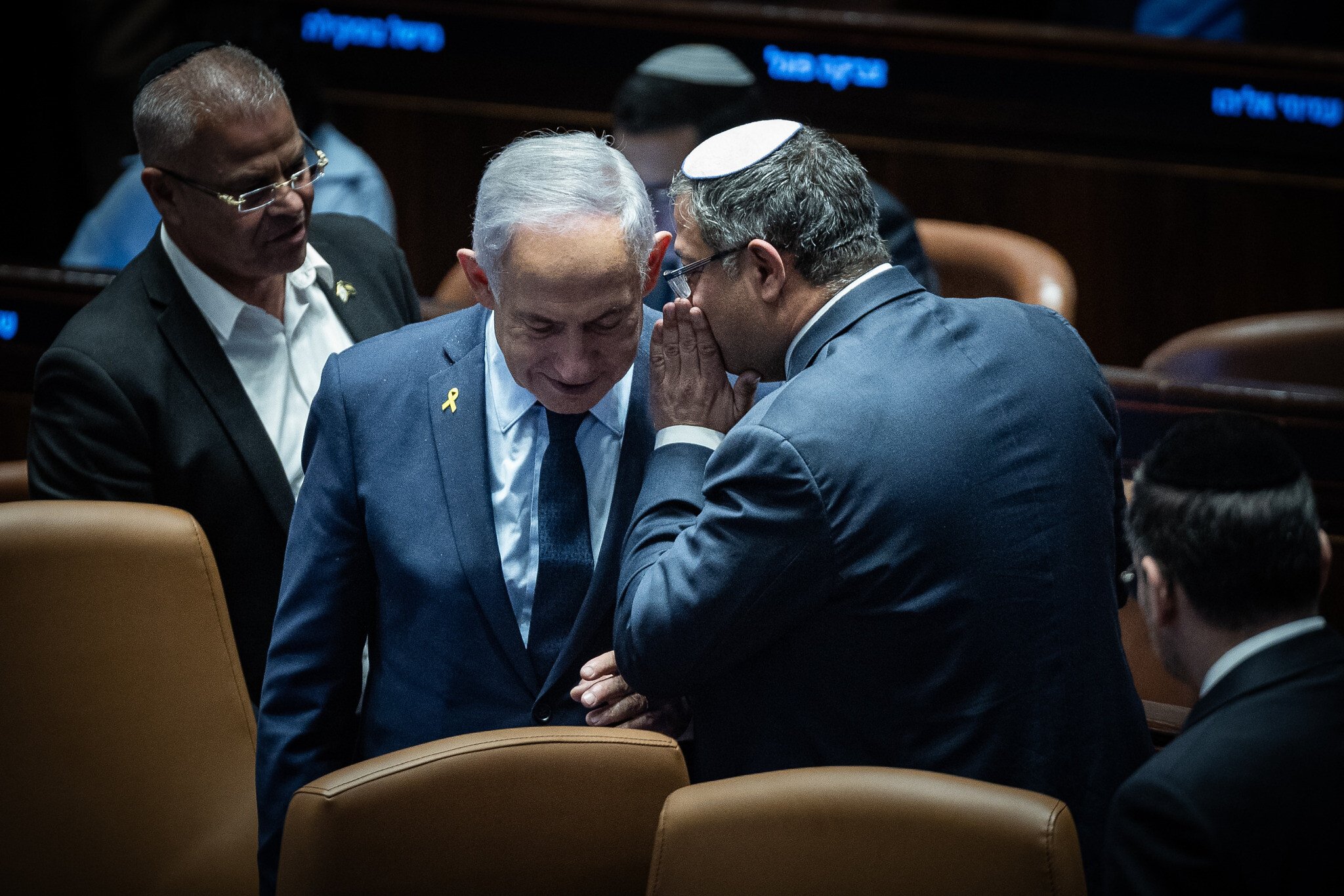
“We may have a deal,” Netanyahu told Dermer at the time, according to the NYT.
But far-right National Security Minister Itamar Ben Gvir got wind of the development and rushed to try and thwart it. He tried to burst into Netanyahu’s Jerusalem office in order to speak his mind, but the premier wouldn’t allow him in. Ben Gvir was resigned to issuing a tweet condemning the “reckless deal,” adding that he was “working to ensure the prime minister has the strength not to fold.”
On July 28, a summit was held at the residence of Qatar’s ambassador to Italy in order to finalize the agreement, with Mossad chief David Barnea, CIA chief Bill Burns, Qatari Prime Minister Mohammed bin Abdulrahman al-Thani and Egyptian intel chief Abbas Kamel in attendance.
While the other participants arrived thinking that a deal was on the verge of being reached, a “sheepish and apologetic” Barnea instead handed the mediators a copy of a letter detailing six new demands from Netanyahu that derailed the process, NYT reports.
The demands included one for Israel to remain in the Philadelphi Corridor border stretch between Gaza and Egypt. While Israel’s security establishment had maintained that continued IDF presence there was not essential and could be quickly restored if need be, Netanyahu decided to turn the issue into a key sticking point in the talks.
US anger at Netanyahu peaked during an August 1 phone call that Biden held with the Israeli premier.
“Stop bullshitting me,” NYT quotes Biden as having told Netanyahu.
Tank commander seriously wounded during north Gaza fighting
A tank commander in the 7th Armored Brigade’s 82nd Battalion was seriously wounded during fighting in the northern Gaza Strip earlier today, the military says.
He was taken to a hospital for treatment and his family was notified, the IDF adds.
Unlike Gafni, Goldknopf says Netanyahu didn’t tip him off about Iran strike

Housing and Construction Minister Yitzhak Goldknopf arrives at a United Torah Judaism party meeting at the Knesset, in Jerusalem, on May 19, 2025. (Oren Ben Hakoon/Flash90)
A spokesman for United Torah Judaism chairman Yitzhak Goldknopf says that he did not receive advance notice of Israel’s June 13 attack on Iran, which came a day after his party backed down from threats to bring down the government over the conscription of yeshiva students.
According to the New York Times, Prime Minister Benjamin Netanyahu informed Degel HaTorah chief MK Moshe Gafni of Israel’s pending attack on Iran four days in advance despite him not having a security clearance.
Degel HaTorah is one of the two factions comprising UTJ. Goldknopf heads the party’s Hasidic Agudat Yisrael faction.
Asked by The Times of Israel if the UTJ chief had been informed as well, a spokesman for the lawmaker states that Goldknopf “was not informed.”
In addition to Gafni, both Knesset foreign affairs and defense committee chairman Yuli Edelstein and Shas party leader Aryeh Deri had been informed of the attack in advance — a fact which likely contributed to their willingness to compromise on the enlistment issue to head off early elections.
Unaware that the Iran strike was imminent, Goldknopf decided to resign from his ministerial post in protest of the coalition refusing to pass legislation aimed at granting ultra-Orthodox yeshiva mass exemptions from military service.
Reports: 10 Palestinians injured in latest settler attack in the West Bank
Ten Palestinians were injured in an attack by settlers on the village of Khirbet al-Tal near Ramallah earlier today, Palestinian media reports.
Settlers had established a new illegal outpost adjacent to Khirbet al-Tal, one of dozens that have mushroomed across the West Bank with little to no enforcement by Israeli authorities.
Footage posted on social media shows several masked settlers arriving in a vehicle armed with sticks.
Another clip shows masked settlers hurling stones at Palestinians.
According to Palestinian media, settlers smashed the windows of a Palestinian ambulance that had arrived at the scene to evacuate wounded Palestinians.
https://twitter.com/NewpressPs/status/1943666751633272839
https://twitter.com/aljarmaqnet/status/1943654065688530950
As mistrust in security establishment peaked, PM had IDF chief patted down for wire before meeting
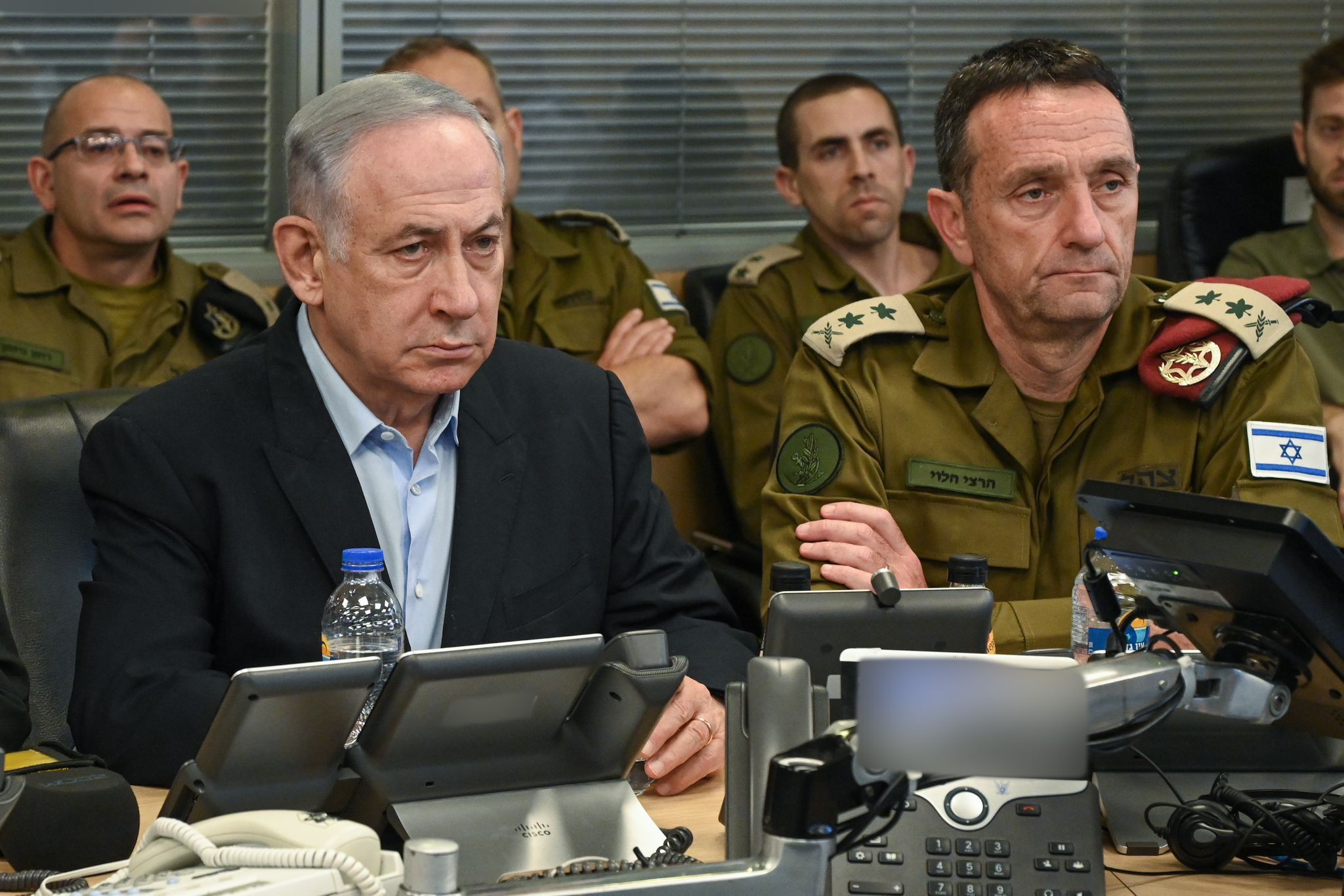
Prime Minister Benjamin Netanyahu (left) and IDF Chief of Staff Herzi Halevi (right) follow Israel's strike in Yemen from the IAF operations room at the Kirya Headquarters in Tel Aviv, July 20, 2024. (Ariel Hermoni/Defense Ministry)
The New York Times reveals that in order to prevent the leaking of conversations that could harm him politically, Prime Minister Benjamin Netanyahu’s aides ordered military officials to stop using a recording device traditionally operated during meetings held by generals.
Weeks after the October 7 onslaught, Netanyahu’s meetings with generals were also moved to another room with no permanent recording device, allowing the premier’s aides to be the ones to record, even while the military officials could not.
Generals, including then-IDF chief of staff Herzi Halevi, were patted down by Netanyahu’s security guards to make sure he didn’t have a hidden microphone on him.
Netanyahu’s suspicions were an extension of his belief that the security establishment was to blame for Hamas’s October 7 onslaught, and not the political echelon.
Also in the NYT story about how Netanyahu prolonged the Gaza war in order to remain in power, the paper reveals that Finance Minister Bezalel Smotrich during a March cabinet meeting to fire then-Shin Bet chief Ronen Bar called for the security agency to be stripped of its mandated requirement to protect Israel’s democratic institutions.
“It is time to remove the protection of democracy from the Shin Bet law. The people protect the democracy,” he said, according to minutes from the meeting obtained by the NYT.
A spokesperson for Smotrich claimed that the minister was misquoted and was only arguing that the Shin Bet shouldn’t meddle in court cases.
The paper also reveals how Justice Minister Yariv Levin — one of the chief architects of the government judicial overhaul that Hamas felt had exposed Israel to attack due to the bitter internal divisions that the initiative had sparked — was found on a staircase crying as the October 7 onslaught unfolded.
A Levin spokesperson denied that the minister had cried that day, but two witnesses testified to the contrary, including Moti Babchick, a senior ministerial aide.
Postponed French-Saudi confab at UN on two-state solution said rescheduled for July 28-29
A United Nations conference hosted by France and Saudi Arabia to work towards a two-state solution between Israel and the Palestinians has been rescheduled for July 28-29, diplomats say, after it was postponed last month when Israel launched a military attack on Iran.
10 more Gaza aid seekers reportedly killed by Israeli fire
Gaza’s Hamas-linked civil defense agency says 10 Palestinians were killed by Israeli fire while waiting near a distribution point around the southern city of Rafah.
Israel’s military does not immediately respond to a request for comment on Friday’s deaths, but it has previously accused terror operatives of firing at civilians in the vicinity of aid centers. It has also acknowledged firing warning shots at Gazans who used unauthorized routes to reach aid centers, while opening investigations into alleged war crimes after the shootings reportedly led to the deaths of hundreds of Palestinians.
In Gaza’s south, a witness says Israeli tanks were seen near Khan Yunis, reporting “intense gunfire, intermittent air strikes, artillery shelling, and ongoing bulldozing and destruction of displacement camps and agricultural land.”
Israel’s military confirms troops are operating in the area against “terrorist infrastructure sites, both above and below ground.”
IDF says troops foiled weapons smuggling attempt from Jordan using drone
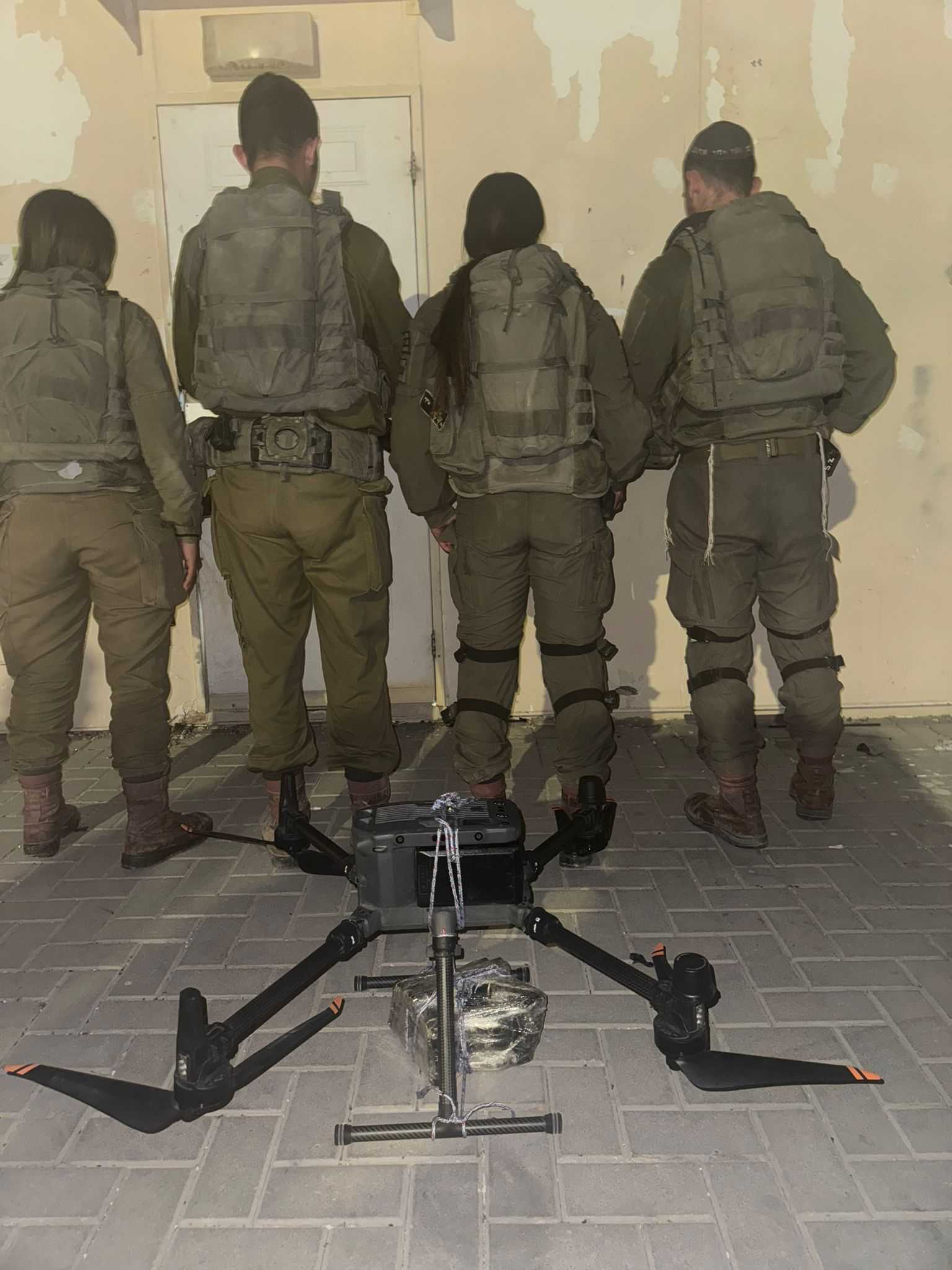
IDF troops pose with a drone that was used in an attempted weapons smuggling on the Jordan border, late July 10, 2025. (Israel Defense Forces)
IDF troops foiled an attempt to smuggle weapons from Jordan into Israel using a drone last night, the military says.
According to the IDF, troops of the Bardelas Brigade operating in an area south of the Dead Sea spotted a drone flying over the border. Later, the drone was located, and it was found to be ferrying seven handguns, the army adds.
Two shot dead in northern town of Shfaram, brining year’s Arab homicide toll to 134
Two men were shot dead in the northern city of Shfaram earlier today.
The victims are named as 45-year-old Noor Hariri, from Umm al-Fahm, and 33-year-old Rami Othman, from Kabul.
The pair was reportedly shot inside a car. Paramedics arrived at the scene to find them both unconscious, without a pulse, and pronounced them dead on the spot.
Police opened an investigation and are searching for suspects, law enforcement says.
The Abraham Initiatives organization, which tracks murders in Arab society, notes eight people have been killed in Shfaram since the start of the year.
The group accuses the government and police of ignoring violent crime in Arab society.
“If the government were to invest resources, deal with and cooperate with the [local] authorities, crime in Arab society would be significantly reduced. The government chooses to ignore, incite and cause harm. We must not allow this situation to continue,” the group says in a statement.
Since the start of the year, 134 Arab Israelis have been killed in violent criminal incidents.
The past two years have seen a spiking murder rate in Arab society. Though already high in previous years, the number of Arab murder victims doubled in 2023, remained at similar levels in 2024, and has continued apace this year.
Many local leaders blame law enforcement for failing to deal with the problem, citing the infrequency with which police arrest suspects in connection with murder cases.
Breaking with government, 74% of Israelis back war-ending deal to free all hostages — poll
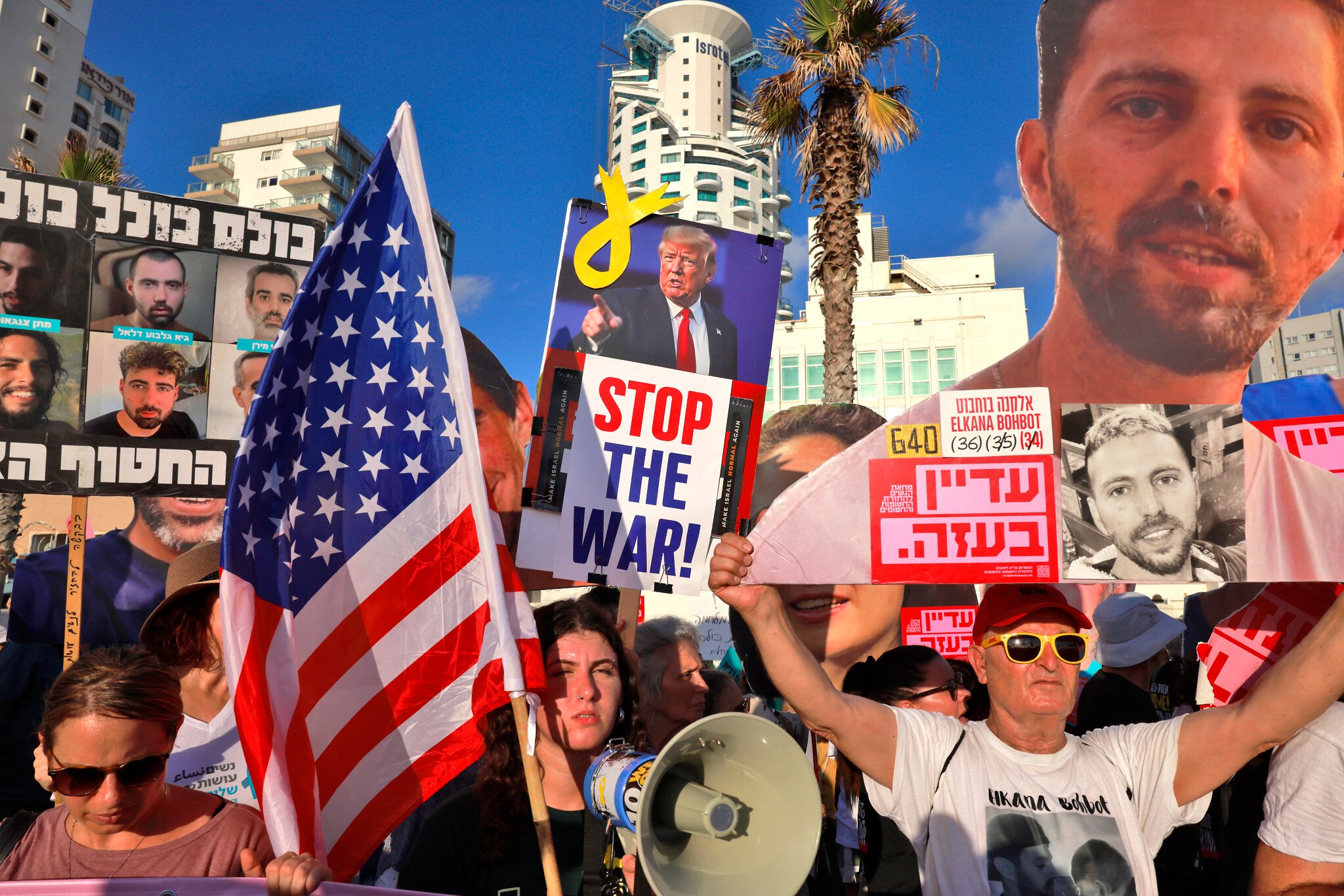
Activists hold portraits of Israeli hostages held in the Gaza Strip by Hamas during a protest calling for their release and an end to the war, outside the branch office of the US embassy in Tel Aviv on July 7, 2025. (Menahem Kahana / AFP)
Seventy-four percent of Israelis back an agreement with Hamas that would release the remaining hostages in exchange for ending the war in Gaza, according to a new poll aired on Channel 12.
Prime Minister Benjamin Netanyahu and much of his governing coalition oppose this exchange, arguing that it would leave Hamas in power.
But as the war drags on for its 21st month, a growing number of Israelis appear unconvinced that the government is capable of defeating Hamas. Moreover, critics argue that Israel long ago sufficiently depleted Hamas’s military capabilities and that trying to fight until the last gunman will leave the IDF bogged down in Gaza indefinitely.
Just eight percent of respondents back the phased hostage release framework that is being advanced by the government, according to the poll.
Even among coalition voters, 60% back a war-ending deal that secures the release of all of the hostages at once, the survey found.
Israel said hampering delivery of baby formula into Gaza, as child malnutrition climbs; COGAT refutes allegation
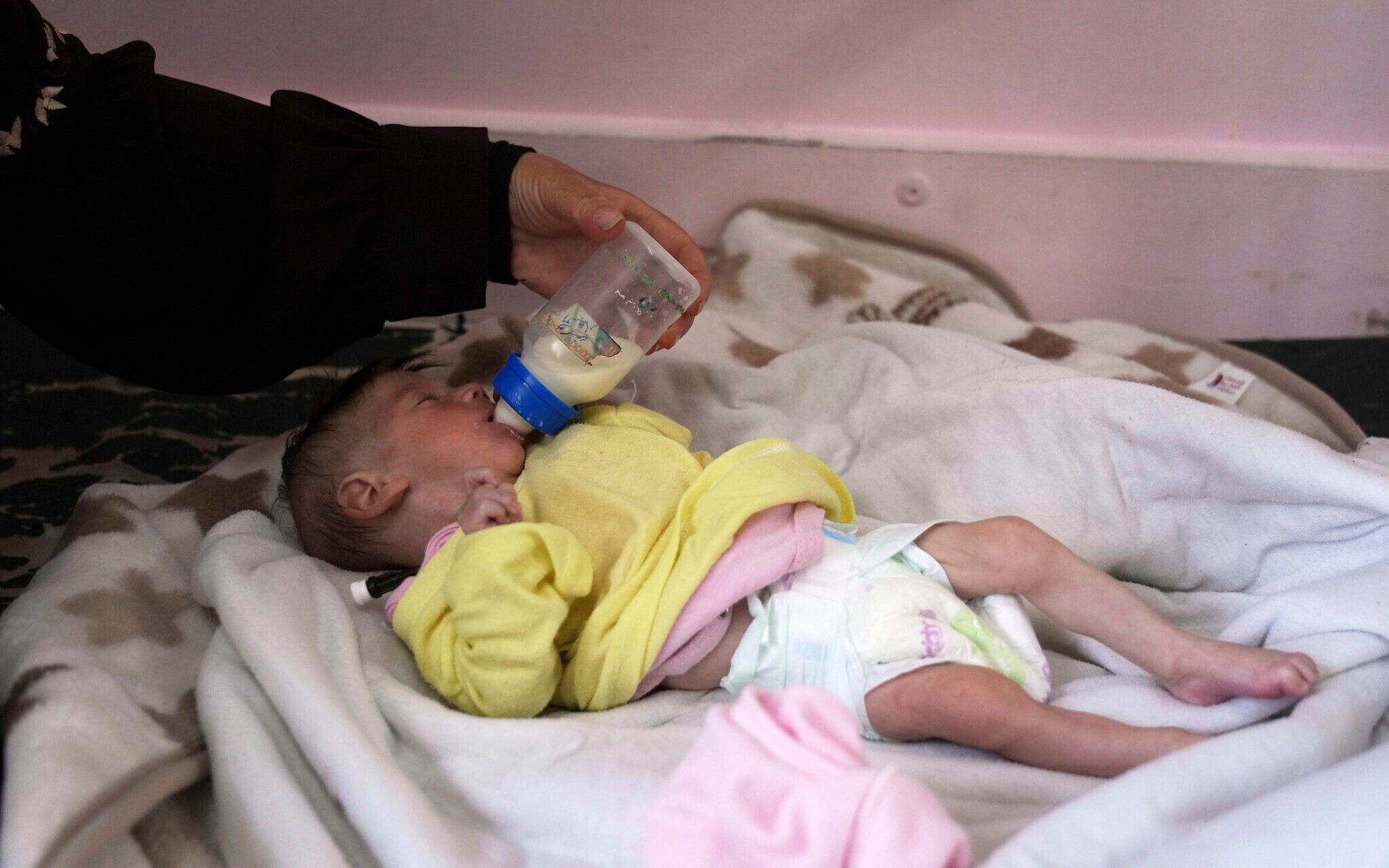
Illustrative: Najia Al-Najjar feeds her 5-month-old baby, Yousef, at a clinic in Nasser hospital, Khan Younis, Gaza, May 21, 2025. (AP Photo/Abdel Kareem Hana)
Israel has been hampering the delivery of much-needed baby formula into Gaza where child malnutrition is climbing to alarming levels, international aid organizations say.
Officials from several organizations tell Haaretz that Israel has started to impose custom duties on aid purchased outside Israel since partially lifting its blockade in May after 78 days. This practice is not done by other countries that neighbor conflict zones, including those near Russia.
The officials said that Israeli authorities are pushing aid organizations to buy their products in Israel, even though they are much more expensive than they would be in the West Bank, Jordan or elsewhere.
The policy has left some aid organizations unable to afford to cost of baby formula and other essential products, humanitarian officials tell Haaretz.
One hundred and thirty-six countries have signed onto an international agreement that urges nations not to collect custom duties on humanitarian aid, but Israel is not a signatory.
UNRWA says it has been gathering data based on the arm diameter of tens of thousands of children in Gaza to examine the state of their diet.
The data found that the percentage of children suffering from malnourishment rose from 5.2% during the ceasefire at the beginning of the year to 10.7% in recent days.
The World Health Organization says that 90% of pregnant and nursing mothers suffer from severe malnutrition, which harms their ability to breastfeed, thereby requiring their children to use baby formula that is in limited supply.
Even the formula that does make it into Gaza requires clean water for preparation, but the lack of access to clean water has exposed children to infections.
Responding to the report, Israel’s Coordinator of Government Activities in the Territories, which facilitates the entry of humanitarian aid into Gaza asserts that it does not prevent or restrict the entry of “baby food, including milk substitutes and baby formula, into the Gaza Strip.
“As evidence, in recent weeks more than 1,400 tons of baby food have been brought in through the crossings, as per the requests of international aid organizations, following stringent security checks.”
The Israeli unit also denies collecting customs on aid brought into Gaza.
IDF says it killed prominent terror operative in south Lebanon strike
An Israeli airstrike earlier today in southern Lebanon killed a prominent terror operative involved in advancing attacks on Israel, the IDF and Shin Bet announce.
Muhammad Shoaib was targeted in the town of al-Numairiya, in the Nabatiyeh district.
The military says Shoaib was a “significant figure in advancing terror attacks within Israeli territory.”
“As part of his activities, he operated to smuggle weapons into Israeli territory, in order to carry out terror attacks in Israel and establish terrorist infrastructure in Lebanon,” the IDF says.
Shoaib was also a “significant figure in the weapons smuggling route from Iran” to Lebanon, Syria, and the West Bank, according to the statement.
The IDF says his killing “undermines the weaponization capabilities of the various terror organizations” operating in Lebanon, Syria, and the West Bank.
Doctors Without Borders warns that acute malnutrition soaring in Gaza
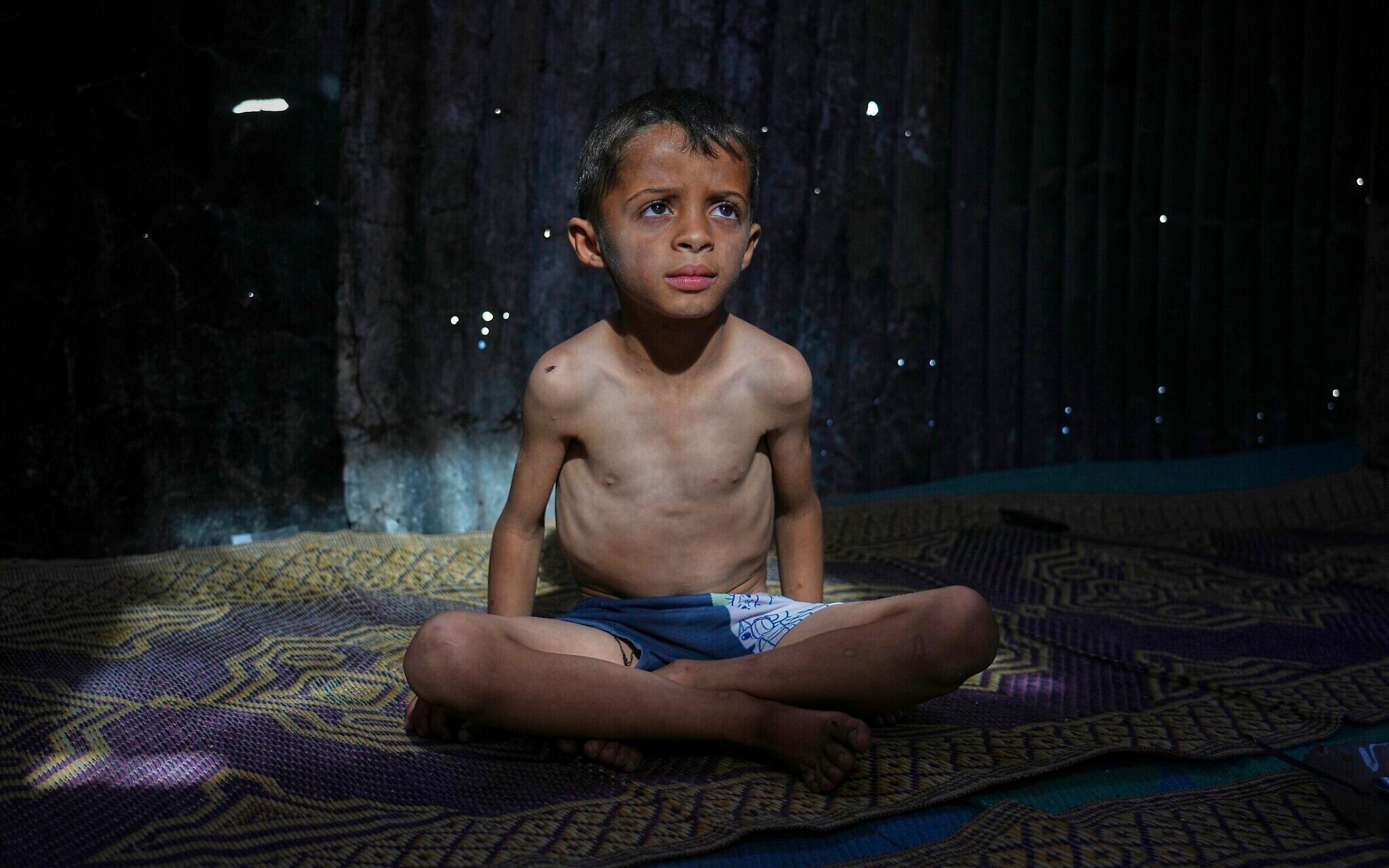
Illustrative: Ahmed El-Sheikh Eid, 7, who shows signs of malnutrition, poses for a photo at his family tent at a camp for displaced Palestinians in al-Mawasi, near Khan Younis in the southern Gaza Strip, May 2, 2025. (AP Photo/Abdel Kareem Hana)
Doctors Without Borders warns that its teams on the ground in Gaza are witnessing surging levels of acute malnutrition in the besieged and war-ravaged territory.
The medical charity, known by its French acronym MSF, says levels of acute malnutrition have reached an “all-time high” at two of its facilities in the Gaza Strip.
MSF says it now has more than 700 pregnant and breastfeeding women and nearly 500 children with severe and moderate malnutrition currently enrolled in ambulatory therapeutic feeding centers in both clinics.
The numbers at the Gaza City clinic have almost quadrupled in under two months, from 293 cases in May to 983 cases at the start of this month, it says.
MSF maintains Friday that “the existence of malnutrition in Gaza is the result of deliberate, calculated choices by the Israeli authorities” — a charge Israel has denied, pointing to the tons of aid that it has allowed into Gaza throughout the war. Aid groups say the assistance has been insufficient.
Far more babies were also being born prematurely, while six-month pregnant women often weighed no more than 40 kilos (88 pounds), MSF says.
Settlers beat Palestinian-American to death during attack on village near Ramallah — PA
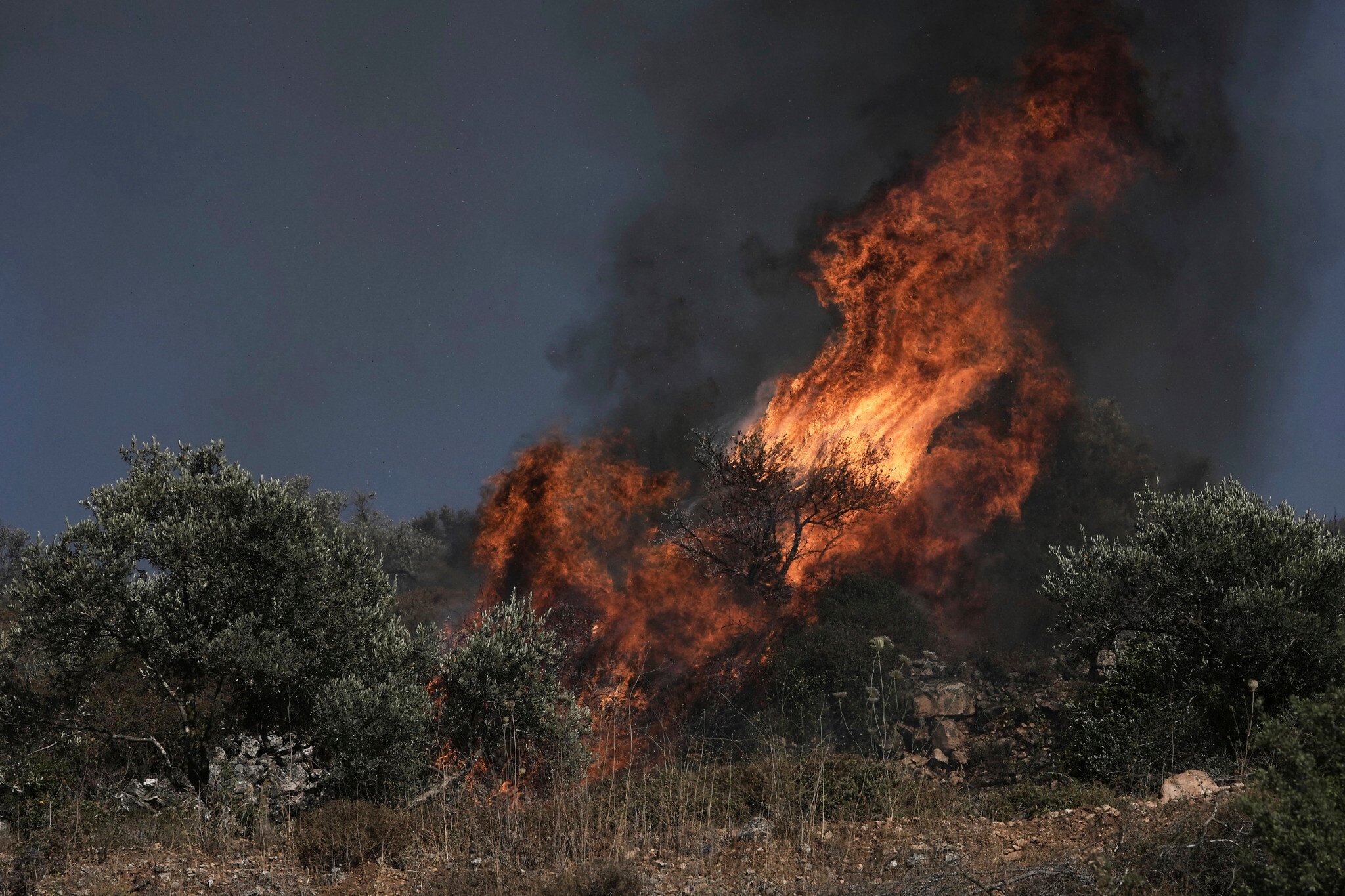
An olive tree burns in a Palestinian village near the West Bank town of Sinjil, Friday, July 11, 2025. (AP/Maya Alleruzzo)
A 23-year-old man was beaten to death by Israeli settlers during an attack on Palestinians north of Ramallah, according to the Palestinian Authority’s health ministry.
A group of Palestinians had been trying to reach the hamlet of Khirbet al-Tal to protest the establishment of a new illegal Israeli outpost that had been built on the village’s land, which is located in Area B of the West Bank, where no settlements are supposed to exist.
But dozens of settlers blocked Palestinians from trying to reach Khirbet al-Tal and began attacking them, the PA’s official Wafa news site says.
Ten Palestinians from nearby towns were injured in the settler attack.
الصحة: ارتقـ،ـاء الشاب سيف الدين كامل عبد الكريم مصلط (٢٣ عامًا)، جراء الاعتداء عليه بالضرب الشديد في مختلف أنحاء الجسد من قبل المستوطنين في بلدة سنجل شمال رام الله. pic.twitter.com/Jb5HiWMHnB
— ق.ض (@Qadeyah1) July 11, 2025
A witness told Wafa that one of the settlers rammed a Palestinian with his car and that other settlers shattered the window of two Palestinian ambulances that arrives at the scene to try and treat the victims.
The man beaten to death was identified as Saif al-Din Musalat from the nearby village of Al-Mazra’a Al-Sharqiya. He is said to have also held American citizenship.
An Israeli security official tells Ynet that they are aware of the incident and that troops have been dispatched to the scene to try and restore order.
As is almost always the case in incidents of settler violence, there have been no reported arrests carried out.
Israel says it allowed 150K liters of fuel into Gaza this week amid widespread shortage

One of seven fuel tankers which the Coordinator of Government Activities in the Territories (COGAT) agency of Israel's Defense Ministry said entered Gaza through the Kerem Shalom goods crossing on Sunday, May 12, 2024. (Courtesy COGAT)
Israel’s Coordinator for Government Activities in the Territories says it transferred 150,000 liters of fuel into Gaza this week through the Kerem Shalom Crossing into Gaza following a directive from the political echelon.
Israel for months has been severely restricting the amount of fuel that is allowed to enter Gaza on the grounds that it is used by Hamas.
But the shortages have prevented generators from running at hospitals and other essential sites throughout the Strip.
‘It will have a chilling effect’: UN rapporteur says US sanctions may inhibit her travel elsewhere

UN Special Rapporteur on the Rights Situation in the Palestinian Territories Francesca Albanese attends a rally to denounce Israel over the war with Hamas in Gaza in Madrid on June 23, 2025. (Thomas Coex/AFP)
The top UN expert on Palestinian rights says that the US decision to place her under sanctions could have a “chilling effect” on people who engage with her and restrict her movements, but that she planned to continue her work.
On Wednesday, US Secretary of State Marco Rubio announced that Francesca Albanese would be added to the US sanctions list for her actions, which he described as prompting illegitimate prosecutions of Israelis at the International Criminal Court.
Albanese says she now faces asset freezes and potential travel restrictions, warning that the US decision could set a “dangerous” precedent for human rights defenders worldwide.
“There are no red lines anymore … It is scary,” she tells Reuters via video link from Bosnia, where she was attending events for the 30th anniversary of the Srebrenica genocide.
“It might block me from moving around. It will have a chilling effect on people normally engaging with me because for American citizens or for green card holders, this is going to be extremely problematic.”
“My plans are to continue what I’ve been doing,” she adds.
IDF filmed blocking Palestinians from fixing water pipe vandalized by settlers
Footage from earlier today shows Israeli troops blocking Palestinian Authority municipal workers from reaching a water pipeline that was allegedly dismantled by settlers in the central West Bank in order to prevent seven Palestinian villages in the area from receiving water.
While the Israeli troops tell the Palestinian municipal workers that they cannot proceed, bulldozers are seen operating freely, clearing ground for Israeli settlement expansion at a nearby hilltop.
In a response issued Saturday, the IDF says the workers arrived without the needed approval. The military adds that the workers received approval to carry out the repairs on Saturday.
סיפור שטחים שאי אפשר שלא להשתגע ממנו: מוקדם יותר השבוע מתנחלים חיבלו בצינור מים שמוביל מים לשבעה כפרים – דומא, מג'דל בני פדל וכו'. היום הגיעו אנשים מהמעוצות של הכפרים כדי לתקן את הנזק. חיילים מנעו מהם לעבור. בינתיים הבאגר של המתנחלים ממשיך לעבוד ברקע. pic.twitter.com/dBCRwRIwWb
— Hagar Shezaf (@hagar_shezaf) July 11, 2025
Israeli authorities open probe into alleged settler killing of Palestinian; no arrests made
Police and the Shin Bet security agency have opened an investigation into the death of a Palestinian man during an attack by Israeli settlers in the Ramallah area of the West Bank earlier today.
The military says the incident began after Palestinians hurled stones at Israelis near Sinjil, lightly injuring two civilians. According to Palestinian accounts, settlers were the ones who instigated the clash when Palestinians tried to protest the establishment of a new illegal outpost.
Shortly after, a “violent clash” erupted between Israelis and Palestinians in the area, which included “vandalism of Palestinian property, arson, physical clashes, and rock hurling.”
The IDF says it is aware of reports that a Palestinian man was killed and others were wounded during the incident, adding that it is being investigated by police and the Shin Bet.
Upon receiving reports of the violence, the IDF says troops and police officers were dispatched to the scene to “disperse the clash,” during which forces used riot dispersal means.
There have been no arrests yet.
US State Department begins laying off more than 1,300 employees
FILE - US Department of State sign is seen at the State Department in Washington, August 10, 2006. (Charles Dharapak/AP)
The US State Department began laying off more than 1,300 employees on Friday as part of US President Donald Trump’s campaign to massively downsize the federal government workforce.
A State Department official says 1,107 members of the civil service and 246 Foreign Service employees were being informed that they were being fired.
The layoffs at the department come three days after the Supreme Court cleared the way for the Trump administration to begin carrying out mass firings of federal workers.
The conservative-dominated top court lifted a temporary block imposed by a lower court on Trump’s plans to lay off tens of thousands of government employees.
The State Department employed over 80,000 people worldwide last year, according to a fact sheet, with around 17,700 based in the United States.
US Secretary of State Marco Rubio announced a major restructuring of his department at the end of April, sharing an article on social media site X that suggested plans for cuts to 15 percent of staff.
Since returning to the White House, Trump has made reducing the federal workforce one of his main priorities, pursuing drastic cuts to jobs and spending through the so-called Department of Government Efficiency (DOGE) previously headed by Elon Musk.
The US Agency for International Development, the primary vehicle to provide US assistance around the world, was among the agencies gutted by DOGE.
According to The Washington Post, State Department employees were being informed of their firings by email.
Foreign Service officers will lose their jobs 120 days after receiving the notice and will be immediately placed on administrative leave, while civil service employees will be separated after 60 days, the newspaper said.
US appeals court scraps 9/11 mastermind’s plea deal
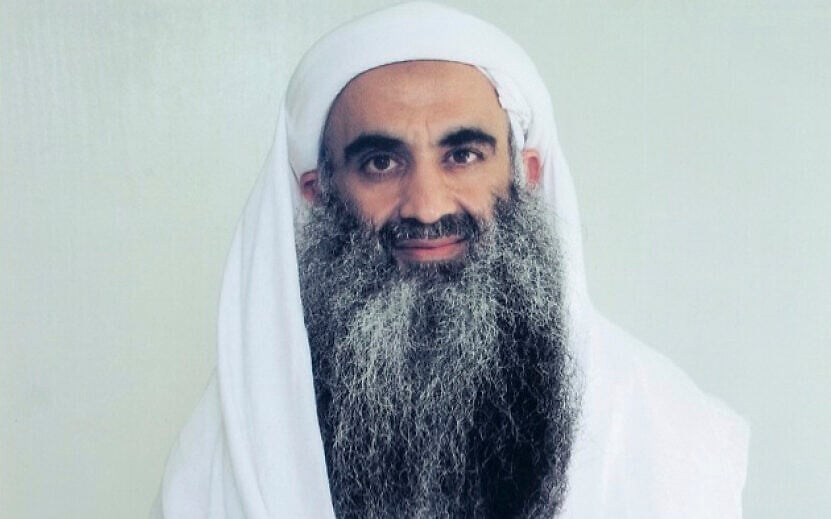
This February 2017 photo provided by his lawyers shows Khalid Shaikh Mohammed in Guantanamo Bay prison in Cuba (Courtesy Derek Poteet via AP)
A US appeals court on Friday scrapped 9/11 mastermind Khalid Sheikh Mohammed’s plea agreement that would have taken the death penalty off the table and helped conclude the long-running legal saga surrounding his case.
The agreement had sparked anger among some relatives of victims of the 2001 attacks, and last year, then-US defense secretary Lloyd Austin moved to cancel it, saying that both they and the American public deserved to see the defendants stand trial.
Austin “acted within the bounds of his legal authority, and we decline to second-guess his judgment,” judges Patricia Millett and Neomi Rao wrote.
Plea deals with Mohammed as well as two alleged accomplices — Walid bin Attash and Mustafa al-Hawsawi — were announced in late July last year.
The decision appeared to have moved their cases toward resolution after years of being bogged down in pre-trial maneuverings while the defendants were held at the Guantanamo Bay military base in Cuba.
But Austin withdrew the agreements two days after they were announced, saying the decision should be up to him, given its significance.
He subsequently said that “the families of the victims, our service members and the American public deserve the opportunity to see military commission trials carried out in this case.”
A military judge ruled in November that the deals were valid and binding, but the government appealed that decision.
US agency approves potential sale of multimission aircraft sustainment to Lebanon
The US State Department approved a possible sale to Lebanon of A-29 Super Tucano aircraft sustainment and related equipment for $100 million, the Pentagon says in a statement.
The Super Tucano is a multimission aircraft that can be used for training and light attack.


read more: