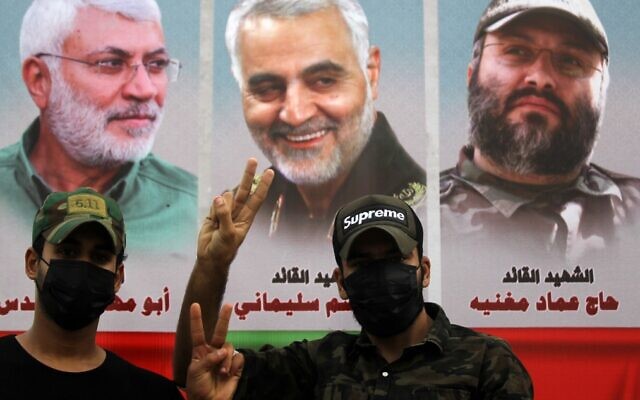
BAGHDAD — Several hundred protesters gather in the Iraqi capital to demand US troops leave the country in accordance with a parliament vote earlier this year.
“We will choose resistance if parliament’s vote is not ratified!” reads one of the banners at the demonstration, which took place near an entrance to the high-security Green Zone, where the US embassy and other foreign missions are located.
Others carried signs bearing the logo of the Popular Mobilization Forces, a state-sponsored network of armed groups including many supported by Iraq’s powerful neighbor Iran.
Following a US strike on Baghdad in January that killed top Iranian Quds Force Gen. Qassem Soleimani and the PMF’s deputy head, outraged Iraqi parliamentarians voted to oust all foreign forces deployed in the country.
The US has sent thousands of troops to Iraq since 2014 to lead an international coalition helping Baghdad fight the Islamic State jihadist group.
Washington has drawn down those forces in recent months to around 3,000, and other coalition countries have also shrunk their footprint.
Starting in October 2019, rockets regularly targeted those troops as well as diplomats at the US embassy.
Over the summer, there was a marked increase in attacks against coalition logistics convoys using roadside bombs.
Enraged by the ongoing attacks, the US in late September threatened to close its Baghdad embassy and carry out bombing raids against hard-line elements of the PMF.
— AFP
Supporters of the Iran-backed Popular Mobilization Forces pose before a banner showing a montage of (L to R) slain Iraqi PMF commander Abu Mahdi al-Muhandis, Iranian Quds Force Gen. Qassem Soleimani and Lebanese Hezbollah military chief Imad Mughniyeh; during a demonstration outside the entrance to the Iraqi capital Baghdad’s highly-fortified Green Zone on November 7, 2020, demanding the departure of remaining US forces from Iraq. (Ahmad Al-Rubaye/AFP)
Help us report truthfully on social media
As a multimedia journalist, my job is to take the quality, fact-based journalism produced by The Times of Israel newsroom and make it accessible across every platform — from Instagram posts to podcasts to short-form videos.
This is how many, especially young people, consume news these days. But misinformation is rampant on social media. Our team at ToI produces accurate, responsible short-form reporting on Israel and the Jewish world.
If you believe in the importance of factual social media journalism, please consider joining our reader support group, The Times of Israel Community. Your financial support is essential to sustain responsible multimedia reporting.
We’re really pleased that you’ve read X Times of Israel articles in the past month.
That’s why we started the Times of Israel - to provide discerning readers like you with must-read coverage of Israel and the Jewish world.
So now we have a request. Unlike other news outlets, we haven’t put up a paywall. But as the journalism we do is costly, we invite readers for whom The Times of Israel has become important to help support our work by joining The Times of Israel Community.
For as little as $6 a month you can help support our quality journalism while enjoying The Times of Israel AD-FREE, as well as accessing exclusive content available only to Times of Israel Community members.
Thank you, David Horovitz, Founding Editor of The Times of Israel


 From the Liveblog of
Saturday, November 7, 2020
From the Liveblog of
Saturday, November 7, 2020
 Add ToI as a Preferred Source on Google