

Russian roulette with an unloaded gun: Nine things to know for March 16
From early elections to UN votes, the press tries to figure out who is serious, who is bluffing, and why Israel sent out only a half-hearted condemnation of the UK nerve gas attack
 Add ToI as a Preferred Source on Google
Joshua Davidovich is The Times of Israel's Deputy Editor
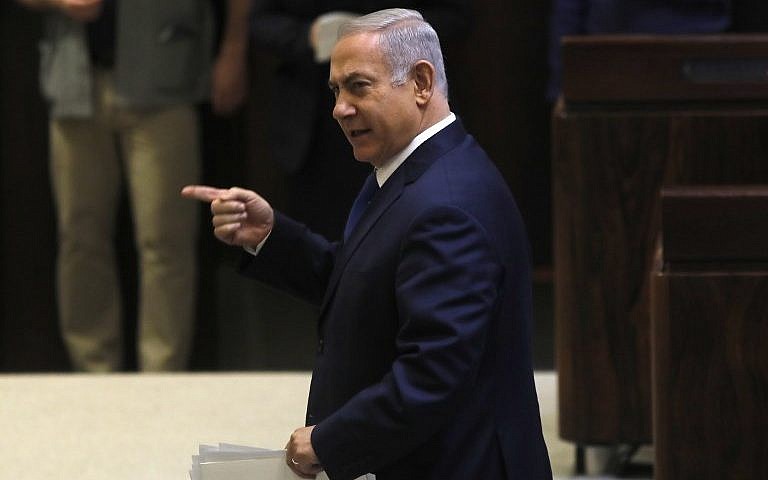
1. It’s a sign of how much things suddenly calmed down that mere days after nearly the entire country was convinced the government would fall and new elections called, front pages on Friday offer little more than the news that a former minister and a bereaved mother won Israel Prizes for lifetime achievement.
- In the test of dog bites man, the good news for David Levy and Miriam Peretz barely even reaches the level of dog bites dogfood, but Israel’s tabloids play it up in any case. “The worker who became a minister who became a national symbol,” reads a lede in Yedioth Ahronoth’s paean to David Levy, appropriately headlined “A psalm of David.”
- Levy, a career politician who fought with Prime Minister Benjamin Netanyahu for control of Likud, is mostly remembered for his time as foreign minister, during which his lack of English made him a non-entity in talks involving anyone who didn’t speak French, Hebrew or Arabic.
- Yet the paper still praises him for being a Moroccan who managed to break into the big league at a time when only Israelis of European descent were taken seriously, and who suffered through a period working in construction despite being an “intellectual.” “From a cement mixer to the Knesset plenum, a leader arose,” Maor Zaguri writes.
- Israel Hayom says Levy is best known for his connection to the city of Beit Shean, a Moroccan migrant backwater whose sister city is Cleveland, which should tell you everything you need to know about the place. (This writer hails from Cleveland.)
2. Miriam Peretz, who lost two sons in separate wars and became an inspirational speaker (and who was also born in Morocco), is also praised for rising above.
- “My eyes weep from missing my children, Uriel and Eliraz, and not a day goes by that I don’t miss them …. But I’m also happy that I have the ability to live a life in the State of Israel full of happiness and love,” she tells Israel Hayom.
3. It was David Levy’s daughter Orly Levy-Abukasis who may have become a spoiler when polls showed her doing better than Yisrael Beytenu, the party she broke away from, which some think spooked Defense Minister Avigdor Liberman and Netanyahu, paving the way for the coalition to compromise and avoid early elections.
- “They played poker with me,” Haaretz’s Yossi Verter quotes Liberman telling colleagues, with the defense minister maintaining that he did not budge a bit. “They said Liberman has only five seats. He’ll fold. He’s afraid of losing the Defense portfolio. The ultra-Orthodox were mistaken about me. They threatened with an unloaded gun.”
- In Yedioth, Sima Kadmon pinpoints the moment the ultra-Orthodox became willing to compromise, after UTJ head Yaakov Litzman asked Finance Minister Moshe Kahlon to support a basic law on the study of Torah that would allow anyone saying they study the bible to be free of having to enlist in the mandatory military draft.
- “Why not a basic law on medical studies,” Kahlon answered Litzman — the deputy health minister — sarcastically, according to the report, adding that if the budget didn’t pass by March 15 he would quit and bring down the coalition.
4. The idea that the crisis was just a bluff, with Netanyahu himself pushing for elections as a way of getting another term before a possible indictment, is also still alive and well.
- Haaretz’s Chemi Shalev accuses Netanyahu of surrounding himself with yes men who allowed the prime minister and his allies to live inside the fantasy that the crisis was real.
- “Ministers and members of Knesset debated the pros and cons of the issue, presented facts and submitted statistics, gave ultimatums and offered compromise proposals, though most of them were well aware of the naked truth. They found it safer, and more convenient, to pretend that the hoax was real rather than admit that the crisis was manufactured to serve Netanyahu’s interests and to improve his chances of evading the law,” he writes.
- Israel Hayom’s Motti Tochfeld claims that Netanyahu went back and forth on calling early elections while visiting the US last week, but in the end decided he did not want them: “In his view, the investigations don’t affect that political arena at all,” he writes.
5. Tochfeld also pokes at Labor leader Avi Gabbay for deciding not to support early elections. “He prefers to be a candidate for prime minister on paper rather than being a candidate for being booted from the party leadership after an electoral loss,” he quips.
- Haaretz’s lead editorial also takes aim at Gabbay and the other opposition leaders for not supporting early elections and trying to boot Netanyahu as early as possible, after they realized Netanyahu wanted to call a snap poll before he is possibly indicted and they decided not to play along.
- “Israel’s opposition leaders were more concerned about their political future than the future of the country. In that, they are no different from the prime minister: Saving himself from indictment has become his driving motivation,” the paper charges.
6. Yet the gambit may have paid off. On Thursday night, Kahlon told the Hadashot news station that an indictment for Netanyahu will mean the end of his term.
- “If a trial begins against the prime minister, he will not be able to continue,” Kahlon said.
- The coalition has made it clear, though, that until Netanyahu is actually on the stand, they will continue to back him as innocent until proven guilty, which likely means he won’t be forced out before the term ends in November 2019.
7. That skittishness about punishing someone before they’ve been tried was probably not what motivated Israel’s strange message condemning “the event that occurred in Great Britain,” which did not mention the nerve gas attack or use the word Russia, a fact which the media and others definitely noticed.
- Israel’s Channel 10 news reports that the statement came after Britain lobbied Israel to condemn the attack, though Jerusalem initially stayed silent. “The request created a dilemma in Jerusalem of whether and how to condemn the attack. … They feared a confrontation with Russian President Vladimir Putin, whose forces are in Syria,” the outlet reports.
- On Twitter, former IDF spokesman Peter Lerner guesses that Israel is actually just still sore about Britain’s votes at the UN, and so gave the UK the most pathetic condemnation it could.
The media is being critical of the MFA for not mentioning #Russia in this announcement. My first thought was #Fail. Then I remembered how #Britain voted in the UN in December against the #Jerusalem move. #RealPolitik at its best. You scratch my back I scratch yours. https://t.co/FCQty3qJDb
— Lt. Col. (R) Peter Lerner (@LTCPeterLerner) March 15, 2018
- Israel Hayom’s Eldad Beck has no compunction about pointing fingers at Russia, and goes a step further by surmising that Putin planned the whole attack and backlash to get a nice rally around the flag effect ahead of Sunday’s election: “There’s nothing like a confrontation with the West for uniting Russians.”
8. If Israel is still butthurt about UN votes, it’s not alone. Foreign Policy magazine reports on a document drafted by US envoy Nikki Haley’s team on where the US should look at cutting foreign aid in response to UN votes going against America’s interests, including the condemnation of Jerusalem’s recognition.
- Among the items on the chopping block to pay the price for a meaningless vote are millions of dollars in job training in Zimbabwe and millions more for schools in Ghana.
- The document notes that neither country had a demographic reason for condemning the Jerusalem decision, giving the impression that those who do have an excuse because of large Muslim populations may get a pass.
9. In The Times of Israel, analysts Zaki Shalom and Jonathan Mintzer say what’s disproportionate is Israel’s response to the Iranian drone that infiltrated the country last month, setting off several hours of heavy fighting, and that’s a good thing.
- “Israel’s escalated response demonstrated that it will continue to counter Iranian actions, even if doing so could lead to an all-out confrontation,” they write. “That being said, the relative calm between Israel and Iran since the drone incident suggests that neither country currently wants a direct military confrontation.”






The Times of Israel Community.