

Safety Gantz: 8 things to know for February 8
Gantz can talk if he wants to, but he can’t leave his friends on the right and left behind, meaning it’s still impossible to get a non-safe answer out of the party
 Add ToI as a Preferred Source on Google
Joshua Davidovich is The Times of Israel's Deputy Editor
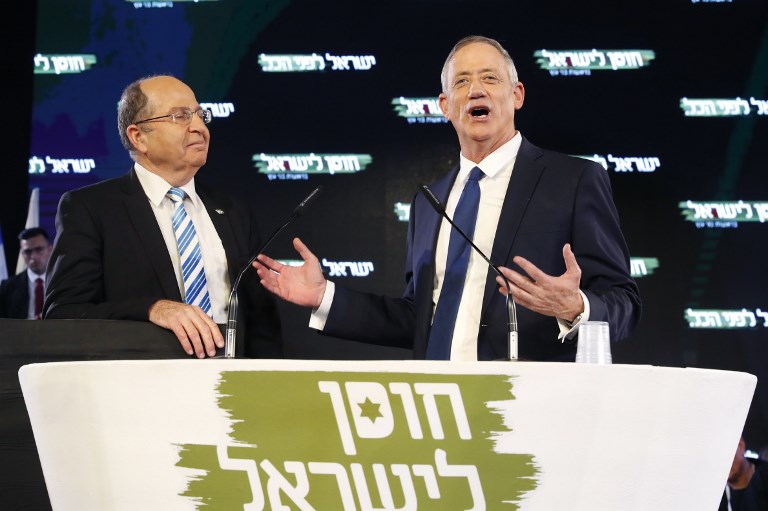
1. Say anything: A long-awaited interview with political candidate Benny Gantz is published in Yedioth Ahronoth Friday, but it seems any big news from the softball Q & A was already released when Gantz hinted that he could pull out of the West Bank.
- Since then, Gantz has been forced to hem and haw amid attacks from the left and right, which don’t seem to be going away, partly thanks to others in his party.
- After further criticism of Gantz’s substance-free response to questions raised about his praise of the 2005 disengagement from Gaza, Israel Resilience spokesperson told The Times of Israel on Thursday that the full interview would be an “in-depth piece that’s almost 10 pages long, and addresses the important economic, social, security and state issues that are of interest to the public.”
- While the renowned Israeli singer Shlomo Artzi and right-wing journalist and comedian Hanoch Daum made for curiously paired questioners, the 7,000 word free-flowing interview does indeed include a vast range of topics relating to almost every realm of Israeli public discourse.
- On whether he is really left or right, Gantz says that for him “the central question is always the security question,” dodging the question with platitudes about “bringing people with different beliefs and opinions together.”
- Already having learned some political tactics in the month since he launched his party, Gantz refuses to be drawn on possible mergers before the election but would also not rule out sitting with either the ultra-Orthodox or Arab parties in a coalition. (Hat tip to Raoul Wootliff for slogging through all 7,000 words.)
2. Pro-something or other: It’s a different interview in Yedioth, with Zvi Hauser, that makes more waves, after the former cabinet secretary who is now number 8 on Gantz’s Israel Resilience slate, promises that the former general will build more settlements than even Netanyahu.
- “Telem will push strengthening settlements across the Land of Israel, beyond what is being done now,” he tells Amit Segal.
- Hauser comes to Gantz’s party via Moshe Ya’alon’s Telem, and Ya’alon recently made it clear to ToI that he does not support a Palestinian statehood, highlighting a potential major rift within the faction.
- Responding to the hubbub, Gantz releases a statement saying that “Israel Resilience will act on the security interests and strive for peace with regional leaders and countries. In the past there were left-wing governments that built in the settlements and right-wing governments that froze building. We act according to security needs and not left-right branding.”
- “If anybody can figure out what Gantz’s stance is on settlements because of this, please let me know,” Channel 13 reporter Barak Ravid quips.
- Israel Hayom columnist Haim Shine also goes after Gantz, accusing him of selling the public “rotten goods.” He writes: “[Gantz’s] claims that he can reach a settlement with the Palestinians will only endanger security.”
3. First Gantz will have to get to a place where he can lead a government.
- With talks to merge with Yair Lapid’s Yesh Atid reportedly going less than swimmingly, a Channel 13 poll showed that while Gantz will get the most seats by merging with Lapid, the two will end up obliterating the left side of the political spectrum and still not have enough partners to form a coalition.
- But if he joins up with similarly chimeric Orly Levy-Abekasis and her Gesher party, and leaves Yesh Atid intact, while Labor and Meretz join forces, there would be enough votes over the electoral threshold to give them a better chance at surpassing Likud and friends.
- Levy-Abekasis may not be keen on such a merger, though. According to Channel 12, she quipped Thursday that Gantz’s party platform was so badly written that her son could have done better when he was 12.
- A separate poll published by Israel Hayom and i24 shows Likud slightly up, Gantz slightly down, but bad news for parties at the bottom, with Labor and Gesher barely hanging in the 120-member Knesset with four seats, and Kulanu and Israel Beytenu out altogether with 3 seats.
4. Breaking ranks: A poll in Walla news in the wake of the Likud primary shows Gideon Sa’ar far and away the most popular person in the party to take over for Netanyahu, both among Likud voters and non-Likud voters.
- From Sa’ar to Likud voters choosing MKs who are considered serious instead of loudmouthed loyalists for other top spots, Yossi Verter sees in Haaretz a primary that showed Netanyahu how little control he has over the party’s rank and file.
- “[Netanyahu] discovered that they are not a flock of sheep that take fright at every passing barking sheepdog and skitter submissively into the pen. They have a sense of responsibility. They possess collective wisdom and they have a measure of independence not shared by many Likud MKs and cabinet ministers,” he writes.
5. Fooling around with Deep Throat: All week, journalists have been getting text messages and other statements about how terrible Gideon Sa’ar, Benny Gantz and others are from shadily named sources such as “those around Netanyahu,” or “someone close to Netanyahu.”
- While the press generally goes along with it and gives the sources whatever name they say they can be quoted as, whether it is true or not, the Seventh Eye media watchdog blows the lid off the method, revealing that the source is — surprise — Netanyahu’s spokesman Yonatan Urich.
- The site notes that most journalists just quoted the information and helped Urich subvert the fact that the info was actually coming from Netanyahu’s office.
- “Journalists are happy to go along with this game, which allowed them to show off how deep their sources go. … Who loses out is the public, which receives a false impression of who is doing what in the political arena, and will wrongly think that politicians representing them in the Knesset are cleaner than they actually are and don’t wallow around in the mud.”
- Not everyone went along with it. Maariv journalist Avishai Grinzaug posted the whole WhatsApped statement on Twitter, leaving little doubt as to the fact that it came from Netanyahu.
- “I myself used some of the quotes in an earlier media review and cited it to Netanyahu’s office. It’s one thing to speak to a journalist and request anonymity. It’s quite another to send out a Whatsapp blast and then demand journalists lie about where it came from. No journalist is under any obligation to follow such crooked ground rules.”
- It’s a good lesson to keep in mind when reading the news in Israel. This case was somewhat benign, as it was clearly coming from Netanyahu. But it is unfortunately not uncommon for journalists to be directed by the army or some other body to lie and cite info to non-existent foreign reports or Palestinian media (or their own independent knowledge), and all too often, those journalists go along with it, making them, and readers, little more than pawns.
6. Two horrible murders, two levels of coverage: A short honeymoon when the country seemed to be taking violence against women seriously has unfortunately receded and the last several days have seen two more cases of young women being murdered.
- In Turkey, Umm al-Fahm resident Siwar Keblawi, 20, was found dead after what her family described as a fall or jump from a balcony. However, it has emerged that she was in Turkey to flee her brother, who followed her there.
- According to press reports, police believe Keblawi jumped from the balcony to escape her brother. Video appears to show him and another man, who appears to be Keblawi’s father, dragging her injured body inside, at which point she was apparently strangled to death by her brother, who has been arrested.
- In the second case, the body of Ori Ansbacher was found in a wooded section of southern Jerusalem Thursday night. Most of the case is under gag order, but it is still getting more attention, with the story leading every major Hebrew news site, because of 1. The fact that it happened closer to home, 2. Suspicions/rumors that it may have been nationalistic in nature and 3. Possibly because she is Jewish.
- While Israeli officials haven’t said anything about Keblawi (just as they remained mum about the murder of Aya Maasarwe in Australia last month for days), the prime minister, president and other have weighed in with public statements on Ansbacher and media crews had swarmed into the settlement of Tekoa, where she is from.
7. Arab women are also marginalized in the Knesset, according to an op-ed in Haaretz by Anwar Mhajne.
- Mhajne writes that only five Arab women have ever served in the Knesset, including a record 3 in the last Knesset and it’s not likely to get much better, with Arab parties putting few women on the tops of their lists.
- “For Arab women who want to campaign by legitimately representing popular opinion in their communities, which is very distant from the mainstream Israeli Zionist politics of left and right, the choice is vanishingly narrow: the few Arab and leftist parties. Those political chasms deter the majority of Arab men and women from competing for Knesset positions as members of non-Arab parties. They are subsequently forced to compete for the few seats available in a small number of Arab parties,” she writes.
8. Throw another boycott on the barbie: In a process that seems to be repeated in every country sending a representative to the Eurovision song contest, local broadcasters are facing pressure to pull out of the event. In most places, the broadcaster has brushed aside the boycott calls, but The Guardian reports that in Australia, officials are taking it more seriously.
- One employee of SBS, the Australian public broadcaster that sends a representative, tells the paper that they have had several discussions about the ethical and political ramifications of collaborating with Eurovision in Israel.
- “It’s a complex situation. It’s at the cornerstone between two pretty sizeable ethnic groups who live in Australia – and there’s lots of people from both groups working here too. No one here is naive to it, but the solution so far is to direct attention away [from the politics],” the source says.
- Meanwhile, Jack White of the White Stripes can now add Eurovision winner to his resume, after he was given writing credits for the song “Toy,” after the Universal record label sued of similarities to “Seven Nation Army.”
- The credit is likely part of a settlement that will allow Netta Barzilai to keep her Eurovision win, after concerns it could have been stripped over the plagiarism claims.
- White doesn’t respond to a request for comment by The New York Times on Thursday, while Amnon Szpektor, who was head of media for Israel’s entry in 2018, tells the paper the agreement included a confidentiality clause, and so nobody can comment.



The Times of Israel Community.