

Syrians refuse attempted relocation along Jordan border
‘If we move from the Jordanian border, Syrian and Russian planes will come and bomb us,’ warns one refugee
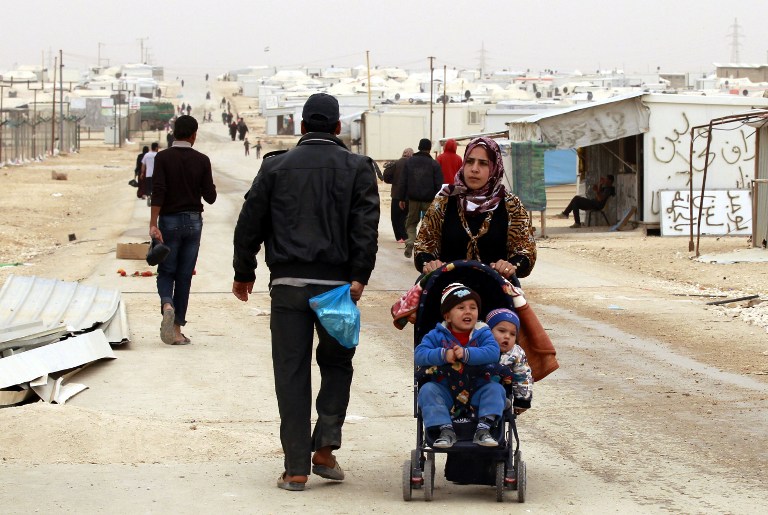
AMMAN, Jordan (AP) — Syrians stranded on the border with Jordan protested Saturday over their refusal to move about six kilometers (3.7 miles) west to a soon-to-be opened aid distribution center.
Videos sent to The Associated Press on Saturday showed a protest against any relocation from the al-Ruqban camp.
“If we move from the Jordanian border, there will be no safety. Syrian and Russian planes will come and bomb us,” said Ahmad, a 40-year-old Syrian living at the 75,000-person camp who wouldn’t provide his full name for safety concerns.
Aid officials, speaking on condition of anonymity, said a new distribution point is being built to draw refugees away from a nearby Jordanian military base. The officials added that the U.N. and Jordan will agree next week to start remote delivery of food, water and basic medical care from a service center constructed recently inside Jordan.
This could incentivize the refugees to voluntarily move to the new distribution center or force them to transport supplies from it back to al-Ruqban, the officials said.
Conditions at the camp have worsened since Jordan sealed the border 10 weeks ago after an Islamic State-claimed car-bomb attack killed seven soldiers nearby. Amidst ongoing security concerns from neighbors Iraq and Syria, Jordan has allowed one food delivery since the attack, but resumed daily water delivery two weeks afterward.
Doctors Without Borders has repeatedly warned of hepatitis and other disease outbreaks in the camp. Both Amnesty International and Human Rights Watch have called for immediate resumption of humanitarian assistance.
While Amnesty International welcomed the resumption of aid, it warned that moving refugees by force from al-Ruqban would be a “flagrant violation of international law.”
“Any relocation of the population at the berm must be voluntary and compliant with international standards. Forced displacement would be a flagrant violation of international law and any attempt to coerce or ask them to move should be rejected,” said Khairunissa Dhala, Amnesty’s refugee and migrants’ rights researcher.
Ahmad said al-Ruqban, while bleak and increasingly dire, is safer than the shelled neighborhoods and carnage he and other refugees fled inside Syria.
“Where can we go?” read a sign in Arabic at the protest. “Starvation and deprivation before us, bombs and murder behind.”
Copyright 2016 The Associated Press.



The Times of Israel Community.