

Talking about a referendum about talks
Netanyahu pushes for a public vote on any deal, to the dismay of several political colleagues
- See more Times of Israel on Google - add us as a Preferred Source
Ilan Ben Zion is an AFP reporter and a former news editor at The Times of Israel.
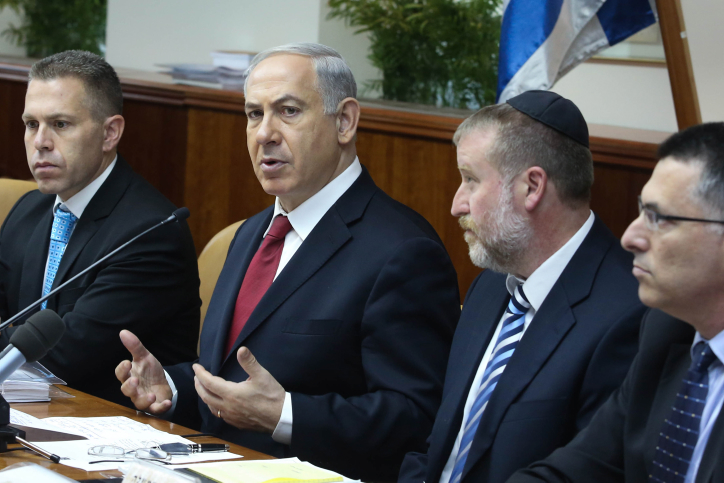
The never-ending saga of peace talks takes another turn as Prime Minister Benjamin Netanyahu calls for a national referendum on any agreement reached with the Palestinian leadership.
“It’s impossible to make a deal like this without a national referendum,” the PM explained Sunday, two days after US Secretary of State John Kerry announced a restart of long-stalled peace talks between Israel and the Palestinians. “If an agreement is reached it will be impossible to implement it without national approval — any other way is liable to create a rift in the nation.”
According to Haaretz, right-wing Likud politicians pressured Netanyahu to push for legislation to include a referendum on a peace deal, which he intends to expedite in the cabinet, a senior Jerusalem official says. According to the existing law, a referendum is only necessary should there be a deal in which territory under Israeli sovereignty — the Golan Heights and East Jerusalem, for example — would be handed over to the Palestinians. The new proposal would mandate a referendum for any deal with the Palestinians whatsoever.
Despite support from members of Likud and Jewish Home leader Naftali Bennett, Yedioth Ahronoth reports that members of Netanyahu’s governing coalition oppose the measure.
Justice minister and top negotiator Tzipi Livni is quoted voicing opposition to the proposition, saying, “It suffices for any decision, as significant or dramatic as it could be, to be made by the government and the Knesset. That’s what the public elected us to do: make courageous decisions. The general elections are a true and singular referendum.”
Shockingly, Yisrael Beytenu party leader Avigdor Liberman, Netanyahu’s bedmate in the governing party, also opposed the idea of a referendum, saying a few weeks ago in the Knesset that such a move would be “decision-makers escaping from responsibility.” The paper also speculates that Yesh Atid party leader Yair Lapid will oppose putting a peace deal to a vote, possibly scuttling the idea.
Maariv highlights anti-peace talks rhetoric, citing senior Foreign Ministry officials saying that “there is no chance of reaching an agreement with the Palestinians based on the current layout of talks,” which haven’t even started. According to the paper, members of the Jerusalem diplomatic corps seek to lock in another interim agreement with the Palestinians instead of a final deal.
The paper also reports that the first round of talks is set to start in the next few days, and that Netanyahu intends to manage the future talks himself, and have the cabinet expedite the talks by empowering him to approve decisions reached in negotiations.
Israel Hayom, ever vigilant in its defense of the prime minister, makes things nice and simple for its readers with terse, unequivocal prose. “Prime Minister Benjamin Netanyahu is advancing a bill for a referendum. He met Sunday with Cabinet Secretary Avihai Mandelblit and asked him to make a government bill that’ll set that all future deals with Palestinians will be approved by a national vote.”
Netanyahu’s office says this proposal by the prime minister is “a step which advances the beginning peace process and is testament to the seriousness of the prime minister.” According to the paper, Netanyahu hasn’t yet decided whether the aforementioned proposal to keep him in the loop for all negotiation decisions should be put to vote in the full cabinet, or the smaller security cabinet.
Haaretz writes that 82 prisoners “will be released in four waves, every six or eight weeks, in accordance with the pace of the talks between the Israelis and Palestinians,” and that those individuals, according to Defense Minister Moshe Ya’alon, “don’t constitute a real threat since they are relatively old, and some of them have sat in Israeli prison for over 30 years.”
(Israel Hayom also features a Page 2 story on the results of a TGI poll, which found that Israel Hayom, which is distributed free, is the most read newspaper in the country.)
As if to defend Maariv’s “cautious pessimism,” Nadav Eyal writes an op-ed with that title about the prospective peace talks. He notes that the Israelis and Palestinians are soberly approaching these new negotiations, and “even the Americans are entering this story with a realistic tone.” The mood surrounding this moderate success — a restart to moribund negotiation — is that of “It apparently won’t succeed, but…”
He goes so far to link last week’s European Union directive to end funding for projects over the pre-1967 Green Line and the restart of talks, saying the push and pull by the EU and US was a game of good cop, bad cop to cajole Israel back to negotiations.
Moshe Arens writes in Haaretz about last week’s brouhaha over the European Union “defin[ing] Israel’s borders as the armistice lines of 1949” and regulating that no EU funding could go to projects over the Green Line. He rails against the pan-European experiment, noting that the continent’s economies are in decline whereas Israel’s is on the rise.
“Who authorized these bureaucrats to pen those guidelines? Who approved them? It is clear that leaders of the major European countries − Angela Merkel, Francois Hollande, David Cameron − did not authorize or approve them. They did not even know about them,” the former defense minister says.
He concludes that there is no coherent EU foreign policy and that “while EU officials continue the endless debate on whether or not to label Hezbollah a terrorist organization, the bureaucrats in Brussels are busy concocting guidelines against Israel — guidelines that will be ignored by almost everyone.”







The Times of Israel Community.