

US stresses opposition to Israeli West Bank annexation but avoids condemning E1 plan
Trump administration says it wants to see ‘a stable West Bank’ as top EU official, FMs of several Arab and Muslim nations denounce Jerusalem over controversial settlement project
 Add ToI as a Preferred Source on Google
The Trump administration on Friday reemphasized its opposition to Israel annexing the West Bank, but intentionally avoided condemning Jerusalem’s planned building of settlements in the controversial E1 area.
Asked for comment on the project, the State Department regurgitated a statement it has previously used regarding Israeli policy in the West Bank, without mentioning E1 at all.
“As the president has clearly stated, the US does not support Israel annexing the West Bank. A stable West Bank keeps Israel secure and is in line with this administration’s goal to achieve peace in the region,” read a statement attributed to a State Department spokesperson that was sent to querying reporters.
The comments came as Israel faced growing international criticism for advancing the E1 project earlier this week, which both supporters and opponents say could mark the death knell for the establishment of an independent Palestinian state by bisecting the West Bank and further preventing Palestinian territorial contiguity.
“The Israeli Government’s decision to publish construction tenders for the E1 settlement project is unacceptable,” European Commission President Ursula von der Leyen wrote Friday in a post on X. “We have long opposed this step.”
France, Germany, Britain and Italy had already condemned the Israeli project, and an Israeli television channel reported Thursday that the European Union was preparing a package of sanctions if Israel breaks ground on the new settlement units.
Israel’s E1 plans were also denounced by the foreign ministers of Turkey, Egypt, Indonesia, Jordan, Pakistan, Qatar, Saudi Arabia and the United Arab Emirates, who issued a joint statement Friday denouncing the project as a “dangerous escalation” that further advances settlement expansion and annexation of Palestinian lands.
“The ministers call for immediate action to halt the ‘E1’ settlement plan, rescind all measures taken in connection with it, and cease all settlement activities and other measures aimed at altering the geographic and demographic character of the occupied Palestinian territory,” the ministers said.

The tenders issued this week call for the construction of seven residential compounds with 1,234 housing units in E1, which would connect the Jerusalem and Ma’ale Adumim areas. Those units are among the roughly 3,400 E1 housing units that the government greenlit in August 2025. Finance Minister Bezalel Smotrich lauded the E1 expansion plan at the time, saying it “practically erases the two-state delusion.”
The project was frozen for long years amid fierce opposition from the international community, including past US administrations, which feared that building a new settlement neighborhood on the mostly empty tract of land would rule out a viable Palestinian state.
‘Shameful’ and ‘deeply offensive’
Separately, on Friday, Britain, Canada and Australia decried Israel’s decision to close an investigation into the deaths of seven aid workers killed in Gaza in 2024.
The World Central Kitchen employees — three Britons, a dual US-Canadian national, a Pole, an Australian and a Palestinian — died in a drone strike on their vehicle convoy after overseeing the unloading of a food aid shipment.
Israel’s military called the incident a “tragic mistake.”
“In the more than two years since, we have been pressing for Israel to swiftly and thoroughly consider the case and hold those responsible to account,” the three nations said in a joint statement. The IDF’s announcement “that it would not pursue criminal investigations into this strike, without further explanation, is shameful,” the statement said.
The incident sparked global outrage and renewed calls to ensure the safety of aid workers in Gaza.
“Announcing this decision on World Humanitarian Day, while the world honored the courage and sacrifice of humanitarians, was particularly egregious,” the joint statement added.
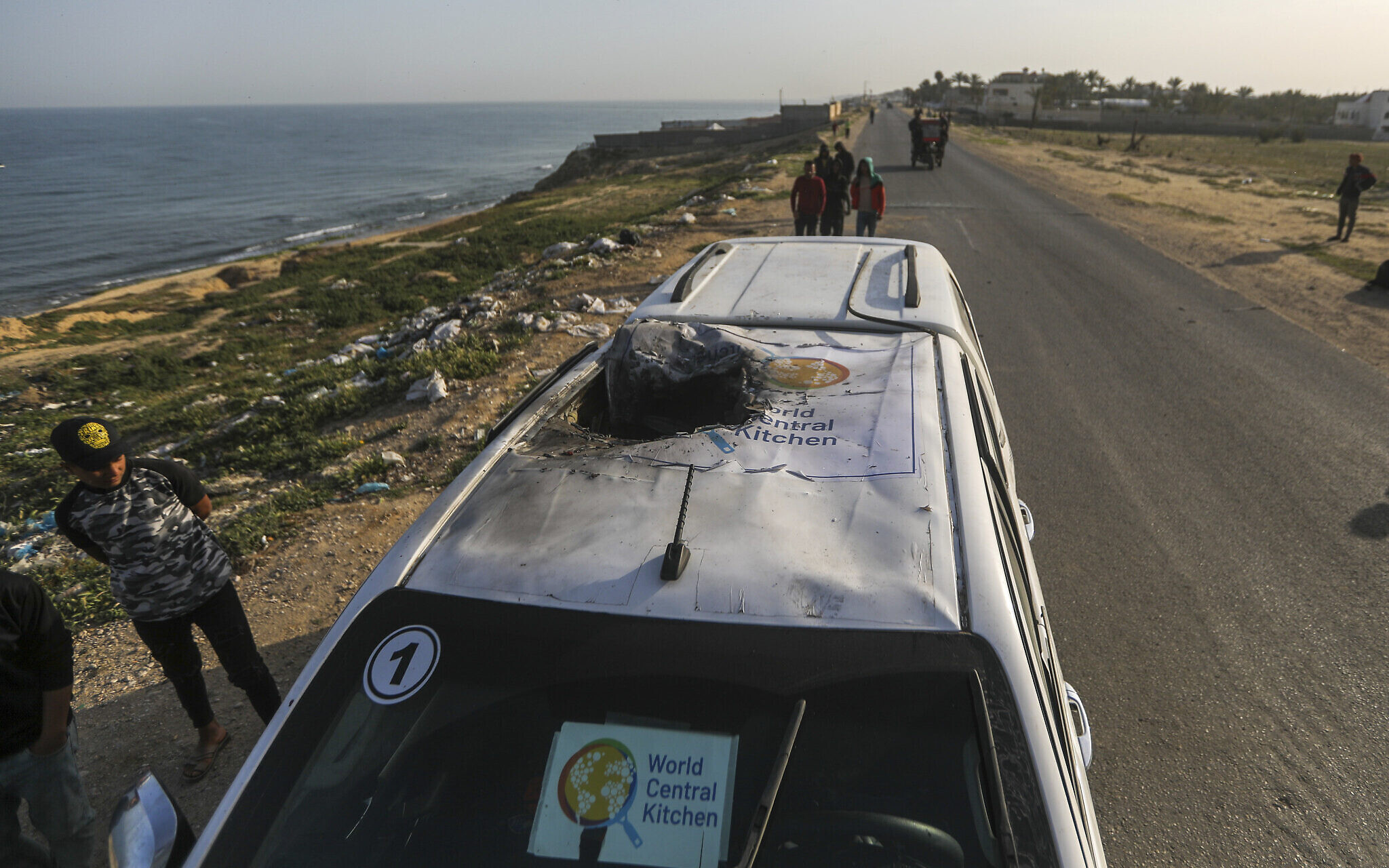
On April 1, 2024, Israeli forces ordered a strike on a convoy of WCK vehicles that officers suspected carried a Hamas gunman, despite a low level of confidence in the assessment and against army regulations. The strike instead left the seven humanitarian workers dead.
The forces did not identify the vehicles as belonging to WCK when the strike was ordered, according to the investigation.
The investigation found that WCK had hired an armed security force to accompany the convoy to protect it from looting, a move that had not been coordinated with the army.
“After examining all the findings of the factual assessment, it was decided that despite failures in the process of forming the assessment that Hamas operatives were traveling in the vehicles, it was found that the commanders’ decisions did not cross the criminal threshold, in light of the sequence of suspicious signs and the overall operational circumstances,” the IDF said.
The US-based World Central Kitchen also condemned the decision, calling it “inconsistent with the full truth and deeply offensive.”
It demanded an independent commission to investigate the airstrikes “because the IDF cannot credibly investigate its own conduct.”
On Thursday, Australia expressed outrage at the closure of the investigation and summoned Israel’s ambassador to the country, in a move later followed by Poland.
“The Ministry of Foreign Affairs of the Republic of Poland is very disappointed to receive the information provided on August 19, 2026, about the discontinuation of the proceedings,” the ministry said in a statement. “The Polish side provided a critical assessment of the actions taken to date to clarify the causes and course of the tragedy, informed that a parallel investigation is being conducted by the District Prosecutor’s Office in Przemysl.”
It also “expressed its expectation that the Israeli side will provide the relevant Polish authorities with all necessary explanations and materials requested by Polish investigators.”

Deputy Foreign Minister Ignacy Niemczycki told public radio PR1 on Friday that “we consider this a surprising decision.”
“We believe that the use of force must be proportionate, and that inappropriate use of force should have consequences, so we expect clarification on this matter,” he said.
Times of Israel staff contributed to this report.








The Times of Israel Community.