

Virus czar says infection rate could stymie rollback of restrictions
Ronni Gamzu says reopening of stores on Sunday a ‘lesser of two evils,’ given need to resume commercial activity, but warns that rate of spread reaching critical threshold
 Add ToI as a Preferred Source on Google
The outgoing coordinator of the government’s battle against the coronavirus warned Thursday of the renewed rise in the virus’s basic reproduction number, saying it would be very difficult to continue reopening the country at the pace that has been planned.
However, the government nonetheless gave its final approval for the reopening of street stores starting Sunday at 6 a.m. Any store that isn’t in an indoor mall or in an outdoor mall with more than 20 businesses will be allowed to open, with a cap of four customers per store at a time.
Ministers also allowed “zimmer” vacation cottage businesses to operate up to six simultaneous cottages per compound, though no more than a single nuclear family is allowed in each.
The decision came over the objections of health officials who have urged a slow and gradual reopening of the economy, schools and more.
“There is great difficulty in completing the next phase of easing restrictions in the same outline that was previously approved,” Ronni Gamzu said at a press briefing.
He called the decision to reopen stores “the lesser of two evils,” given a large push by business owners to allow the reopening of non-essential shops.
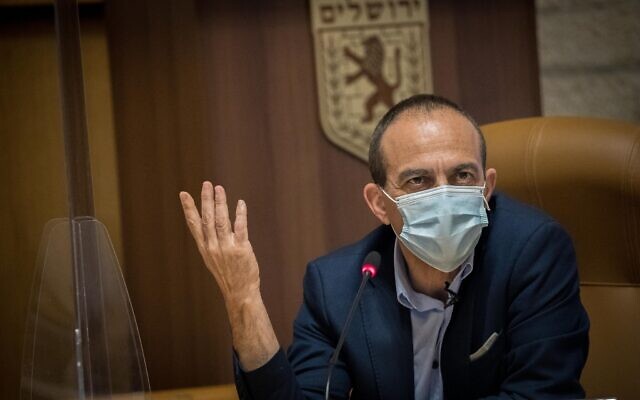
“Even with the Health Ministry persisting with its objection to any easing, we had to enable some level of commerce in Israel,” Gamzu explained. “We need to strike a balance and prevent the collapse of many commercial sectors.”
Under Israel’s phased lockdown exit plan, various public activities will be gradually reinstated, with a minimum of two weeks in between steps. However, politicians have begun to push for a quicker reopening, citing the swift drop in infection rates. The opening of shops, which is the third stage of the rollback, was not scheduled to take place before November 15 under the original plan.
Gamzu noted that the rate of infection appeared to be rising, putting the basic reproduction number, a figure representing the average number of people every carrier infects, at around 0.9 per case.
The Health Ministry has previously said that if the figure, also called R0 (R-naught), is above 0.8, it will not support new easing of restrictions. Any number above 1 would indicate that the number of infections is climbing.
“We are currently at an infection rate of 600-700 cases per day,” Gamzu said. “The very fast downward trend has pretty much stopped, a trend that represented a basic reproduction number around 0.6, meaning infections went sharply down.”

“As people went back to their daily routines and [with] the reopening of workplaces and the education system, we saw a very significant increase in traffic throughout Israel in all cities and communities, which brings us almost to the normal traffic and travel rates in Israel,” he said.
Gamzu said the worst outbreak was being seen in the Arab community, where the R0 is over 1. The ultra-Orthodox community, which previously had the worst infection rates nationwide, was doing much better and had an R0 of 0.6 compared to 0.8 among the non-Haredi and non-Arab community.
He said the only way other than a lockdown to stop infections was mass testing and quickly isolating cases, reiterating his call for Israelis to get tested even if they aren’t experiencing symptoms, since most infections are caused while carriers are asymptomatic.
The Health Ministry said Thursday evening that 754 coronavirus cases were recorded a day earlier, with another 349 confirmed since midnight.
The ministry said 331 people were in serious condition, 156 of them on ventilators. The number of patients in moderate condition dropped to 96.
The share of tests returning positive remained low, at 1.9% for Wednesday. The ministry said 39,783 tests were conducted on Wednesday.
The number of active carriers stood at 9,111.
The death toll rose by 42 since the morning, hitting 2,639.
Meanwhile, Hebrew-language media reported that the Health Ministry would recommend extending a closure in the Druze Golan Heights town of Majdal Shams, and introduce a full lockdown in nearby Mas’ade, another Druze locale.
The recommendation will be brought to a special ministerial panel, which will decide whether to impose the measures amid a spike in coronavirus infections in those areas, the reports said.
Israel sharply brought down its daily coronavirus infection rates from some 8,000 in mid-September to several hundred by late October with a nationwide lockdown, which it began to gradually ease last month.
Gamzu, who steps down next week, said that over the past week he has worked closely with his successor, Nachman Ash.
“He is next to me for every decision and meeting and he now better understands the complexity and the challenges,” Gamzu said, adding that he would remain available for consultations after ending his tenure.










The Times of Israel Community.