

With demolition deadline passed, Bedouin village living on borrowed time
Residents say they’ll leave Khan al-Ahmar only under duress, while general mood of despair among Palestinians has forced them to rely on Europe for support instead
 Add ToI as a Preferred Source on Google
Jacob Magid is The Times of Israel's US bureau chief
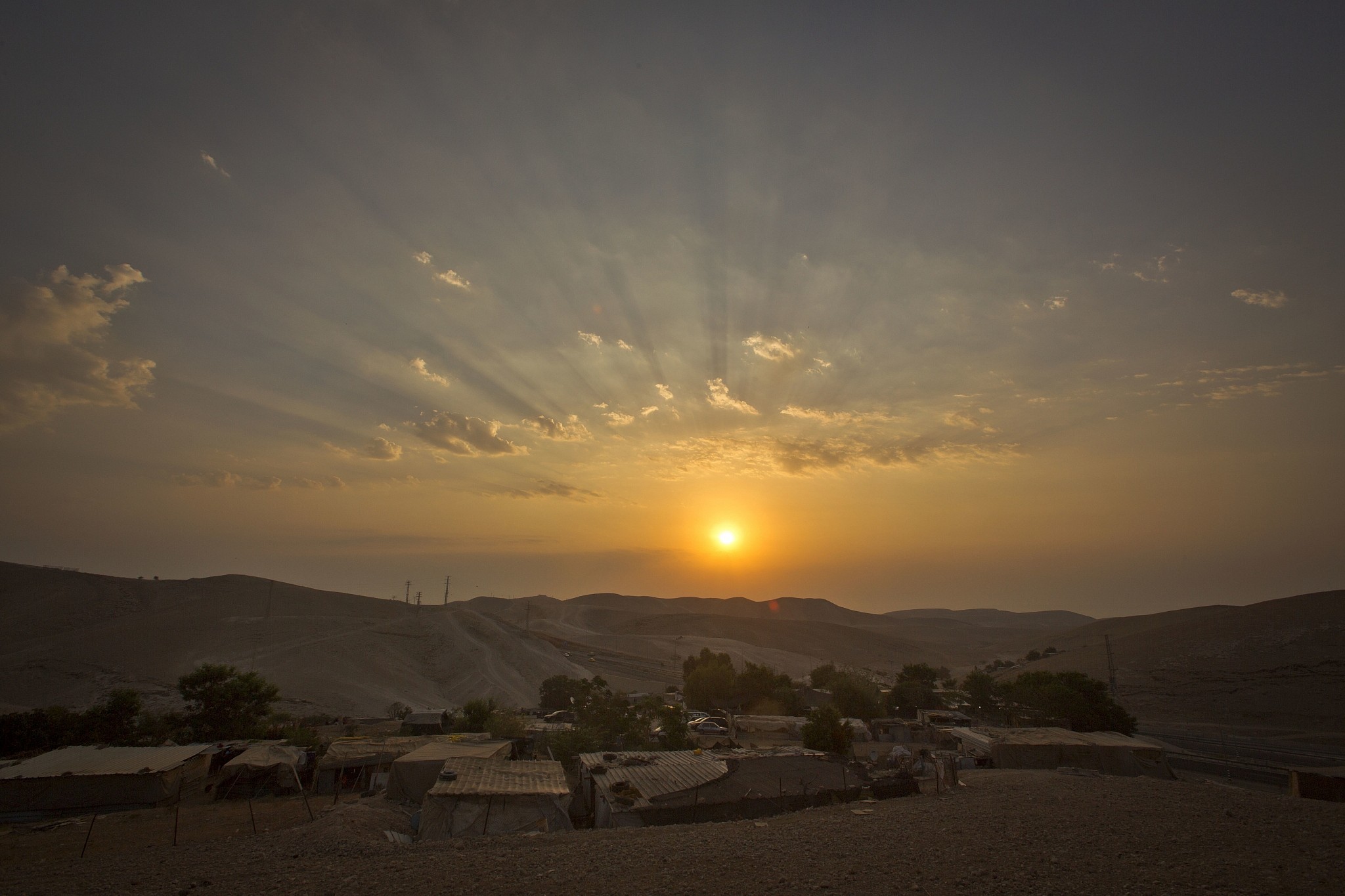
KHAN AL-AHMAR, West Bank — Residents of Khan al-Ahmar were operating on borrowed time Tuesday as the deadline set by Israel to demolish the Palestinian hamlet had passed nearly 48 hours prior.
Nonetheless, it appeared to be business as usual in the central West Bank community, and classes continued to be taught at its Italian-funded elementary school. Teachers could be heard leading lessons in each of the seven classrooms that surround a small rectangular courtyard, where a handful of young children played hopscotch.
Still, a sense of urgency underlay the normalcy, as over 100 activists, journalists and Palestinian supporters congregated in and around the village’s welcome tent.
Keeping with a custom established in recent months as the demolition has crept closer, one of the Palestinian Authority’s ministries held its weekly meeting in Khan al-Ahmar to show solidarity with residents who were given until October 1 to pack their belongings or see state authorities flatten their community, which had been built without permits. Tuesday brought officials from the education ministry who — before turning to more routine affairs — opened their session with an address by Eid Abu Khamis, a leader and spokesman for the Bedouin community.
“We are the eastern door to Jerusalem,” he told the group of two dozen educators, who sipped on small paper cups of coffee and tea under the shade of the community’s welcoming tent.
“If Khan al-Ahmar falls so will Al-Aqsa, as well as the entire peace process,” Abu Khamis said to supportive applause.
Speaking to The Times of Israel following the ministry meeting, the Bedouin leader said his community has no intention of complying with requests from the Defense Ministry to gather their things and relocate to a new site prepared for the villagers several miles east near Abu Dis.
Residents of Khan al-Ahmar — 180 in number, according to the UN — have vehemently opposed moving there, saying that they were never consulted, the location is unsuitable for their rural way of life and is next to a garbage dump, and residents of Abu Dis have warned them to stay away.

The villagers have been similarly uninterested in an additional relocation site proposed to them by the state two months ago adjacent to the nearby settlement of Mitzpe Jericho as well as to a sewage treatment facility.
“Each option is more foul than the next,” said Abu Khamis.
The 51-year-old appeared to have aged significantly since we had met first met just six months ago.
Then, the village leader had been more critical of the Palestinian Authority, who he said had played a significant role in the the Bedouin village’s predicament.
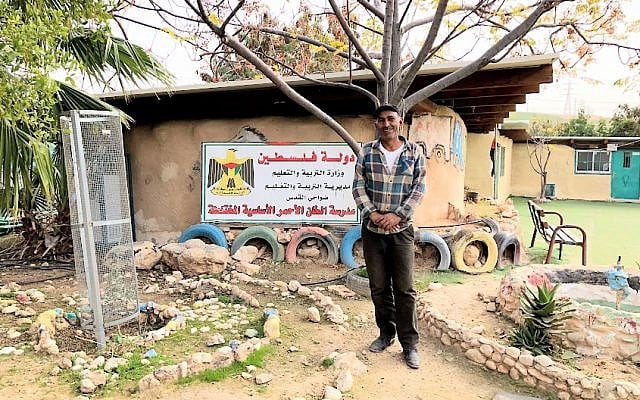
Abu Khamis charged at the time that the PA and other NGOs claiming to work on behalf of Khan al-Ahmar had been pocketing money they had been receiving and that barely any of it had trickled down to the villagers themselves.
He did not ignore the Israeli government’s role, suggesting that had authorities been willing to at least negotiate with Khan al-Ahmar residents, it is possible that they would have been willing to move elsewhere.
But now, both in his speeches to pro-Palestinian activists visiting the village and in his subsequent conversation with The Times of Israel, Abu Khamis had only positive things to say about the PA and he placed blame squarely on Israel, whose authorities could be arriving with bulldozers any day now.
The state says Khan al-Ahmar’s structures, mostly makeshift shacks and tents, were built without permits and pose a threat to residents because of their proximity to a highway.

The villagers — who have lived at the site, then controlled by Jordan, since the 1950s, after the state evicted them from their Negev homes — argue that they had little alternative but to build without Israeli construction permits, as such permits are almost never issued to Palestinians for building in parts of the West Bank, such as where Khan al-Ahmar lies, where Israel exerts full control over civilian affairs.
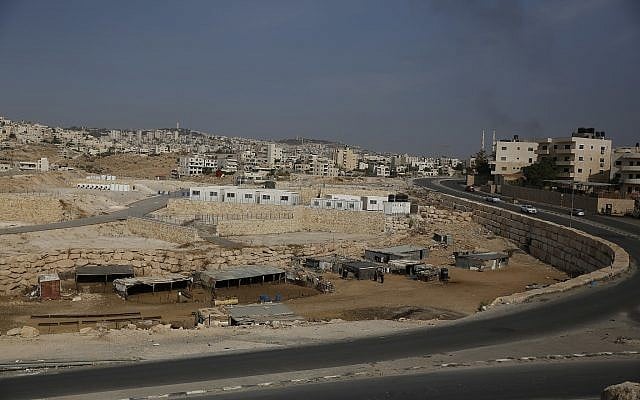
Opponents of the demolition also argue that it is part of an effort to enable the expansion of the nearby settlement of Kfar Adumim, and to create a region of Israeli control from Jerusalem almost to the Dead Sea, a move critics say will bisect the West Bank, making a contiguous Palestinian state impossible.
But while over a dozen Palestinian flags hung at the entrance of the hamlet, where the presence of PA officials has been constant, it has been difficult to argue that the villagers have succeeded in making their plight an issue of PA-wide concern.

On Monday, Palestinians and Israeli Arabs launched a general strike in protest of the nation-state law passed by the Knesset in July. While senior Palestinian official Hanan Ashrawi said the strike also aimed to show solidarity with Khan al-Ahmar, mention of village appeared to be an afterthought in her tweet.
And yet, the hamlet has succeeded in garnering international support and sympathy. The EU parliament passed a measure condemning Israel for its May High Court ruling that green-lighted the demolition; and France, Germany, Italy, Spain and the United Kingdom issued a rare joint statement warning that the razing would have “very serious” consequences.
But demonstrations on behalf of the Bedouin Jahalin tribe have attracted hundreds, not thousands, of supporters.
A PA official present at the village Tuesday acknowledged that the street was not galvanized like it had been during the last national campaign — against the placement of metal detectors at the Temple Mount (Al-Aqsa compound) in the summer of 2017.
“It’s not that they aren’t with Khan al-Ahmar, but the people are tired and have lost hope,” he said.
Abu Khamis explained that the reasons behind the smaller crowds seen at his West Bank village compared to the throngs that converged on East Jerusalem during the metal detector protests were simply logistical.

“We can only hold a few hundred here. This is a small village isolated from everything else,” he said. He insisted that the Palestinian public was firmly behind Khan al-Ahmar.
Asked to characterize the mood in the community, Abu Khamis said residents have remained resolute.
“If they demolish the village, we will stay and rebuild it,” he declared.
But once pushed, he appeared to concede somewhat. “The only way we will leave here is by force,” adding that the villagers would have no choice but to move to the site near Abu Dis if the IDF does flatten their community.
“We ourselves won’t use violence against them, but I’ll stand in front of the bulldozer with my family. This is our land and our land is our life,” said Abu Khamis. But he spoke dejectedly.
As for when exactly that square-off with Israeli demolition equipment will take place, the Khan al-Ahmar residents have been left in the dark.
Abu Khamis said he had heard rumors that Jerusalem is holding off its razing orders until after German Chancellor Angela Merkel’s visit this week.
Activists had even brought posters of Merkel to the village on which messages were written pleading with the German chancellor to intervene on their behalf.

A Civil Administration official told The Times of Israel that the Defense Ministry body responsible for facilitating the demolition has no plans to carry it out this week, though she clarified that it had more to do with bureaucracy than politics.
“It’s all in their hands,” Abu Khamis said. “In truth, it always has been.”









The Times of Israel Community.