

Give war a chance
The press finds Israel headed for the brink, Abbas more willing to butt heads with Israel than Hamas, and leftists who don’t want to hug it out with the right at the Rabin rally
 Add ToI as a Preferred Source on Google
Joshua Davidovich is The Times of Israel's Deputy Editor
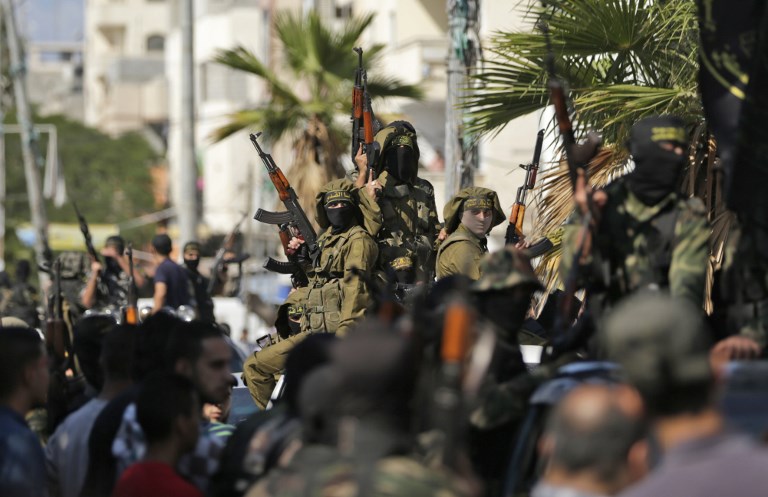
Friday’s Hebrew-language print media landscape repeats the twin focuses of a day before: Gaza/Syria and remembrances for slain prime minister Yitzhak Rabin. But whereas on Thursday Israel Hayom was focused on Israel’s security challenges in the north and south and Haaretz was more concerned with the handover of Gaza crossings as a part of the Palestinian reconciliation, on Friday it is flipped.
Haaretz’s front page top story on Friday is nearly a mirror image on Israel Hayom’s on Thursday, pointing out the challenges facing the country, with Hezbollah and Syria in the north and Gaza tunnels in the south. But unlike Israel Hayom’s gung-ho, we can take them on, attitude, Amos Harel’s analysis in the broadsheet finds Israel on a dangerous precipice.
“At some point, something is bound to go wrong, either with an airstrike or with the consequent missile fire. Hence the great caution and sensitivity required in managing the two fronts, north and south. It’s no wonder the top brass wasn’t keen to publicly praise the killing of terrorists, as Education Minister Naftali Bennett urged,” he writes. “Nor is the latest escalation vis-a-vis the Gaza Strip fully behind us. The Palestinians’ resounding silence in the wake of the explosion of the tunnel, in which 14 Islamic Jihad and Hamas militants, including some senior commanders, were killed, was met with a certain amount of surprise.
Islamic Jihad may be planning a major terror attack whose prevention requires a longer-term deployment by the Israel Defense Forces, or it may be waiting to exploit a weakness in the army’s defense of the Gaza border. An attempted reprisal could also take place in the West Bank. For now, the army has decided to maintain a high state of alert, although it is barely being felt by the residents of the communities near Gaza (aside from a temporary ban on farmers approaching the border fence).”
Similarly, Israel Hayom’s look at the Palestinian crossing guard handover is pessimistic on its importance or prospects for future relevance, whereas Harel a day earlier had played up the event as the most important thing happening down south.
The tabloid quotes associates of Palestinian Authority President Mahmoud Abbas saying that not only will the PA not insist that Hamas disarm as part of the reconciliation, it will also let Hamas continue building a network of tunnels under the Strip and maybe into Israeli territory as well (the paper calls the tunnels “terror tunnels,” but doesn’t specify that they are actually attack tunnels and not defensive ones inside Gaza, since it calls everything Hamas does “terror”).
“The Palestinian reconciliation and handing over control of the crossings are only words. In practice, it is Hamas who is controlling Gaza and the Palestinian security forces have no ability to stand up to them or other Palestinian factions, certainly not to stop the digging of terror tunnels,” the paper quotes from a senior Palestinian source, who adds that to Abbas, giving the rapprochement with Hamas a chance to work is more important than butting heads with the rival faction.
In Yedioth Ahronoth, columnist Yoaz Hendel says it’s not just Palestinians who think words speak louder than action, pointing out what he calls a “new Israeli romance” with strong statements.
“A whole class of people prefer at any point strong words and weak action to strong action and quiet words. To promise to defeat Hamas instead of defeating them, to promise to assassinate [Hamas leader Ismail] Haniyeh instead of assassinating him,” he writes. “In practice, the reality is far from the promises. The political echelon does not present its red lines and makes do with statements in order to not seem flaccid. I’ve written countless times about the need to defeat Hamas militarily. To hit them where it hurts most. To destroy most of their forces. A war like they used to make. The question of what comes after is important as long as the replacement could end up being worse. The other option is to give them enough so that Hamas will be afraid to lose. A seaport, incentives and economic levers. You might not agree with me, but Israel has chosen not to decide. It’s easier that way, to just blame the army.”
Swept under the hug
The Hendel column is buried way in the back of Yedioth, which leads off its pages with a slew of columns and stories about Rabin, ahead of a big annual rally planned for Saturday night. The paper’s main front page headline reads “for whoever forgot,” and points to a picture of the front page of the November 5, 1994, edition, the morning after the murder. While that headline reads “Israel mourns,” the question over whether the rally should be a time of national coming-together for all of Israel’s political spectrum or a time for the left to lash out at the right over the political murder is again rearing its head and is the subject of several of the columns.
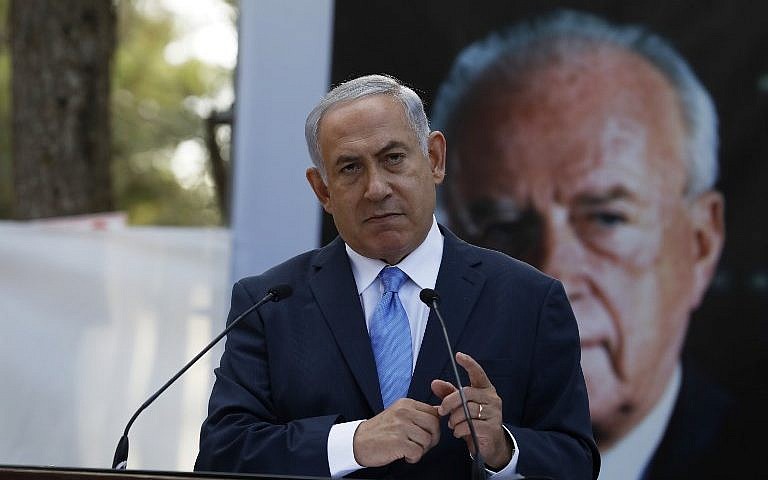
In one, Ra’anan Shaked, after accusing Prime Minister Benjamin Netanyahu of dividing the country, takes the view that the rally should not be a kumbaya moment where rightists and leftists hug out the pain of the murder.
“The Rabin rally dedicated to a unity that does not exist — or as the organizers this year like to call it, ‘we are one nation’ — is ready to include a speech by a settler from Ofra who claims that ‘the national conversation on both sides allowed [the assassination] to happen.’ There’s no problem with this claim other than that it is a total lie,” he writes. “But as we learned from the right, if you repeat a lie enough times, at least half the public will be willing to swallow it whole and ask for seconds. A few years of ‘one nation’ rallies like this for Rabin and this saccharine and comfortable narrative will become official.”
Haaretz’s lead editorial continues the theme begun by Rabin’s son Yuval a day before in his attack on Netanyahu, writing that Netanyahu’s continued ascension shows that Rabin’s killing was, from the perpetrators’ standpoint, “one of the most successful murders in the history of political assassinations. It fulfilled the gunman’s intentions beyond all expectations, and has continued to do so for a generation.”
Yet a column by Yossi Verter in the same paper on Knesset sausage-making includes some signs that Netanyahu’s own response to Thursday’s harsh speech, a call for reconciliation, caught at least one opposition MK by surprise, Ayelet Nahmias-Verbin, who approached Netanyahu and said she wants to be part of the effort, if he is serious.
“‘Yes,” the prime minister replied. ‘Bring in plenty more MKs,’” Verter writes. “I asked Nahmias-Verbin whether, after half a term in the Knesset and three decades of flopping around in the political mire alongside leaders, the time hadn’t come to abandon the naïveté. ‘I don’t rule out that possibility,’ she replied, ‘but we have to try. And I put aside in advance the corruption and the investigations and the sourpusses. There was something different in what he said, both at Mount Herzl and in the Knesset, and I can’t ignore that. I’m a naïve sourpuss.’”





The Times of Israel Community.